


Niantic’s Hidden Agenda
Those who played the game paid Niantic to work for them. And none of them were told that Niantic...


The skeptics and “experts” who said this wasn’t possible will be handed their shorts again.

150 million degrees Celsius.
That’s 10 times hotter than the temperature at the core of the Sun.
A temperature that has now, as of a few days ago, been reached here on Earth in Everett, Washington.
Everett is home to Boeing (BA), where I worked as a contractor very early on in my career, supporting the Boeing 777 program in the ‘90s.
It is also home to one of the most important and secretive nuclear fusion companies in the race to commercialize this next generation of clean energy production – Helion Energy.
Helion is a standout in the industry as it was the first nuclear fusion company to sign a power purchase agreement (PPA) for its future clean energy production.
In May 2023, it signed a deal with Microsoft (MSFT) to provide a minimum of 50 megawatts (MW) by 2028 to help fuel Microsoft’s future data centers.
This was a big deal at the time, but it was met with a lot of skepticism as Helion had been very guarded with the progress it had been making with its fusion technology.
Not to mention the time frame – just a short five years from the PPA to bringing power on the grid from its fusion reactor.
The skeptics and “experts” who said this wasn’t possible will be handed their shorts again.
Helion has already begun construction of its Orion nuclear fusion power plant in Malaga, Washington, near the Columbia River (shown below). The company is on track to meet its commitments to Microsoft for providing electricity to its data centers.

Helion’s Power Plant in Malaga, Washington | Source: Helion Energy
The construction underway isn’t just for show either. It’s backed by a $425 million capital raise that happened about a year ago, which included backers like Lightspeed Venture Partners, Softbank, and OpenAI founder Sam Altman.
That’s why Helion’s announcement this month about fusion and a plasma at 150 million degrees Celsius is so important…
It was conducted on Helion’s seventh-generation fusion reactor, Polaris, using deuterium-tritium (D-T) as its fuel.
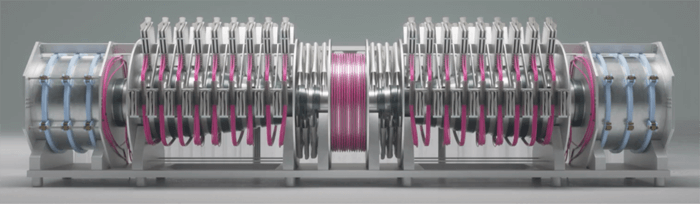
Rendering of Polaris | Source: Helion Energy
Of the roughly 50 nuclear fusion projects that I research, 36 use deuterium-tritium as the fuel source. Both are isotopes of hydrogen, and hydrogen is the most common element in the universe.
Deuterium is easily found in seawater, of which we obviously have an abundance. And tritium is a radioactive isotope that is produced by nuclear fission reactors, as well as high-energy accelerators. It’s worth mentioning that tritium only has a half-life of 12.3 years, nothing like what is seen in nuclear fission reactors.
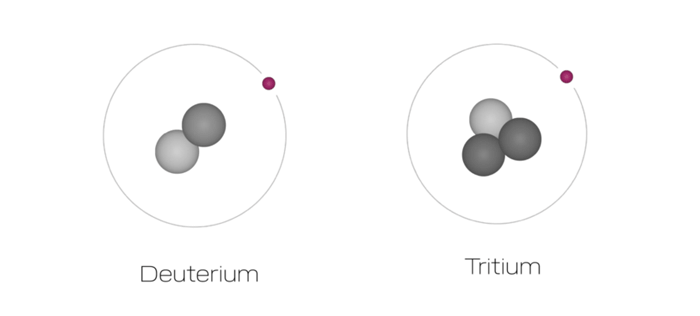
Under intense heat and pressure, the deuterium and tritium fuse together, releasing a neutron and 17.6 MeV of energy. That’s literally the power of nuclear fusion. Two hydrogen isotopes merged, releasing incredible amounts of clean energy – the power of the sun.
But this isn’t Helion’s endgame.
Its commercial fusion reactor is being designed to use deuterium and helium-3 (D-He-3) as its fuel. This may seem like a small nuance, but it is not…
It’s critical for the commercialization of fusion technology.
A D-He-3 reaction produces even more energy, 18.3 MeV, and it doesn’t emit neutrons like the D-T reaction, which greatly reduces wear and tear on the fusion reactor (neutrons, over time, damage the reactor).
As the fusion plasma expands in Helion’s reactor, it “pushes back” on the magnetic field that contains the plasma. This interaction induces an electric current that can be directly captured as electricity. There is no thermal recapture or steam cycle that is common in many reactors.
This dramatically improves the economics of a nuclear fusion reactor. Helion will likely need to increase temperatures to around 200 million degrees Celsius to support the D-He-3 fuel, but it is clear to me from the progress that Helion has made over the last three years that it has a path to success within the next two years.
Several different kinds of technological approaches to nuclear fusion will be able to generate net energy outputs, such as field reversed configurators, stellarators, inertial confinement, tokamaks, and Z-pinch reactors.
The same is true for fuels, the primary sources being deuterium-tritium, deuterium-helium 3, and proton-boron.
But most nuclear fusion reactors that will go into commercial production will be driven by economics, plain and simple. The combined fuels and reactor technology that will drive the best operational economics will receive the largest investment and will scale the fastest.
That’s why this current phase of investment, iteration, and experimentation in the nuclear fusion industry is so critically important. The industry has moved well past theory into measured results with prototype reactors.
The next phase will be net energy production and, soon thereafter, putting the electricity production on the grid.
Helion Energy has been around for more than a decade and has raised about $1 billion to date. Aside from the technological progress and PPA with Microsoft, it is primed for a potential IPO this year.
At the beginning of this year, one of the most advanced nuclear fusion companies and a competitor to Helion Energy, General Fusion, announced that it would be going public via a reverse merger with a SPAC.
I fully expect that Helion Energy and a couple of others will follow in the months to come.
Nuclear fusion is a critical solution to the need to produce significantly larger amounts of (preferably clean) energy to support this once-in-history leap in productivity, fueled by advancements in artificial intelligence.
Jeff

Read the latest insights from the world of high technology.
Those who played the game paid Niantic to work for them. And none of them were told that Niantic...

The entire internet will need to be upgraded to post-quantum encryption technologies.

We’re on the cusp of the most extraordinary productivity boom in the history of the world.
Thanks for signing up for The Bleeding Edge — we’re glad you’re here!
Want updates sent straight to your phone too? Sign up for SMS alerts to get the latest delivered via text.
Brownstone Research: By submitting your phone number, you agree to our SMS Terms & Conditions, Terms of Use, & Privacy Policy, and give express written consent to receive marketing text messages from BSR. Messages are recurring & frequency may vary. Reply STOP to 94703 to opt out. Reply HELP to 94703 for info. Consent is not a condition of purchase. Message and data rates may apply. For additional information, you may contact Customer Service at 888-512-0726 or smssupport@brownstoneresearch.com.