



The Largest Merger in History
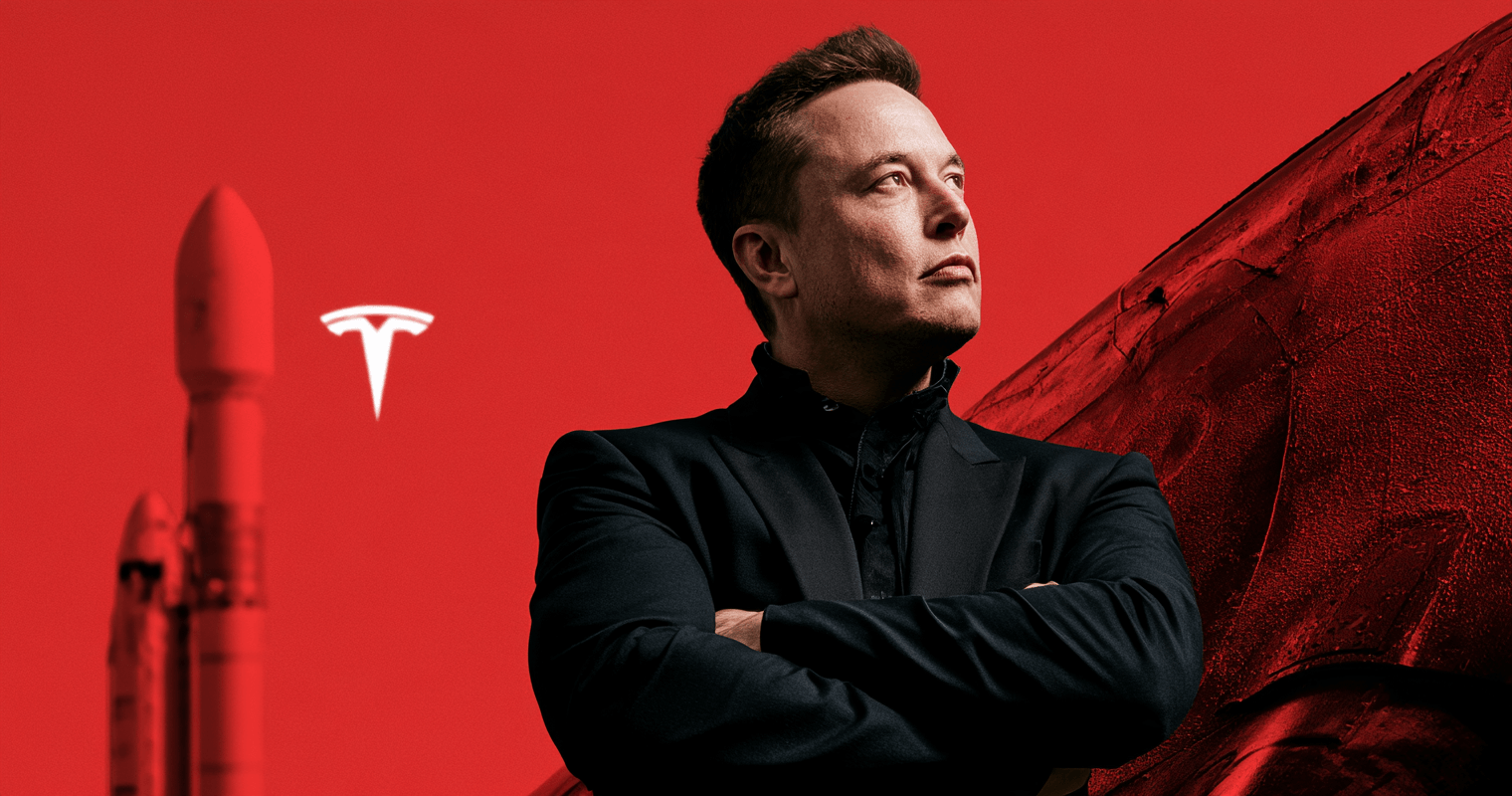
Tesla and SpaceX have now formed special committees to evaluate a potential merger between these two Elon Musk-led powerhouses.



This level of personalized medicine has been the future of medicine for a long time.

There were big headlines this week in biotech from a major announcement made by Merck (MRK) and Moderna (MRNA).
The two companies announced results from a Phase 3 trial of a personalized cancer treatment involving more than 1,000 patients that indicated positive results in the treatment of melanoma.
The market’s response to the news pretty much said it all…
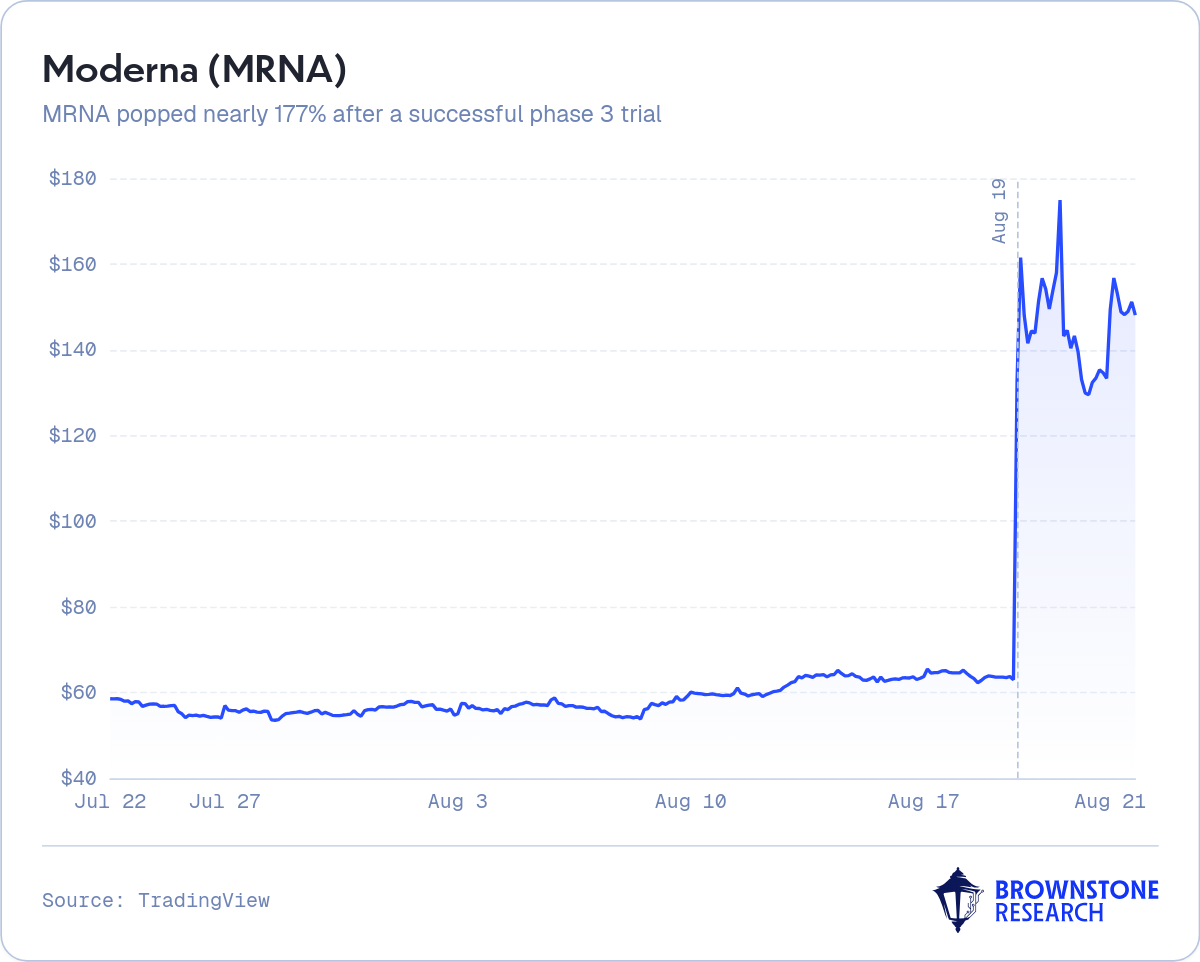
The reason for the big pop in share price wasn’t just because of the application of this new biotechnology to melanoma patients. It’s because the ramifications of this kind of personalized cancer therapy can potentially be engineered for many other forms of cancer.
The trial involved sequencing both the patients’ DNA and the cancer tumors’ DNA and then using that information to develop a personalized mRNA therapy designed for each individual patient in the trial.
This level of personalized medicine has been the future of medicine for a long time.
And thanks to dramatically lower costs of sequencing, combined with the employment of AI, this kind of therapeutic approach is not only possible… it is economically feasible for the industry to develop this kind of personalized cancer therapy at scale.
Whether or not Moderna gets through the FDA approvals process or not is certainly not a given.
As we learned from the pandemic, mRNA technology has some major challenges and horrible side effects, including death, as has been well documented through research of the impact of COVID-19 mRNA “vaccines.”
That said, whether it is through the use of CAR-T, genetic engineering, or mRNA, we have entered an era of precision and personalized medicine.
And with the FDA actively updating its processes to account for the use of artificial intelligence, and the support for a regulatory process enabling approvals for a therapeutic development as opposed to a one-size-fits-all drug, we’re going to see the evolution of health care that enables higher efficacy and drug safety, and far fewer unwanted side effects.
And that means higher quality of life and longevity for us all.
Jeff
Hello Jeff,
I was talking with my Dad recently about the AI data center buildout, and he asked me an interesting question that I couldn’t give a good answer to. I was wondering if you know why data centers are generally built single-story, requiring huge amounts of land instead of a multi-story building? The only reason I could think of was that the distance between the racks on different floors and the interconnects would slow the processing speed down, but I’m just guessing on that theory. I would love to hear your thoughts on this.
– Synthya G.
Hi Synthya,
This is an important and interesting question concerning the largest infrastructure buildout in history. And it’s a fun one, because it’s natural to think that it must be for performance reasons.
But the answer is actually much simpler. The driver for almost all business decisions. Time and money.
The reason is pure economics. It is faster and cheaper to build single-story data centers than multi-story data centers. Assuming the land is available, single-story is always the way to go.
The reality is that these AI server racks that are assembled side by side, row upon row, are extremely heavy. The floor loads per square foot are typically three or even four times that of a normal office building.
In a single-story data center, concrete slabs can support this kind of weight. And given how heavy and bulky the equipment is, being able to deliver the equipment via a loading dock at ground level is fast and comparatively inexpensive.
In a multi-story building, a much stronger foundation would be required, as would extensive structural reinforcement to handle the floor loads. Large, specialized freight elevators would be necessary to move the hardware vertically. And that means time and money.
The same is true for cooling systems. Heat rises, so in a single-story building, it is easy to vent through the roof. In a multi-story building, far more complex ducting and piping would be needed. This would also be true of liquid-cooled systems, as it would be necessary to pump fluids vertically to keep the computing systems cool.
And if we think about power/electricity, the same is also true. Transformers, large backup batteries, natural gas turbines, etc., are all best placed at ground level.
They are large, heavy, and ground-level access is simpler for maintenance. In a multi-story building, longer copper cable runs would be required to distribute the power.
The economics of these massive AI data centers come down to cost per megawatt. The simple reality is that building vertically is far more expensive and takes significantly more time to build than a single-story data center facility.
Hi Jeff,
I am looking forward to when I can buy an Optimus. Do you know if Musk will send out software updates to improve it as he does with the Tesla cars? Or would I have to buy a new Optimus to upgrade to new features and capabilities?
– Stella R.
Hi Stella,
You and me both!
And you’ll be happy to know that Tesla will send out “over the air” software updates to Optimus in the same way that Tesla does for its intelligent robots on wheels (i.e., its electric vehicles).
The technological design and strategy are exactly the same.
Tesla’s customers’ fleet of robots on wheels is a massive data collection network of real-world traffic conditions and roads. Tesla’s robots on wheels have now collected more than 13.6 billion miles of data in fully autonomous mode, which Tesla uses to improve its full self-driving (FSD) software.
For anyone who would like to keep tabs on Tesla’s autonomous driving miles, you can find it right here in Tesla’s Safety Report.
Tesla will do – is already doing in-house – the same approach. Each Optimus that is working on the factory floor, in Tesla offices, and in the homes of Tesla employees is collecting real-world data on how to navigate real-world situations and perform economically valuable tasks.
Tesla tends to send out a software update to its robots on wheels at least once a month. And there are usually about three major updates a year. We can expect that Optimus will have a very similar cadence for software upgrades.
With that said, just like a Tesla EV, hardware gets updated as well. Every three years or so, Tesla evolves its AI hardware (semiconductors and cameras for vision). More advanced hardware provides improved performance.
I always lease my Teslas for this exact reason. This is especially important to me because the latest AI hardware performs better, and since my robot on wheels drives me autonomously, I want the best-performing hardware available.
Just like our smartphones, every three or four years our phones get slower, and the battery doesn’t hold the same charge. The new software for the phones doesn’t run as well on three- or four-year-old hardware as it does on a new phone. So, we upgrade.
While it hasn’t been made public yet, I suspect that Tesla will design some modularity into its Optimus in terms of being able to repair or upgrade hardware.
For example, it would make sense to enable easy battery swap-outs, or the ability to remove and replace a compute module for improved performance.
This would make sense to me because the demand will be so high for Optimus that Tesla simply won’t be able to manufacture enough to meet demand. Upgrades to existing units would help solve the manufacturing shortage. Fingers crossed.
As we know, Tesla has already decommissioned its Model S and Model X production lines at its Fremont, California, factory in order to build manufacturing space for Optimus.
Optimus production is already happening in small quantities, and the new Fremont production is scheduled to begin imminently. I expect an announcement in September about Optimus production status.
On top of that, a dedicated Optimus factory is under construction at Tesla’s Giga Texas location. I’ll have more updates on that by mid-October, as I am scheduled to visit that site to see the latest developments at Giga Texas.
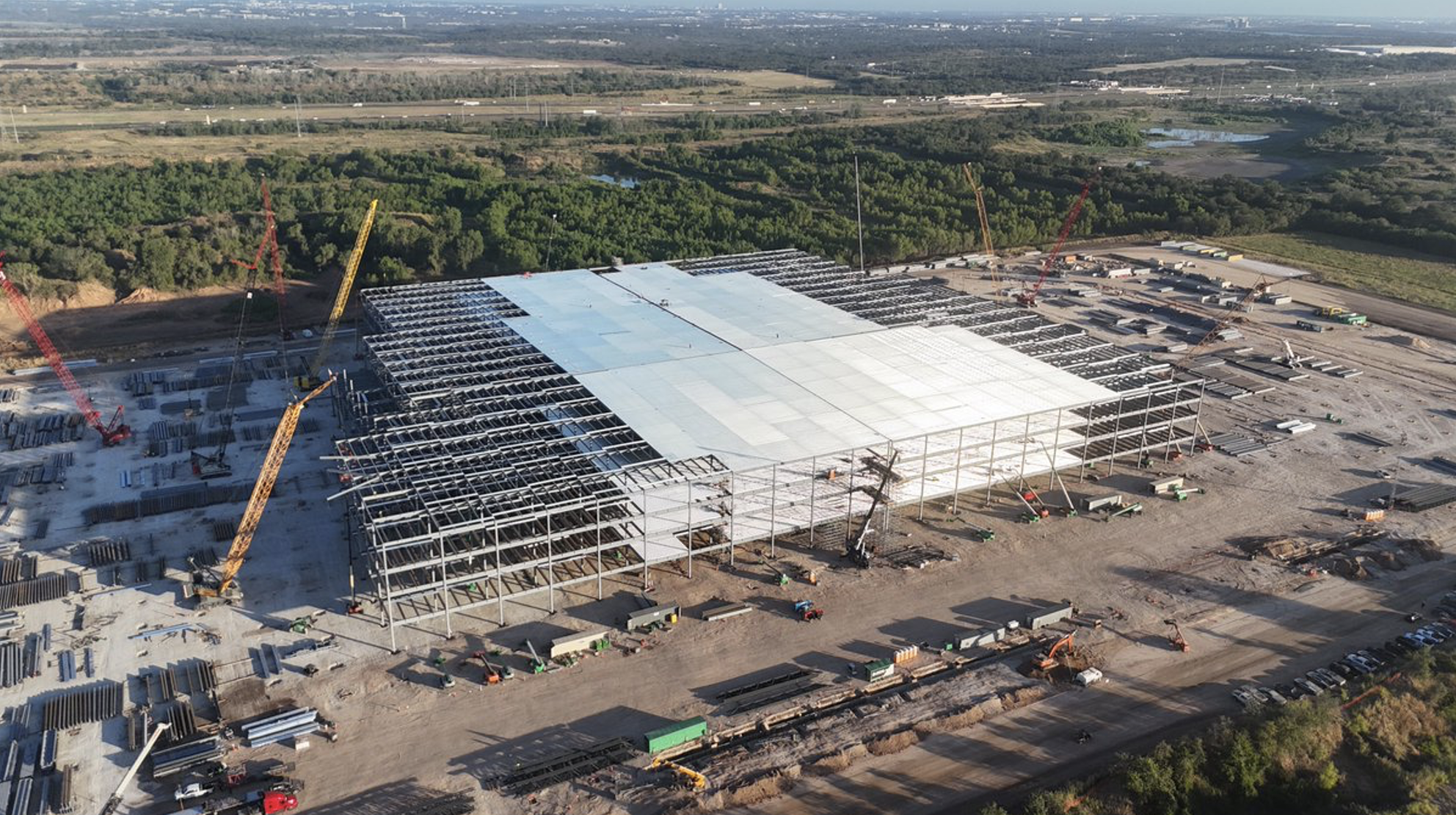
Tesla Optimus Factory Under Construction, August 17, 2026 | Source: @JoeTegtmeyer
Tesla’s original plan was to start selling Optimus in limited quantities to enterprise customers in “late 2026.” We’ll see what happens in the coming months. I am expecting a major update in the September/October time frame from Tesla.
And the goal for consumer sales of Optimus is still by the end of 2027. So, we’ll probably have to wait a year and a few months before we can welcome Optimus to our homes.
Just imagine how life is going to change in the presence of intelligent general-purpose humanoid robots!
I have had around a 27% drop in my tech shares over the last few weeks. Can you talk about this significant downturn and what you envisage for the very near- to mid-future? This is in areas associated with AI and all the infrastructure associated with its recent development. Regards.
– Desmond S.
Hi Desmond,
This summer pullback that you’re referring to was the result of a few factors that gave institutional investors the excuse to take some profits off the table, sending shares down.
The big issue that got institutional investors skittish was the very visible impact of all this AI investment in infrastructure on the financials of major tech companies.
Take Meta (META) for example.
In the first quarter of this year, it generated $13.2 billion in free cash flow. Its second quarter free cash flow dropped to just $1.7 billion, and it forecasted a negative $9.65 billion for Q3. Meta will generate a negative $5.2 billion in free cash flow for the full year, and the current forecasts are for negative $29 billion in 2027.
This is significant because Meta has been printing money for the last decade. Investors have never seen this from Meta before.
With Amazon (AMZN), it’s the same thing, but on a greater scale. Alphabet (GOOGL) is in the same boat.
It doesn’t matter that these companies have massive cash reserves (META – $90 billion; AMZN – $123 billion; GOOGL – $242 billion). They just see cash flying out the door in investment, wondering about the return on investment.
This is classic, quarter-by-quarter, Wall Street thinking.
The other factor that has been important is the rising yields of U.S. Treasuries. These higher yields mean higher costs of debt, and they reduce the present value of future cash flows. Anytime we see this, we tend to see compression of valuations in growth stocks. And the reverse happens when interest rates come down (that’s coming).
And the kicker to the pullback was the sheer stupidity and greed of Leo Ashenbrenner with his hedge fund Situational Awareness. It is one of the most spectacular hedge fund blowups in history.
I wrote a special Bleeding Edge on this topic, appropriately named Situationally Unaware, that captures the drama. I strongly encourage reading that issue for additional context on why related tech stocks pulled back. It’s a quick and very fun read.
So that’s what happened and why. Had I believed that this was anything but a short-term pullback being driven by the above factors, I would have alerted my subscribers with an update and recommendations on what to do with our model portfolio holdings.
Looking ahead, barring any unexpected exogenous events, I am still seeing a strong fall for the markets and particularly for growth stocks related to this massive AI infrastructure buildout.
While I do expect a lot of profit-taking around late November, early December by institutional capital to lock in profits (and thus their bonuses for 2026), that too will be short-lived.
The reality is that more than $1 trillion will have been invested in AI infrastructure this year, with even more invested in 2027.
And yes, this will continue into 2028. Equally as important is that AI-related companies are generating tremendous revenues from their products and services, which means that there is a fundamental economic driver for continued investment.
Needless to say, this is very bullish for related growth stocks.
Also worth mentioning is that I expect some very exciting tech IPOs between the period post-Labor Day (September 7) and early December.
Most anticipated are names like OpenAI and Anthropic – which will both go public north of a trillion-dollar valuation – and Databricks, another major AI-related software company.
And this IPO window will be just the start of an explosive 2027. The liquidity that will come from these IPOs will only be recycled in additional investment in both public and private companies.
In short, what’s coming will be unlike anything we have seen before.
We have so much to look forward to,
Jeff
Add Brownstone Research as your preferred source on Google to see our latest stories in your feed.
 Add as a preferred source
Read the latest insights from the world of high technology.
Tesla and SpaceX have now formed special committees to evaluate a potential merger between these two Elon Musk-led powerhouses.

This isn't about simply recreating the old system on new infrastructure…

As companies give digital workers more responsibility, protecting their systems becomes part of the cost of putting AI to...