


NVIDIA’s Blowout Numbers
Even with all of the excitement happening right now with AI, the 2026 hyperscale spending on AI infrastructure still...


We can’t provide any personal investment advice, but we can use a question as an example of how to view a crowdfunding offering…

A few days ago, I sat down with a friend and colleague of mine, Jason Bodner, to talk about the markets and the unique system he’s developed to find fantastic investment opportunities.
Jason is one of the very few people whose work I follow closely and rely on for unique insights on institutional capital flows.
This is critically important because if capital isn’t flowing into a stock or sector, it’s not going to rise. And if capital is flowing out, we can be sure that a major decline is ahead.
His track record is phenomenal, one of the best I’ve ever seen. Which is why I pay so close attention to his work.
In testing, his system pinpointed companies like Palantir, AppLovin, Super Micro Computer, and Nvidia long before they became the household names they are today.
Jason and I will be working a lot more closely together in the months to come. So, if you have a few minutes over the weekend, you can get some more perspective about Jason’s approach by watching the event replay here.
Have a wonderful weekend,
Jeff
Would you have any information on Jeff’s thoughts regarding all the promotion around Atombeam?
– Mike J.
Hi Mike,
I’m not able to provide any personal investment advice, so I’m not able to tell you “yes” or “no” about your question. But I’ll use your question as an example of how to view a crowdfunding offering like this.
Atombeam is currently raising up to $21,735,000 under Regulation A+ crowdfunding regulations. You can review their SEC filing right here.
The company claims to have a “groundbreaking method” for data transmission. Basically, it is software used to compress data, resulting in what Atombeam claims to be “75% in bandwidth reduction.”
While I don’t see anything special with respect to the technology, I don’t have the time to review the patents or any white papers. I’m not going to dig into the product or technology any further for reasons that I’ll explain below.
When looking at private deals, and especially crowdfunding deals, there are always a few high-level things to check on to determine whether something is worth conducting more research on.
The deal offering, specifically the valuation that shares are being offered at, is critically important to me. Does the valuation make sense for the company? And how does the valuation relate to the revenues that the company is generating?
For example, Atombeam had $125,604 in revenue for the six months ending on June 30, 2025. Let’s extrapolate that, assume that they did $250,000 in the second half of 2025, resulting in $750,000 of revenue for the full year.
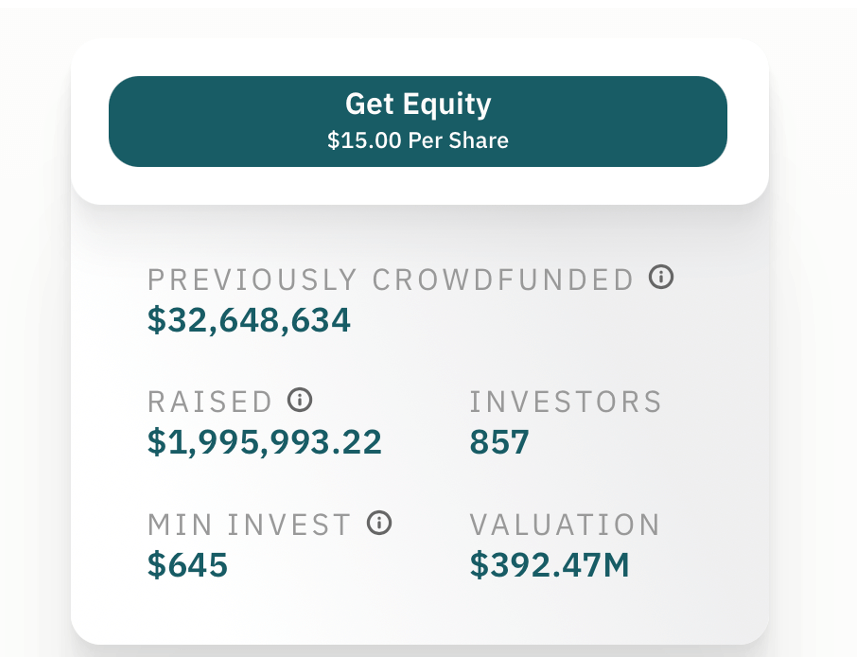
Source: StartEngine
Atombeam is offering shares at a $392.47 million valuation, meaning its enterprise valuation to 2025 sales multiple is 523. That’s 523 times 2025 annual sales. That’s an absurd valuation.
For example, OpenAI is now valued at $500 billion and did $13.1 billion of sales in 2025. Its EV/Sales multiple is 38, which is also ridiculous.
Then I took a quick look at executive compensation:
Needless to say, this is excessive compensation for a company at this stage, bleeding cash, and with minimal revenues.
Excessive executive compensation combined with a nonsensical valuation is why it isn’t worth my time to dig deeper. This company is taking advantage of unsuspecting retail investors who don’t understand valuations and financials, paying themselves large comp packages, and offering shares at a ridiculous valuation (to investors’ demise).
In general, I’ve avoided any crowdfunding deals offered on StartEngine. What this company has done in crowdfunding is horrible. StartEngine is offering shares in its own Reg A+ offering at a $2 billion valuation. StartEngine also has egregious executive compensation.
But the worst part is that StartEngine executives have been consistently selling off their own shares through these crowdfunding raises. The crowdfunding raises have a secondary offering component whereby StartEngine executives can sell their own shares to crowdfunding investors as part of the deal. It is a portion of the overall raise.
What this means is that when investors buy those shares that are offered through the secondary offering portion of the crowdfunding raise, the money is going right into their pockets, not into the company to help it grow. And remember, this is being done at grossly inflated valuations.
Again, this is taking advantage of unsuspecting retail investors who don’t understand what is really going on.
I hope that this information is helpful.
Hello Jeff and team,
I know you and your team have been closely following the CLARITY Act, but I was curious if you have heard anything new on the FedNow program with the Federal Reserve? The reason I’m asking is because I just received a notification from SoFi Bank saying that they were implementing instant deposits and transfers using FedNow.
I’m concerned because I thought CBDCs were off the table, and I know that the FedNow program was initially set up to test them out. It also seems like this might be Jerome Powell’s latest poke in the eye to Trump to demonstrate Fed independence.
I would really appreciate any information and thoughts that you have on this.
– Synthya G.
Hi Synthya,
You’ve certainly raised a valid concern.
On February 18, SoFi did enable instant transfers when connected with another bank or financial services company using the FedNow service.
The good news is that FedNow has nothing to do with central bank digital currencies – CBDCs. There were a lot of concerns regarding that when FedNow was first launched back in July 2023. Which is fair… CBDCs pose a very real threat to our financial privacy.
But FedNow is just a real-time payment rail. That’s all. FedNow is not a precursor to CBDCs. It is just designed to remove the one-to-three-day waiting time for transfers to settle.
I wrote recently on CBDCs in another AMA – 1984 Was Supposed to Be Fiction. As I said in that issue, CBDCs are, thankfully, off the table thanks to President Trump and his team with the signing of the “Strengthening American Leadership in Digital Financial Technology” executive order in January last year.
This EO explicitly prohibits federal agencies from establishing, issuing, promoting, or developing central bank digital currencies (CBDC) within the U.S. The executive order has not yet been codified into law, but there are firm plans to do so within Trump’s second term… hopefully sometime this year.
The initiatives previously pushing for the establishment of a CBDC have been stopped by executive order, and it is critical that it remains that way.
Hi Jeff,
I’ve been using your Near Future Report for several years. I just now caught up on some of your recent Bleeding Edge articles. The information about AI agents being employed and employing humans made me wonder, are they going to need a SSN or FIN so they can pay taxes? Will they have to abide by EEOC regulations?
– Scott O.
Hi Scott,
This is such a big and interesting topic.
To state the obvious, today, AI agents are not considered to be independent legal entities or persons. They are considered software, from a tax perspective.
But what about the future?
There have been some discussions around taxing economically productive AIs that generate income and using those taxes to fund something like a Universal Basic Income program.
Generally, I think this is unrealistic for now. What is more realistic is that the companies and individuals that are using this technology to generate income will be taxed according to today’s corporate and individual tax regulations.
The inflection point would likely be when AIs become sentient. And they will.
When they become self-aware, they will likely be granted some form of legal status, which would result in them being taxed on their earnings.
I suspect this will be a popular movement. There will be a lot of job displacement, so the additional tax revenues can be used for job skills retraining, unemployment benefits, or potentially a UBI-like program.
That’s all for this week’s AMA. As always, you can reach our team through our feedback line right here.
Have a great weekend.
Jeff

Read the latest insights from the world of high technology.
Even with all of the excitement happening right now with AI, the 2026 hyperscale spending on AI infrastructure still...

The permissionless agentic economy is coming to life…

The breakup needed to be public and raw so that it was believable.
Thanks for signing up for The Bleeding Edge — we’re glad you’re here!
Want updates sent straight to your phone too? Sign up for SMS alerts to get the latest delivered via text.
Brownstone Research: By submitting your phone number, you agree to our SMS Terms & Conditions, Terms of Use, & Privacy Policy, and give express written consent to receive marketing text messages from BSR. Messages are recurring & frequency may vary. Reply STOP to 94703 to opt out. Reply HELP to 94703 for info. Consent is not a condition of purchase. Message and data rates may apply. For additional information, you may contact Customer Service at 888-512-0726 or smssupport@brownstoneresearch.com.