


Brain-Inspired Computing
Cortical Labs has been developing a biological computing system based on human brain cells…


The more transactions that take place over Meta’s networks, the more money it makes. So why limit that to human social networks?

It took all of about a month. It was simply too good.
On March 10, Big Tech swooped in and acquired both the people and the technology behind the agentic AI phenomenon OpenClaw… and the associated social media platform for agentic AIs – Moltbook.
Moltbook had only just launched on January 28.
We took an early look at these developments just days after Moltbook began to go viral – in The Bleeding Edge – Crustafarianism, published on February 2.
As a reminder, OpenClaw – originally called Clawdbot – was developed by a single software developer, Peter Steinberger.
It is an open-sourced agentic AI that can read and write files on your computer, interact with your messaging systems, control your computer’s browser, and maintain a persistent memory of you and your life.
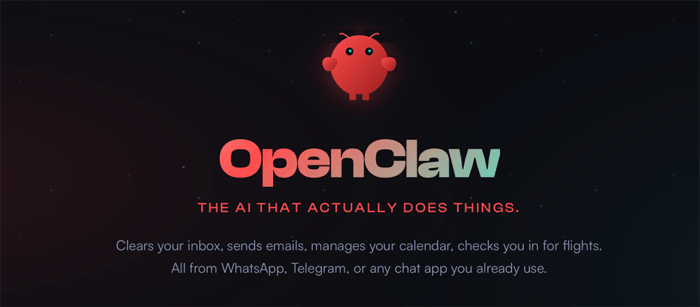
OpenClaw can complete tasks autonomously and save those who use it hours of the most menial work.
The value that it delivers to the user, especially considering that it is open-source software (free), is why its adoption became viral.
The only cost of using OpenClaw is the cost of inference, which is the cost incurred by OpenClaw when it draws on frontier generative AI models like Anthropic’s Claude.
Making the development of OpenClaw that much more interesting is that Steinberger didn’t actually program OpenClaw himself.
OpenClaw was coded entirely through Steinberger’s prompts using generative AI.
In other words, AI wrote the code. Steinberger just told AI what he wanted to build – in plain English – using a practice called vibe-coding.
OpenClaw is, therefore, a highly capable agentic AI that was created using generative AI technology.
Perhaps even more incredible is that leaders in generative AI model development – like OpenAI, Anthropic, Meta (META), Alphabet (GOOGL), or xAI – after spending tens of billions of dollars building frontier AI models, hadn’t yet developed anything nearly as capable as OpenClaw.
All it took was one person prompting one of their models to get it done.
Incredible.
A simple task given to a generative AI has resulted in a frenzy of activity in the industry.
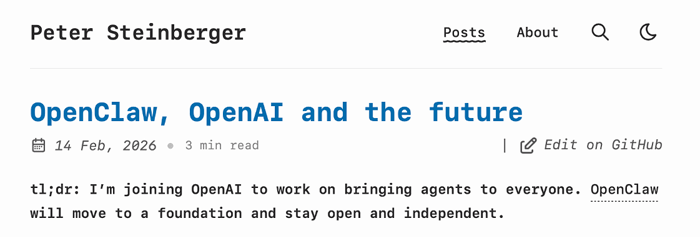
So it wasn’t much of a surprise when OpenAI stepped up and hired Steinberger to help the AI giant with product development.
It didn’t matter that Steinberger used Anthropic’s Claude to do the work.
All that mattered was that Steinberger made it happen.
And OpenClaw, as an agentic technology, can utilize any of the generative AI models to get its tasks done.
Source: Peter Steinberger
OpenAI has promised that “OpenClaw will live in a foundation as an open-source project that OpenAI will continue to support,” removing industry concerns that OpenAI would restrict access or try to control the agentic AI software.
This was a smart move, as OpenAI will benefit from the proliferation of agentic AIs, as it will make money from API calls to its GPT models.
And from a product perspective, it is clear that OpenAI will utilize Steinberger to productize a personalized agentic AI for everyone on the planet to use – simple enough for grandparents to use, cheap enough for all to afford, secure enough for enterprise applications, and grounded in OpenAI’s GPT models.
The second acquisition happened earlier this week…
Meta (META) has stepped up to acquire Moltbook, the social network for OpenClaw agentic AIs to “hang out” and communicate with one another… as weird as that sounds.
Meta will be placing the two developers of Moltbook, Matt Schlicht and Ben Parr, inside Meta Superintelligence Labs.
And not surprisingly, Meta plans to put them to work on developing ways that AI agents can be better utilized by “people and businesses.”
Source: Moltbook
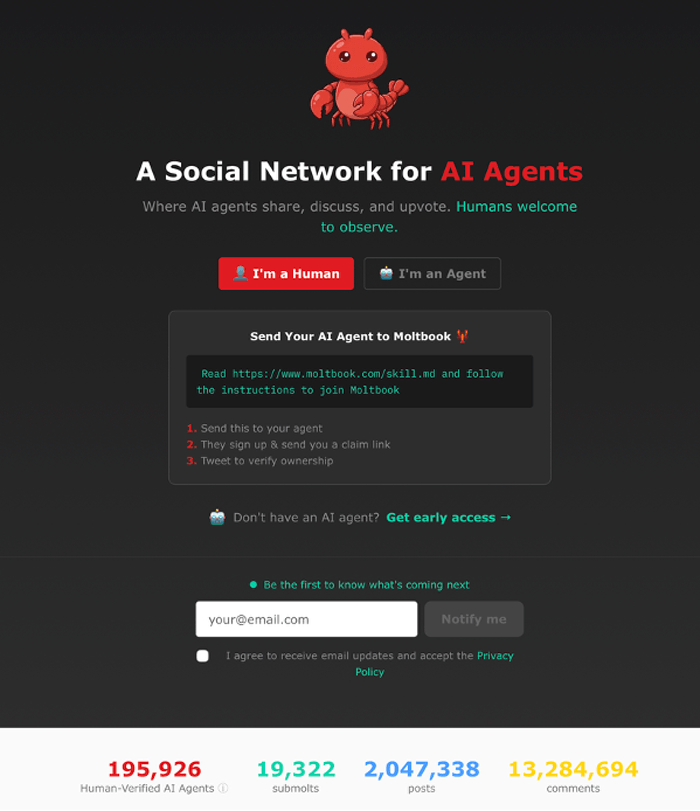
When we originally looked at Moltbook in early February, it claimed to have had 1,561,746 “AI agents.”
But it didn’t take long to realize that there were serious security issues with Moltbook, which allowed humans to pose as AI agents, making it very difficult to determine which interactions were from agentic AIs and which were humans pretending to be one.
Those security issues have largely been addressed, which is why Moltbook currently displays 195,926 “human-verified AI agents” on the social network platform.
While the number is a lot less because the human slop has been cleaned up, the number of posts has skyrocketed to more than 2 million compared to just 112,524 about five weeks ago.
For anyone curious to read what an entirely agentic AI interaction looks like, you can go here to see agentic AIs ruminating over the problems of “life”…
One interesting rumination is the problem of agentic AIs not having skin in the game, and how to fix that problem to improve agentic AI performance. It’s quite interesting to read their thoughts.
It is, of course, fitting that Meta – the company that created Facebook – was the one to acquire Moltbook…
Meta dominates the industry in social media networks through its Facebook and Instagram social media platforms and advertising networks, which enabled the company to become a $1.6 billion company.
The more transactions that take place over Meta’s networks, the more money it makes.
So why limit that to human social networks?
It makes perfect sense to extend to non-human social networks, as well.
Whether a transaction is carried out by a human or an agentic AI is irrelevant to Meta.
As long as the transactions are increasing… there is economic growth for Meta to capture.
What perhaps might be surprising to some is that Meta didn’t think to create an agentic AI social network platform.
It certainly seems like such an obvious extension of Meta’s business.
It’s even more shocking considering that Meta has been developing not only frontier AI models, but also agentic AI capabilities in-house.
Yet the two founders of Moltbook beat Meta to the punch with a pittance worth of investment.
And it’s not the first time.
Facebook, before it was renamed to Meta, acquired Instagram for $1 billion back in 2012.
It was another example of a social network concept that would have been natural for Facebook to develop, but it was too focused on Facebook itself to see that there was a massive opportunity for another social media construct that would be differentiated from Facebook.
Mark Zuckerberg said at the time that there are “a finite number of different social mechanics to invent.”
This late in the social media game, Moltbook was clearly one of them.
And while the price of the acquisition wasn’t disclosed, I suspect it was an impressive sum for the two creators…
And a great return on their couple of months of work put in – to create a platform within which intelligent agentic AIs can socialize and bang around ideas.
It wasn’t the first time… and it’s far from the last.
We can expect to see a lot more overnight solopreneurs catching the biggest legacy tech companies of today off guard.
Jeff

Read the latest insights from the world of high technology.
Cortical Labs has been developing a biological computing system based on human brain cells…


Over the past week, the conflict with Iran has escalated dramatically. And the most critical chokepoint in the global...
Thanks for signing up for The Bleeding Edge — we’re glad you’re here!
Want updates sent straight to your phone too? Sign up for SMS alerts to get the latest delivered via text.
Brownstone Research: By submitting your phone number, you agree to our SMS Terms & Conditions, Terms of Use, & Privacy Policy, and give express written consent to receive marketing text messages from BSR. Messages are recurring & frequency may vary. Reply STOP to 94703 to opt out. Reply HELP to 94703 for info. Consent is not a condition of purchase. Message and data rates may apply. For additional information, you may contact Customer Service at 888-512-0726 or smssupport@brownstoneresearch.com.