


Death of an Apocalyptic Environmentalist
It’s hard to believe that anyone would listen to Paul Ehrlich at all after being so concretely proven to...


Early this month, Amazon (AMZN), through its Amazon Leo subsidiary, filed a petition with the Federal Communications Commission (FCC). The petition requested that the FCC deny SpaceX approval of its plans to launch and deploy a 1 million AI satellite constellation. Amazon’s argument against SpaceX was that the “application seems to describe a lofty ambition […]
Managing Editor’s Note: Don’t forget to sign up with one click to join our colleague, Larry Benedict, at his AI Chaos to Cash event on Thursday at 2 p.m.
He’s revealing the one-ticker strategy he’s used for decades to snap up quick profits in volatile markets…
And according to Larry, the volatility we’ve seen so far this year is just getting started, which means lots of opportunities for traders like Larry in the months ahead.
Just go here to automatically add your name to the guest list.
Early this month, Amazon (AMZN), through its Amazon Leo subsidiary, filed a petition with the Federal Communications Commission (FCC).
The petition requested that the FCC deny SpaceX approval of its plans to launch and deploy a 1 million AI satellite constellation.
Amazon’s argument against SpaceX was that the “application seems to describe a lofty ambition rather than a real plan – and a speculative placeholder rather than a complete application under the Commission’s rules.”
It went further, stating…
The application has raised alarm from astronomers and environmental groups, and risks worsening international backlash from regulators already concerned about the monopolization of orbital resources.
That was an odd choice of words…
Especially coming from a dominant company with a monopolistic-like hold on two massive industries – e-commerce and terrestrial cloud-based web services.
The petition’s most ridiculous assertion concerning SpaceX’s plans was that “deploying the proposed million-satellite constellation would take centuries, even assuming the availability of all global launch capacity to do so.”
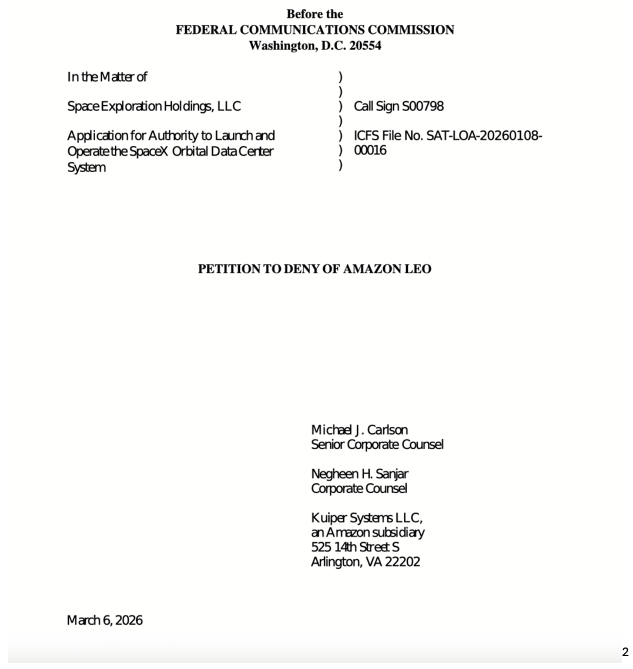
It was a ridiculous petition lacking substance… and clearly a backhanded and weak attempt to slow down a rival.
And it didn’t go over too well with the Chairman of the FCC, Brendan Carr:
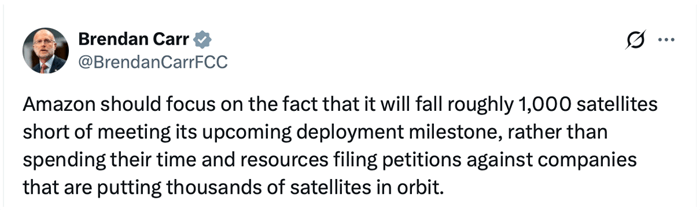
Source: X @BrendanCarrFCC, March 11, 2026
Carr was referring to Amazon Leo in his comments.
As longtime Bleeding Edge readers know, Amazon Leo – formerly known as Project Kuiper – is Amazon’s answer to SpaceX’s Starlink service to deliver broadband internet access via satellites.
To date, Amazon has roughly 250 satellites in orbit.
And here’s the funny part…
For Amazon to keep its license from the FCC, it has to deploy half of its constellation, which is 1,616 satellites, by July 30, 2026. That’s what Carr was referring to.
Amazon is way behind.
In fact, there’s no way it will make it in time. And the company has admitted it.
This January, Amazon filed for a two-year extension to July 30, 2028, for its halfway milestone, or a waiver of the milestone completely.
Amazon blamed a “near-term shortage of available rockets” and supply chain issues as the reason for its delays…
But its problems were of its own making.
Bezos tried his best to minimize the use of Musk’s SpaceX to get his satellites into orbit.
The problem with that is that SpaceX launches 95% of all payloads into Earth’s orbit right now. Blue Origin can’t possibly hit its FCC-mandated requirements without leaning heavily on SpaceX.
SpaceX doesn’t have an availability problem. The rest of the launch industry does.
But this story gets so much richer.
On Thursday, March 19th, Bezos, through Blue Origin, filed an application with the FCC for – you guessed it – a constellation of orbital AI data center satellites. Hilarious.
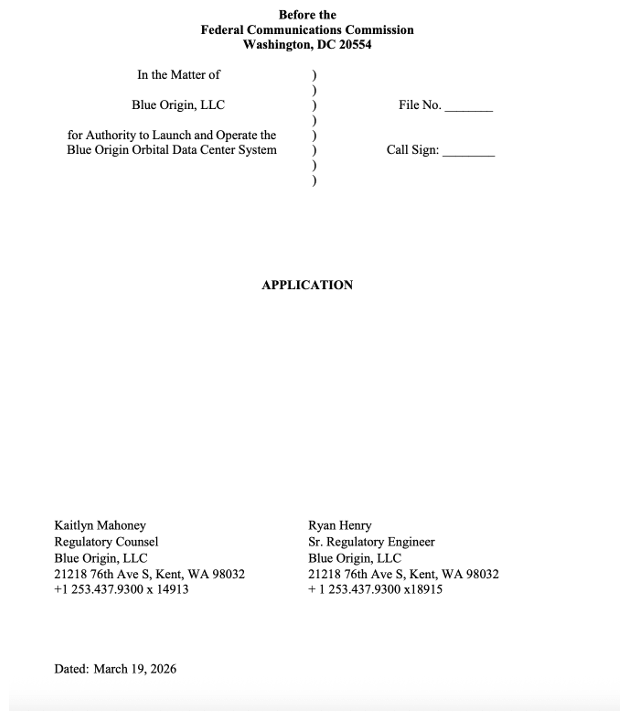
From Blue Origin’s application to the FCC…
This system will consist of up to 51,600 satellites operating in circular, sun-synchronous orbits from 500–1,800 km in altitude, with inclinations between 97 degrees and 104 degrees, with each orbital plane containing approximately 300–1,000 satellites.
Blue Origin’s Project Sunrise will rely largely on optical links to support its communications by routing traffic through its TeraWave system and other mesh backhaul networks to transmit to the ground.
Project Sunrise… oh, the irony.
Bezos, through Blue Origin, has filed what is intended to be a competitive alternative to Musk’s (SpaceX’s) 1 million AI data center satellite constellation…
The very constellation that Amazon petitioned the FCC to deny the launch of.
And Blue Origin’s architecture, while only 5% of the scale of SpaceX’s, is almost a mirror image of what SpaceX has designed.
SpaceX’s sun-synchronous satellite constellation is supported by its current space-based world wide web infrastructure – its Starlink network with optical interconnects.
Blue Origin’s sun-synchronous orbit constellation is supported by its future space-based world wide web infrastructure, TeraWave, which employs optical interconnects, a subject that we explored this January in The Bleeding Edge – Catching SpaceX.
The irony, of course, was not lost on the team at SpaceX.
I’d wager they were having a good belly laugh last Thursday, when Blue Origin filed for Project Sunrise.
So naturally, they wrote to the FCC with the most logical response.
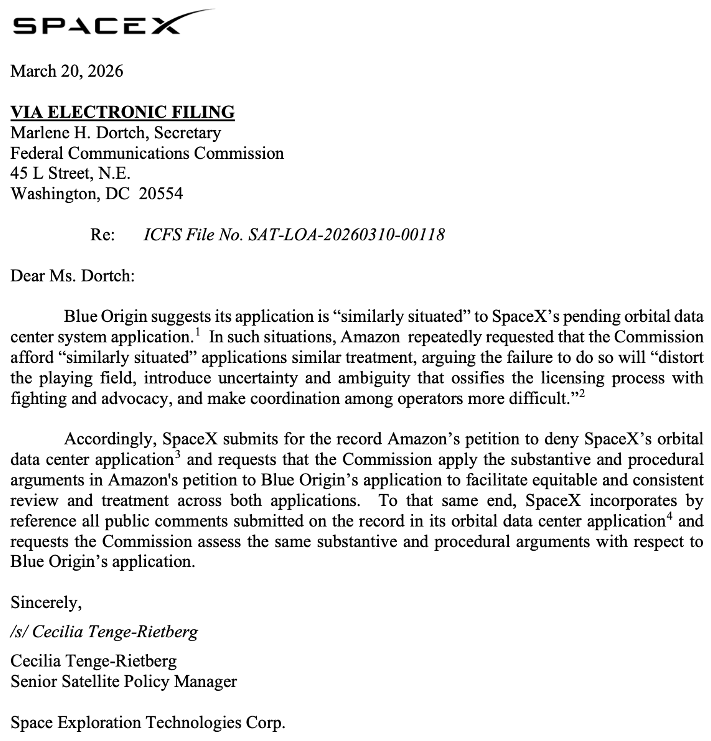
SpaceX’s position is simple…
[It] requests that the Commission apply the substantive and procedural arguments in Amazon’s petition to Blue Origin’s application to facilitate equitable and consistent review and treatment across both applications.
In other words, Amazon can’t apply to deny SpaceX while at the same time filing to do the same things as SpaceX.
Amazon can’t have everyone’s cake and eat it too.
Both parties should be treated under the same framework equally, a point that the FCC will certainly agree with.
Checkmate for SpaceX.
The simple reality is that Bezos had no choice.
Amazon got caught flat-footed by SpaceX and its extraordinary success with Starlink.
And then it got caught off-guard with SpaceX’s 1 million satellite constellation – of what amounts to orbital web services (OWS), a direct competitor to Amazon’s Web Services (AWS).
The reality is that within three years, possibly two, it will be cheaper to host orbital web services than it will be to host terrestrial web services.
And with Musk’s history of consistently achieving the “impossible,” SpaceX/xAI has become a clear and present danger to Amazon’s golden goose – AWS.
But you might be wondering, why did Bezos undertake Project Sunrise at Blue Origin rather than at Amazon and Amazon Web Services?
That’s a simple answer.
Bezos wants to keep this highly risky, untested Project Sunrise off of Amazon’s balance sheet.
It will be very capital-intensive, cost billions, and not the kind of thing that Bezos wants to wrestle with the Amazon board and analysts over. Especially while trying to compete against a radical innovator like Elon Musk.
Regardless of whether or not Amazon can afford it, Project Sunrise would still have a material impact on Amazon’s (AMZN) earnings and free cash flow.
It’s a multi-year, risky, and capital-intensive play, the kind that Wall Street tends not to reward in the short term.
Making matters worse, AWS executives have been public and pessimistic about large-scale orbital data centers, saying that they are “pretty far from reality.”
Well, we’ll see about that…
Jeff
P.S. Hi, Jeff’s managing editor here, again.
Despite what AWS executives are claiming, large-scale orbital data centers aren’t so far from reality at all…
In fact, Jeff and the team have already started eyeing the companies that are particularly aligned with this mission and suited to help build the infrastructure to make it happen.
Suppliers for the TeraFab that Jeff discussed on Monday… as well as companies positioned to help him with his orbital data center plan… you can go here to learn more.

Read the latest insights from the world of high technology.
It’s hard to believe that anyone would listen to Paul Ehrlich at all after being so concretely proven to...

True to form, Elon Musk is doing it again. This time, he is going to reinvent semiconductor manufacturing. Last...
OWS is an entirely new industry that will experience explosive growth in the next few years, and one that...
Thanks for signing up for The Bleeding Edge — we’re glad you’re here!
Want updates sent straight to your phone too? Sign up for SMS alerts to get the latest delivered via text.
Brownstone Research: By submitting your phone number, you agree to our SMS Terms & Conditions, Terms of Use, & Privacy Policy, and give express written consent to receive marketing text messages from BSR. Messages are recurring & frequency may vary. Reply STOP to 94703 to opt out. Reply HELP to 94703 for info. Consent is not a condition of purchase. Message and data rates may apply. For additional information, you may contact Customer Service at 888-512-0726 or smssupport@brownstoneresearch.com.