

Clash of the Orbital Titans
Early this month, Amazon (AMZN), through its Amazon Leo subsidiary, filed a petition with the Federal Communications Commission (FCC)....


There was some renewed excitement in the last few days about fourth-generation nuclear fission technology and the Department of Energy’s (DOE) Reactor Pilot Program (RPP). Publicly traded Oklo (OKLO) announced that it received U.S. DOE approval for the Nuclear Safety Design Agreement for its Aurora Powerhouse fast-fission plant. The plant is to be situated on […]

There was some renewed excitement in the last few days about fourth-generation nuclear fission technology and the Department of Energy’s (DOE) Reactor Pilot Program (RPP).
Publicly traded Oklo (OKLO) announced that it received U.S. DOE approval for the Nuclear Safety Design Agreement for its Aurora Powerhouse fast-fission plant.
The plant is to be situated on Idaho National Laboratory lands near Arco, Idaho.
This is a location and project that I know well, as I traveled out to Arco, Idaho, last November to get a clear understanding of how far along the project had progressed.
There had been a lot of press coverage on the groundbreaking in the months prior, and the management team at Oklo continued to hail the progress they had been making on the Aurora Powerhouse.
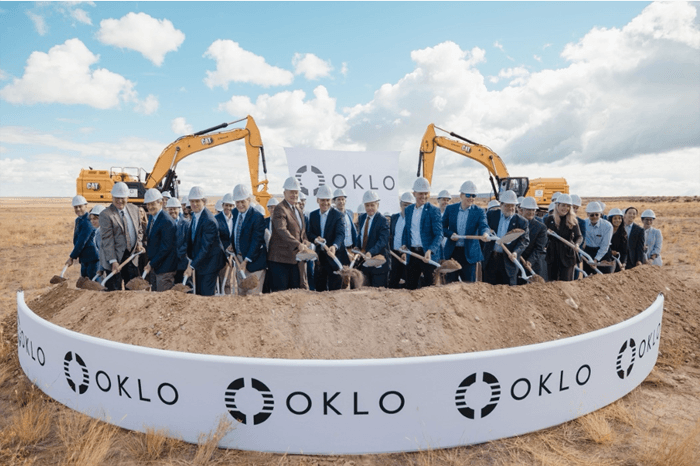
Source: Oklo
Here’s what I saw of the Aurora Powerhouse when I was there:
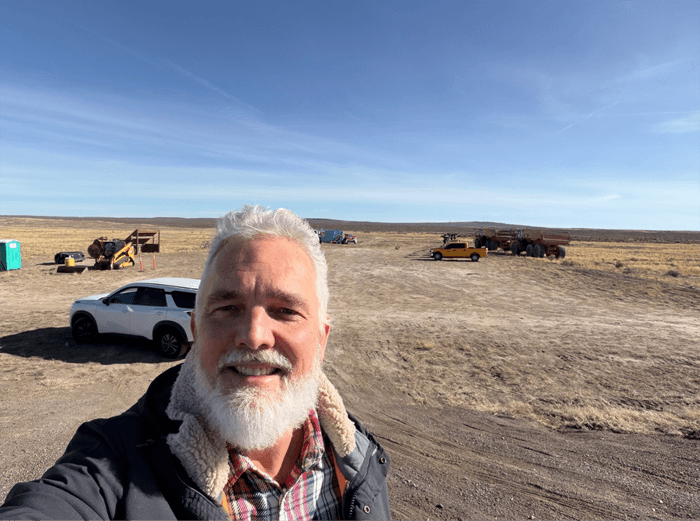
As you can see, not a whole lot.
There were a few trucks, some small dirt-moving equipment, a few storage containers, and my white rental car over my shoulder.
The funniest bit of the site was the outhouse, however. You can see it over my right shoulder in the above picture.
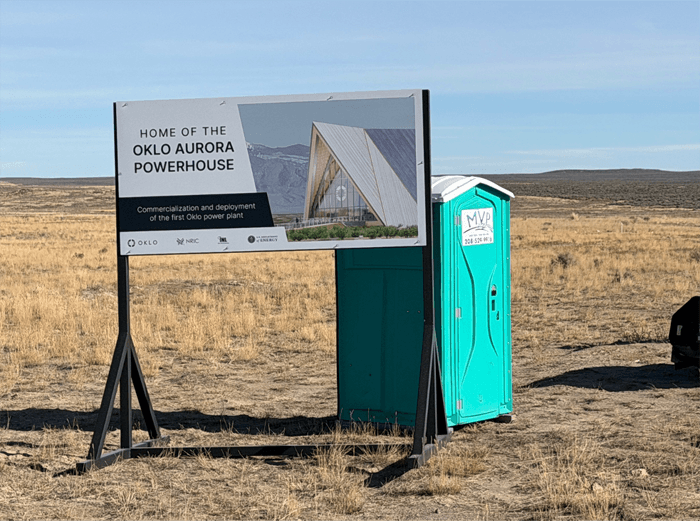
Here it is again in the picture below…
Quite an impression to give.
The project sign proclaimed the “Home of the Oklo Aurora Powerhouse”… with a bright turquoise porta-potty right behind it.
Talking about nuclear power…
While the groundbreaking was clearly just for show, this latest progress with the DOE has brought about some significant developments at Oklo, which are far more promising.
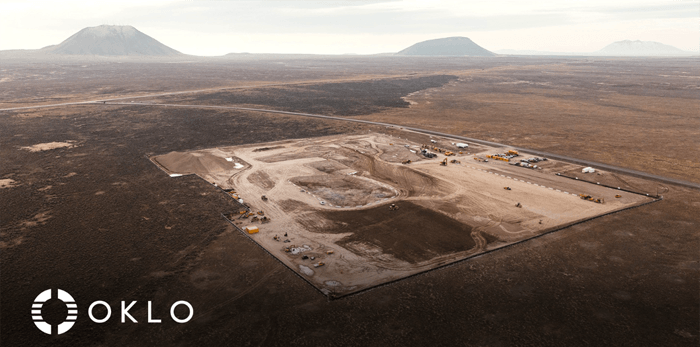
Here is the latest site location for the Aurora Powerhouse from earlier this month:
Source: Oklo
The road that we can see on the right side of the site is where I parked and took the pictures.
Oklo is now in the early stages of site preparation, focused on site layout, blasting, and deep excavation. But the company is moving forward with the build.
Given that it is March, though, it is obvious that there is a zero chance for Oklo to demonstrate criticality – or the precise moment when a nuclear fission chain reaction becomes self-sustaining – at this location in the original timeframe set out by the Reactor Pilot Program, which targeted criticality by July 4, 2026.
But that doesn’t mean that it won’t happen.
Oklo has a less talked-about Atomic Alchemy plant, which is its Groves Isotopes Test Reactor, located in Texas, which is also part of the DOE RPP program.
I fully expect that it will reach criticality by July 4.
Oklo tends to receive a lot of attention from the financial media because of its affiliation with OpenAI CEO Sam Altman.
Altman was a seed round investor in Oklo in 2015 and was also the chairman of Oklo for many years.
On the surface, the connection between Altman and nuclear energy made no sense to most back then. Just about everyone thought it was just a “clean energy” thing.
But the reality was quite different.
Altman knew back then, a decade ago, that energy would be the biggest bottleneck for achieving artificial general intelligence (AGI) and artificial superintelligence (ASI).
So, he put his money to work on a possible solution to the energy bottleneck… in the form of Oklo’s sodium fast reactor design.
He only recently stepped down from the Oklo Chairman role in April 2025, to remove any conflicts of interest between OpenAI.
That’s a clear signal that OpenAI intends to use Oklo’s nuclear energy technology to power future OpenAI AI data centers.
Oklo was one of the first next-gen nuclear fission companies to go public, and the market loved it, until it didn’t.
It has been a bumpy ride since it went public via a reverse merger into a SPAC in May 2024.
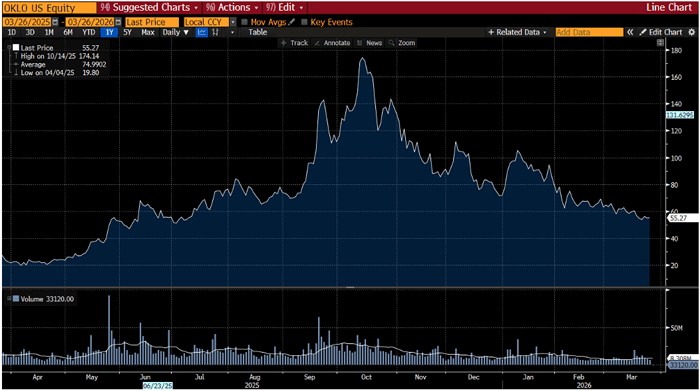
Oklo rose on basically zero revenues – for the first two years – to rise from a pre-SPAC price of $10 a share to $193 a share in October last year, putting Oko’s valuation around $30 billion.
An absurd valuation for a company that’s years away from a live nuclear fission plant producing energy.
Valuing these pre-product revenue tech/biotech companies is always tricky.
Substantive revenues are so far out and highly speculative, so traditional discounted cash flow methodologies aren’t very useful.
It’s more about a belief that the company will be able to commercialize its technology, continue to make material progress towards doing so, and that there will be enough institutional capital that feels the same and will be willing to show it – by purchasing large amounts of the company’s stock.
That’s precisely what happened to Oklo through October of last year, and then the fast money started taking profits.
Oklo is down 68% from its highs, but still significantly above its initial $10 share price, now sitting around $55.
Another contender, NuScale Power (SMR), experienced an even more dramatic rise and fall.
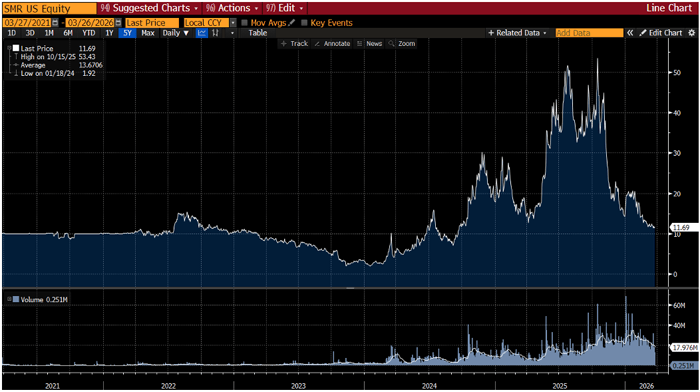
Without that Sam Altman “shine” and his connections to OpenAI, which has access to a seemingly endless supply of capital, NuScale has collapsed 78% from its highs.
It now sits barely above its initial $10 IPO share price at a mere $11.69.
NuScale Power is valued at around $2.6 billion today, and Oklo supports an $8.1 billion valuation.
I expect both of their share prices to decline further this year.
While both companies are generating revenue, they are both still pre-product revenue with regard to the actual design and construction of next-generation nuclear fission power plants.
NuScale Power has been generating technology licensing revenues for its intellectual property, the primary source being the RoPower project in Romania.
And Oklo is focused on building a shorter-term revenue stream by developing and selling isotopes to be used for irradiation in research and development, semiconductor doping, and defense applications, as well as some customer prepayments for future fission reactor developments.
While Oklo and NuScale Power are certainly companies to keep a close eye on, there are a few more enrolled in the DOE’s RPP that are even farther along in their quest for criticality.
And outside of the DOE RPP program, we have:
This is a healthy, competitive field of companies and projects with an abundance of capital, advanced technology, regulatory tailwinds, and a critical market demand.
That demand is to spin up electricity to fuel the explosive growth in artificial intelligence – as much and as fast as possible.
Here’s to fast reactors,
Jeff

Read the latest insights from the world of high technology.
Early this month, Amazon (AMZN), through its Amazon Leo subsidiary, filed a petition with the Federal Communications Commission (FCC)....

It’s hard to believe that anyone would listen to Paul Ehrlich at all after being so concretely proven to...

True to form, Elon Musk is doing it again. This time, he is going to reinvent semiconductor manufacturing. Last...
Thanks for signing up for The Bleeding Edge — we’re glad you’re here!
Want updates sent straight to your phone too? Sign up for SMS alerts to get the latest delivered via text.
Brownstone Research: By submitting your phone number, you agree to our SMS Terms & Conditions, Terms of Use, & Privacy Policy, and give express written consent to receive marketing text messages from BSR. Messages are recurring & frequency may vary. Reply STOP to 94703 to opt out. Reply HELP to 94703 for info. Consent is not a condition of purchase. Message and data rates may apply. For additional information, you may contact Customer Service at 888-512-0726 or smssupport@brownstoneresearch.com.