


A Quick “How To” for Viewing Crowdfunding Offerings
We can’t provide any personal investment advice, but we can use a question as an example of how to...


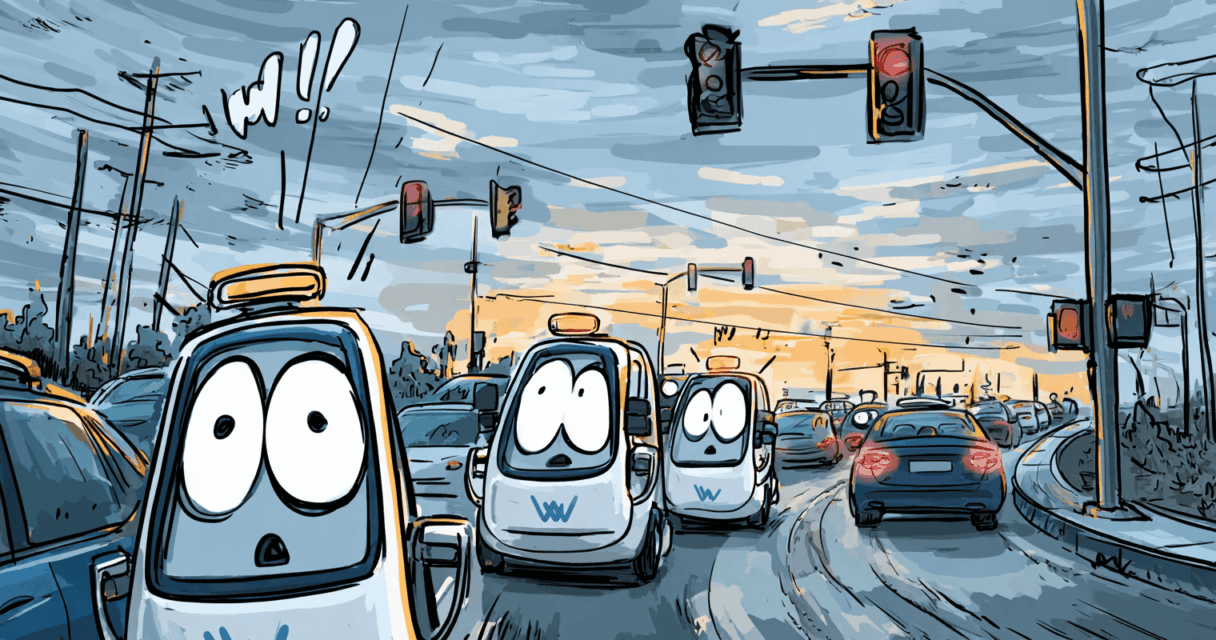
This was hilarious to see, considering how we’ve been pointing out the weaknesses of Waymo’s autonomous technology for years now…
Managing Editor’s Note: Expect more volatility and wild swings in 2026…
That’s according to our colleague, Larry Benedict, over at The Opportunistic Trader. Larry has decades of experience trading choppy markets, and he says he’s got just the strategy to consistently generate double-digit returns…
And that’s in any market conditions, including through the kind of volatility he’s anticipating this year.
He’s walking folks through the strategy during his Get Rich Slow briefing next Thursday at 8 p.m. ET. You can go here to sign up with one click to join him on January 15…
The artificial intelligence boom, not bubble, continues…
This week brought news that frontier AI model developer Anthropic is raising $10 billion at a $350 billion valuation.
Singapore’s sovereign wealth fund, GIC, and Coatue Management are leading the raise.
What makes the raise so incredible is that Anthropic just raised $13 billion at a $170 billion pre-money valuation last September. That puts this latest raise at double the valuation in just a matter of months. And Anthropic was only founded in 2021.
Anthropic’s first round was at a $337 million valuation in the spring of 2021, which means an increase in valuation of more than 1,000 times over the last five years. What a spectacular rise, and one that is fueled by real revenues and exponential growth.
The latest whispers suggest that this is a pre-IPO raise for Anthropic. This would add fire to the excitement about major IPOs this year that potentially include OpenAI and SpaceX. And unlike OpenAI, Anthropic’s business is far less capital-intensive. It’s not building massive data centers like OpenAI, which puts it on a path towards profitability in 2028.
And we shouldn’t forget, OpenAI’s next funding round is expected to be $100 billion at around a $750 billion valuation.
What an exciting start to the year, and very positive news that supports a banner year in new public tech offerings.
Have an exciting weekend,
Jeff
How will Project Orion and Elon’s battle with Apple over Globalstar (GSAT) affect both SpaceX and Starlink?
– James C.
Hi James,
There are some really interesting dynamics at play here between these three companies. And there is also a bit of history.
But before we get to that, it’s important to point out that “Project Orion” doesn’t exist. That’s just a name someone made up for marketing investment research.
What is/was a real project at Apple was Project Eagle – the name Apple originally had for a satellite service, including direct-to-cell services – that would have been a competitive service offering against SpaceX’s Starlink.
Originally, Apple had considered partnering with Boeing to launch thousands of satellites, similar to what Starlink has done.
Clearly, that never happened. Apple gave up.
Musk was pitching Apple to provide direct-to-cell services back in 2022, before Starlink had launched its specialized direct-to-cell satellite constellation. At that time, Starlink had launched thousands of other operational Starlink satellites and showcased its capabilities.
Apple was choosing between Starlink and Globalstar (GSAT), and Apple’s Tim Cook chose Globalstar.
Musk had apparently asked for $5 billion up front to build the direct-to-cell constellation for Apple, and Globalstar asked for 95% of the cost of building its constellation. Ultimately, Apple ended up investing $1.7 billion in Globalstar, so Apple got its direct-to-cell deal “cheaper.”
As the old saying goes, you get what you pay for…
Starlink’s direct-to-cell capabilities are dramatically better than anything Globalstar is capable of. Globalstar’s constellation is at an altitude of 1,414 kilometers, and Starlink’s satellites sit between 480–550 kilometers. Starlink has hundreds of direct-to-cell satellites (approaching 1,000), and Global has tens of satellites.
Globalstar can only send text messages due to its limited bandwidth. Starlink’s direct-to-cell service can send texts, make voice calls, and send/receive data, as it is operating at 4+ Mbps. Starlink also supports any LTE/5G phone, including Apple iPhones.
Naturally, the SpaceX acquisitions of key spectrum from EchoStar and deployment of its large direct-to-cell satellite constellation put SpaceX in a very different position.
To answer your question directly, there is no effect on SpaceX or Starlink. Consider this… Globalstar uses SpaceX to launch its direct-to-cell satellites into orbit. SpaceX wins. And Globalstar doesn’t have the technology or the satellites to compete against Starlink at the lower altitudes.
Furthermore, SpaceX continues to work with Apple to ensure that Starlink direct-to-cell works on Apple iPhones operating on other wireless carriers around the world (like T-Mobile in the U.S.).
Also relevant is a regulatory battle happening with the Federal Communications Commission (FCC) over the use of certain spectrum.
Globalstar is lobbying to use certain spectrum that would interfere with SpaceX’s spectrum for direct-to-cell services. Naturally, SpaceX is asking the FCC to prevent this. If Globalstar were to turn on services in that spectrum, both Globalstar and SpaceX would have interference problems.
What’s playing out is some real corporate antics by Globalstar. It sees an opportunity to sell itself – for a price well above what it’s worth and a “wealthy” potential buyer in SpaceX.
It’s generating an antagonistic situation in hopes that SpaceX will step up and buy Globalstar and its spectrum outright. SpaceX may just do that, considering all the spectrum it recently acquired from EchoStar – more on that here in The Road to SpaceX Mobile.
That’s all this is…
And no matter what happens, SpaceX and Starlink will win.
Jeff,
Please explain to us in detail what happened to WAYMO this week during the power outage in [San Francisco].
– Richard B.
Hi Richard,
I’m glad you picked up on this.
I have to say, this was hilarious to see, considering how I have been pointing out the weaknesses of Waymo’s autonomous technology for years now. I’ve been a very contrarian voice about this topic, and the video clip below says it all.

Source: X, Mishaal Abbasi @WhereIsMishaal
For everyone’s benefit, there was a major power outage in San Francisco. The outage impacted about 125,000 homes and businesses, which went without power. And it also resulted in widespread failures of traffic light systems throughout the city.
Waymo’s autonomous driving technology is architected in a very different way than Tesla’s. It is heavily programmed with traffic regulations – “if/then” kinds of programming – and it requires precise mapping of any area that it operates down to the centimeter. This is why the areas where Waymo operates are geofenced.
Its autonomous tech relies on detecting and interpreting traffic signals based on the rules it has been programmed with. The lack of active traffic signals due to the power outage caused many of the Waymos to revert to a safety protocol, “freezing” them at the intersection and causing traffic jams and chaos. Luckily, no one was hurt.
Part of the safety protocol of the Waymo autonomous software is to revert to human intervention. Waymo has a team of humans at a central location that can “teleport” into the vehicle and figure out what to do when a Waymo gets stuck. I’ve experienced this personally when I tested Waymo in Arizona a couple of years ago.
The even bigger problem in San Francisco was that so many Waymos failed and froze that the remote command center was overwhelmed. The human support staff couldn’t address all of the issues with the Waymos, which is what led to the chaos.
Waymo was forced to suspend its autonomous service in San Francisco as a result, until the power was restored and the traffic signals were functioning properly.
The funniest, or most interesting, happening during the power outage was the footage of Teslas with full self-driving navigating through San Francisco, effortlessly driving through the darkened streets in the absence of functioning traffic lights.
It’s a perfect representation of the technological difference between Waymo and Tesla’s full self-driving (FSD) AI.
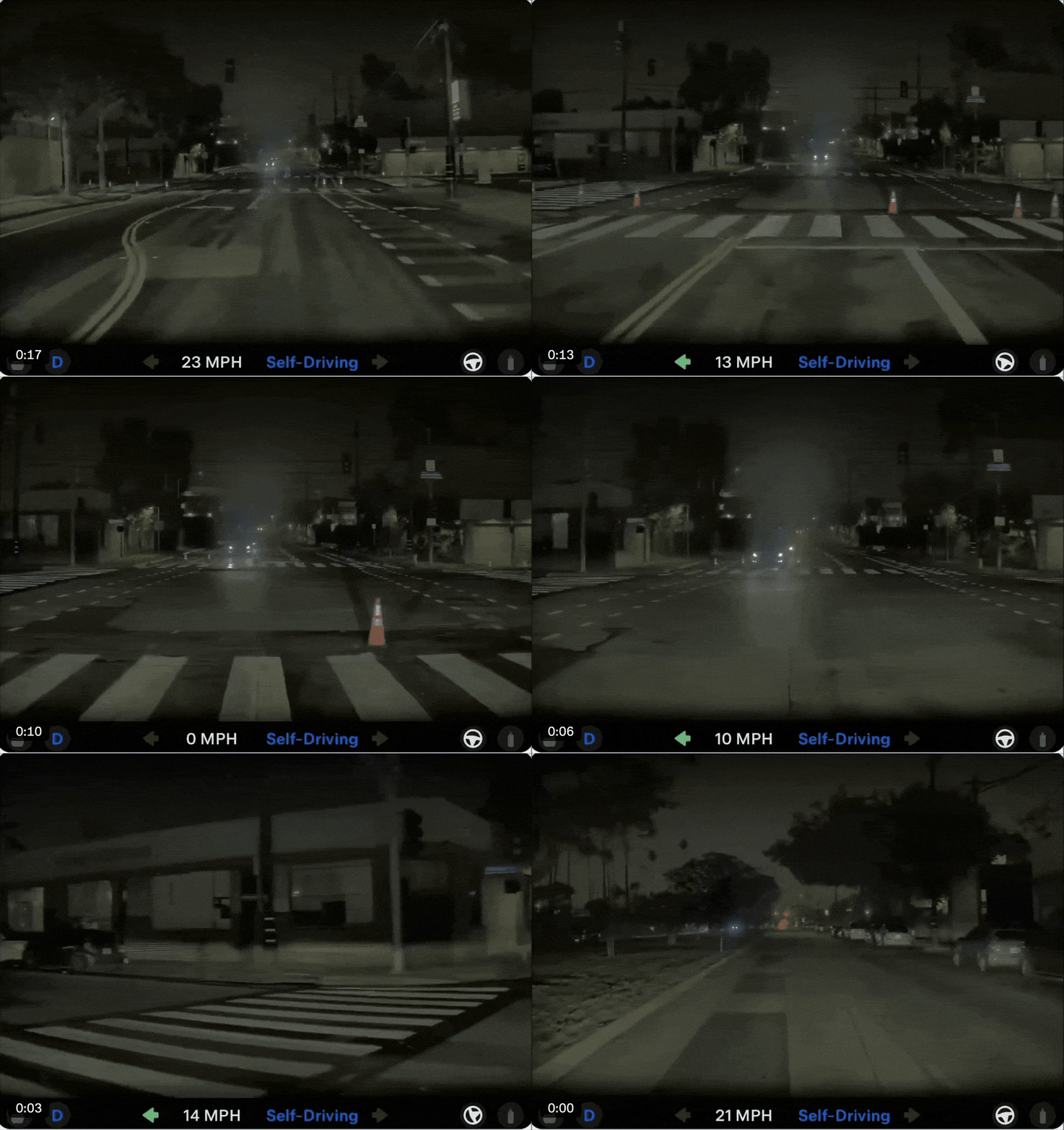
Source: X @Tesla_AI
Tesla developed an entirely vision-based AI model capable of reasoning and problem-solving when faced with unusual traffic conditions.
I’ve actually experienced this myself in my Tesla when power was down in my town due to a fallen tree taking out power lines. Tesla’s FSD navigated multiple intersections with inactive traffic signals flawlessly and safely, waiting for other cars to pass and taking turns with traffic.
So, that’s what happened with Waymo. And it is a major flaw in Waymo’s autonomous software.
Should we hang on to your cryptocurrency, or is it time to downsize crypto holdings? Thank you.
– Nader R.
Hi Nader,
Great timing for your question, as I have been down in Washington, D.C. this week, meeting with Congressional offices to advocate for the market structure bill for digital assets that is currently being intensely negotiated in the Capitol.
I can’t give personalized investment advice, so please understand that my comments are meant as my general take on the digital assets market for this year.
While there are definitely some tough negotiating points being hashed out right now, I can say that both sides of the aisle want a bill to go through.
Market structure is a reference to regulatory clarity for how digital assets, and which digital assets, should be regulated and by what regulatory agency.
The CLARITY Act – AKA the Responsible Financial Innovation Act (RFIA) (there are two versions of what is ultimately the same bill) – is designed to provide clear direction to the digital assets and financial industries.
It lays out what assets are to be considered ancillary or network assets – to be regulated by the Commodity Futures Trading Commission (CFTC) – and what assets are considered to be tokenized securities – regulated by the Securities and Exchange Commission (SEC).
The broad health of the cryptocurrency markets depends heavily on this bill passing. Once it does, it will be very bullish for the industry.
So, while we will continue to see volatility and uncertainty as the bill is negotiated and put before the Senate, the House, and ultimately the President, once the deal is done, the industry will have the guiderails to get things done and run.
We are very bullish on blockchain technology and digital assets. It is the next generation of financial technology. The Chairman of the SEC has said the entire financial industry will migrate to blockchain technology within the next two years.
We provide very in-depth research on the projects that are most important to this technological migration in our buy-and-hold digital assets research product, Permissionless Investor. (Interested readers can go here to learn more.)
Clear and investor-friendly regulations are such a critical issue for my subscribers. It’s why I spend so much time in D.C. advocating for a great outcome and providing support with my other digital assets industry colleagues who want to do the same.
We are very close to getting it done, and some fantastic people are working very hard to make sure it happens.
That’s all for this week’s AMA… As always, you can send us your questions and comments through our feedback line right here. Just remember that I cannot give personalized investment advice.
Enjoy your weekend,
Jeff
Read the latest insights from the world of high technology.
We can’t provide any personal investment advice, but we can use a question as an example of how to...
Even with all of the excitement happening right now with AI, the 2026 hyperscale spending on AI infrastructure still...

The permissionless agentic economy is coming to life…
Thanks for signing up for The Bleeding Edge — we’re glad you’re here!
Want updates sent straight to your phone too? Sign up for SMS alerts to get the latest delivered via text.
Brownstone Research: By submitting your phone number, you agree to our SMS Terms & Conditions, Terms of Use, & Privacy Policy, and give express written consent to receive marketing text messages from BSR. Messages are recurring & frequency may vary. Reply STOP to 94703 to opt out. Reply HELP to 94703 for info. Consent is not a condition of purchase. Message and data rates may apply. For additional information, you may contact Customer Service at 888-512-0726 or smssupport@brownstoneresearch.com.