


Anthropic’s Multi-Billion Mistake
A mistake like this would typically result in job losses, the loss of future funding, and the loss of...


We’re on the cusp of the most extraordinary productivity boom in the history of the world.

Managing Editor’s Note: Next week, Jeff is hosting an event he calls AI Doomsday…
We’ve seen this year the disruptive potential of AI to businesses… and Jeff believes the volatility we’ve been experiencing is just the start.
That’s why he’s sharing his strategy for profiting from the losers. It’s happening next Wednesday, April 8, at 2 p.m. ET. You can go here to sign up automatically.
Dream, dream big.
This is the time to do it.
We’re on the cusp of the most extraordinary productivity boom in the history of the world.
And we’re now tackling the really complex hardware challenges…
Clean energy production through next-generation nuclear fission and fusion…
Intelligent general-purpose robots…
Self-driving cars and trucks…
And rockets and spacecraft capable of returning astronauts to the moon and eventually to Mars.
Last night was a big night. Inspiring. Bold. Something I and many others have dreamed about for a long time…
A return to the moon.
At 6:35 PM Eastern time, NASA’s Artemis II SLS (Space Launch System) lifted from Earth’s gravity with a massive 8.8 million pounds of force at liftoff.
The launch kicked off what will hopefully be a successful 10-day mission around the moon.
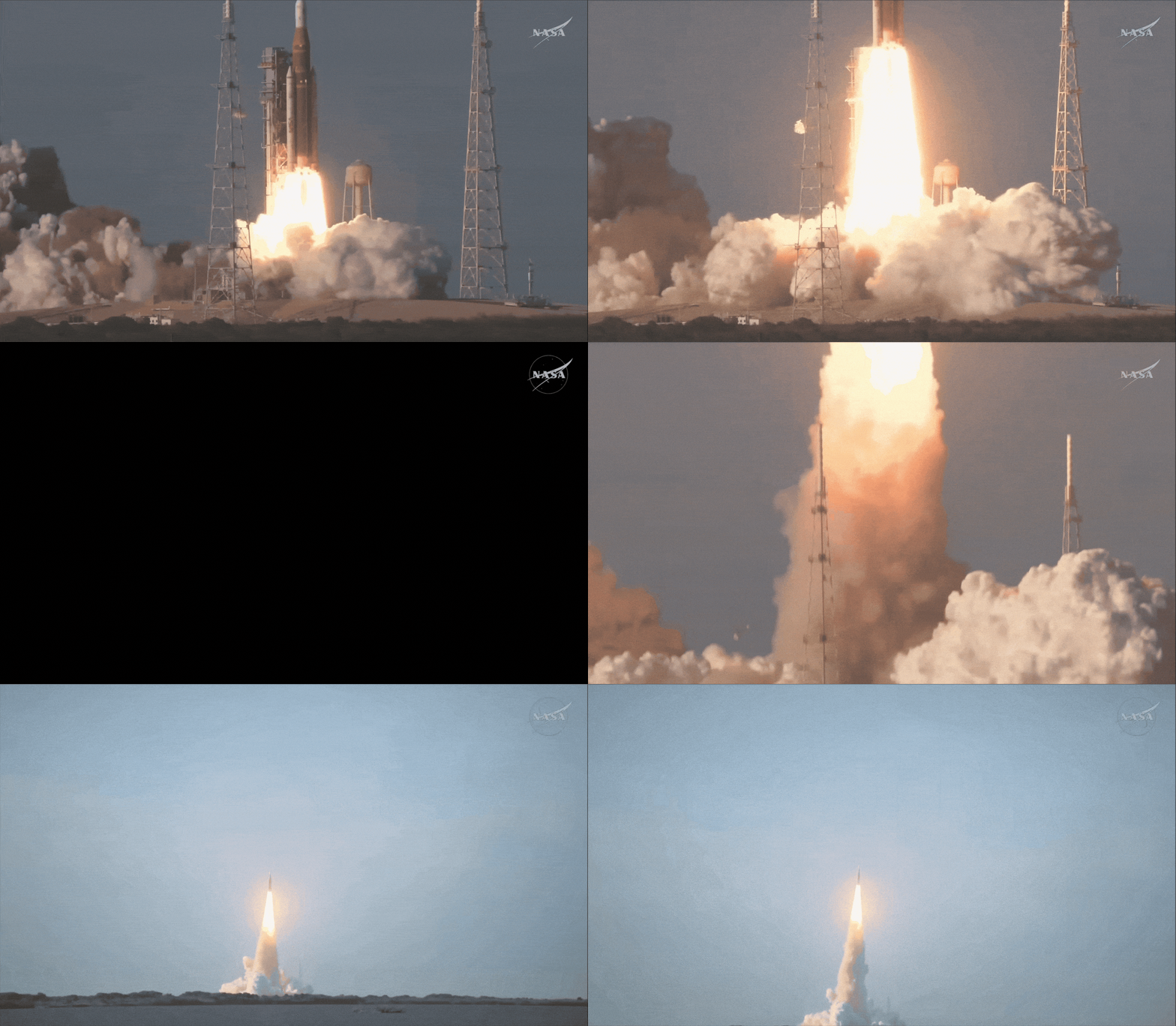
Artemis II Liftoff | Source: NASA
The Artemis II mission is significant, as it is the first crewed lunar flyby in more than 50 years.
To think about how far aerospace technology has advanced over the time frame, it’s hard to believe that it has taken us that long to return.
The Artemis II flight path will take the crew around the far side of the moon at an altitude of 3,000 to 9,000 miles, which means that the astronauts will venture further into deep space than anyone has ever gone before.
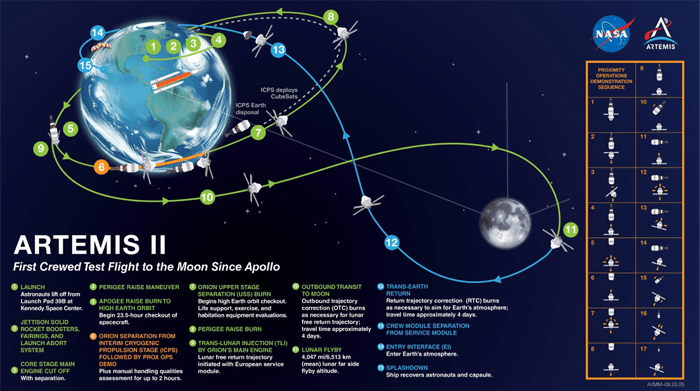
Artemis II Flight Path | Source: NASA
I have to say…
I have been nervous about this mission.
The NASA Space Launch System (SLS) has been an absurdly expensive program, under development for the last 15 years, with each launch costing more than $4 billion.
It’s an absurd sum, considering that SpaceX can accomplish the same mission for about 5% of the cost using a Falcon 9 Heavy rocket.
NASA’s SLS has also suffered years of technical issues and delays, primarily related to problems with the technology provided by its prime contractor, Boeing (BA).
For Boeing, and NASA for that matter, this is a do-or-die mission.
If there is a failure in Boeing’s technology or the spacecraft, not only would the astronauts’ lives be at risk or lost…
The logical outcome would be to shut down the program… and fall back on SpaceX to take over the core of the Artemis program.
It would be devastating in many ways.
For Boeing, and also for NASA, my concern would be for a further delay in the U.S.-led return to putting astronauts near the South Pole of the moon.
Which isn’t just an arbitrary achievement, as long-time Bleeding Edge readers know.
Time is of the essence here… and just days ago, significant changes were announced to the Artemis program.
The newly appointed NASA administrator, Jared Isaacman, is already affecting positive change at NASA…
The largest of which was the scrapping of a planned lunar orbiting space station, which was originally intended to be used as a waypoint between the lunar orbit and the surface of the moon.
The shift is to focus on a lunar base, which makes perfect sense.
A lunar gateway was operationally unnecessary and only added complexity and delay to the Artemis missions.
The revamping of the Artemis program also intends for NASA’s SLS to be phased out entirely by 2029… in favor of dramatically cheaper and more reliable launch services, offered by SpaceX and potentially Blue Origin.
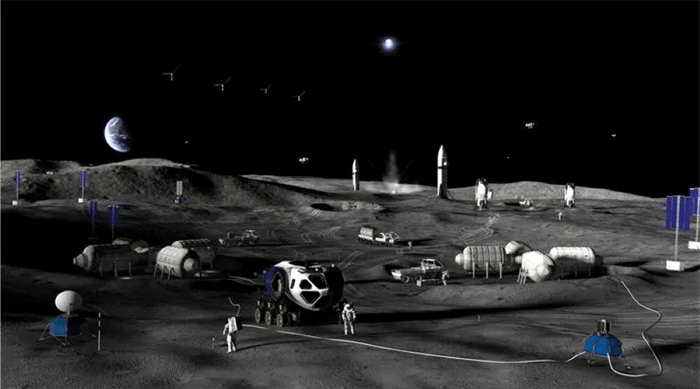
Rendering of a NASA Lunar Outpost | Source: NASA
Isaacman is taking a smart approach to revamping NASA, with the goal of having an increase in the number of flights and projects at NASA, while at the same time reducing the costs to do so.
This is not only possible, it is also proven with the use of private aerospace companies like SpaceX.
And as I said, time is of the essence.
With the U.S.’s number one adversary, China, on track with plans to land its own astronauts on the moon by 2030, Isaacman shares the sense of urgency to get there first… with a plan to put U.S. astronauts on the moon before the end of 2028.
The new plan is to conduct 24 launches from 2026–2028, up to 27 launches from 2029–2032, and up to 29 launches in 2033–2036 to build a fully sustainable lunar outpost.
Imagine that… a manned lunar outpost within the next six years.
It is no longer science fiction.
Building a manned lunar outpost is so obtainable and so realistic, as long as NASA leans on SpaceX and potentially Blue Origin.
Think about it, an average SpaceX Falcon 9 Heavy launch costs around $150 million.
That means that SpaceX can deliver about 26 launches to the moon, providing the foundation for the lunar outpost, for the same cost as a single NASA SLS launch.
And consider this: SpaceX will be launching rockets, on average, every three days throughout this year.
It has successfully made launching payloads into orbit as normal as you or I taking a commercial flight anywhere in the U.S.
I can only hope that the Artemis II mission goes to plan and returns the astronauts safely to Earth with a victory in hand. The stakes are too high to do otherwise.
Not only does the U.S. need the inspiration for young students to pursue studies in math, physics, science, and engineering…
We also need to gear up for the burgeoning space economy.
It will quickly become a multi-trillion-dollar economic opportunity that will help solve some of the biggest challenges here on Earth…
Like the availability of energy to fuel AI data centers, and the significant demand for Helium-3, a critical input to quantum computing and nuclear fusion on Earth, which is only in abundance near the south pole of the moon, a topic that we explored in The Bleeding Edge – What Could Possibly Be Worth $30,000 a Gram?
This is why the U.S.’s return to the lunar surface is so critically tied to the emerging technological advancements here on Earth.
The mission is one and the same – towards a world of abundance and limitless, cheap, clean energy.
This is the time to dream big.

Read the latest insights from the world of high technology.
A mistake like this would typically result in job losses, the loss of future funding, and the loss of...

The time to harden blockchain technology is right now.

To say that helium is a critical part of semiconductor manufacturing is an understatement. The industry can’t operate without...
Thanks for signing up for The Bleeding Edge — we’re glad you’re here!
Want updates sent straight to your phone too? Sign up for SMS alerts to get the latest delivered via text.
Brownstone Research: By submitting your phone number, you agree to our SMS Terms & Conditions, Terms of Use, & Privacy Policy, and give express written consent to receive marketing text messages from BSR. Messages are recurring & frequency may vary. Reply STOP to 94703 to opt out. Reply HELP to 94703 for info. Consent is not a condition of purchase. Message and data rates may apply. For additional information, you may contact Customer Service at 888-512-0726 or smssupport@brownstoneresearch.com.