
Block Is the First of Many
Last week, Block CEO Jack Dorsey announced that the company would be cutting its organization almost in half…


Tomorrow marks seven years since Google’s artificial intelligence from its DeepMind division – AlphaFold – shocked the entire life sciences industry.
In 1972, a winner of the Nobel Prize in Chemistry postulated that a protein’s amino acid sequence could be used to determine how a protein folds.
And understanding how a protein folds is the key to understanding how proteins work in our bodies, how they interact with compounds, and how misfolded proteins cause disease.
Understanding protein structures became one of the grandest challenges in life sciences and a five-decade-long problem of immense complexity…
Then AlphaFold came along.
Tomorrow marks seven years since Google’s artificial intelligence from its DeepMind division – AlphaFold – shocked the entire life sciences industry.
On December 2, 2018, the results of AlphaFold’s performance on the 13th Critical Assessment of Protein Structure Prediction (CASP13) were released, placing first in the field.
DeepMind’s AlphaFold was far from perfect at the time, but what made its benchmark remarkable was that it was DeepMind’s first submission, which was made by a team of computer scientists.
Those in the life sciences industry were stunned. The “win” at the top of the rankings came from such an unusual place. After all, DeepMind was part of Google (GOOGL) – the world’s largest advertising company – which had nothing to do with life sciences.
And yet, the CASP13 benchmarking was just a sign of things to come.
On November 30, 2020, the team at DeepMind had even bigger news to share. It again put forth its latest AI, this time its second-generation AlphaFold 2, with even more astonishing results.
AlphaFold 2 won by such a large margin with such incredible accuracy that the founder of CASP proclaimed that AlphaFold 2 solved the “protein folding problem.” It wasn’t even close. AlphaFold 2 scored a Global Distance Test (GDT) median score of 92.4 across all targets.
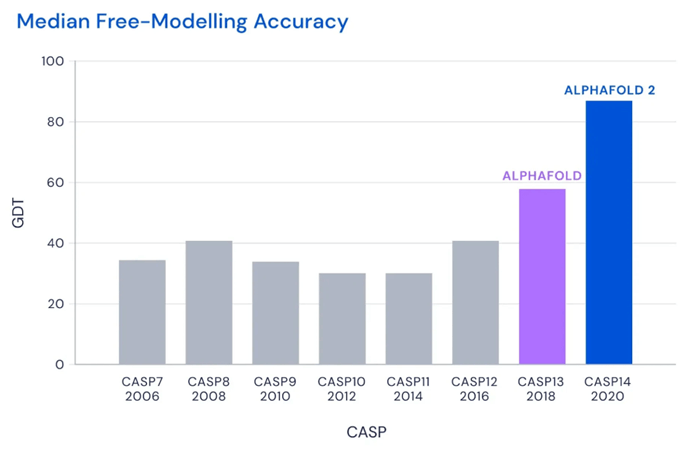
CASP Benchmark Winners Since 2006 | Source: Google
The accuracy was breathtaking. The average error was only 1.6 Angstroms, roughly the width of a single atom. The short clip shown below is a visual representation of AlphaFold 2’s remarkable accuracy.
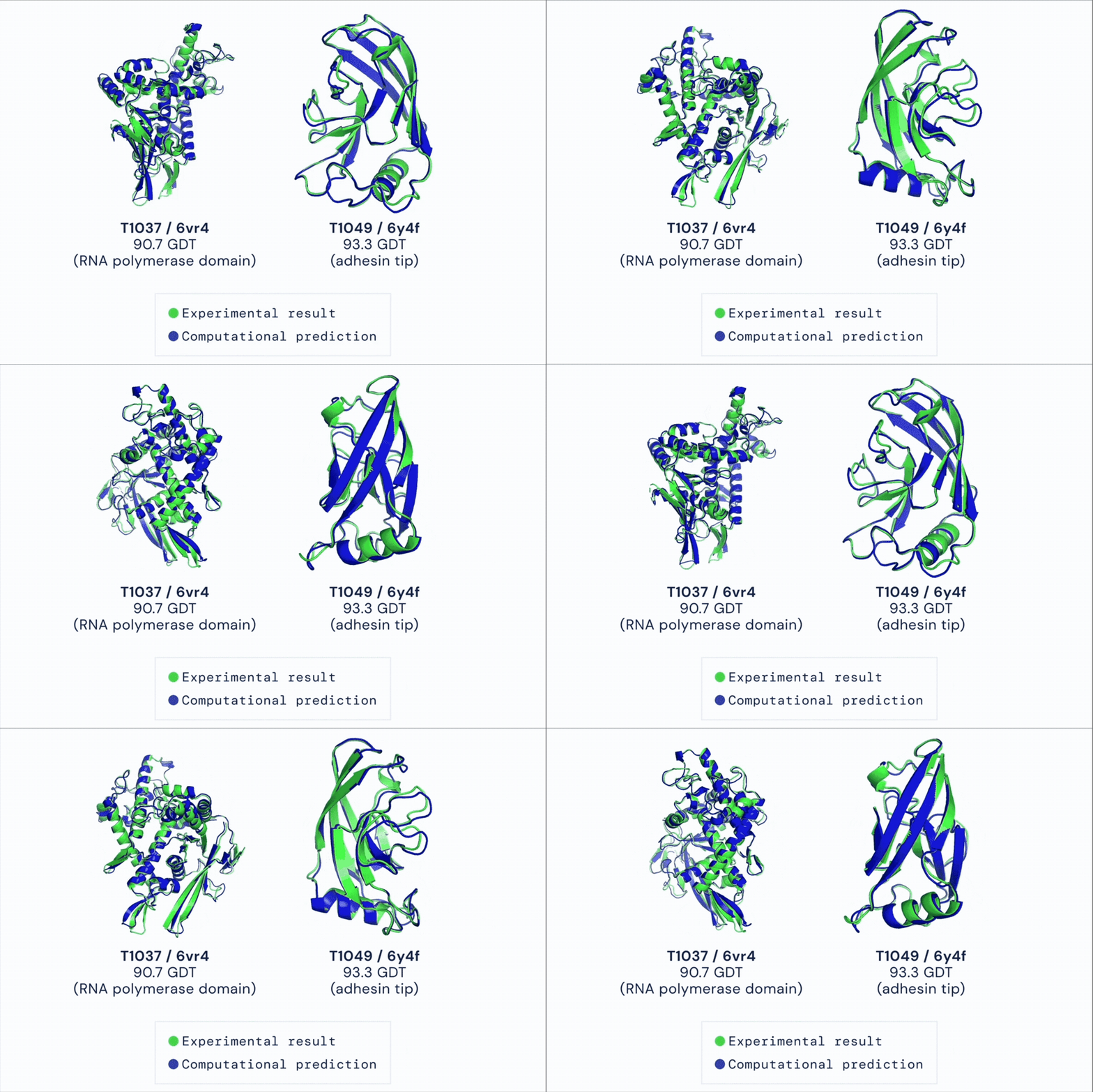
DeepMind’s Predictions vs. Experimental Reality | Source: Google
The implications of DeepMind’s success were profound.
The team at DeepMind simply used artificial intelligence (AI) to “learn” from a public protein database with about 170,000 known protein structures and combined that information with even larger databases of the amino acid sequences of more proteins and used that to produce the world’s largest and most accurate database of protein structures.
If computer scientists could use existing data to solve the greatest challenges in life sciences, just imagine what the technology could be used for in other industries.
Sure enough, DeepMind’s advancements were a precursor to what was to come, two years prior to OpenAI’s first release of ChatGPT, which brought to life the potential of AI to anyone with internet access.
After DeepMind’s submission and victory at CASP14, advancements only accelerated from there. By July 2021, DeepMind had partnered with EMBL European Bioinformatics Institute (EBI) to release AlphaFold DB, a database of more than 200 million protein structure predictions based on the output of AlphaFold2.
Accurate predictions of more than 200 million proteins would have taken hundreds of millions of years to achieve through manual experimentation… in other words, impossible. And yet, with the powers of deep neural network technology, a form of artificial intelligence, such an astounding accomplishment was possible in a matter of weeks.
Around the time of releasing AlphaFold DB, Google spun out a new venture from its DeepMind subsidiary, Isomorphic Labs, a computational biology company now privately valued at $1.79 billion.
Its mission is simple: To leverage the work done at DeepMind and solve all diseases by working at the intersection of biology and computer science.
That’s the outward message, of course, while the underlying mission of Google is actually to monetize the investments that it has made in research and development at DeepMind.
After all, Google is one of the most profitable companies in history, and it is ruthless in culling projects and people if it doesn’t see a path to profitability.
Many in the industry thought that DeepMind’s work was done in life sciences, but the team saw even more opportunity.
By May 2024, DeepMind partnered with the well-funded team from Isomorphic Labs and released AlphaFold3, an AI designed to accurately “predict the structure and interactions of all of life’s molecules.”
AlphaFold 3 was even greater in its ambitions, not just predicting the structure of proteins, but also those of DNA, RNA, and ligands. Plant, animal, and human proteins and molecules – it makes no difference. AlphaFold 3 can accurately predict them all.
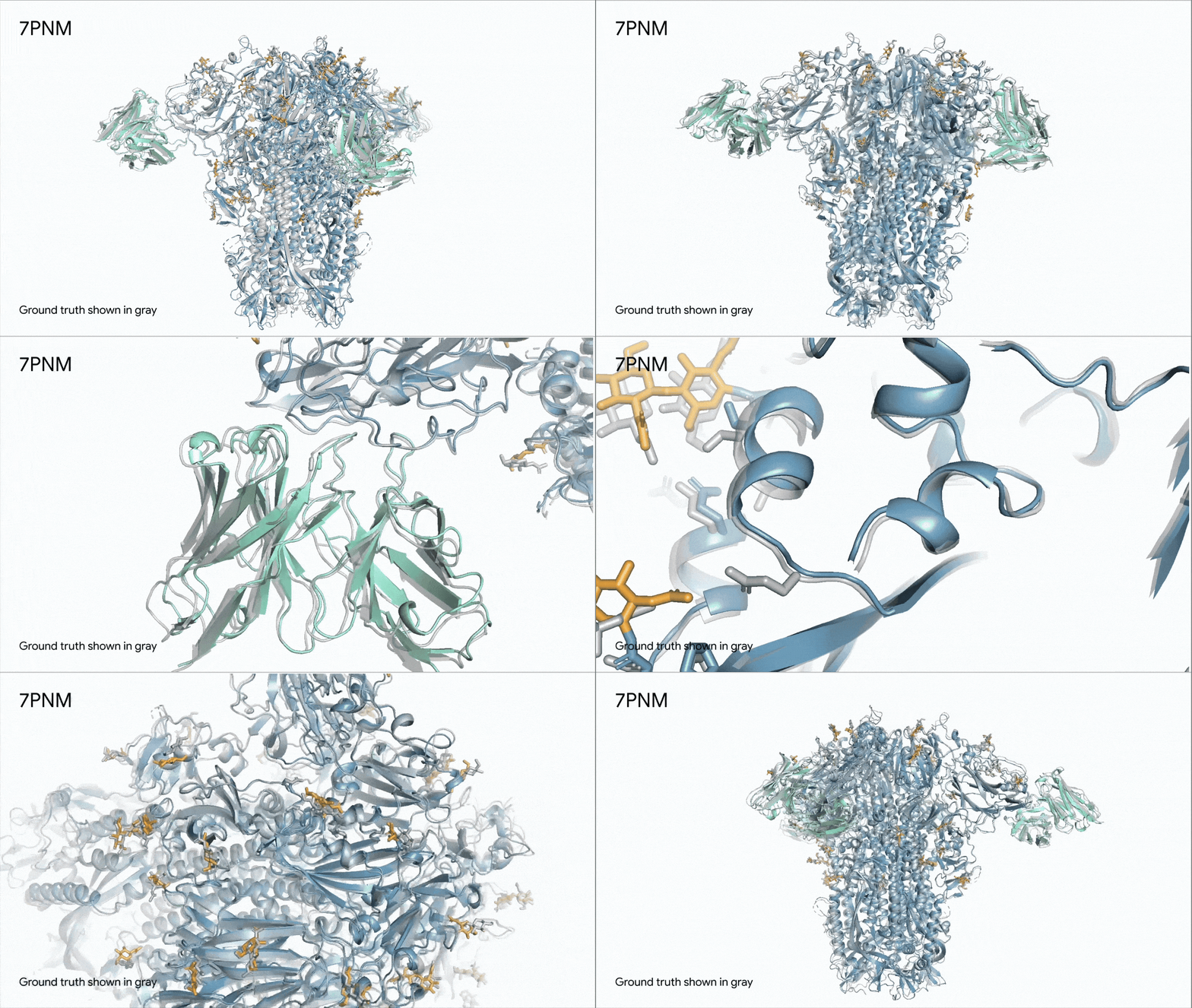
AlphaFold 3 Prediction of Spike Protein from Common Cold Virus | Source: Google
DeepMind and Isomorphic Labs also released the AlphaFold Server, free for all to access the wonders of AlphaFold 3’s predictive powers.
To most, it was a seemingly magnanimous gesture – a gift to humanity – until we understand that the use of DeepMind’s data is for non-commercial use only, with very strict and severe terms of service. Any violations of the terms of service can trigger legal action by Google if anyone tries to commercialize discoveries from the database.
The development and release of AlphaFold, however, earned DeepMind executives Demis Hassabis and John Jumper the 2024 Nobel Prize in Chemistry, symbolizing the significance of solving one of life sciences’ grand challenges.
Fast forward to today, seven years after the first submission of AlphaFold at CASP, DeepMind’s AlphaFold DB has been used by more than 3 million researchers in more than 190 countries. Extraordinary!
The impact that small team has had on life sciences and biotechnology would be impossible to overstate.
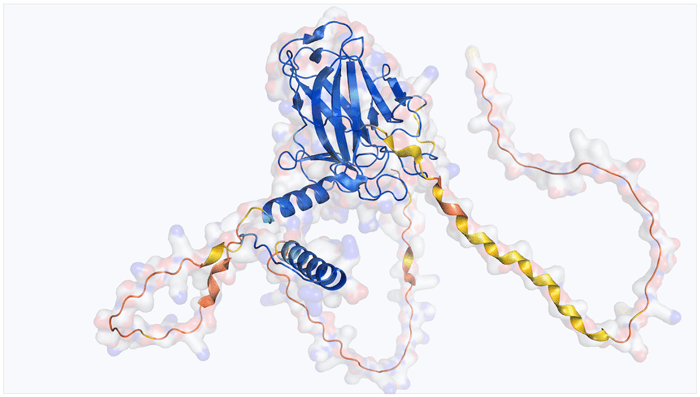
Prediction of p53 – a cellular tumor antigen – related to cancer | Source: Google
I’ve been tracking and writing about DeepMind’s work since the very beginning, from around the time that Google acquired the company, providing insights on DeepMind’s technology and the implications of this newfound knowledge and its future impact on the biotech industry.
With all this incredible progress and understanding of protein structure, the entire drug discovery and development process has accelerated. We would have thought we would be in a roaring bull market in biotech right now.
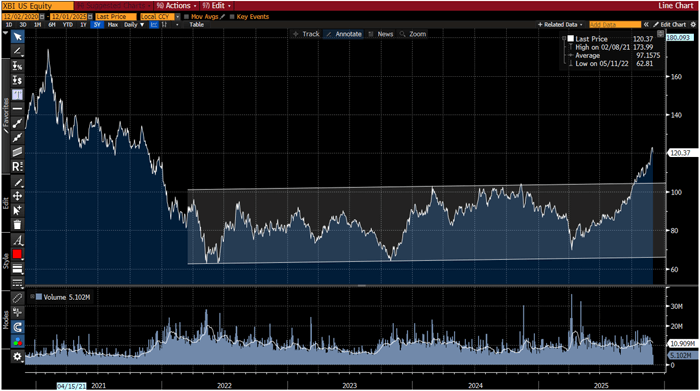
5-Year Chart of S&P Biotech ETF (XBI)
And yet…
From the peak of the S&P Biotech ETF (XBI) in early 2021, the index plummeted 64% into 2022, catalyzed by a scientist/politician-caused pandemic, which induced the biotech bear market that lasted four painful years.
But as we can see above, there is very good news. XBI has clearly broken out of its channel of the last three-plus years this quarter. And interest rates have finally started to drop, which is necessary for the early-stage biotech industry to see inflows of institutional capital into small-cap biotech stocks.
Clearly, with the changes scheduled to happen in early 2026 with the replacement of Powell as the Chair of the Federal Reserve, we’ll have the last piece of the puzzle needed to unleash the biggest bull market in biotech history.
If that wasn’t enough, DeepMind has also released:
The industry now has all of the tools it needs for accelerated drug discovery. And Google’s DeepMind has shown the way for other companies to develop their own neural networks using similar databases of known life sciences data.
This, combined with an interest rate-lowering cycle that will last for the next couple of years, and structural improvements being made at the Food and Drug Administration – some of which are AI-enabled – will make it dramatically easier and faster for safe and effective therapies to get through the FDA clinical trial process to start saving and improving the lives of those suffering from disease.
2026 is the beginning of the golden age of biotech.
This will be a major priority for us at Brownstone Research over the next few years.
Jeff

Read the latest insights from the world of high technology.
Last week, Block CEO Jack Dorsey announced that the company would be cutting its organization almost in half…
We can’t provide any personal investment advice, but we can use a question as an example of how to...
Even with all of the excitement happening right now with AI, the 2026 hyperscale spending on AI infrastructure still...
Thanks for signing up for The Bleeding Edge — we’re glad you’re here!
Want updates sent straight to your phone too? Sign up for SMS alerts to get the latest delivered via text.
Brownstone Research: By submitting your phone number, you agree to our SMS Terms & Conditions, Terms of Use, & Privacy Policy, and give express written consent to receive marketing text messages from BSR. Messages are recurring & frequency may vary. Reply STOP to 94703 to opt out. Reply HELP to 94703 for info. Consent is not a condition of purchase. Message and data rates may apply. For additional information, you may contact Customer Service at 888-512-0726 or smssupport@brownstoneresearch.com.