




The Next Automation Revolution
In this issue, we dive into the next great leap in automation brought on by advanced physical artificial intelligence...



It’s a good time to take a break, sit back with friends and family, enjoy a nice fire or two, and let the volatility pass.

This year has certainly felt like a sprint from January 1 to Thanksgiving week.
And the last couple of months have been full of volatility and craziness. Much of it is artificial and unnecessary, but we get buffeted, nonetheless.
It’s a good time to take a break, sit back with friends and family, enjoy a nice fire or two, and let the volatility pass.
And it will. Fundamentals are so strong. The economy is so strong. And investment planned for 2027 are at record levels.
Next year will be a phenomenal year, and institutional capital will be leaning into equities, especially as interest rates come down. And they will come down.
To my U.S.-based subscribers, I hope you have a wonderful Thanksgiving holiday, and to those subscribers around the world, I wish you a wonderful holiday season.
We have so much to look forward to,
Jeff
I do have a question for Jeff, though. I don’t know whether he ever takes input or not, but I’m just curious.
Cerebras [has been positioned] almost like a retirement account stock. And then just recently, a short seller has been saying that the books are cooked. They’ve got phony-baloney going.
I’m just curious whether he’s gonna address that and [if he thinks] it’s true or if the short seller, as often is the case, is misrepresenting the truth.
– Stephen L.
Hi Stephen,
Yes, I always take input and feedback, and always try to go to extremes in terms of maintaining objectivity with all my research. And whenever I have a preference for something or am making a prediction, I state that as well.
The most important fact to understand about Culper and their ilk is that they establish their short positions in stocks first, and then they publish supporting research, go on TV, or publish on the internet with the intention of driving those stocks down.
And when/if they are successful, they close out their positions for a profit and don’t tell anyone that they have done so.
Below is a snippet from Culper’s website – its disclosure. If you’d like to read the entire disclosure, you can find it here…
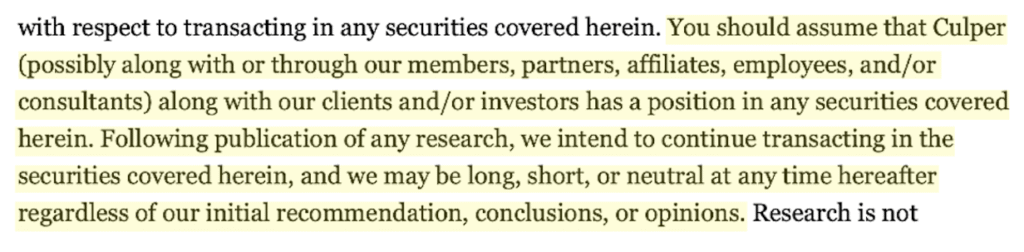
Source: Culper Research
Culper Research is just like Muddy Waters, Hindenburg, or Citron Research. And it’s worth mentioning that Andrew Left – the trader behind Citron Research – was found guilty of securities fraud this summer, convicted on one count of securities fraud scheme and 12 counts of securities fraud. He now faces up to 25 years in prison.
Culper itself has faced multiple defamation lawsuits over the last five years alone. And given its business model, we always need to take research from an outfit like this, with a clear conflict of interest, with a grain of salt.
The key falsehood that the clowns at Culper built their entire short thesis upon is that Cerebras’ CS-3 wafers would only last 1.4 to 2.3 years in the field, and therefore Cerebras’ own depreciation models are wrong.
Unfortunately for Culper, that assumption is flat out wrong, as is its short case.
About 30% of Cerebras’ business is offering cloud-based services to its customers, and that side of the business is growing rapidly.
In that way, Cerebras is not only a semiconductor company, but also a cloud services provider (of its own technology). Therefore, it uses a depreciation of three to five years for its wafers, which is absolutely standard for artificial intelligence-specific semiconductors.
Many wrongly assume that AI semiconductors will only be used for two or three years before being discarded for the latest generation. This is fundamentally wrong.
We’ve already seen this play out in the industry, where not only are NVIDIA’s complex GPUs being used for more than five years, but the rental prices for those GPUs have actually been increasing because of the sheer demand for those computational resources.
Even SpaceX designs its Starlink and future Starmind satellites for five to seven years of operation before deorbiting. That is because they still have useful life to that timeframe.
Culper represents one of the things that I dislike the most about Wall Street. They build their positions quietly, and get their clients in too, and then they go on a public campaign to push the stock in the direction that will result in a profit. And they do it at the expense of retail investors. I really hate to see that, but it happens all the time.
It’s important to always understand the financial motivations of the investment bank, or short-selling research firm, that is telling us which direction a stock is going.
If we see it on the internet or see a representative on CNBC, we can be sure that they and their clients are already positioned.
I was thinking that maybe it would be a good idea to offer your followers a chance to trade the same stocks and suggestions that you do. I sincerely doubt you are suffering the consequences of the election that we are. Just saying. I’m not going anywhere and will continue to be a lifetime subscriber forever, but my goodness, this is ridiculous.
– Andrew S.
Hello Andrew,
Thanks for writing in, and I know that you know I have a no conflicts of interest policy. And you might be surprised to know that I hold very few publicly traded stocks. The truth is that the stocks that I would want to own are precisely the stocks that are in our model portfolios at Brownstone Research.
And in my current capacity as the CEO of Brownstone Research, I devote almost every waking hour to research for my subscribers. I simply don’t have the time to be an active trader. The vast majority of my personal investments are made in private companies where there is no risk of conflict of interest.
I like to focus all my energy on my investment and trading research that we publish every day at Brownstone Research.
To answer your question specifically, yes, the very limited public equities that I do hold are down with the rest of the market. So yes, I’m “suffering the consequences” of the current market volatility as well.
And I’m not worried. This current pullback had origins this summer when we saw the bout of fear that there was an AI bubble. That turned out to be nonsense as hyperscalers kept increasing their capital expenditure (capex) projections and AI-related tech companies continued to deliver record results.
This latest bout started leading into the midterms with family offices and institutional investors stepping to the sidelines because projections were that the Democrats would take control of Congress. That’s what happened, and we’ve seen the impact on the market.
And then this evil and intentionally fabricated story designed to take down Jensen Huang and NVIDIA added fuel to the fire. I discussed this coup in The Bleeding Edge – NVIDIA’s Board Got Played, as well as his justified reinstatement in The Bleeding Edge – A $1 Trillion Vindication.
The recent volatility is not built on fundamentals. There are a lot of shenanigans going on right now, and they are temporary. Incredible companies like NVIDIA, Micron, and so many others are so cheap right now, and they continue to deliver record results, quarter after quarter.
And more importantly, capex on the AI infrastructure buildout and reindustrialization of the U.S. economy will continue to push even higher in 2027.
This pullback – and that’s all this is – will be short, and the market will be much higher by Q1 of next year.

During “Phase I” of Elon Musk's "M.A.G.I." you could have made 360x your money on Jeff Brown's calls. Jeff now says Musk's new Texas filing sets “Phase II” in motion. In his new strategy session, he shows you how to prepare. Click To Watch It Now While It's Still Online

Everyone knows Warren Buffett as a world-class stock investor… Almost nobody knows the “side strategy” he used to collect $4.9 billion without guessing which way the market would go. Larry Benedict does. He used a similar strategy at his hedge fund for years. And now he’s demonstrating a rapid-fire, same-day version that anyone can try. [Get the Full Details Here]
Greetings Jeff and Team,
Recently, my medical insurance carrier sent out a campaign promoting Cologuard for colon cancer screening, including email, text, and a physical mailing. Shortly after, I received an unsolicited testing kit in the mail.
The info sheet included in the kit noted that part of the test involves DNA screening. While the campaign frames this complimentary screening kit as non-invasive preventative testing – which I generally support in the abstract – it raises a question for me: Is this a genuine benefit, or a disguised effort to collect DNA data with cancer screening as merely a side benefit?
This situation highlights a conflict I often face with modern diagnostic tools:
- The desire for data: As a data-driven person, I want actionable health metrics, mapped DNA, and personalized insights to optimize my well-being.
- Privacy concerns: I am deeply cautious about how my personal information and health metrics are stored, shared, or potentially exploited by tech companies, insurance companies, hackers, governments, and others.
This illustrates a clear dilemma for me: whether the results I receive provide enough benefit to outweigh the privacy concerns.
The same dilemma applies with wearable monitoring devices, DNA mapping, and really any other scan or screen. It also brings up the broader dilemma of the future of health and medicine.
On one hand, effective AI models and diagnostic tools require comprehensive data, and withholding my data could hinder the accuracy of diagnoses for my demographic, not to mention that I would not find out about any potential issues through that particular testing avenue. On the other hand, participating feels like a significant privacy risk, even though I may get valuable insight into my health in the bargain. It is a conundrum.
Back to the original question: what do you think is the true purpose of this screening campaign? The insurance carrier has clearly shelled out a fair bit of money for this campaign.
At the face level, the number-crunchers likely have determined that early detection on enough subscribers may not only save some lives, but also would save the insurance carrier a lot of money.
There may be additional levels of diagnoses, testing, or treatment that would be informed by this screening, or an if-this-then-that scenario that is not immediately obvious to the subscriber. From there, as evidenced by the question posed in my first paragraph, my hypotheses turn dark and cynical, and I will refrain from further articulating them here.
I look forward to your thoughts on the matter!
– Christen P.
Hi Christen,
I am 100% with you and share all of your concerns. Let’s look at your specific example of Cologuard first, and then we’ll step back at the bigger picture.
Cologuard is a product of Exact Sciences, which was acquired for $21 billion in November 2025 (closed in March this year) by Abbott (ABT).
Insurers and some health systems partner with Abbott to market these diagnostic kits to their population that fits the diagnostic test and is eligible for insurance coverage. Abbott’s incentives are clear. They benefit from increased volume of the diagnostic kits.
The health systems also benefit because they see increased transactions through their healthcare system. Patients who discover something will come in to see a doctor and determine a path of treatment if necessary. And insurers can save large amounts of money by catching a disease early. Early detection and polyp removal are relatively cheap. Dealing with late-stage colorectal cancer is very expensive for the insurance company.
So, there are healthy economic incentives in place for all parties to market these kits, and early detection results in better outcomes for patients.
With regard to the DNA testing, in the case of Cologuard, it only looks for specific mutations in a patient’s DNA (i.e., cancer-related markers) and then disposes of the sample after testing.
In general, this is true for most tests. Running a DNA test on specific markers is far cheaper than performing a DNA sequence on someone’s entire DNA. Specific diagnostic tests like these are just designed to get precisely the information needed to produce the desired diagnostic result.
There are, however, companies that perform entire DNA sequencing and analysis for our DNA, like Human Longevity. Obviously, they keep your DNA on file, as it assists in their treatment of any known conditions, or expected future conditions based on certain identified genetic mutations.
There are companies out there that use DNA sequencing for the purpose of analysis and training and AI to identify and match phenotypes and diseases to genetics.
These companies tend to remove the patient’s name and any personal identifiers from the DNA sequencing results. Their goal is to extract learnings and insights on a population basis, not at a patient level.
From my perspective, there is no way to ensure that the healthcare system is going to protect our privacy at all costs.
If I learned anything from the manufactured pandemic, it was how deeply corrupt the healthcare system really is, and how individuals and institutions that are supposed to be prioritizing patients would lie, cheat, and steal for money.
And yes, to your point, there are evil forces at work. There are people and entities that genuinely believe in the need for depopulation of the Earth. Or those who want to inject experimental drugs into our bodies for their benefit, not ours, etc.
So, I always remain on my toes with anyone in healthcare and always perform my research before any appointments. My solution is to be as well informed as I can. Sometimes it leads to some uncomfortable discussions with doctors when I ask informed questions, but the process also helps me sift through those I can trust and have open conversations with and those I cannot.
And like you, I am very data-driven, so I proactively use diagnostic tests of all sorts to get a current understanding of my health and better inform my future decisions on treatment.
I hope that helps you in your conundrum.
Here’s to your health,
Jeff
Add Brownstone Research as your preferred source on Google to see our latest stories in your feed.
 Add as a preferred source
Read the latest insights from the world of high technology.
In this issue, we dive into the next great leap in automation brought on by advanced physical artificial intelligence...

Bitcoin continues to follow the trend it’s been tracking throughout its history.

Many of us don’t realize how dependent we are on big, centralized systems. We don’t think about it because,...