


The Burgeoning Space Economy
The Artemis II team has now traveled farther from Earth than any humans in history…


After an incredibly busy 2025, let’s take a look at how Jeff’s predictions for this year have panned out…

At the very beginning of this year, I shared a very sober yet optimistic outlook for 2025.
It was definitely not an outlook shared by all.
After all, we began the year with inflation running rampant, U.S. national debt growing exponentially – something I referred to as “The Wrong Kind of Exponential Growth” – war and conflict, vast censorship, high interest rates, and an untenable cost of living for most of the population due to soaring prices.
Many, if not most, believed that the U.S. economy would be in trouble this year with widespread job losses and a suffering U.S. stock market.
Those fears were further stoked and amplified when President Trump implemented tariffs on trade partners, triggering a market panic and pulling down the S&P 500 by nearly 19% from its February highs.
I saw something very different.
During the time of the tariff levies, I explained that the tariffs were simply a tool for negotiation – to bring trade partners to the table in order to put in place more balanced trade agreements… quickly.
And that’s exactly what happened.
One after the other, new trade deals with trading partners were announced that were highly beneficial to the U.S. economy and the stock markets. The chart below says it all.
1-Year Chart of the S&P 500 Index
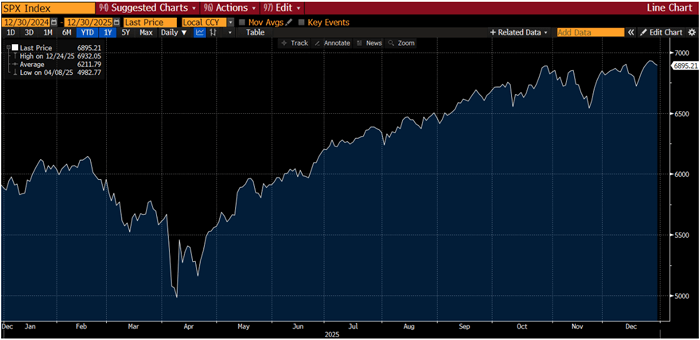
The S&P 500 jumped 38.5% from its April lows and is up 17.3% since January 2.
It has been a fantastic year for the markets and for investors.
This is especially true for my Near Future Report and Exponential Tech Investor subscribers, who have seen extraordinary returns at or beyond those of the very best-performing hedge funds.
My key predictions at the beginning of the year that informed my bullish stance on 2025 were as follows:
Except for just one prediction, I don’t think I could have been more accurate.
Artificial intelligence (AI) and its related technologies were literally responsible for almost all of the U.S. economic growth in 2025.
In the first half of the year, AI was responsible for 92% of economic growth – 92%!
This will absolutely be the case for the full year of 2026, as well.
Throughout the year, my team and I have consistently provided the most bullish forecasts for AI spending that I’ve seen anywhere…
If anything, I feel like I ended up being a bit conservative considering the scale of the investment that has been made toward and committed to AI infrastructure development.
Biased journalists did their best to suggest that the AI boom was “propping up the economy,” as if the investment was just a mirage.
But they were then – and still are now – missing the point.
The investments and research in artificial intelligence – which are leading to artificial general intelligence (AGI) – are resulting in the largest productivity increases in history… and this is just the beginning.
The U.S. economy has experienced the beginning of a radical restructuring into an AI-powered, techno-centric juggernaut that will lead to the largest economic growth ever seen.
What’s coming will make 2025 look like we were just learning how to ride a bike with training wheels.
But we’ll leave that look ahead for tomorrow, January 1, 2026.
My prediction about the rapid regulatory shift, fortunately, turned out to be spot-on as well.
I had thought long and hard about that prediction, because regulatory changes tend to take years and are painfully slow.
But to jump-start the economy and accelerate investment, major regulatory changes were the most obvious tool to get industries investing again.
Here’s what happened in support of my predictions:
The above list is just a snapshot of U.S. initiatives taken to support this regulatory shift that I predicted.
The positive impacts on the economy, domestic investment, and the stock markets were material, tangible, and will build the foundation for accelerated economic growth in 2026.
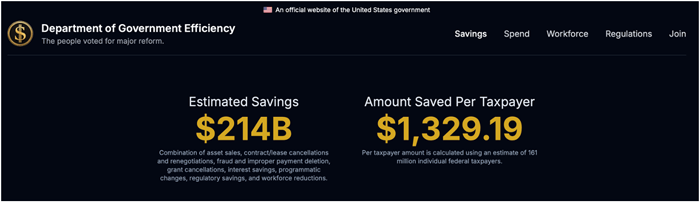
As for the Department of Government Efficiency (DOGE), it was the one major prediction I got half wrong.
The short-term savings prediction of $250 billion was actually quite close.
At $214 billion and growing, it may be just a couple more months before $250 billion in savings has been reached.
Source: Doge.gov
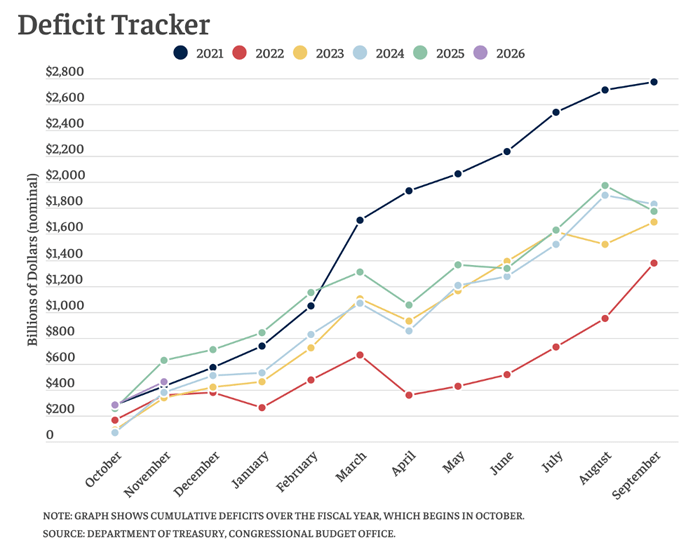
The one thing I got wrong was the forecast that DOGE would lead to a $1 trillion reduction in the 2026 fiscal deficit (for the year starting October 1, 2025, through September 2026).
Perhaps it was wishful thinking, but the current fiscal year spend is tracking at a very similar level to past years, like 2024, albeit below the 2025 fiscal year, which ended this September.
Source: Bipartisan Policy Center
This was a disappointment for sure.
And I would say that the weight of the disappointment increased throughout the year, as we learned of massive Medicaid fraud in Ohio… Child Day Care Center Fraud in Minnesota… and other medical fraud in Minnesota… just to name a few. There are actually too many to mention.
And based on DOGE research on fraud this year, Elon Musk estimates that the lower bound of annual federal fraud in the U.S. is $1.5 trillion.
It pains me to think about that.
If we could get rid of fraud in U.S. government programs, we could literally eliminate the U.S. deficit and put a halt to the growth in U.S. debt. Problem solved.
That gives me hope for the next few years, though…
Acknowledging the theft of taxpayer dollars enables the opportunity to clean up the mess and right the ship.
Objectively, I have to acknowledge that had $1 trillion been removed from the 2026 fiscal deficit, there would have been negative economic implications.
I’m certain that this was part of the logic in delaying the cuts.
If they wait until the economic growth expands even further, it will be a better environment to make the improvements in the fiscal deficit in fiscal years 2027, 2028, and 2029.
As for my predictions concerning the Centers for Disease Control and Prevention (CDC), National Institutes of Health (NIH), and Department of Health and Human Services (HHS), they were extremely accurate.
By February, Robert Kennedy Jr. shifted entirely to evidence-based approaches to health that were implemented with very tangible changes.
Kennedy made sweeping changes by restructuring the HHS, getting rid of bloat and inefficiencies, resulting in a $1.8 billion annual savings to taxpayers.
The Department has since been refocused on evidence-based medicine and evidence-based interventions to address the root cause of any illness.
At a practical level, with the help of NIH Director Jay Bhattacharya, the emphasis has shifted toward enhanced reproducibility in research and real-world data and streamlining the approvals for drugs and therapies.
HHS has also implemented the fast-tracking of drugs for rare diseases, which has already increased investment in gene and cell therapies in this area.
The FDA introduced Platinum-Standard Science in an effort to streamline research and development for biosimilars and improve the quality and efficacy of related therapies.
And the new team also began the process of reviewing the safety, efficacy, and side effects of the entire vaccine schedule in the U.S. This was long overdue.
It is critical to take a fresh, objective view, understand the risks, uncover the corruption, and put human health first based on evidence and real-world health outcomes, not the profits of the biopharmaceutical complex.
The kind of work takes time, but it is already yielding results, and it will lay a framework that will benefit the biotech industry for new drug and therapeutic development in the next few years.
The timing is incredible.
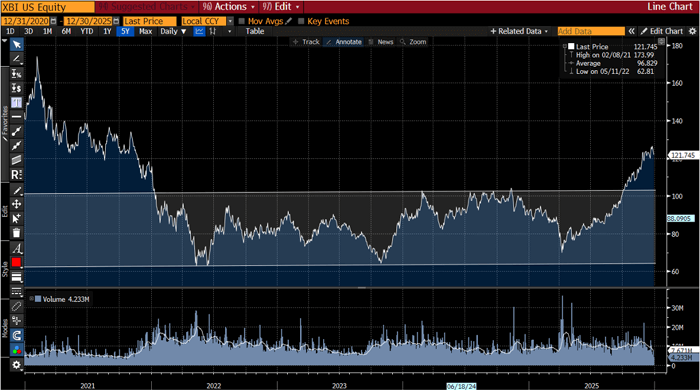
We can see the positive impact on the biotech industry in the breakout of the 5-year chart of the XBI equally weighted biotech index below…
5-Year Chart of XBI
As for interest rates, this prediction also turned out to be spot on, contrary to prevailing opinion at the time.
At the beginning of the year, I said:
I wish I could be more aggressive with my prediction of U.S. interest rates. But it will take some time for the fiscal and economic policy changes to tame inflation. The larger cuts will come in 2026, which will be an even better year for the economy and the markets.
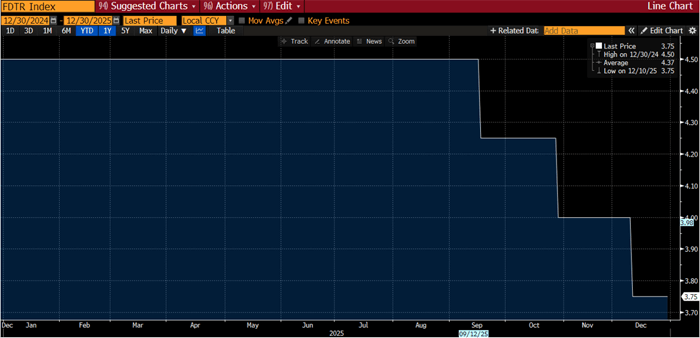
And my prediction that we would see a 50-75 basis point reduction, mostly in the second half of the year, is exactly what happened.
We can see the 75-basis-point reduction in the chart below, dropping from 450 basis points (4.5%) to 375 basis points (3.75%) this December.
More to come in 2026…
This year was nothing short of a groundbreaking, mind-boggling year of developments in artificial intelligence.
I’m very proud to say that I’ve been ahead of every major development in AI for the last decade.
I leaned in heavily in early 2016 when I was pounding the table to buy NVIDIA, which I framed as a foundational AI company, not a gaming company. No one else saw that back then.
Brownstone Research subscribers were extremely well-positioned in AI stocks over the last two years, as I consistently predicted that the investment levels and AI “boom” that was taking place were still growing.
Subscribers made fortunes along the way, which makes me very happy.
At a high level, I predicted:
2025 will be the year of agentic AI technology.
These AI agents will be capable of reasoning and solving tasks that require multiple steps to complete. Agentic AI will be capable of transacting on behalf of anyone. The technology will be able to interface with the internet and fill out fields to complete assigned tasks.
This technology will extend even further to the blockchain industry, where AI agents will be capable of managing smart contracts and engaging in self-directed economic activity.
This is exactly what happened in the industry.
Agentic AI is such a good representation of what will become “general intelligence.”
Agentic AI is capable of advanced reasoning, conducting multi-step tasks to achieve a desired outcome, and doing everything with little to no human intervention.
This is what our world will soon look like with every step we take closer to AGI.
A simple text or verbal prompt will set off a string of actions all managed by our AI, kicking off a productivity boom unlike anything we’ve ever seen before, and also dramatically improving our quality of life.
Software from Cursor, Windsurf, OpenAI, xAI, and Anthropic has already completely revolutionized software coding and development environments.
I’ve never seen an entire industry (i.e., software development) adopt a new tool as quickly as what has happened with AI for coding.
Agentic AI has also been widely adopted in the legal industry for drafting contracts, performing legal research, case summarization, and even compliance checks. The productivity improvements have been incredible.
VISA and Mastercard began to use agentic AI technology applied to e-commerce transactions.
Stripe and OpenAI’s Agentic Commerce Protocol enabled agentic AI-driven shopping and payment applications.
And Shopify began to employ agentic AI for filling out forms and completing payments for merchants linked to its platform.
Even Google jumped into the fray with its Agent Payments Protocol (AP2) for e-commerce and shopping.
We’ve only just started to see what this will mean for consumers.
In the blockchain industry, I spent a lot of time this year positioning subscribers of my buy-and-hold digital assets research service, Permissionless Investor, for the agentic AI trend incorporating blockchain technology.
My subscribers were way ahead of this trend.
This year, about 4.5 million daily unique digital wallets linked to AI decentralized applications.
Agentic AI has been used for managing smart contracts, for decentralized finance (DeFi) yield optimization, portfolio management, and automated trading.
AI agents are now able to conduct self-directed trading, some of which have become tokenized and investable.
The cross-section of AI and blockchain technology was particularly powerful.
I also predicted…
We’ll see the equivalent of genius-level IQs from the foundational models of OpenAI, Anthropic, Meta (Llama), Alphabet (Gemini), and xAI (Grok). And the outlier – the big surprise in 2025 will be from Elon Musk and his team at xAI.
This was 100% accurate, as evidenced by all the benchmarks that I’ve been writing about in The Bleeding Edge this year – showing the PhD-level performance of various frontier AI models.
The capabilities are simply incredible, and every month of this year we witness performance records being broken.
I also made a very bold prediction:
I’m also predicting that we’ll see something pretty close to AGI before the end of 2025. I’ll go so far as to say that at least some in the industry will claim that it has been achieved. It will be contested, but it’s going to happen.
We are definitely close.
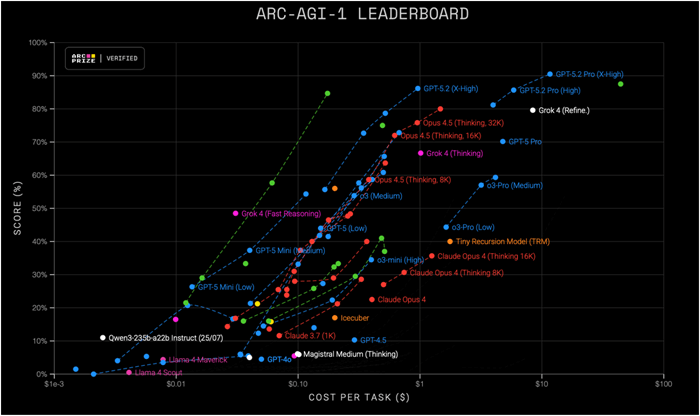
Just this month, OpenAI’s latest GPT 5.2 Pro model scored about 90% on the original ARC-AGI-1 benchmark, as shown below.
Source: Arc Prize
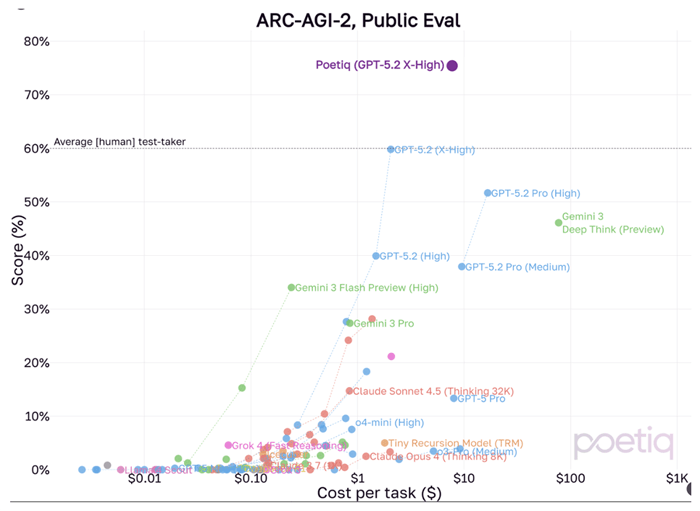
And just days ago, Poetiq – using a version of OpenAI’s GPT 5.2 – blew all previous efforts out of the water on the ARC-AGI-2 benchmark, achieving 75% at a lower cost than some of the leading attempts.
What makes this such a big deal is that it is 15 percentage points higher than the second best, it leverages technology that already exists, and it is far above where the average human test taker is benchmarked.
Source: Poetiq
This development has happened while most have been checked out for the holidays.
It is a huge deal that is predictive about what is to come in the weeks ahead.
Dario Amodei, CEO of Anthropic, recently said that AGI could arrive as soon as 2026. Months ago, OpenAI CEO Sam Altman coyly said that AGI could come “pretty soon.” And AI researcher Derya Unutmaz gave AGI a 90% chance of being achieved by the end of this year.
There are plenty of rumblings about it happening already. And there are also a lot of naysayers, as I predicted.
But we are getting very, very close.
I also predicted that xAI’s Grok would outperform the rest of the industry. Most of the industry and the media continue to pretend that xAI doesn’t exist. It’s comical.
And yet, xAI seemingly came out of nowhere, and it’s made more progress on AI and AGI than any other player in the industry.
With every new release of xAI’s Grok, new benchmark records were shattered.
No company in the industry made more progress building physical AI infrastructure or developing its AI as much as xAI did in such a short period of time.
xAI’s pace is breathtaking in every endeavor…
Whether it is multi-modal AI, infrastructure, Grokipedia, text to image, text to video, AI-enabled coding, speech synthesis, it doesn’t matter.
xAI dominated this year.
Regular readers of The Bleeding Edge will know how passionate I am about autonomous technology.
Applied to any robotic form of manifested AI, this technology will be what transforms our entire economy.
Applied to humanoid robots, a fully autonomous intelligent machine will be able to navigate the real world and fill just about any labor shortage we can think of.
Applied to robots on wheels (i.e., intelligent electric vehicles), this technology will transform both the personal transportation sector as well as the public transportation sector – by driving the cost of personalized point-to-point public transportation down to levels at or below today’s public transportation.
One of the biggest developments of the year was this month’s release of Tesla’s full self-driving software (FSD) version 14.2.2. It integrates xAI’s Grok with Tesla’s FSD navigation.
I’m not kidding when I say that I don’t drive anymore. I get in my Tesla, I tell Grok where I want to go, I press one button on the screen, “Start Self-Driving,” and then I arrive at my destination. FSD even parks the car.
And when I tell Grok to “take me home,” that’s exactly what happens.
It’s not an exaggeration to say that FSD now feels “sentient.”
I’ve been driving since I was 16 years old without an accident, and I can honestly say that FSD is now a better driver than I could ever be.
It sees 360 degrees around the car in real time and sees things coming that no human driver could see.
And its response times are far faster than mine.
Here’s what I predicted at the beginning of the year…
2025 will also be the year when we experience Level 5 autonomous transport without any geofencing, entirely driven by vision models. This is different than Waymo, Cruise, or others that are heavily dependent upon LIDAR and require very precise maps allowing them only to operate in geofenced areas.
And there is only one company capable of this technology – Tesla.
This year will be the first year when we experience unsupervised full self-driving technology. Unsupervised means that no one will have to sit in the front seat and monitor the full self-driving software for safety. Tesla will succeed in “turning on” this technology in at least one U.S. state this year.
This will also enable Tesla to launch a robotaxi network, enabling Tesla owners to opt their Teslas into the network, enabling their electric vehicles to earn income.
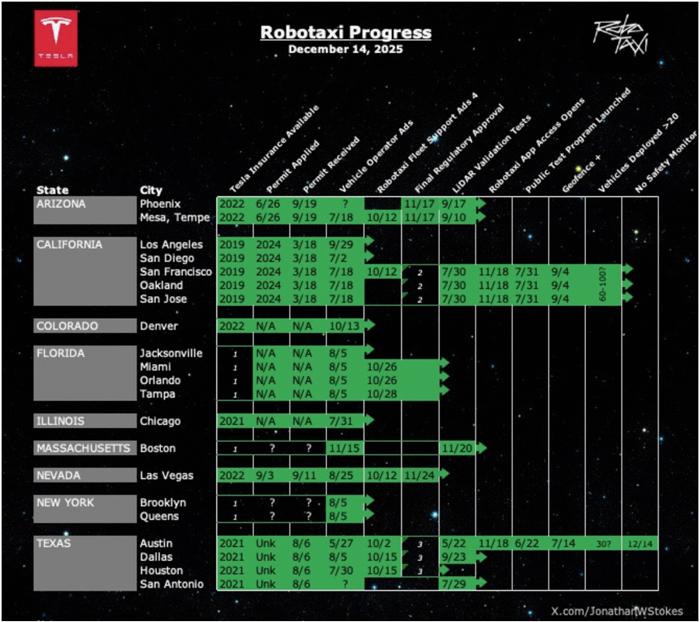
Well, it came down to the wire, but Tesla officially removed the safety driver from the front seat of its Robotaxi service in Austin, Texas.
In the chart below, we can see this happened on December 14 in Austin. And we can also see that San Francisco, Oakland, and San Jose are extremely close to doing the same.
We are weeks away for those California cities.
Source: Jonathan Stokes
And if that wasn’t exciting enough, early production Cybercabs are currently driving themselves around Austin without any safety driver as well, which would be impossible anyway, considering the Cybercab doesn’t have a steering wheel, gas pedal, or brake pedal.
Fully autonomous, level 5, unsupervised autonomous vehicles.
Check.
I made a string of predictions about the digital assets industry back in late 2024, of which every single one came true in the first half of 2025.
And at a higher level, at the beginning of this year I predicted:
New regulations will be put in place, providing clarity and clear guidance on industry rules. And the enforcement of baseless and antagonistic actions against the leaders in the industry will come to an end.
And:
We’ll see U.S. dollar stablecoin projects thrive this year, as more and more financial transactions happen and settle on blockchain technology.
And I’m happy to predict that the talk of a central bank digital currency (CBDC) in the U.S. will completely die.
This was clearly the case, with all the developments in digital assets and cryptocurrencies this year.
The SEC’s reign of terror for the blockchain industry came to an immediate end.
It stopped regulating by issuing lawsuits and began proactively engaging the blockchain industry to develop clear regulations for the industry.
This July, the GENIUS Act was passed and put into law for the stablecoin industry.
This was transformational for the industry. So transformational… that members of the traditional finance industry are still trying to block it despite it being passed into law.
As a result, stablecoin projects have been thriving this year, and an intended byproduct of the legislation has been tens of billions of U.S. Treasuries being bought by stablecoin projects.
Incredible progress was almost made on the market structure bill known as the CLARITY Act.
It may have hit a stumbling block as a result of the silly government shutdown, but it is still advancing, and I expect it will be signed into law before the end of the first quarter 2026.
And yes, thankfully, any talk of the CBDC has completely died in the U.S.
It is a non-starter now in the U.S. market.
Put a fork in it – it’s cooked.
What an incredible year it has been in the aerospace industry.
There has been incredible progress in every area of this sector.
I predicted that:
I fully expect that Boom Supersonic will succeed in flying its one-third-scale aircraft supersonic in the first half of this year.
Here it is on its first supersonic flight, which happened early in the year, in late January.

Source: Boom Supersonic
I also predicted:
I also expect that Blue Origin, Jeff Bezos’ privately funded aerospace company, will successfully launch its New Glenn rocket, which also has a reusable first-stage booster similar to Musk’s SpaceX approach.
Here’s what happened on January 16 when New Glenn NG-1 reached orbit:

NG-1 Launching to Orbit | Source: Blue Origin
Congratulations to the team at Blue Origin, with whom I spoke a couple of times this year.
Blue Origin went on to have a second New Glenn launch, successfully landing the first stage booster on a floating landing pad in the ocean to demonstrate reusability in November.
As for SpaceX, here was my outlook for the year in 2025:
Speaking of SpaceX, it will launch at least 15 Starships this year, as it refines the technology of the largest rocket and spacecraft in history. SpaceX will successfully demonstrate the catch by the Mechazilla of not only the first stage booster again, but also the Starship itself after its return from low earth orbit.
SpaceX will also demonstrate the docking of two upper stages in low earth orbit and the transfer of fuel from one to another – yes, while in low earth orbit.
In the case of SpaceX, I was too optimistic about the number of launches this year.
SpaceX conducted five successful test launches of Starships this year.
It did, however, demonstrate the Mechazilla catch of the first stage again, which is always mind-blowing.
But it didn’t attempt a catch of a Starship yet, nor did it demonstrate the docking of two upper stages in orbit for a fuel transfer.
I don’t feel too bad about these two misses for SpaceX, as SpaceX changed its approach during 2025.
Rather than focus on a Starship catch or getting 15 Starships launched, it leaned into testing for resiliency.
SpaceX did things like removing critical heat shielding tiles to see if the Starship was resilient enough to still return to Earth undamaged. It also tested new fin designs for better control.
SpaceX chose to optimize its design for its 3rd generation of Starship, which will launch in the first quarter of 2026.
The key point is that fewer test launches did not negatively impact the progress that SpaceX has been making on Starship.
And next year is the year SpaceX commercializes Starships.
I would like to think that everyone would want “less war, more peace,” but this is obviously not the case.
As we’ve learned, warmongering is very corrupt, and the deep state thrives off of this kind of conflict. “They” don’t want President Trump to be successful.
That – and the fact that the European Union bureaucrats have also not wanted to bring an end to the horrible Russia-Ukraine conflict – are why my first prediction below, concerning resolving the conflict in the first 90 days, did not come true.
Making the situation that much more unbelievable, European countries continue to buy Russia oil and gas through intermediaries, thus supporting the Russian economy.
The whole thing is so ridiculous.
And while the EU politicians are on a long holiday, President Trump is meeting this week with Zelensky of Ukraine in an all-out effort to put an end to the conflict.
With a little luck, we can hope that the new year will bring an end to it all.
I predict that the conflict between Ukraine and Russia will end within the first 90 days of Trump’s presidency.
We should also expect that Trump and his team will build upon the success of the Abraham Accords from his first term, which will bring about more peace in the Middle East.
Less war, more peace in 2025. I can’t wait.
What I did get correct is that the Trump administration worked to reinstate and revive the framework of the Abraham Accords.
In addition to countries that were previously part of the accords, Kazakhstan joined in November with additional countries under discussion, including Azerbaijan.
The U.S. has actively been brokering peace agreements with several conflicts/wars around the world, including…
I also predicted that…
The U.S. will stop the absurd spending and funding of overseas wars and focus instead on rebuilding a technologically advanced defensive capability for the U.S. military… a peacekeeping military.
We’ll also see an increase in spending on defense as it applies to the U.S. Space Force. The progress with hypersonic technology in 2024 will make space-based defense systems and communications that much more critical as a deterrent to war.
This is precisely what happened.
The U.S. reduced its financial commitments around the world funding war and conflict… And it refocused that budget on rebuilding the U.S. defense capabilities with advanced technologies, including hypersonic weapons and AI-enabled drone and fighter jet technologies.
This was an area that I hated to be right about.
Unfortunately, there was very little commercial progress for eVTOL technology in 2025, exactly as I predicted:
And as for eVTOL technology as it applies to commercial air transportation, sadly, I don’t think that we’ll see commercial operations commence in the U.S. before the end of the year. I predict this will be pushed out into the first half of 2026.
But we will see commercial operations begin in Abu Dhabi and Dubai in 2025, which have been far more welcoming markets from a regulatory standpoint.
But that doesn’t mean that there wasn’t great progress.
The most critical development was the signing of Executive Order 14307: Unleashing American Drone Dominance.
It finally addressed the issue of allowing beyond visual line of sight (BVLOS) operations of eVTOL technologies.
This opens the door for future commercial operations of fully autonomous eVTOLs operating as air taxis, or cargo-carrying drones.
Fully autonomous vehicles will unlock inexpensive and scalable air transportation and cargo transportation for logistics networks.
Archer Aviation conducted its first eVTOL flights in Abu Dhabi this year and is also the first company to get a license for commercial operations in the UAE.
And Joby Aviation conducted its first eVTOL flights in Dubai this November.
And it also announced a six-year exclusive deal to provide commercial flights in Dubai, which will commence in 2026.

Joby S4 in Dubai | Source: Joby Aviation
The energy sector represented one of the largest, 180-degree shifts I’ve ever seen this year.
It was like the entire public sector and private sector got on the same page, realized that increasing energy production was a matter of both national security and necessary for the U.S. to continue to lead in artificial intelligence… and it needed to do whatever it takes to increase energy production.
I predicted that:
Energy policy will also become a cornerstone development in 2025 for the new administration.
Most will be quite surprised by the continued support for clean energy production with no carbon emissions.
The “pause” that we witnessed in natural gas production in the last four years will be lifted and the industry will start to invest heavily again in natural gas. Energy produced from coal will drop, just as it did during the first Trump administration.
[…] There will also be a major policy push to bring both oil prices, and thus gasoline prices, down.
Energy policy has certainly been a cornerstone of the current administration.
And to the surprise of many, the solar energy industry has continued to thrive in parallel with the incredible support for nuclear energy production, both nuclear fission and nuclear fusion.
The “pause” in natural gas production and exploration was indeed lifted quickly, and natural gas has proven to be the single most important resource to fuel the AI data center boom.
It is very easy to see that the policies worked in two simple charts.
Here is a 1-year chart of West Texas Intermediate (WTI) oil prices for 2025. The trend has been very clear, down and to the right…
1-Year Chart of WTI
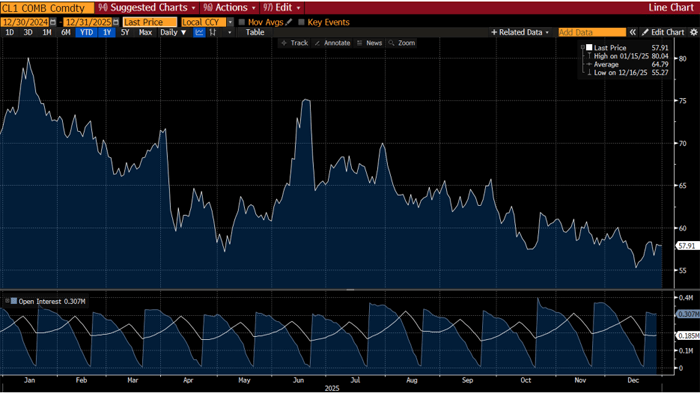
And here is a chart of the average price of a gallon of gasoline in the U.S. for 2025…
1-Year Chart of Average Price of a Gallon of Gasoline
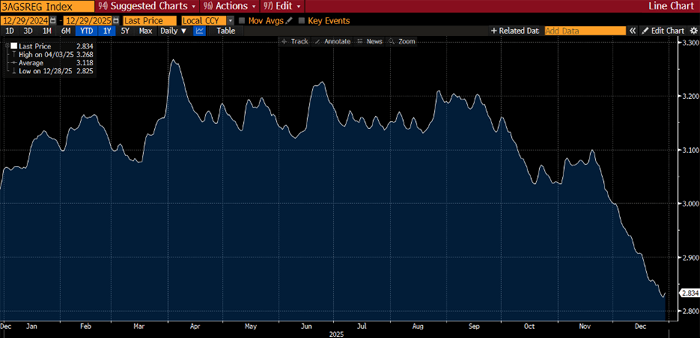
These are remarkable changes compared to two years ago.
The economic policies and regulatory policies have had a direct, material, positive impact on prices.
As for nuclear energy, I predicted that…
In parallel, there will be strong regulatory support for the recommissioning of nuclear reactors in the U.S., as well as for the commissioning of new fourth-generation small modular reactors (SMRs) to address the shortages in energy production.
Nuclear energy will experience a rebirth in 2025. That will be true for both nuclear fission as well as nuclear fusion technology.
I stand by my original prediction made back in 2019: We’ll see the first net energy-producing fusion reactor before the end of 2025.
As I mentioned early on, there were four executive orders in support of the nuclear power industry: 14301, 14300, 14302, and 14299.
These were issued on May 23, 2025, and quickly resulted in a major initiative led by the Department of Energy to have three next-generation nuclear reactors reach criticality by July 4, 2026.
The outspoken support and regulatory changes reignited the entire industry and stimulated billions in investment in next-generation, small modular reactor (SMR) technologies in the U.S. market.
The change has been remarkable, and I’ve never seen the nuclear energy industry work at this pace.
It has absolutely experienced a rebirth this year… and its success has become a national priority.
As for nuclear fusion, the National Ignition Facility (NIF) set another record of net energy production this April with its fusion reactor of 8.6 megajoules (MJ), about four times more than the previous record.
Fusion is no longer theoretical. It is proven.
Now, it just needs to be commercialized.
I was hoping that Commonwealth Fusion Systems might accelerate their timeline to test their commercial prototype reactor this year, but that event has been pushed out into next year.
The NIF 8.6 MJ achievement was still remarkable, and many more fusion reactors of various types will demonstrate something similar within the next couple of years.
It was wonderful to see signs of life in the IPO markets in the U.S. this year.
The declining interest rates, healthy economy, investment, and vibrant capital markets made for a good environment for the IPO markets to improve.
At the beginning of the year, I predicted:
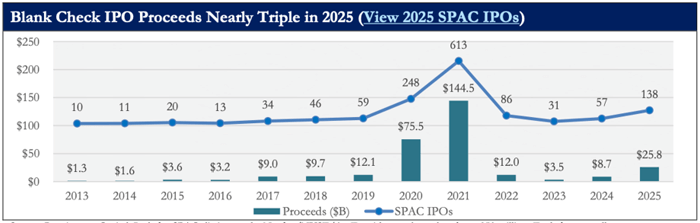
We will see 2025 IPO proceeds above the levels we saw in 2018 and 2019, somewhere between $46-60 billion across more than 150 IPOs. This will represent a major jump compared to last year.
As we can see below, we saw 202 IPOs bringing in $44 billion in proceeds, just at the bottom end of where I predicted.
But if we add in the 138 SPACs – which raised $25.8 billion – we saw a total of $69.8 billion raised, above the top of my range.

Source: Renaissance Capital
Source: Renaissance Capital
Some of the biggest tech IPOs of 2025 were: CoreWeave (CRWV), Circle Internet Group (CRCL), Figma (FIG), and Chime (CHME).
Easily my biggest disappointment of the year, and my missed prediction was around the ineffective and unsafe mRNA-based COVID-19 “vaccines,” which are experimental drugs that suppress the immune system and have horrible side effects.
I said that:
Another major prediction that I have for 2025 is that the mRNA-based COVID-19 “vaccines” (experimental drugs) will be pulled from the U.S. markets. With RFK Jr. and Bhattacharya in leadership positions, they will default to an evidence-based approach to medicine. Rather than politics, data will drive good decision-making.
I admit that this prediction was very optimistic to assume that RFK Jr. could overcome the biopharmaceutical complex and win on this issue in Year 1.
That doesn’t mean that progress wasn’t made, however.
In October, the Centers for Disease Control (CDC) removed its blanket recommendation for everyone to take the COVID-19 drugs.
The CDC restored informed consent and pivoted to an individual-based risk-benefit decision-making process for each patient.
Florida was a real leader in the U.S., with the state surgeon general withdrawing the COVID-19 “vaccines,” citing the extensive, dangerous safety signals that have been reported, including extensive peer-reviewed research of DNA contamination of the “vaccines.”
The following organizations in the U.S. have also formally called for a nationwide withdrawal of the drugs this year:
The amount of peer-reviewed, scientific research demonstrating the ineffectiveness and severe side effects that has been published this year is remarkable.
The truth has long been out.
This will continue to be a fight next year.
It’s painful to think back about those years when inflation was running rampant.
The cost of everything went through the roof.
It was unsustainable, entirely caused by U.S. government policies, and it needed to change.
Aside from the changes that we’ve seen in the price of oil and gasoline that I showed earlier, we’ve also seen a major drop in the average 30-year mortgages in the U.S.
Average 30-year Mortgage in the U.S.
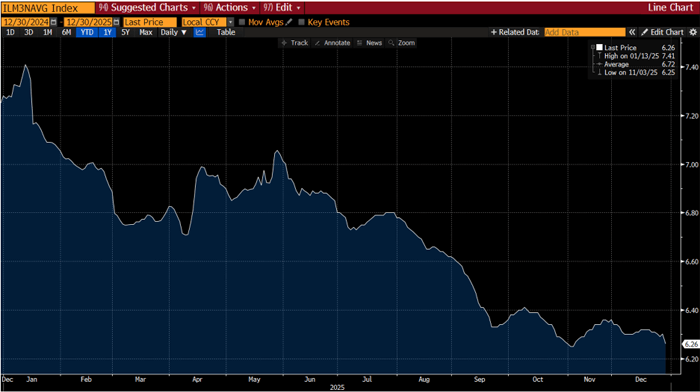
At the beginning of the year, we saw 7.4% mortgage rates – sky high.
And we’re finishing the year around 6.26%, more than 100 basis points lower.
We still have a long way to go to get those rates down to 4% or lower, but we’re headed in the right direction.
And food prices have fallen, as well.
I’ve seen it and checked it myself as I travel around the country.
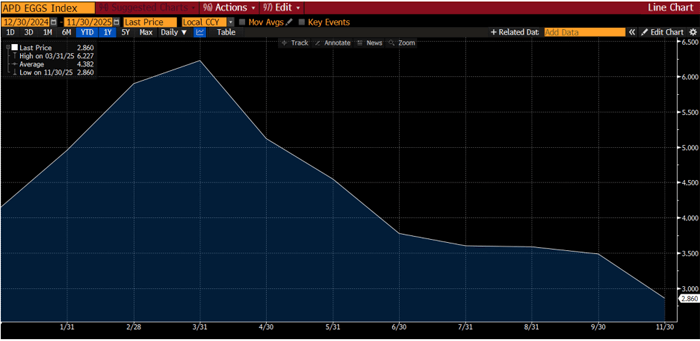
A perfect example is the representative cost of eggs in the U.S., which fell by more than half in 2025.
Average Price for Grade A Large Eggs
In all, it was a fun and challenging year to predict, given all the changes happening back in November/December of 2024.
But overall, my predictions were almost entirely spot on.
That was great news as it meant a great economic and market environment for my subscribers – one that we capitalized on greatly here at Brownstone Research.
It was an exhausting year, and an exhilarating one as well. I hope it was a great year for you all, as well.
2026 is going to make 2025 look like a boring year, though.
I hope you are getting some rest over the holidays.
You’re going to need it.
Best wishes for the new year,
Jeff

Read the latest insights from the world of high technology.
The Artemis II team has now traveled farther from Earth than any humans in history…

Here at Brownstone, we know how invaluable a strategy that lets us leverage momentum anywhere disruption strikes can be...

Those who played the game paid Niantic to work for them. And none of them were told that Niantic...
Thanks for signing up for The Bleeding Edge — we’re glad you’re here!
Want updates sent straight to your phone too? Sign up for SMS alerts to get the latest delivered via text.
Brownstone Research: By submitting your phone number, you agree to our SMS Terms & Conditions, Terms of Use, & Privacy Policy, and give express written consent to receive marketing text messages from BSR. Messages are recurring & frequency may vary. Reply STOP to 94703 to opt out. Reply HELP to 94703 for info. Consent is not a condition of purchase. Message and data rates may apply. For additional information, you may contact Customer Service at 888-512-0726 or smssupport@brownstoneresearch.com.