

The Maximum Truth-Seeking AI – A Magnitude Smarter
Grok 4.2 has evolved into something so much bigger than what was originally planned…


It’s flashy… the sort of announcement that seems specifically designed to catch headlines.
Managing Editor’s Note: Don’t forget to go here to automatically sign up to join the upcoming Secret AI Stock Summit this Wednesday.
Jeff is teaming up with Wall Street quant Jason Bodner to unveil a powerful system that Jason created to pinpoint little-known stocks that, on the surface, might not even seem connected to artificial intelligence… but have the potential to become the next trillion-dollar AI giants.
Each one is quietly becoming essential to AI… and this system is designed to spot them before everyone else catches on.
Just go here to add your name to the guest list with one click…
Most of what was announced wasn’t new…
But it is flashy… the sort of announcement that seems specifically designed to catch headlines.
A three-way announcement among Uber (UBER), Lucid (LCID), and Nuro (still private) is the kind of marketing-driven partnership we typically see around the January Consumer Electronics Show.
Uber plans to deploy at least 20,000 Lucid Gravity SUVs designed for autonomous driving that are equipped with a roof-mounted “halo,” which is equipped with cameras, LIDAR, and radar sensors used in conjunction with other sensors around the car.
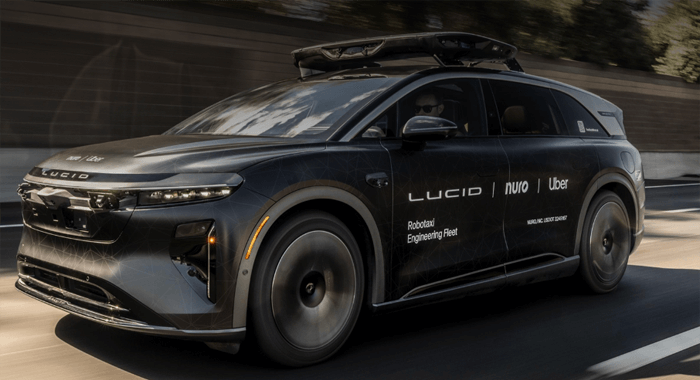
Lucid Gravity with Rooftop Sensor Array | Source: Lucid
The idea is pretty simple…
Uber will license the self-driving AI system developed by Nuro, and Lucid will manufacture the production vehicles upon which the Uber-led robotaxi service will be offered.
On the surface, the announcement doesn’t seem like much at all… the reality is something much more.
Over the next six years, 20,000 Nuro self-driving AI-enabled Lucid Gravity vehicles are targeted to be deployed in the U.S. and some international markets.
The earliest consumers who might be able to experience the service will be “in the San Francisco Bay area later this year.”
Now, 20,000 vehicles might sound like a lot compared to the roughly 1,500 vehicles Google’s Waymo subsidiary has on the road around the U.S. right now.
But compared to the 1.1 million Teslas on the road right now that are already enabled with full self-driving software – which have already driven 8.3 billion miles fully autonomous – it’s absolutely nothing.
To be fair, those Teslas aren’t currently part of a robotaxi network. But that’s exactly the point. When Tesla “turns on” its Robotaxi network and allows those Tesla owners and lessees to opt in their cars to go to work, the entire industry will change seemingly overnight.
This is the catalyst… the driver behind the moves of these three companies.
They are all trying to position for a world with millions of fully autonomous Teslas – Robotaxis, production cars, and, of course, Cybercabs. Their motivations, however, are different.
Lucid (LCID) is a company that I know well. I’ve been tracking it for years. The company makes beautifully designed electric vehicles, but that’s it. It is a car company, plain and simple, with no point of differentiation other than design.
For that reason, I predicted years ago that Lucid’s stock would collapse. Starting a new car company – as opposed to a tech company or an artificial intelligence company like Tesla – is extremely difficult to do. And Lucid had no material competitive advantage.
Lucid produced a little more than 18,000 vehicles in 2025. That’s it. There is no economy of scale at those levels, not even close.
I knew the company would be bleeding cash for a long time. The company had a negative $3.3 billion in free cash flow in 2022, negative $3.4 billion in 2023, negative $2.9 billion in 2024, negative $3.4 billion in 2025, and a forecasted negative $3 billion for 2026.
That’s not a healthy business. It’s a business burning through cash and on the verge of bankruptcy in the absence of raising additional capital.
The stock chart speaks for itself:
5-Year Chart of Lucid (LCID)
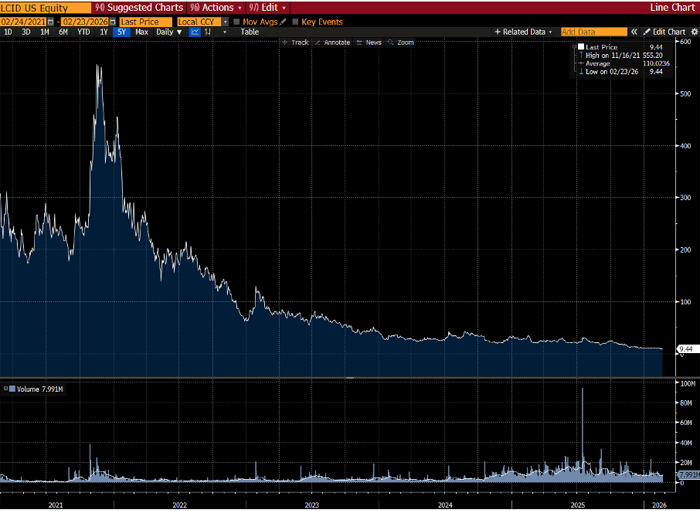
The stock is down more than 98% from its all-time high. Why anyone would lend this company money is a complete mystery to me.
But this is precisely the reason that Lucid teamed up with Nuro and Uber.
It needs a different story than just being yet another flailing electric vehicle company. It is now trying to position itself as having an autonomous driving solution, despite the entire software stack coming from Nuro.
Lucid will basically be out of cash by the end of this year, so it needs to raise additional debt and/or capital through a secondary offering. This is its attempt to do that.
Nuro, still a private company, is in a bit of a different bind. It was very unsuccessful over the last few years selling its Nuro R2 mini autonomous vehicle designed for commercial deliveries.
It’s a great design and makes a whole lot more economic sense for deliveries of things like groceries in a vehicle, like the one pictured below, rather than a human-operated car.
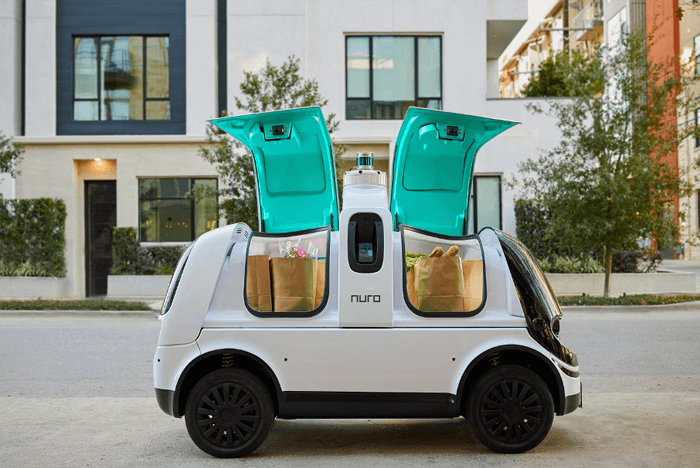
Nuro R2 | Source: Nuro
Nuro got stuck in the tough regulatory environment from 2021 to 2024 for autonomous technology, failed to scale its business, and fell short on capital. It was forced to pivot last year into a less capital-intensive business model, which is the licensing of its autonomous driving technology.
That technology was designed for the smaller delivery vehicles, but the concept is the same. The weakness, of course, is that it has adopted a similar software architecture to Waymo. And as we’ve seen, that doesn’t scale quickly or easily, and it’s limited exclusively to geofenced areas.
Despite its technological weaknesses and the need for expensive sensor arrays around the car, Nuro managed to raise $200 million last August at a surprisingly high $6 billion post-money valuation.
One of the investors in that round was Uber. Another was NVIDIA, which would benefit from additional sales of NVIDIA’s GPUs and autonomous driving reference hardware. Also, uncoincidentally, Uber invested $300 million into Lucid last September as a strategic investment tied to a future robotaxi offering.
This is where the story really comes together.
Uber is an incredibly successful company.
It is still growing at very healthy double-digit revenue growth rates, sports 41% gross margins, and will throw off more than $10 billion in free cash flow this year.
Uber is proactively investing in a future in the event that it can’t be a marketplace for Tesla’s robotaxi service.
And just today, it announced its autonomous “offering” to the industry in the form of its Uber Autonomous Solutions service.
Those who choose to partner with Uber gain access to:
This is exactly what Uber should be doing… leveraging its assets.
In particular, the autonomous vehicle fleet financing is really smart. It has $7.6 billion in cash and more than $10 billion in free cash flow this year. It makes perfect sense to help finance autonomous fleets.
After all, it can help ensure the utilization of autonomous fleets using its Uber ride-hailing service. It can even garnish a portion of the ride revenue to automatically collect on the financing debt.
Regulatory support, remote assistance, and field operations are all things that Uber is staffed up to support in the cities where Uber is most active. I can even envision that Uber might offer cleaning and maintenance services to support autonomous fleets.
And perhaps the most interesting aspect is the offer to support autonomous vehicle insurance. This answers the complex question of which party is responsible in the event of a self-driving car crash.
Is it the car manufacturer (i.e., Lucid)? Is it the autonomous software company (i.e., Nuro)? Or is it the ride-hailing service (i.e., Uber)? Is it the owner of the autonomous fleet?
Uber is the first to have an answer to that question.
By teaming up with Marsh and Apollo, it is offering comprehensive coverage for all related parties. That way, whichever party is deemed to be responsible, Uber’s autonomous vehicle insurance coverage has every party covered.
The reality is that the cost of insuring autonomous vehicles will drop rapidly over time. Both Waymo and Tesla have hard data proving the technology is already multiple times safer than human drivers.
And the safety levels are constantly improving. Insurance costs will decline in sync.
Partnerships continue to be formed, critical solutions to autonomous vehicle operations are being put into place, and Uber is proactively preparing for the inevitability of autonomous ride-hailing.
The two wild cards are when/if Waymo and Tesla are willing to leverage Uber and Lyft (LYFT) as the largest ride-hailing marketplaces connecting cars with riders.
Jeff

Read the latest insights from the world of high technology.
Grok 4.2 has evolved into something so much bigger than what was originally planned…

The skeptics and “experts” who said this wasn’t possible will be handed their shorts again.

Pandora’s box has been opened in the last 24 hours, and there is no way to put a lid...
Thanks for signing up for The Bleeding Edge — we’re glad you’re here!
Want updates sent straight to your phone too? Sign up for SMS alerts to get the latest delivered via text.
Brownstone Research: By submitting your phone number, you agree to our SMS Terms & Conditions, Terms of Use, & Privacy Policy, and give express written consent to receive marketing text messages from BSR. Messages are recurring & frequency may vary. Reply STOP to 94703 to opt out. Reply HELP to 94703 for info. Consent is not a condition of purchase. Message and data rates may apply. For additional information, you may contact Customer Service at 888-512-0726 or smssupport@brownstoneresearch.com.