

A Quick “How To” for Viewing Crowdfunding Offerings
We can’t provide any personal investment advice, but we can use a question as an example of how to...


It has taken more than 30 years to accomplish fully autonomous driving, where the passenger no longer has to touch the steering wheel, brakes, or gas pedal at all…
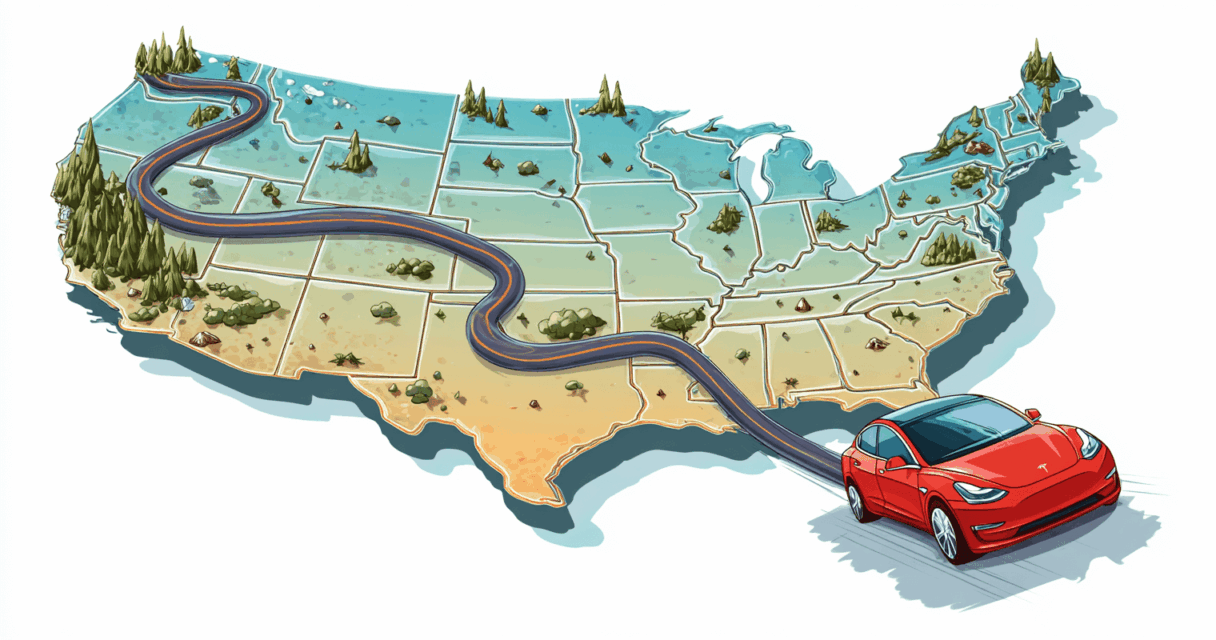
“No Hands Across America” is considered the first attempt at an autonomous cross-country trip in the U.S.
Thirty years ago, two researchers who spun out of Carnegie Mellon’s robotics lab modified a 1990 Pontiac Trans Sport minivan with computing systems capable of steering the vehicle on roads.
In preparation for the trip, the duo traveled in their autonomous vehicle – from Pittsburgh, Pennsylvania, to Washington, D.C., and back again – before setting out for San Diego from Pittsburgh on July 23, 1995.
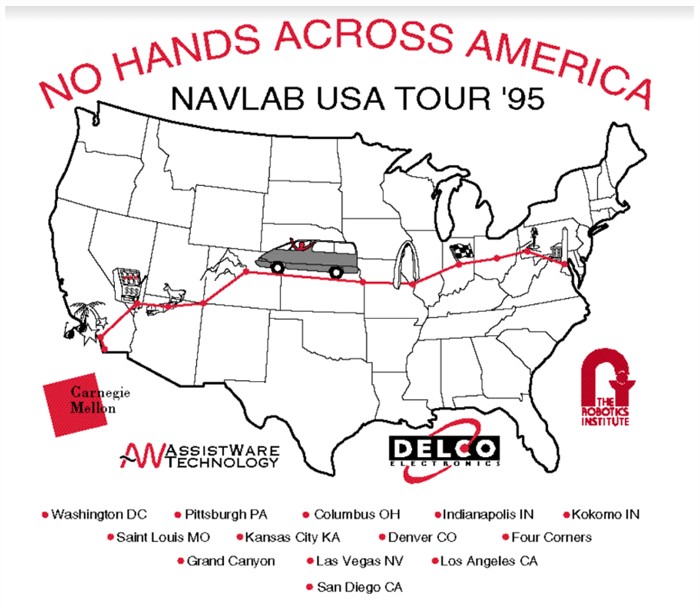
Source: Pittsburgh Robotics Network
The team travelled 2,797 miles – 98.2% of which were autonomously driven. And on July 30, 1995, they arrived at their destination in San Diego.
For anyone curious to see the team’s journal of their trip, you can find it here.
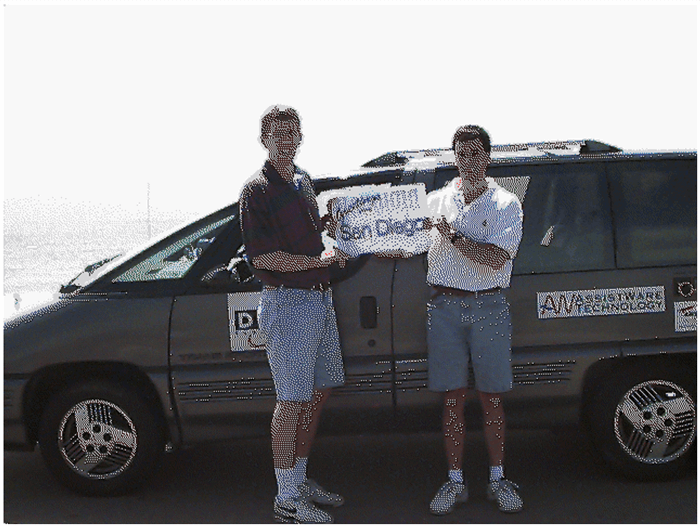
Source: No Hands Across America Journal
It’s kind of hard to believe that the drive took place more than 30 years ago.
Thinking back, it was an entirely different era. It was only the early days of the internet, the IT infrastructure build out, and personal computers.
And yet, they were able to accomplish it.
… Or did they?
The reality was much different.
The souped-up Pontiac actually wasn’t an autonomous vehicle.
The system that the team built was only capable of steering on roads.
The system had no control over the throttle or the brakes – that all had to be managed manually by the driver. The system couldn’t even control the distance between itself and a car driving in front of it.
Their autonomous steering system – which they called Rapidly Adapting Lateral Position Handler (RALPH) – was designed based on three simple steps:
The system’s output was control signals sent to the steering system. That’s all there was to it.
No supercomputer on board. No radar. No LiDAR. No artificial intelligence.
Just vision, mathematics, and some very low-powered computers capable of running off the vehicle’s lighter plug.
After the trip, one of the researchers stated…
In five more years, I wouldn’t be surprised to see a Tesla drive from D.C. to San Diego, doing all of the driving except maybe a mile or two – and that would be because of some fluke.
I love the optimism, but that was a horribly inaccurate prediction considering it would have meant full autonomy by the year 2000.
Steering between two lines is a relatively easy task to accomplish.
But understanding the entire world around the vehicle – 360 degrees, up to 250 meters out – and being able to navigate all surface roads, all weather, parking lots, driveways, pedestrians, bikers, and all the outlier events like a police officer on the street giving hand signals to direct around an accident…
This is the hard part.
It requires contextual understanding, physics-based systems, reasoning capabilities, and split-second response times that are faster than a human.
As it turns out, the remaining 1.8% of the miles driven is the real challenging part.
And that’s why it has taken more than 30 years to accomplish fully autonomous driving, where the passenger no longer has to touch the steering wheel, brakes, or gas pedal at all.
On December 31, 2025, an actual, fully autonomous, coast-to-coast trip was accomplished in the spirit of what the team was trying to do in 1995.
David Moss departed from the Tesla Diner in Los Angeles late December… and arrived in Myrtle Beach, South Carolina, on the last day of the year.
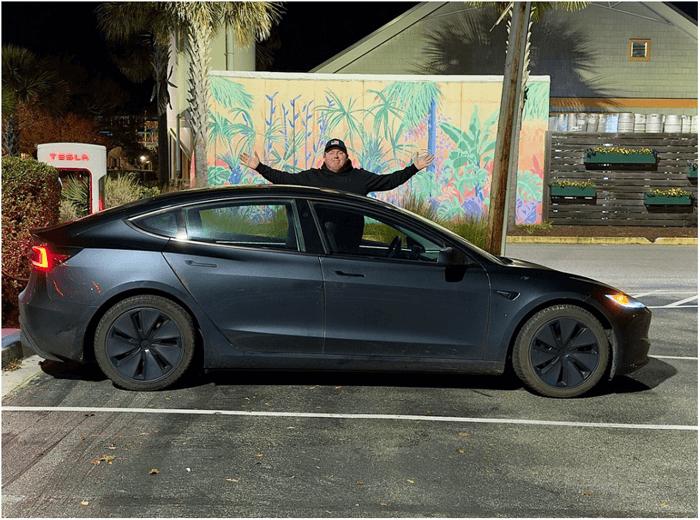
Source: X @DavidMoss
Well done, David. Or should I say, well done, Tesla!
The reality was that David was driven by Tesla’s AI – version 14.2.1.25 – of its full self-driving (FSD) software.
The trip was accomplished with zero disengagements.
During his entire trip, Moss never had to touch the steering wheel. Not once.
The Tesla even parked itself at every supercharging station – marked in the letters on the map below – completely autonomously. It charged itself when it needed.
Incredibly awesome, and if you’ve been reading The Bleeding Edge, I doubt you’ll be surprised.
For those curious, here was Moss’s trip across the U.S.
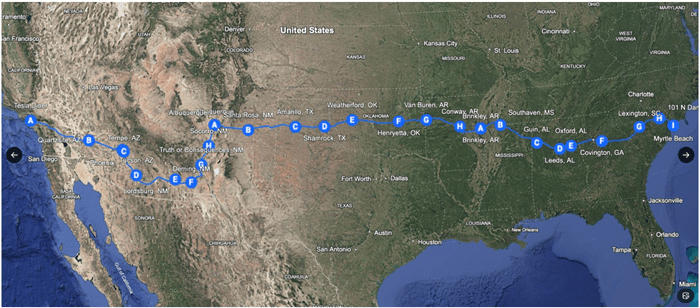
Source: X @DavidMoss
David Moss and Tesla set a record with this incredible autonomous journey.
And along the way, Moss set another record: 10,000 consecutive miles driven without any interventions.
Think about that.
On average, the typical American drives about 14,000 miles a year.
Moss has been driven almost a year’s worth of miles without having to touch the steering wheel in his Tesla.
Moss actually posts his autonomous stats online; you can see them right here.
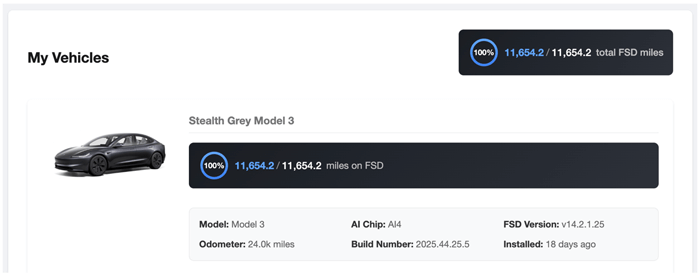
He is now at 11,654.2 miles – without a single intervention.
It’s no longer a science project. Full autonomy has already happened.
And it is entirely vision-based, manifested in affordable production electric vehicles.
In my 2026 predictions issue of The Bleeding Edge, here is what I laid out for the year for this technology:
2026 is going to be the year for autonomy:
- Prediction 10:Tesla will have compiled more than 18 billion miles driven autonomously using its FSD software, and its safety statistics will have improved further by the end of the year.
- Prediction 11:Tesla will roll out its Robotaxi service in at least 10 U.S. states. It will target the most populous states, as this is how it will have an even greater impact. Robotaxi rates will be a fraction of what Waymo charges, which will result in high utilization.
- Prediction 12:Tesla will manufacture Cybercabs in the tens of thousands in 2026 and will launch Cybercab services in only five cities or fewer in 2026. The technology will be ready, but the regulatory changes necessary for the nationwide rollout of vehicles without any steering wheel or gas/brake pedals will limit deployment.
- Prediction 13:We will see Tesla gain approval for an unsupervised version of its FSD software by the end of 2026. This will enable passengers to literally sleep at the wheel, work on their phones/computers, or watch a movie on the center console while being “teleported” to their destination.
We’re in for a wild ride this year.
And tens of millions of Americans will witness or experience directly the sentient feeling one gets when being driven by Tesla’s latest, full self-driving software.
I strongly encourage all of you to find a way to experience it if you haven’t already.
It will change your outlook on everything.
Jeff
Read the latest insights from the world of high technology.
We can’t provide any personal investment advice, but we can use a question as an example of how to...
Even with all of the excitement happening right now with AI, the 2026 hyperscale spending on AI infrastructure still...
The permissionless agentic economy is coming to life…
Thanks for signing up for The Bleeding Edge — we’re glad you’re here!
Want updates sent straight to your phone too? Sign up for SMS alerts to get the latest delivered via text.
Brownstone Research: By submitting your phone number, you agree to our SMS Terms & Conditions, Terms of Use, & Privacy Policy, and give express written consent to receive marketing text messages from BSR. Messages are recurring & frequency may vary. Reply STOP to 94703 to opt out. Reply HELP to 94703 for info. Consent is not a condition of purchase. Message and data rates may apply. For additional information, you may contact Customer Service at 888-512-0726 or smssupport@brownstoneresearch.com.