


The Better Business Bureau of Agents Is Onchain
The permissionless agentic economy is coming to life…


Even with all of the excitement happening right now with AI, the 2026 hyperscale spending on AI infrastructure still caught many off guard…
Managing Editor’s Note: Last night, Jeff and Jason Bodner gathered to discuss a unique group of under-the-radar stocks that they believe could become the next AI super-stocks…
These are companies that are quietly becoming essential to AI… even though, on the surface, it might not be obvious that these are related to AI at all.
If you missed out, you can still catch the replay of the event for a short while longer. Just go here to watch…
To the great disappointment of the “AI Bubble” crowd…
Last night, NVIDIA (NVDA) released blowout numbers on its earnings call, including higher-than-expected forward guidance.
For my readers, this will come as no surprise.
We’ve been closely tracking the investment by hyperscalers in AI infrastructure year after year since the large language model breakthrough in late 2022, as well as the progress in artificial intelligence for the last decade.
But even with all of the excitement happening right now with AI, the 2026 hyperscale spending on AI infrastructure still caught many off guard.
The 2026 capital expenditures (CapEx) currently forecasted by the Big 4 are:
Does this look like an industry that is slowing down? Or speeding up?
What’s so remarkable about these numbers isn’t just the sheer scale of the investment this year.
It’s the percent increase year-over-year.
And they all have the money to make this level of investment.
They aren’t teetering on the edge of financial collapse. They are all flush with cash.
And these are just four companies.
My own estimations put the entire AI industry spend above $1 trillion this year – all for building AI factories.
What I have done my best to communicate is that this investment in AI infrastructure is not speculative in nature at all.
Those in the industry understand the value – and the nearly immediate return on investment – of employing powerful AI models in workflows.
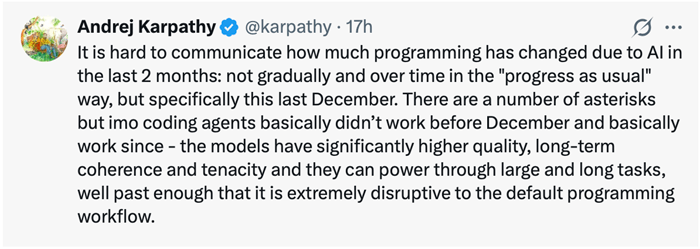
Andrej Karpathy, the former Director of AI at Tesla and a co-founder of OpenAI – someone who is considered an expert in artificial intelligence – famously said just a few months ago that we were at least 5–10 years away from achieving artificial general intelligence (AGI).
I publicly said he was completely wrong, and I have been predicting AGI by 2026 for years.
It’s happening, right now, and even Karpathy has been caught off guard.
Here’s what he just posted in the last 24 hours.
Source: X
He used agentic AI technology to take on a home project that would have normally taken him a whole weekend to accomplish on his own.
Here’s what happened:
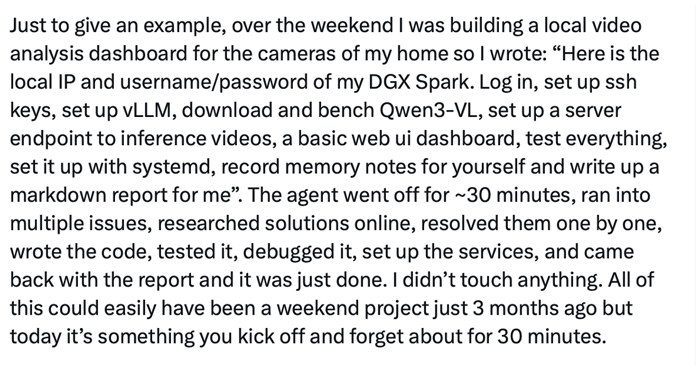
The headline is that the technology was intelligent enough to function autonomously, reason, troubleshoot, and complete a very complex task without any human intervention. In 30 minutes.
For the right mindset, multiply this functionality by a million and apply it to every industry on Earth.
Only then can we sense the raw potential of this multi-trillion – or quadrillion – dollar market that is unfolding before our eyes.
This is why the hyperscalers are spending like they are. And it’s why NVIDIA’s, AMD’s, Micron’s, etc. numbers keep running higher, quarter after quarter.
As for NVIDIA’s earnings announcement last night, it was stunning…
Here are the biggest takeaways from NVIDIA’s reported Q4 and Fiscal 2026 earnings:
This is the most valuable company in the world, now worth around $4.5 trillion, and it is still growing at a breakneck pace.
Can you feel it?
Can you sense what’s happening and the sheer scale of it?
But those numbers are from what has already happened. It’s in the past.
What about next quarter?
While this represents a drop in quarter-over-quarter growth compared to the earnings release, it would be wrong to extrapolate that the growth rate is slowing down.
First fiscal quarter often sees smaller quarter-over-quarter growth.
What’s important is the year-over-year comparison.
$78 billion of first-quarter revenue will represent about a 77% growth year over year compared to = fiscal first quarter 2026. Just incredible.
But this wasn’t even the most important development for NVIDIA’s latest announcement last night.
NVIDIA unveiled some more specifics about its next-generation GPU platform, Vera Rubin, which will be shipping in the second half of 2026.
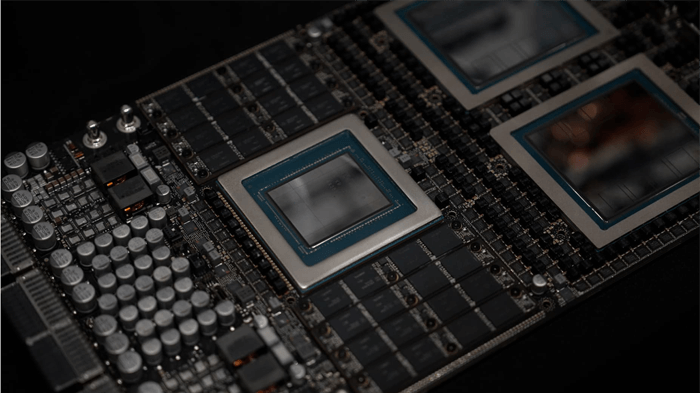
NVIDIA’s Vera Rubin Supercomputer | Source: CNBC
Just like NVIDIA’s current mass production GPU system – the Grace Blackwell – Vera Rubin is a rack-scale system.
A full Vera Rubin “pod” looks like the picture below:
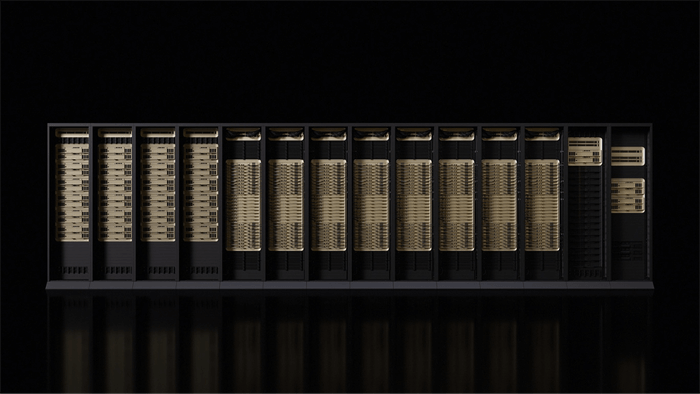
Vera Rubin GPU Pod | Source: NVIDIA
A Vera Rubin system is ridiculously complex, constructed of 1.3 million components and entirely liquid-cooled in order to dissipate the extreme heat that each rack throws off in operations.
What’s stunning, however, is that the new GPU architecture will have about 2.5 times more raw computational performance compared to the Grace Blackwell system, twice as much power consumption, and 10 times more performance per watt.
A magnitude greater performance per unit of electricity… in a single product iteration. Absolutely incredible.
While Vera Rubin systems will require double the power per rack, it’s the power efficiency that drives buying decisions.
A magnitude better performance per unit of electricity directly impacts operational costs in a large, material way.
This is precisely why NVIDIA already has orders for Vera Rubin years in advance. All production is spoken for.
Every hyperscaler needs to acquire as many of these new systems as quickly as they can.
The performance gains are simply too significant, which is why the demand is so incessant.
And it’s not just NVIDIA.
AMD (AMD) will begin shipping its first rack-scale system – Helios – also in the second half of this year.
AMD’s Helios will be on par with NVIDIA’s computational performance, featuring 72 AMD MI455X GPUs per rack.
AMD’s rack architecture, however, will be set apart from NVIDIA’s with 50% more high-bandwidth memory than NVIDIA’s Vera Rubin rack.
What we need to understand is that it’s not one versus the other.
The industry will suck up as many racks as NVIDIA and AMD can manufacture.
Earlier this week, Meta and AMD announced a massive deal worth more than $100 billion, equivalent to about 6 gigawatts of computing power.
That’s enough power to support about 5 million homes… Six times the peak electricity demand of San Francisco, or equivalent to the output of six nuclear reactors.
The scale is incredible.
As concrete as these developments are, as well-funded as these investments have and will be, there are still skeptics.
Michael Burry continues to pitch his short story on NVIDIA, claiming the company continues to “Ratchet Up the Risk.”
His latest hang-up is that NVIDIA’s purchase obligations have increased to $95.2 billion, up from $16.1 billion a year ago.
The latest figure was just announced in NVIDIA’s latest annual report filing with the SEC.
So what?
Vera Rubin is one of the most complex semiconductors designed in history.
TSMC, NVIDIA’s contract manufacturer, had to build out custom semiconductor manufacturing and packaging facilities to produce the product for NVIDIA.
Do you think TSMC would do so without having order guarantees from NVIDIA?
Of course not.
And given the incredible demand for NVIDIA’s current and future GPUs, we should expect that NVIDIA is making this purchase commitment to ensure that it can meet demand from its own customers.
This is not a bubble.
This is the largest infrastructure build-out in history.
Industry spend on infrastructure will be even higher next year.
And Michael Burry will lose his shorts.
Jeff

Read the latest insights from the world of high technology.
The permissionless agentic economy is coming to life…

The breakup needed to be public and raw so that it was believable.

It’s flashy… the sort of announcement that seems specifically designed to catch headlines.
Thanks for signing up for The Bleeding Edge — we’re glad you’re here!
Want updates sent straight to your phone too? Sign up for SMS alerts to get the latest delivered via text.
Brownstone Research: By submitting your phone number, you agree to our SMS Terms & Conditions, Terms of Use, & Privacy Policy, and give express written consent to receive marketing text messages from BSR. Messages are recurring & frequency may vary. Reply STOP to 94703 to opt out. Reply HELP to 94703 for info. Consent is not a condition of purchase. Message and data rates may apply. For additional information, you may contact Customer Service at 888-512-0726 or smssupport@brownstoneresearch.com.