




The Bleeding Edge
5 min read
NVIDIA’s Tesla-Killer?
NVIDIA has just released its Alpamayo open-source AI models for autonomous driving. But here’s why Tesla isn’t nervous…
Written by
Published on
Jan 7, 2026
It’s the first week of January… and that means the Consumer Electronics Show (CES) in Las Vegas – running from January 6th through the 9th.
CES is one of the biggest tech events on the planet.
Hosted each year, there are always major announcements made by industry players in and around the event.
This year is no different.
One of the most significant announcements that the press and media glommed onto this week came from NVIDIA… no surprise there.
Specifically, the announcement about NVIDIA’s release of its Alpamayo family of open-source AI models for autonomous driving.
“Look out, Tesla!”
Alpamayo 1
Alpamayo is a mountain in the Peruvian Andes that rises to an elevation of almost 20,000 feet.
It’s known for its unique, pyramid-like shape and challenging terrain.

Alpamayo | Source: International Mountain Guides
Perhaps that’s why NVIDIA chose to name its latest autonomous driving software after the Peruvian mountain…
Because, as we learned in yesterday’s Bleeding Edge – No Hands Across America, autonomous driving is extremely difficult to do – especially the remaining 1.8% of use cases.
And that’s precisely what NVIDIA designed its Alpamayo 1, open-source software… to address the edge cases in autonomous driving.
From NVIDIA’s CEO Jensen Huang…
Alpamayo brings reasoning to autonomous vehicles, allowing them to think through rare scenarios, drive safely in complex environments, and explain their driving decisions — it’s the foundation for safe, scalable autonomy.

Source: NVIDIA
Huang went so far as to proclaim that Alpamayo is a “world’s first,” which is a ridiculous statement, considering that Tesla has already racked up more than 7.16 billion miles driven in every possible situation using its full, self-driving software around the world.
Of course, many pundits were quick to suggest that NVIDIA just released the software platform that would enable the entire automotive industry to catch up to Tesla on self-driving software.
Tesla gets a “brutal reality check”… and now has “an NVIDIA problem.”
Give me a break.
A Development Kit for Autonomous Driving
The pundits clearly don’t understand what it is that NVIDIA released.
Perhaps Musk himself summed it up best with his response:

Source: X @elonmusk
Musk is absolutely right.
NVIDIA’s Alpamayo is a reasoning-based vision language model (VLA), designed to have the intelligence to navigate complex and unusual road conditions that happen from time to time for every driver.
If anything, NVIDIA’s release of this AI model validates Tesla’s approach to a vision-based system, as opposed to the sensor-laden systems that the rest of the industry, including Waymo, has pursued. An approach that I have argued for years will not scale well at all.
To avoid any misunderstanding: What NVIDIA has done with Alpamayo is smart. As I pointed out in The Killer App of Consumer Electronics, any consumer electronic device that isn’t rapidly building in general intelligence is writing its death warrant. And yes, cars are increasingly becoming a consumer electronics device.
This is NVIDIA’s playbook.
It engineers what are essentially development kits for various industries.
These are software stacks that are designed for and optimized for running on NVIDIA GPUs.
NVIDIA creates these development kits, which have immense value, and makes them free to use for whatever industry it is targeting. The strategy is to make it easy for companies to build on NVIDIA’s GPUs. This ultimately drives sales of its semiconductors and fosters its development community.
NVIDIA has had multiple releases of development kits for advanced driver assistance systems (ADAS) over the years. This is the technology for intelligent cruise control that safely drives a car on a highway and maintains safe distances from the car in front.
Alpamayo is the equivalent of semi-autonomous driving. It’s a development kit, not a complete production AI model that enables full, level 5 autonomy at the level of what Tesla is demonstrating today.
If pundits had taken the time to read NVIDIA’s blog and understand the details of what was released, they would have had a very different position.
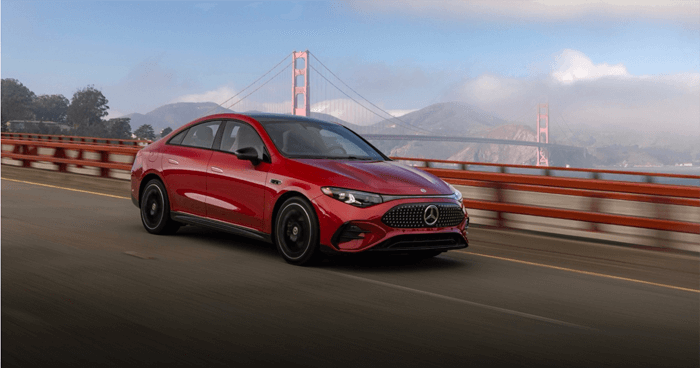
NVIDIA debuted the Alpamayo stack on a Mercedes-Benz CLA as an “enhanced level 2 driver-assistance system.”
Not level 4, or level 5. Level 2.
Source: NVIDIA
Even more relevant is that Alpamayo is just a development kit.
We can think of it as a tool to help get an automotive company started on its way to developing an autonomous car.
It is just the beginning of an extremely complex process of integration, testing, data collection, and trial-and-error – not to mention the actual hardware required to utilize the kit, which must be designed into the cars – that takes many years of diligent engineering work and billions of dollars of investment.
Not Losing Sleep
For additional context, as part of the Alpamayo release, NVIDIA also released a physical AI – an open data set comprised of 1,700 hours of video “across the widest range of geographies and conditions, covering rare and complex real-world edge cases.”
Less than 2,000 hours of real-world data.
Let’s compare that to Tesla’s 7.16 billion miles driven…
If we assume a mile a minute, Tesla’s real-world data set is about 119,333,333 hours collected on full self-driving mode.
And Tesla also has more than 9 billion miles collected on Autopilot – which is roughly the equivalent of what NVIDIA and Mercedes-Benz are demonstrating with Alpamayo at Level 2 autonomy.
So, to be very clear, NVIDIA’s release is very useful for the general automotive industry that chose the wrong technological architecture for autonomous driving… and will very quickly have to switch to vision-based architectures or quickly become irrelevant.
But this NVIDIA release is not a competitive threat to Tesla’s FSD. Helpful to the industry, yes, but not damaging to Tesla.
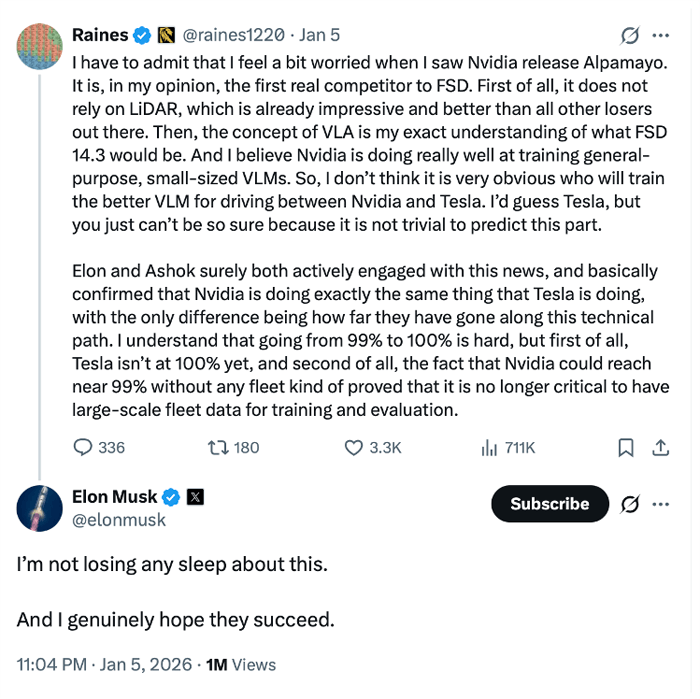
And the pundits – an example as shown below – are incorrectly extrapolating what Alpamayo means:
Source: X @elonmusk
NVIDIA has no way to collect more than 100 million hours of real-world training data to improve Alpamayo’s capabilities.
And no, NVIDIA hasn’t reached 99% complete autonomous driving.
And the last 1% takes more time, training, and money than the first 99%.
More importantly, and this is the big one, anyone developing fully autonomous software for the automotive industry must have large-scale fleet data – measured in billions of miles of real-world data – to train an AI model, test it, and prove that it is safer than human drivers.
This is the way…
And that’s why Musk and his team at Tesla aren’t losing any sleep over NVIDIA’s announcement.
Jeff

Jeff Brown
Founder and CEO
More stories like this
Read the latest insights from the world of high technology.
-
-

No Hands Across America
It has taken more than 30 years to accomplish fully autonomous driving, where the passenger no longer has to...
-

The Killer App of Consumer Electronics
Consumers will soon begin flocking to products and services that are intelligent… and it’s going to shake up the...