

The Beginning of an Entirely New Industry
OWS is an entirely new industry that will experience explosive growth in the next few years, and one that...


Ford’s EVs have never been compelling consumer products.
Managing Editor’s Note: We write in The Bleeding Edge often about the impact of artificial intelligence – both in the present and more importantly, in the future.
Well, the next iteration is coming, and coming up fast. Now is the time to prepare for when it arrives and kicks off a new era of economic prosperity.
Jeff’s kicking things off tomorrow evening at 8 p.m. ET, where he’ll reveal what we can expect in the next generation of artificial intelligence… and how we can position ourselves ahead of the surge.
Just go here to add your name to the list.
I remember shaking my head back in the summer of 2023, when reading a bizarre announcement from the Department of Energy (DOE)…
The DOE was going to give Ford Motor (F) a $9.2 billion loan to construct three domestic lithium-ion battery plants.
The purpose of the plants was to support Ford’s electric vehicle program through the DOE’s Advanced Technology Vehicles Manufacturing (ATVM) program.
It wasn’t the loan itself that caught me off guard. It was the sheer amount – a record-setting $9.2 billion sum, so far above anything done before.
It gave me flashbacks of the taxpayer-funded bailouts of the automotive industry during the financial crisis in 2009.
By 2024, the DOE loan actually grew to $9.63 billion… to fund what is known as BlueOvalSK, which is a joint venture between Ford and SK On, which is the battery manufacturing division of the South Korean conglomerate SK Group.
The funds were intended to be used for the construction of three lithium-ion battery manufacturing plants – two in Glendale, Kentucky, and one in Stanton, Tennessee.
It was a crazy sum to commit to Ford for a variety of reasons…
Ford is a publicly traded company that was profitable in 2023 and 2024, generating $6.68 billion and $6.74 billion in free cash flow in those years, respectively.
While heavily in debt to the tune of $160 billion, it still could go out and raise additional capital for its EV program.
Ford’s EVs have never been compelling consumer products.
This is immediately evident once you experience a Ford EV compared to something like a Tesla EV.
Ford’s manufacturing costs were also way out of whack, negatively impacted by union costs and manufacturing technologies, resulting in Ford losing about $50,000 for each EV sold. It is an absurd amount to lose considering that a Ford Mustang Mach-E starts at a base price of around $40,000.
This resulted in uncompelling EV models and the loss of $13 billion since 2023 for Ford’s EV programs.
It just didn’t make sense.
Ford’s EV design, product strategy, battery technology, and manufacturing strategy weren’t performing…
Yet the loan provided by the DOE reflected an unparalleled level of political favoritism. It was an obvious attempt to give Ford the ammunition to take market share away from Tesla (TSLA).
But it was never going to work… just throwing good money after bad.
Which is why it wasn’t a surprise to hear this week that Ford (F) is taking a $19.5 billion write-down… and killing several major EV models, marking a radical shift towards gas-powered cars/trucks and hybrid vehicles.
Ouch, that’s gotta hurt.
But when you mismanage your business so badly, this is what happens.
One of the casualties of Ford’s EV program is the Ford F-150 Lightning.
Early last year, over at my Outer Limits newsletter, I shared a hilarious gif of an F-150 Lightning stranded on the side of a road… with a gas-powered generator in the pick-up bed running on high tilt – in an effort to recharge the F-150’s batteries.
Ford’s battery technology and battery management software are nowhere near as sophisticated as Tesla’s, which is what made the photo so funny.
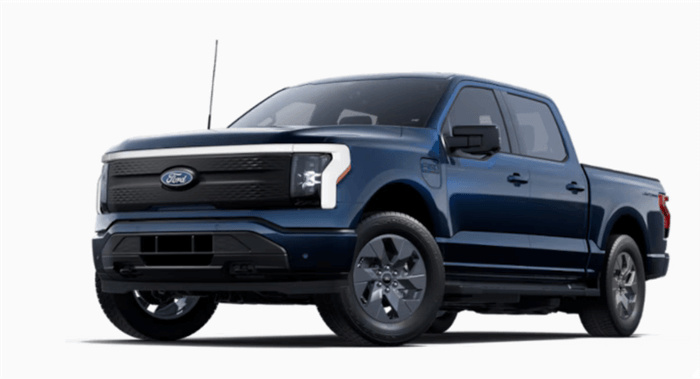
The F-150 Lightning has been Struck | Source: Ford
Ford’s write-down is broken down to $8.5 billion for cancelling EV models, $6 billion to dissolve the joint venture with SK On, and $5 billion for “program-related expenses.”
Ford CEO Jim Farley summed it up well:
Instead of plowing billions into the future knowing these large EVs will never make money, we are pivoting.
Andrew Frick, Ford’s head of petrol engine and electric businesses, said something similar:
Rather than spending billions more on large EVs that now have no path to profitability, we are allocating that money into higher-returning areas.
It’s about time.
Ford failed to compete with leaders in the EV industry.
Its union-based, automotive manufacturing-centric approach to EVs, its product strategy, and its battery technology and integration were all wrong.
And without government subsidies, it would have sold only a tiny fraction of the EVs that it did.
The DOE loan to Ford is in the process of being restructured, with an effort to reduce the exposure to U.S. taxpayers.
While not yet finalized, one of the battery plants in Kentucky will remain with Ford, and the plant in Tennessee will be taken over by SK On, which will become independent.
Needless to say, Ford’s pivot back to its roots of gas-powered vehicles and hybrid vehicles will dramatically change the landscape in Tesla’s (TSLA) favor.
This reality is already reflected in their respective share prices.
Ford is currently down about 46% from its most recent highs in early 2022. And Tesla is now trading at its all-time high at a $1.5 trillion valuation.
We can gain even more insights by comparing Ford, Tesla, and another EV-only company, Rivian (RIVN), by their financial metrics:
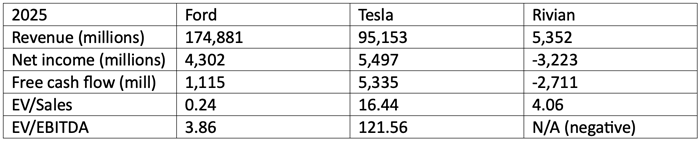
Tesla has clearly proved that it is possible to build a highly profitable electric vehicle company.
Better yet, the company has no net debt (i.e., it has a lot more cash on the books than it has debt).
To be fair, Tesla did receive a $465 million loan from the DOE back in 2010, under the same Advanced Technology Vehicles Manufacturing program that provided the $9.63 billion loan to Ford.
What’s different is what Tesla did with it…
Tesla’s success is clear from the data.
But as for the loan, Tesla paid it back in full in May 2013 – a mere three years later and nine years ahead of schedule. And it even paid a prepayment penalty for doing so.
Taxpayers won, consumers won, Tesla won.
Try though I may to make it known, what many still don’t understand about Tesla is that it is one of the world’s most advanced and successful robotics and artificial intelligence companies, something that I have long maintained for almost a decade.
It’s not a car company. I’ve never considered its “product” a car.
At the core of Tesla is artificial intelligence…
Specifically, it’s the most advanced neural network on the planet available to consumers. It just so happens that at this moment in time, it comes in the form of something resembling a car.
Tesla used AI and robotics to completely redesign its manufacturing process for both its robots and its batteries, which is precisely why the “car” company is so profitable.
But its end product isn’t a car. It’s a robot.
It just happens to be a robot that has four wheels and can fit four or five people comfortably, plus some cargo.
Tesla’s robots-on-wheels are the most successful in the industry, not only because they are an incredible consumer product, but because they are intelligent.
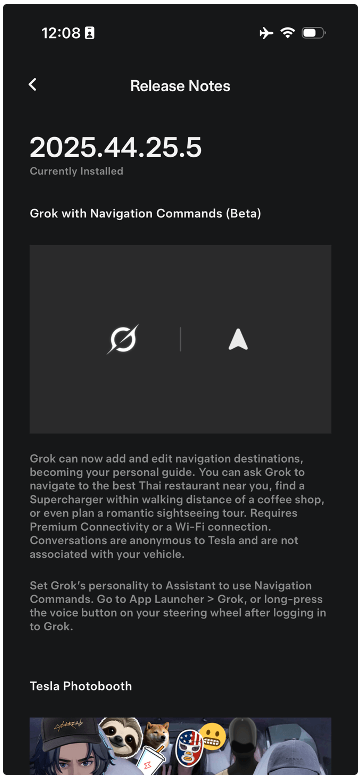
And just this week, Tesla dropped its latest software update to its robots-on-wheels.
This software update involves an AI upgrade I’ve been predicting for years now…
Source: Tesla
Tesla has now integrated xAI’s frontier AI model – Grok – with Tesla’s full self-driving navigation.
With this upgrade, all a passenger has to do is have a discussion with Grok.
Tell Grok where you want to go, and press one button on the screen to “Start Self-Driving.”
That’s it.
“Grok, can you please take me to the nearest Whole Foods?”
“Grok, can you take me to the nearest Supercharger?”
How about, “Tesla, can you take me to the nearest Whole Foods, and along the way, can we stop at the nearest Supercharger?”
That’s all it takes.
And Grok can even reroute a trip using different roads, or you can add a stop along the way while you are being driven.
All you have to do is talk with Grok, and it will send the instructions to Tesla’s full self-driving neural network.
It is absolutely breathtaking.
And yes, I have tested it myself, even in the snow and the dark, and in heavy congestion.
The reason that Tesla is going to become a $10 trillion company isn’t because of EVs.
It’s because of AI.
The future of the automotive industry is autonomous driving technology…
EVs just happen to be a byproduct of that.
Robots perform better when they are battery-powered. It’s that simple.
Rivian (RIVN) is in trouble.
It is deeply unprofitable and designed its EV as a car.
It relies on LiDAR and is only capable of advanced driver assistance systems (ADAS)-level autonomy.
Its limited capabilities are on par with what most car manufacturers are doing.
Ford (F) is in trouble.
While it may appear “cheap” from a valuation-multiple perspective, its revenues are shrinking, and it has $164 billion in debt.
Worse, it has no autonomous driving story, as it threw the towel in on its investments made into Argo AI, which it acquired the majority of in 2017.
Ford shut down that subsidiary in October 2022 – horrible timing, for which it will pay a dear price.
The future is already here.
The future is autonomous.
And all we need to do to access it now is to have a simple conversation.
Jeff

Read the latest insights from the world of high technology.
OWS is an entirely new industry that will experience explosive growth in the next few years, and one that...

One of the most exciting topics of the Fusion Industry Association’s Annual Policy Conference is the proximity of not...

Someone with no medical training whatsoever leveraged AI to devise a custom cancer vaccine entirely on their own, in...
Thanks for signing up for The Bleeding Edge — we’re glad you’re here!
Want updates sent straight to your phone too? Sign up for SMS alerts to get the latest delivered via text.
Brownstone Research: By submitting your phone number, you agree to our SMS Terms & Conditions, Terms of Use, & Privacy Policy, and give express written consent to receive marketing text messages from BSR. Messages are recurring & frequency may vary. Reply STOP to 94703 to opt out. Reply HELP to 94703 for info. Consent is not a condition of purchase. Message and data rates may apply. For additional information, you may contact Customer Service at 888-512-0726 or smssupport@brownstoneresearch.com.