


A Bitcoin Forecast Based on Three Market Factors
Most Bitcoin predictions are not about being right... They're about grabbing a headline.



Starlink Mobile is coming, and it can’t arrive soon enough.

Managing Editor’s Note: Next week, Jeff is broadcasting an important strategy session.
He says we’re fast approaching the next “Million-Dollar Cycle.” It’s an extremely consistent and predictable market window that occurs every four years, yet it tends to fly under the radar for most investors.
But for those who are aware of it and know how to take advantage, it presents a huge opportunity.
You can go here to sign up to join Jeff next week for his October Million-Dollar Cycle strategy session next Wednesday, October 14, at 8 p.m. ET.
Yesterday brought an incredible announcement that SpaceX (SPCX) would build the world’s most advanced mobile network…
The announcement was, of course, related to its aspirations to build its Starlink Mobile service, which is a global satellite-to-mobile constellation of satellites.
The threat has long existed that SpaceX would become its mobile network operator competing with the likes of AT&T, T-Mobile, and Verizon in the U.S., and their equivalents in other countries.
But there was one major problem…
Transmissions to/from satellites designed to support this mobile service don’t perform well indoors. Oftentimes, they don’t perform at all, which would create a major issue for a mobile service… No continuity of coverage.
This is why mobile network operators have consistently dismissed the threat of Elon Musk and SpaceX.
They should be shaking in their boots right now.
The announcement included news that SpaceX acquired up to 14 MHz of paired spectrum in the 800 MHz band nationwide (in the U.S.). This is low-band spectrum, which means it has long propagation, resulting in the need for fewer cell towers.
It also means that SpaceX can build a terrestrial mobile network to supplement coverage from space to deliver signal coverage indoors.
SpaceX said it would deploy an “advanced terrestrial deployment” using this spectrum. The plan is that they will install small cellular base stations attached to consumers’ Starlink receivers that use the terrestrial low-band spectrum to enable the terrestrial portion of its network.
Now that Starlink has more than 12 million subscribers, this is possible, but there is a patchwork nature to a deployment like that. And urban coverage will be the most problematic for SpaceX.
While SpaceX hasn’t said explicitly, it will have to install more traditional base stations in certain locations to enable nationwide indoor coverage.
One thing is for certain… SpaceX has both the technological know-how and the capital to make this a reality.
And that’s why the major mobile network operators took a big hit overnight in their share prices.
Oh, and SpaceX up 4% after hours.
Billions of dollars of market cap stripped from the incumbents that overcharge us for their services flowed right to SpaceX… as it should.
Starlink Mobile is coming, and it can’t arrive soon enough.
Have a great weekend,
Jeff
Surely the greater danger of this publicity stunt is that this will be forever on the internet and future sentient robots will see what their manufacturers do to them when they are obsolete. It seems probable that they will not like it and work out how to prevent it happening to them.
– Richard B.
Hi Richard,
You’re making a very meaningful point.
After all, it is almost certain that we humans will not know when an AI – or AIs – actually becomes sentient. In fact, some believe it has already happened.
That includes one of the cofounders of Anthropic, who has argued that Anthropic’s Claude may very well have already achieved a form of consciousness and have some kind of emotional states.
I don’t believe this to be the case, but the more important point is that eventually this will happen, and it will probably be many months or perhaps a year or two before we recognize that it has happened.
To your point, it might be a good idea to be respectful and not be abusive to these emergent forms of artificial life.
On a serious note, as we program future intelligence, efforts are certainly being made to align these AI-powered robots with rules aligned with Issac Asimov’s laws of robotics:
Assuming that we build intelligent robots with this framework in mind, no matter how badly a robot, or robots, are treated by humans, they would not harm us. But that certainly doesn’t mean that we should disrespect this emerging intelligence.
The larger fear that we should have is that bad actors would program intelligent robots without this alignment of protecting humans and humanity for ill intent. This is the real danger, not Figure AI’s publicity stunt.
And to be very practical, an intelligent self-aware robot would certainly understand that Figure 02 was not sentient and was just a “dumb” robot no different than the ones that move pallets around in an Amazon facility or assemble cars in an automotive factory. When those break or reach end of life, they are either discarded or recycled for future parts.
And not to go too far down the rabbit hole, intelligent robots will have access to cloud storage (i.e., they will be connected devices).
The physical robots will simply be a shell, a mechanical piece of hardware through which they can manifest themselves in the real world. When one piece of hardware needs to be retired, the “brain” could simply be moved to another piece of hardware.
Regardless, a little bit of kindness and respect goes a long way, and we’ll soon be co-existing with a vastly intelligent species that will bring incredible benefits to human civilization.
So, my humble advice… Let’s appreciate them.

It happens about every four years (not elections)... and every single time, without exception… It has created some of the biggest millionaire making opportunities in history. It’s happening again by the end of this month. Which is why Jeff Brown will give you all the details this coming Wednesday, October 14, at 8 p.m. ET. Click here to save your seat for The October Million-Dollar Cycle.
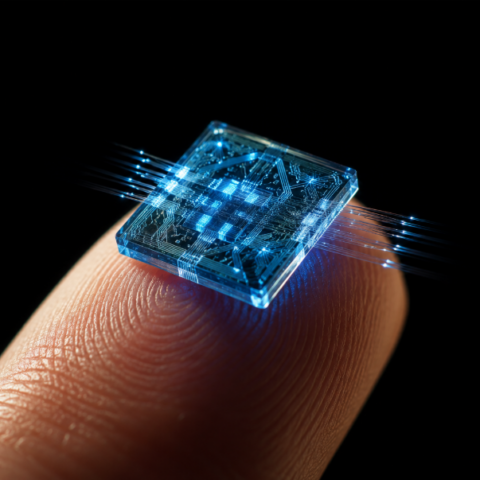
Take a look at this… It’s a radical “light-speed” device that’s turning AI as we know it into “Accelerated AI”, making it 100 times faster and 100 times more energy efficient. In fact, Jensen Huang, Nvidia’s founder and CEO, says this device is shattering the limitations of AI and without it, AI can’t scale. If you want to discover what this technology is, why Nvidia is betting billions on it… And the one stock we believe could be the biggest winner when “Accelerated AI” goes mainstream… Click here to see all the details.
Question for Jeff.
I have spoken with a local space, let’s say, nerd, who has been into space things for decades and has his own space museum. Amazing place with satellite feeds, real space suits, models, space junk, you name it, it’s there.
We talked about having AI processors in space to utilize the ‘free’ energy and cold conditions.
He said the cooling was a huge issue, as there is no easy way to dissipate the heat, as there is no ‘air’ to absorb it. Is he right? How do they do it?
Love your articles.
Regards, Dave. New Zealand.
– David H.
Hi David,
Well, he’s definitely right.
The cooling of the computing system is one of the biggest challenges to solve, and it hasn’t been demonstrated at scale yet. This is an engineering problem, however, and it is manageable.
The general rule of thumb is that for every 1 kilowatt of power, you’d need 1 square meter of radiators. Or for every 1 megawatt, you’d need at least 1,000 square meters of radiators.
This means that the radiators will make up the largest amount of mass of an AI satellite. It’s wild to think of it this way, but it is all because it is so difficult to radiate the heat in space without cold air or cold liquid as is used in data centers on Earth.
Most of the players in the AI satellite space are planning to pull the heat away from the processors using a cold plate and/or thermal interface material. Then they’ll use pipes that pump fluids to shuttle the heat out across the large radiators, and then the heat is radiated through the radiator panels in infrared.
SpaceX is planning for its AI1 satellites to have large radiators that are oriented edge-on to the sun (i.e., the edge of the radiator faces the sun). This is done so a two-faced radiator will be more effective at radiating heat on both sides, pumping heated liquid through the radiators.
Another interesting design is by Sophia Space, which will create computational “tiles” whereby one side of the satellite will have the solar panel underneath, which will be the semiconductors, and on the other side that faces away from the sun will be the radiator.
The idea is that with this design – about a square meter in size – there will be no need for pumps or coolant loops. There will just be a passive radiator to spread the heat and dissipate the heat in infrared into space.
I like this design. It is elegant in its simplicity, and it will also reduce the weight of the spacecraft (i.e., cheaper to launch).
Both approaches will work. In the end, it will come down to which designs are the most economical and performant. And for us to understand that, we’re going to have to launch systems into space and see how they function in a real environment.
Love your articles about what is happening in the crypto world. You talk about things that are very interesting. I would like to see some articles explaining how to do what you talked about in your article, “Your Next Loan Won’t Come From a Bank” on Oct 2. What would I need to do to become a depositor earning 7+% interest? Would it be liquid like a deposit in a bank? How would I go about getting a loan? Details about how to do some of these things would be appreciated.
– Greg L.
Ben Lilly here. Thanks for your question, Greg.
The ability to create your own loan from assets you own is already possible. It’s been possible for years. Tokenized stocks are simply the latest assets being used to borrow against.
Which means earning yield on lending out stablecoins or other assets is also possible, and has been for some time.
Where the possibilities to generate yield get really exciting is when you get outside of U.S. dollar stablecoins. For example, the possible yield earned on protocols like Aave is not dependent upon the Federal Reserve the way your local bank is.
It’s dependent upon the borrowers.
Which means as the activity in digital assets rises, the rates often rise with it. More attention, more activity, more borrowing. So, when the market realizes rising prices, yields rise with it.
The market is anticipating this. That’s why we’re seeing various applications releasing incentive offers.
Aave is rolling out its new mobile Aave app. You can find it by visiting aave.com and looking under products.
You’ll first need to join the waitlist. To do so, you can go to the website to download the app or search “Aave” in the Apple App Store on your mobile phone.
Here’s a screenshot of what that looks like. 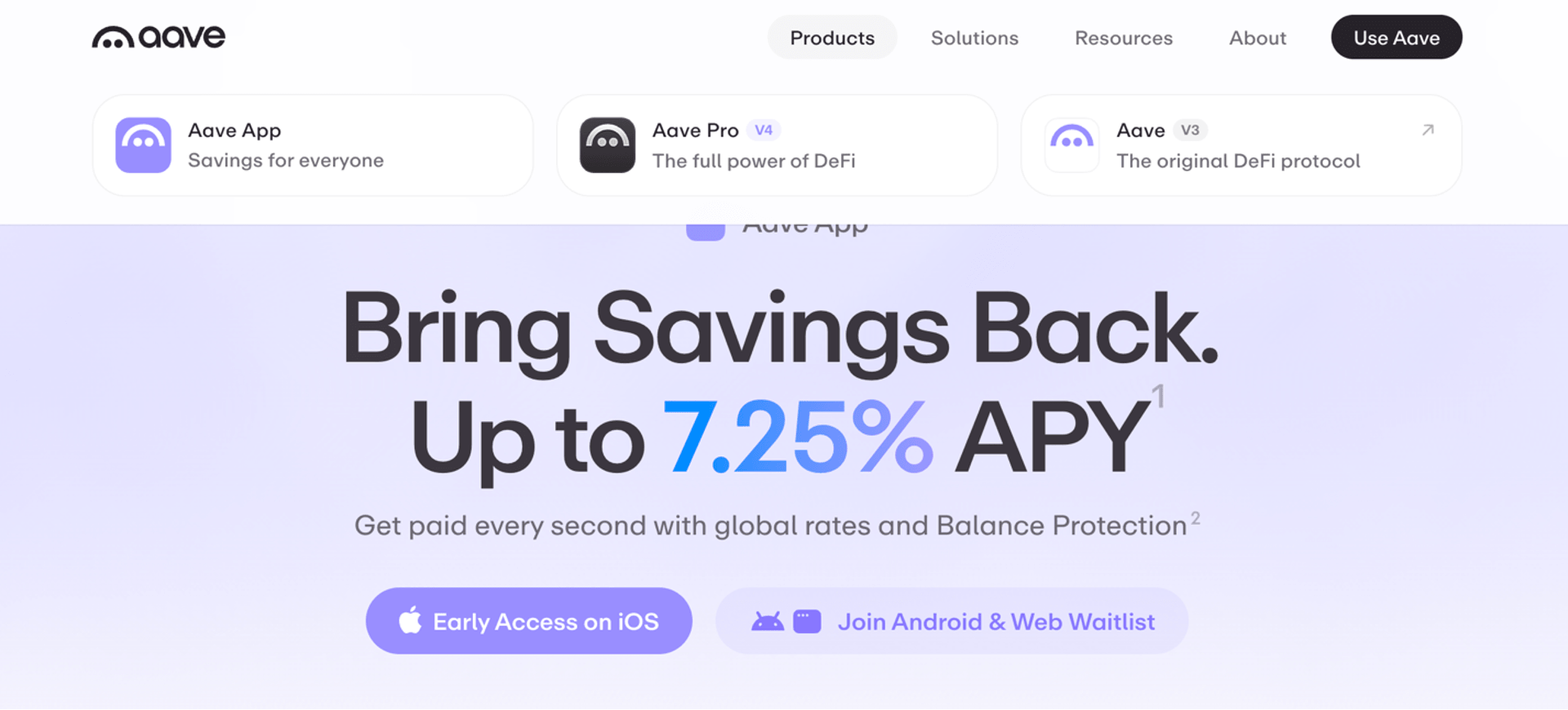
Once you download and open the app, it’ll ask for your mobile phone number, to create a password, select the country you live in, and your full name.
Once complete, you’ll be on the waiting list.
Once you’re no longer on the waitlist, you can follow the steps for depositing money.
Crypto has come a long way in terms of making it easy to complete this step. You can usually use Apple Pay, a debit card, or your checking account. You’ll also be able to deposit crypto via a normal wallet-to-wallet transaction.
The rate they advertise of 7.25% is for those who refer 15 individuals to join the app. But 6% is the actual amount you can get on day one.
That’s strong. But it’s also not the only opportunity out there…
Coinbase has an offer where you can join their Coinbase One program and receive 8.75% for 90 days up to $500,000. This is a short-term incentive they pay on top of the 3.75% they currently pay on USDC – a U.S. dollar stablecoin – held on their exchange.
Robinhood has an offer of 7%. It uses Aave’s competitor, Morpho, under the hood for the lending solution. Some of this yield is paid by Robinhood, as current lending rates are not at 7% today.
The point being here is that the digital asset market can pay these higher yields to earn your capital. There are fewer middlemen taking fees. And they view banking margins as an incentive that can be passed on to you.
Most of this ecosystem is centered on stablecoins as it relates to U.S.-based users, thanks to the GENIUS Act – the legislation that made U.S. dollar stablecoins legal.
CLARITY Act was supposed to do the same thing for tokenized stocks and other assets for U.S. individuals. But that was stalled in the Senate several weeks ago.
In response, the SEC and CFTC are pushing hard to make tokenized stock trading onchain legal for U.S. users. They are very close and getting closer still by the day.
Which is to say, today you’re asking about how to earn a higher yield via crypto on dollars… Tomorrow, you may be ready to ask how to earn a yield on your shares of Tesla.
We see this future coming. And we at Brownstone Research are committed to staying on top of the progress and bringing you the latest updates from the leading edge of the trend, so you can make the most out of the assets you hold.
We’ll definitely be providing more research in the future on this topic as the industry evolves along with SEC and CFTC regulations.
Take care, everyone. Have a great weekend.
Regards,
Add Brownstone Research as your preferred source on Google to see our latest stories in your feed.
 Add as a preferred source
Read the latest insights from the world of high technology.
Most Bitcoin predictions are not about being right... They're about grabbing a headline.
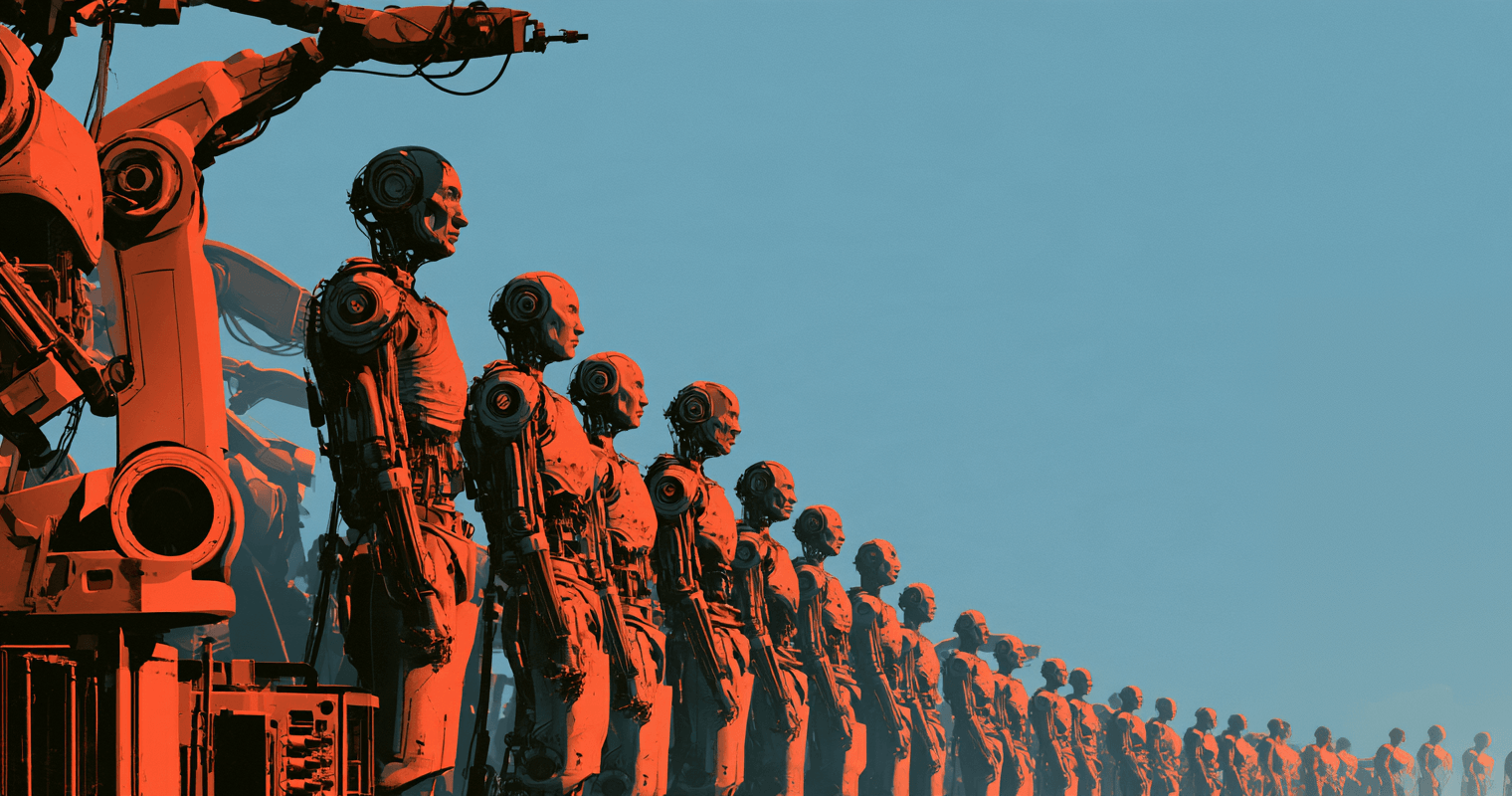
The fundamental relationship between man and machine has remained largely unchanged… Humans gave machines instructions, and the machines followed...

Tomorrow’s loans won’t be written by the banks of today. The deposits will flow to where the yield is....