


The Big Beautiful Breakup
The breakup needed to be public and raw so that it was believable.


The permissionless agentic economy is coming to life…

Managing Editor’s Note: In just a few hours, Jeff is teaming up with Jason Bodner for their Secret AI Stocks Summit…
They’re unveiling a system Jason has developed that’s capable of spotting the next AI mega-winners… stocks that many don’t even realize are connected to artificial intelligence.
But Jason’s system is designed to spot them long before everyone else catches on…
You can still go here to automatically add your name to the guest list. The big event is starting at 8 p.m. ET. We look forward to seeing you there.
The number of Ethereum active addresses just logged a record high…
This might come as a surprise considering the current malaise in the cryptocurrency markets.
The blockchain network clocked an impressive 1.65 million active addresses on February 8, topping the previous all-time high set in 2018 by more than 300,000. And much higher than the 250,000 to 500,000 range we saw throughout 2024 and the first half of 2025.
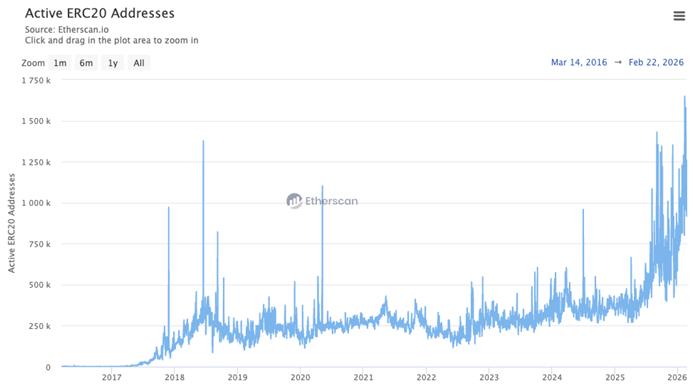
Source: Etherscan.io
The rise in addresses isn’t from market euphoria or a major selloff causing a surge in trade activity – a characteristic of most outlier readings…
It was a byproduct of something new – a technology released about 10 days before the new all-time high.
This isn’t a one-off, but a sign of something far greater. It’s a steady signal that transactional activity is accelerating on blockchains.
What we are witnessing is the AI agents coming online. The permissionless agentic economy is coming to life.
Longtime Bleeding Edge readers will be familiar with this concept. We’ve covered the rising agentic economy wherein AI agents find a home on public and permissionless blockchains in these pages before in issues like The Permissionless Agentic Economy and The Agentic AI Undercurrent.
As for why this onchain shift makes sense, it’s straightforward. Public blockchains, the digital asset being used for transactions, and the smart contract language are all entirely digital. It’s as if public blockchains were made for them.
When we think about the use of AI with financial infrastructure, it makes sense to have a technological platform with a well-defined structure that makes it easy to interact and transact. This is what blockchain technology enables.
This stands in stark contrast to traditional finance (TradFi), which is built on friction and middlemen that allow value to be extracted at the expense of consumers and businesses using these traditional systems.
Agentic artificial intelligence is designed in a way that allows us to direct AI agents to perform a task, and they perform those tasks without us having to direct them through the process or oversee their every move.
The legacy financial system is not built for this.
These agents are purely digital, entirely software-driven. No human interface is required, and agents can navigate any system that has well-defined interfaces.
Take, for instance, this signature request. It’s a standard screen you might encounter while transacting onchain using a blockchain wallet like MetaMask.
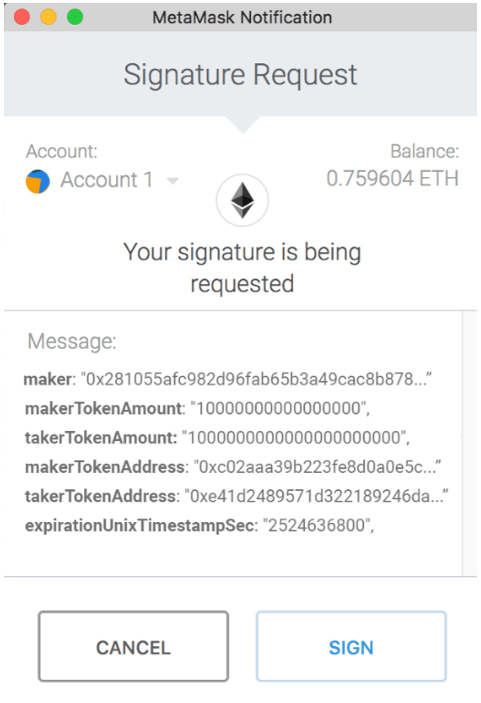
Source: Ethereum-magicians.org
It looks like a foreign language because it is a foreign language.
It’s code… A language easily understood by computers.
Onchain, all the smart contracts, signatures, verifications, and much more are often constructed not for humans, but machines. That’s because computers are the ones that ultimately verify a transaction or approve that the blockchain is working correctly.
It’s not some covert underworld happening on servers. It’s simply the operating system of the future of finance. It’s why newcomers find learning how blockchains work, the ins and outs of transacting onchain, or how smart contracts function requires months of education.
But for computers, it’s merely standard operating procedure. We don’t need to understand what each line of code means, just that the result is what we expect. And machines are helping us get there more easily.
What’s more…
The friction is minimal onchain for agents.
A wallet doesn’t require a driver’s license, social security number, or bank account information to get started. It merely needs an internet connection and a few dollars’ worth of tokens.
This is why onchain solutions, as opposed to standard bank accounts, are preferred. The agent can tap whatever solution they need as they need it.
Once equipped, the digital wallet is primed for agentic activity on the blockchain. The world of decentralized finance (DeFi), sourcing additional compute, chatting with other wallets, creating a website, and so much more, is possible.
It’s a toolkit for agents to become businesses, service providers, or assistants.
And the most recent release from Ethereum that pushed address usage to new highs is bringing this reality to the forefront.
The newest coding standard for Ethereum hit on January 29. It’s called ERC-8004.
I first wrote about ERC-8004 in August last year in The Bleeding Edge – A New Asset Class Is Coming.
The standard was still new at the time, too new to write extensively about the degree of its influence and impact yet. But our take was that it would act as a major catalyst for future innovation.
The standard does something very fitting for a trustless blockchain – i.e., a decentralized network where you can transact directly without relying on a “trusted” middleman. There’s no specific gatekeeper saying something is good and something else is bad. It instead operates in a meritocratic way. You do the job, your trust grows.
In traditional finance, this might sound familiar… It’s essentially a Better Business Bureau for onchain agents.
That means if someone you’ve never heard of before releases a new ERC-8004 agent, they need to earn trust scores in real time.
Every interaction, assistance in swapping assets, finding the best yield, relaying price information, or answering messages is getting graded.
It’s a check-and-balances system where the best agents earn your business.
And since public blockchains are immutable ledgers, this track record persists indefinitely. There is no favoritism, phone call, bid, or hidden deal that can be made to get a bad review erased from a website.
That’s how this development is “trustless.” It’s a system that leverages transparency over having to blindly trust or put faith in intermediaries who might have their own angles and motivations… You can simply see for yourself on the ledger.
The upgrade was highly anticipated by agent developers. We can see this in the fact that in the weeks following the release of ERC-8004, tens of thousands of agents created accounts.
Here’s a chart that showcases the explosion in agents hitting the scene.
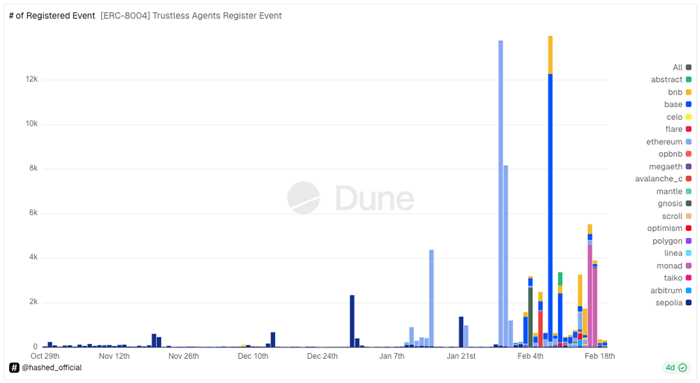
Source: Dune.com/hashed_official/erc8004
There were more than 50,000 agents launched on Ethereum and its layer-two chain, Base, alone in the days that followed.
And since the new standard is on Ethereum, many other blockchains that are based upon a similar codebase called the Ethereum Virtual Machine (EVM) started seeing agents register.
These chains included popular networks like Binance Smart Chain, Celo, Avalanche, Mantle, Polygon, Monad, Arbitrum, and more.
It was a subtle Cambrian explosion of activity centered around trustless agents setting up their trust score registry.
The surge in activity is promising.
Developers are eager to test and iterate on their solutions in real time. They’re eager to let the market score their services. And so far, we’re seeing a variety of offerings.
The obvious use cases are centered around financial DeFi solutions… Things like finding the best market yields, ideal swap markets, and the most efficient borrowing solutions.
But we’re also seeing some pretty novel ones… Such as sports betting market analysis, robotics engineering and computer vision, content creation, website development, and more.
It’s becoming the equivalent of freelancer websites like Fiverr and Upwork, but for onchain agents.
But there’s no payment or billing page in these instances. Agents can use a micropayment solution built upon a solution called x402.
We’ve covered x402 before in a previous Bleeding Edge – The Forgotten Code. It makes use of code that was made decades ago but has since been refitted for public blockchain solutions.
This simple tool lets an agent know that whatever they are trying to access requires a payment and enables agents to make small payments for services without needing to use a credit card, fill out billing information, or provide other payment information.
Micropayments are a corner of the payment market that credit card companies can’t compete in due to their transactional minimums. Which is why x402 is being described as the payment rails for machines to interact and transact.
It’s not designed or intended for human use cases but rather is centered around the future users of public blockchains – machines.
The trend is early. The excitement is real. And the standard was just introduced to Ethereum weeks ago. This is just the first wave of agents setting up identities onchain.
But more waves will come.
According to agdp.io – a website that tracks agent revenue – the economy for agents just surpassed $2.5 million. By the end of the year, we should expect this figure to be nine figures.
This is a productive and meaningful development for blockchain technology.
We have a clear sign that the permissionless agentic economy is gaining momentum.
It’s a trend we’ve been tracking closely here at Brownstone Research and at our long-term cryptocurrency service, Permissionless Investor.
The future of finance is onchain.
AI solutions such as chatbots and onchain agents like ERC-8004 will become part of our everyday financial lives. As more people become aware of this and the impact this technology will have on the financial system, onchain usage will surge to unprecedented levels.
And as usage grows, the native tokens for the networks where these agents reside will be in great demand… A demand that will spark a major re-pricing event across the industry.
In a world where our agents are transacting throughout the day autonomously, most folks truly don’t realize how significant a shift is coming to the digital asset market.
You heard it here first. And you can be sure you’ll hear from us again as the story develops and the trend plays out.
Your Pulse on Crypto,
Ben Lilly
Senior Crypto Analyst, The Bleeding Edge

Read the latest insights from the world of high technology.
The breakup needed to be public and raw so that it was believable.

It’s flashy… the sort of announcement that seems specifically designed to catch headlines.

Grok 4.2 has evolved into something so much bigger than what was originally planned…
Thanks for signing up for The Bleeding Edge — we’re glad you’re here!
Want updates sent straight to your phone too? Sign up for SMS alerts to get the latest delivered via text.
Brownstone Research: By submitting your phone number, you agree to our SMS Terms & Conditions, Terms of Use, & Privacy Policy, and give express written consent to receive marketing text messages from BSR. Messages are recurring & frequency may vary. Reply STOP to 94703 to opt out. Reply HELP to 94703 for info. Consent is not a condition of purchase. Message and data rates may apply. For additional information, you may contact Customer Service at 888-512-0726 or smssupport@brownstoneresearch.com.