

The Beginning of an Entirely New Industry
OWS is an entirely new industry that will experience explosive growth in the next few years, and one that...


To oversimplify the intelligence-to-price ratio… it is getting much, much cheaper to run AI applications.

Managing Editor’s Note: Tonight’s the night…
In just a couple of hours, Jeff is diving into the next generation of artificial intelligence… the economic impact that will follow once we achieve it… and how now is the time to be getting ready.
If you want to learn how you should be positioning yourself ahead of “what’s next” in AI, just go here to automatically sign up to attend tonight.
There isn’t much time left until the show kicks off at 8 p.m., so make sure you get your name on the list if you want to know how we’re planning to play the next AI boom. We look forward to seeing you there…
It’s been the single most exponential trend all year…
And it’s been easy to miss.
With all the bells and whistles we’ve been reading about in The Bleeding Edge – highlighting all the incredible breakthroughs that have been happening as a result of this semiconductor-enabled, intelligent-reasoning software that has taken the world by storm…
This one will take the cake.
Seeing it is believing it.
So that’s exactly what we’ll do today. We’ll show you.
It is the most powerful trend that allows us to understand why AI adoption has been so quick, why the business models are sound, and why the explosion in productivity and GDP growth will be unlike anything in history.
We haven’t seen anything yet.
I’m referring, of course, to the exponential decline in the cost of “intelligence.”
Conceptually, it might be a bit tricky to understand…
So here’s a simple way to think about it: “cost of intelligence per unit of compute.”
Another way to think about it is that per unit of intelligence (a stated AI output), the costs are declining exponentially. It’s costing less and less to arrive at the same AI output.
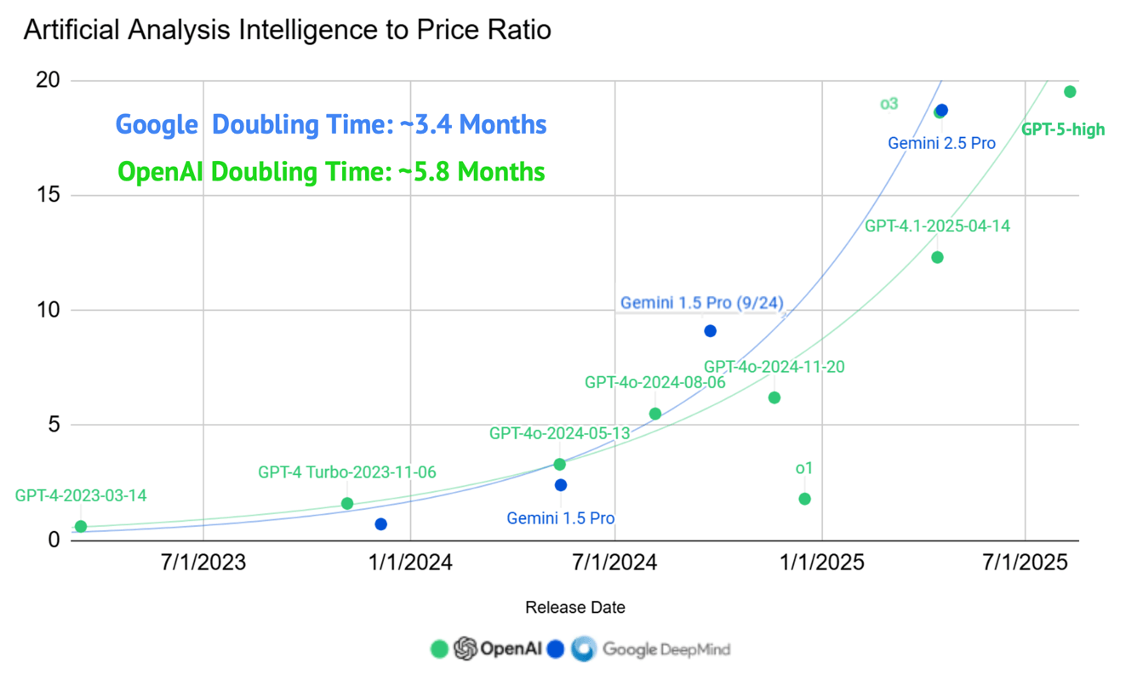
Shown below is an example of the “Intelligence-to-Price Ratio” of two prominent frontier AI models, OpenAI’s GPT and Google DeepMind’s Gemini.
Source: Air Street Capital
The chart above is useful because we can see the inflection point in late 2024, where the curves start to go exponential.
“Intelligence-to-Price Ratio” is just another way of saying that the cost of running frontier AI models is declining exponentially per unit of intelligence.
To oversimplify, it is getting much, much cheaper to run AI applications.
The chart above demonstrates that OpenAI’s “doubling time” is down to 5.8 months, and Google’s doubling time is down to 3.4 months.
For reference, Moore’s Law is predicated on a doubling time of 18–24 months.
Just 3.4 months is mind-blowing.
And the above data is through July of this year. It’s now December…
By the above metrics, OpenAI’s cost per unit of intelligence has already fallen by half again, and Google’s cost has almost fallen by half twice (two halvings).
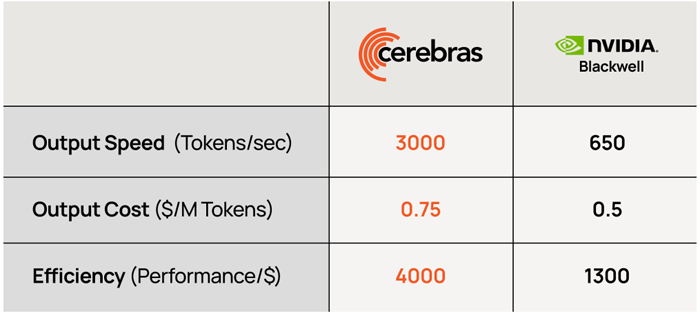
To put things in perspective, the cost of the output of a million tokens from an AI model has dropped below $1.
A token can be a short word, a part of a long word, or punctuation.
A simple way to think of the relationship between tokens and words is for every 100 tokens, it equates to about 75 words.
Source: Cerebras
So for just 50 cents, we can get 750,000 words of output from an AI model. That’s how cheap running AI software has already become.
How is this possible?
There is some nuance here we must understand, because cost is absolutely dependent on which semiconductors are being used for inference, and which AI models are being run.
With every successive release of bleeding-edge semiconductor technology – and with every new frontier AI model – they become more efficient per unit of compute. Which is to say, the cost per unit of performance continues to decline exponentially.
The chart below is even more dramatic, demonstrating the difference between an “older” frontier model like GPT-3.5 (in green) declining in cost by 9X a year, and the more advanced GPT-4o model declining at a precipitous 900X a year.
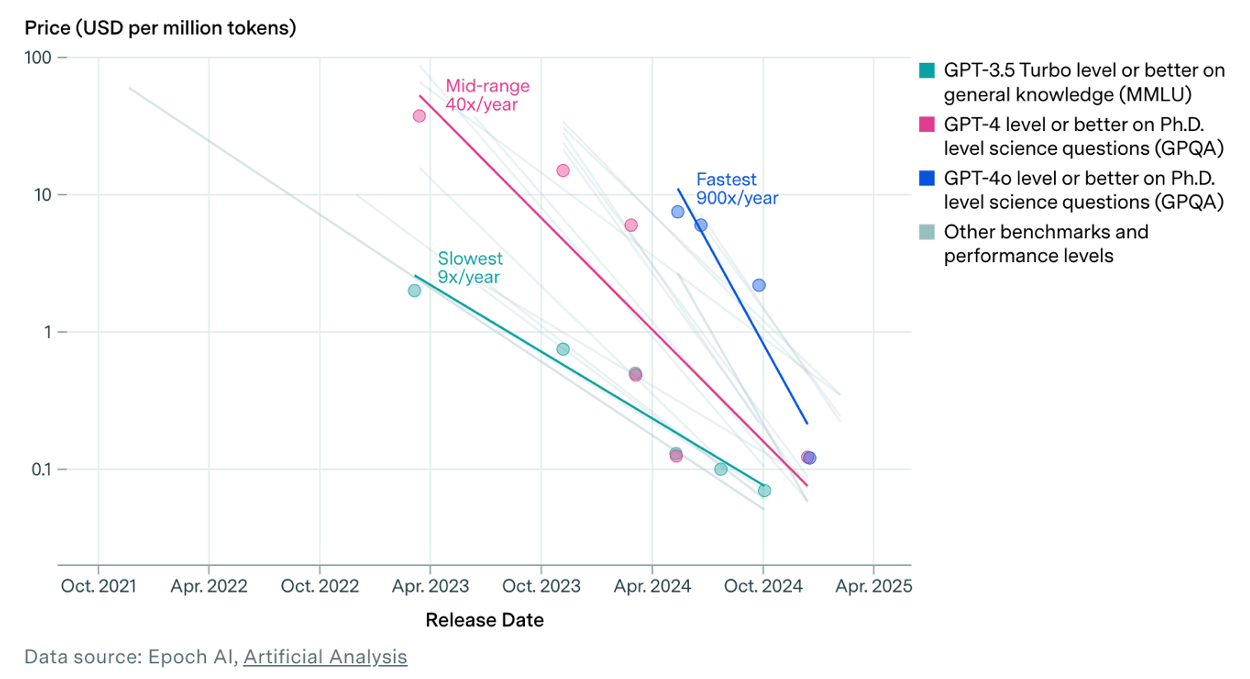
A 900X decline a year in the cost of outputting 1 million tokens (~750,000 words).
Months from now, that cost will become pennies. Affordable for anyone.
That’s why the Jevons Paradox is being discussed so widely in the industry now.
The principle is simple: As efficiency improves, it drives down costs. And as costs decline, consumption increases.
There has never been a more appropriate example of this than with what is happening with artificial intelligence.
This is the Jevons Paradox in hyperdrive.
At a 900X decline per year, we’re at warp speed right now.
And personalized agentic AI capabilities that will become widely available next year are the “agents” that will accelerate adoption beyond light speed.
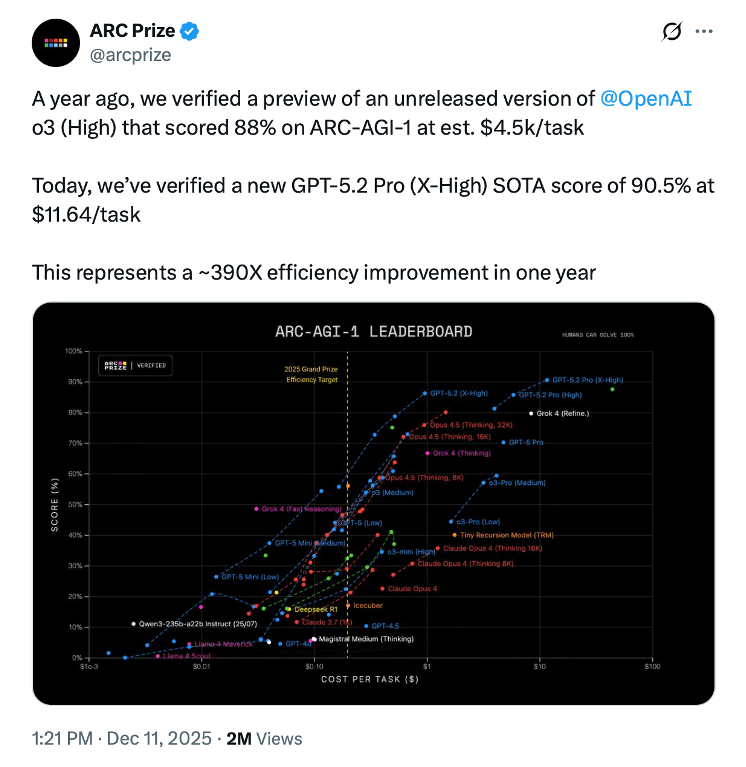
I’ve been thinking a lot about this acceleration in the last few months. And I was reminded of this a few days ago, when the ARC Prize organization provided an end-of-year update on its ARC-AGI leaderboards.
Source: ARC Prize
The latest release from OpenAI with its GPT-5.2 is impressive.
It was no doubt a rush for OpenAI to push out an out-of-sequence release (5.2 rather than 5.5 or 6) as the company was getting trounced by Google’s Gemini and xAI’s Grok – see The Bleeding Edge – Google is Back in the AI Race.
The leaderboard will be different by January, but that’s not the key point…
What is relevant is that the latest leaderboard has shown the dramatic difference in cost per task of the ARC-AGI-1 test for artificial general intelligence (AGI).
That cost has declined from $4,500 per task to just $11.64 per task, now scoring 90.5% on the ARC-AGI-1 test. That represents a 390X improvement in efficiency. In a single year.
Almost unbelievable…
The same is true for the ARC-AGI-2 test, which is much harder than the original ARC-AGI-1 test.
GPT-5.2 is now the first to achieve more than 50% on the test, overtaking Gemini 3 Pro and Grok 4 at just $15.72 per task.
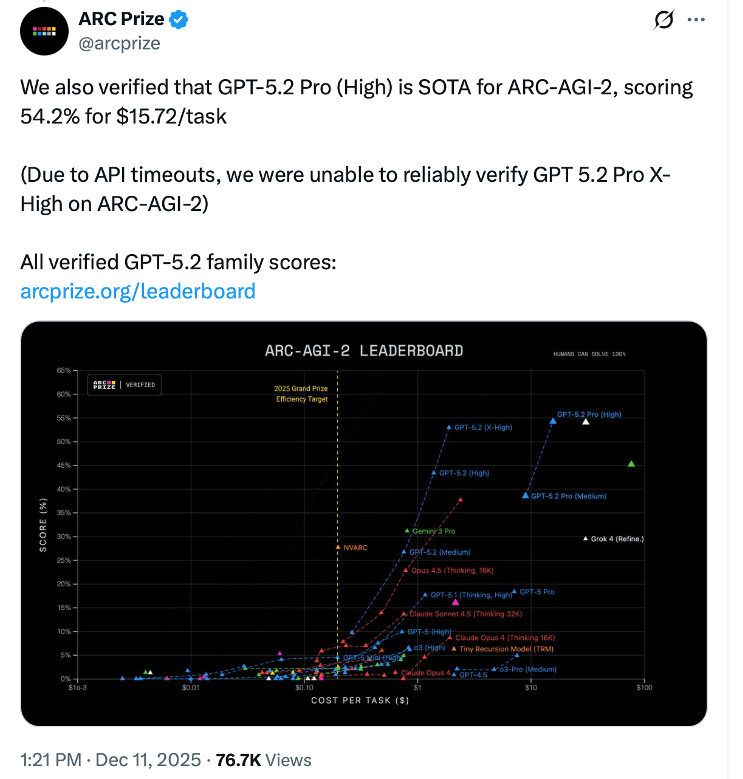
What’s incredible is that in 2026, the above chart is going to bend back on itself.
It will curve to the left, as the cost per task declines to less than $0.50 and the score nears 100%.
ARC Prize set a Grand Prize challenge to achieve $0.20 per task this year.
That was very aggressive, and it didn’t happen this year, but with another 390X improvement in efficiency in 2026, it will happen next year.
What comes next?
The team at ARC Prize will release a devious ARC-AGI-3 challenge. This will require advanced reasoning for an AI, which will be required to demonstrate the ability to learn and generalize in novel environments.
And it all must be done efficiently (i.e., cheaply).
What’s after that?
AGI. And it’s months away.
And despite the trillions of dollars being spent to build AI data centers in this once-in-a-lifetime race, this technology will be dirt cheap to run. And it will be available to everyone on the planet who has access to the internet.
It will be the most rapid adoption of technology in history.
It will be unlike anything we’ve ever experienced before.
Get ready for a wild year.
Jeff

Read the latest insights from the world of high technology.
OWS is an entirely new industry that will experience explosive growth in the next few years, and one that...

One of the most exciting topics of the Fusion Industry Association’s Annual Policy Conference is the proximity of not...

Someone with no medical training whatsoever leveraged AI to devise a custom cancer vaccine entirely on their own, in...
Thanks for signing up for The Bleeding Edge — we’re glad you’re here!
Want updates sent straight to your phone too? Sign up for SMS alerts to get the latest delivered via text.
Brownstone Research: By submitting your phone number, you agree to our SMS Terms & Conditions, Terms of Use, & Privacy Policy, and give express written consent to receive marketing text messages from BSR. Messages are recurring & frequency may vary. Reply STOP to 94703 to opt out. Reply HELP to 94703 for info. Consent is not a condition of purchase. Message and data rates may apply. For additional information, you may contact Customer Service at 888-512-0726 or smssupport@brownstoneresearch.com.