

The Beginning of an Entirely New Industry
OWS is an entirely new industry that will experience explosive growth in the next few years, and one that...


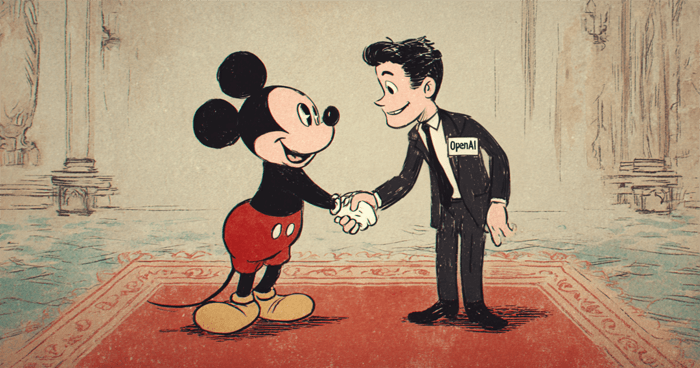
Last week, Disney and OpenAI agreed to a three-year licensing agreement...
Managing Editor’s Note: We’re approaching a significant inflection point for artificial intelligence…
AI systems are about to get faster, smarter, and better beyond anything we’ve seen so far. And now is the time to position ourselves ahead of the prosperity boom that will follow this AI advancement.
That’s why Jeff is sitting down to discuss the oncoming economic boom… the future of artificial intelligence… and how we can play it.
The event is kicking off at 8 p.m. this Thursday, December 18. You can go here to automatically add your name to the guest list.
A young child picks up a box of colored pencils…
She proceeds to draw a picture of her favorite Disney character.
That drawing is then displayed in public at a local art fair…
Constituting copyright infringement under U.S. law.
Legally, it would be considered a derivative work based on Disney’s own intellectual property. And without the explicit permission from Disney to produce the derivative work, damages could rightfully be claimed.
Now, of course, that doesn’t happen in practice.
It would certainly be bad business for Disney to sue every one of its customers who are inspired to create derivative works of characters they know and love.
And to state the obvious, it would be nearly impossible for Disney to police.
The cost of doing so would almost certainly exceed any value that could be received from pursuing legal action.
It’s kind of like what happened when smartphones came out. It became impossible to stop people from recording at concerts… because almost everyone was doing it and posting to social media.
But this problem of derivative works becomes much larger and tangible at the corporate level.
Specifically, what happens when a generative AI – like OpenAI’s ChatGPT or xAI’s Grok – trains on Disney images… and then produces what would be considered a derivative work, at the request of a user?
Uh oh…
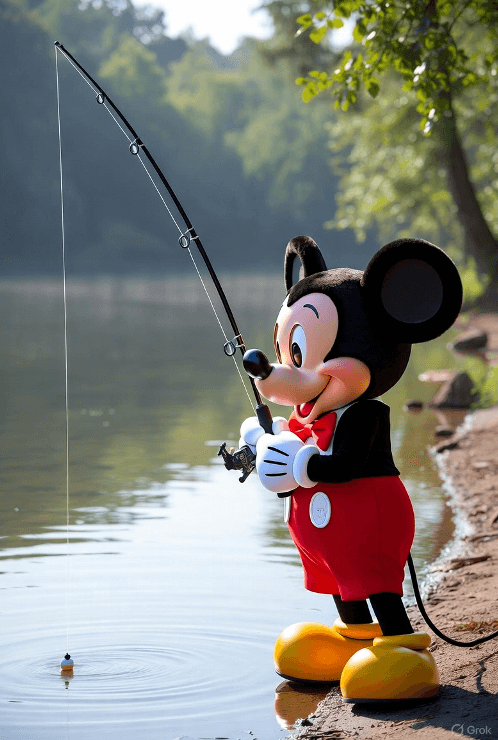
Image Created by Prompting Grok
Which party becomes liable, if any?
Is it the company that trained the AI model? The user who issued the prompt? The platform upon which the image was made public?
And to make matters more complicated, anyone with an internet connection has access to generative AI at no cost today.
That means billions of users around the world are creating images from the “minds” of AI models.
Good luck chasing them all down…
Which is why corporate content producers like Disney have targeted the enterprise, rather than the user/consumer.
This summer, Disney teamed up with Universal Studios, Marvel Characters, Lucasfilm, and Twentieth Century Fox to sue private generative AI company Midjourney for copyright infringement.
This is a landmark industry case, as it will set the tone for what is and isn’t permitted using generative AI.
Midjourney’s defense was filed this August, taking the position that its technology is capable of producing images representing characters under fair use.
That was the obvious position for Midjourney to take.
After all, its technology simply trains on, and learns from, publicly available images.
It doesn’t intentionally produce images for direct commercial gain. It’s generative AI technology that simply produces images at the request of a user.
Last month, the court consolidated the lawsuit against Midjourney with another content producer, Warner Bros Entertainment, which is currently in the process of being acquired by Netflix (NFLX).
Disney remains the lead on the lawsuit, and all motions are due by November 2026.
But I’m certain that the lawsuit will be settled before then, based on the latest development…
Last week, Disney and OpenAI agreed to a three-year licensing agreement that will allow OpenAI to use its Sora generative video AI to produce user-prompted, short videos that represent characters from the universe of Disney, Marvel, Pixar, and Star Wars.
For a licensing deal, it is highly unusual.
Not only does OpenAI not have to pay Disney any cash, but it will also receive a $1 billion investment from Disney.
That doesn’t mean that OpenAI isn’t paying anything, though.
As part of the equity investment, OpenAI is giving Disney warrants to purchase additional equity in OpenAI.
Warrants have value, and that value is what OpenAI is paying to Disney to produce these derivative works.
This is clearly an unusual situation, as OpenAI is seen as such an attractive investment by so many… with more upside ahead, despite its most recent $500 billion valuation at highly inflated valuation multiples.
Disney clearly felt that it would make a whole lot more money through its equity and warrants in OpenAI… than it would through a traditional licensing agreement.
This deal is the first of its kind, as it pertains to image/video generation using a generative AI.
And because OpenAI entered into the agreement as a first mover from a position of strength, it avoided any cash outlays and actually got paid $1 billion for allowing Disney to invest in OpenAI.
OpenAI is “paying” Disney – for OpenAI’s ability to use Disney’s copyrighted content – by issuing Disney warrants for future equity purchases in OpenAI.
This sets an industry precedent between content producer and generative AI company that will certainly be a topic of discussion in the Disney et. al. case against Midjourney.
Resolution from that lawsuit will likely come in 2026 from a deal struck outside of court between the content producers and Midjourney.
If that doesn’t happen, the court will have to decide if Midjourney’s use of copyrighted material for training and image generation is fair use or not.
The industry will be patiently waiting for an outcome.
Some earlier licensing deals for the purpose of training an AI model have been previously struck, like:
Many more will follow…
Those who are proactive in putting licensing agreements in place will be far better off than pursuing legal action, which is expensive and very time-consuming.
In this world – where data, images, and videos are all openly accessible in the public domain – thousands of AI models will exist that were trained on copyrighted material… and will then use that knowledge to produce user-prompted outputs.
And of course, the largest, most well-funded players in artificial intelligence will be the “targets” by the content industry.
Corporate content producers will naturally gravitate to where they know there is plenty of cash and a deal to be had, as they struggle for relevance in a world that will soon be able to produce realistic, high-resolution, hour-long, film-quality videos in a matter of minutes, turning the entire content production industry on its head.
Get it while you can…
Jeff

Read the latest insights from the world of high technology.
OWS is an entirely new industry that will experience explosive growth in the next few years, and one that...
One of the most exciting topics of the Fusion Industry Association’s Annual Policy Conference is the proximity of not...
Someone with no medical training whatsoever leveraged AI to devise a custom cancer vaccine entirely on their own, in...
Thanks for signing up for The Bleeding Edge — we’re glad you’re here!
Want updates sent straight to your phone too? Sign up for SMS alerts to get the latest delivered via text.
Brownstone Research: By submitting your phone number, you agree to our SMS Terms & Conditions, Terms of Use, & Privacy Policy, and give express written consent to receive marketing text messages from BSR. Messages are recurring & frequency may vary. Reply STOP to 94703 to opt out. Reply HELP to 94703 for info. Consent is not a condition of purchase. Message and data rates may apply. For additional information, you may contact Customer Service at 888-512-0726 or smssupport@brownstoneresearch.com.