

Luddites vs. Effective Acceleration
Warning for anyone who has anxiety over the impact of AI on work, this is bound to cause convulsions....


After nearly four years of a brutal biotech bear market, the industry has sprung back to life…
Managing Editor’s Note: Don’t forget to go here to automatically sign up to join our colleague, Larry Benedict, for his Get Rich Slow event this Thursday at 8 p.m. ET.
He’s got a strategy for tapping into the volatility he sees coming down the line in 2026 to collect short-term, double-digit gains. The bigger the swing, the bigger the profit.
Over and over again.
Just go here to sign up with one click to join Larry on January 15… you’ll hear from him about what’s driving these swings and how you can use his strategy to make the most of them.
The biotech industry has sprung to life in the last few months… after nearly a four-year, pandemic-induced bear market.
If you have ever experienced a biotech bull market, you know they are spectacular.
And I believe the one starting now will be unlike anything we’ve ever seen.
We’re now in a declining interest rate environment, which has historically benefited the biotech sector, combined with near-record levels of dry powder – private equity capital yet to be deployed – of almost $2.2 trillion.
The accelerant to this biotech bull market, however, is something that has never existed in any previous biotech bull markets…
Artificial intelligence.
I’ve been writing about the AI-powered discoveries in The Bleeding Edge for years now.
Industry adoption of the technology has been rapid, considering the breakthroughs that have been made available in life sciences.
I wrote recently about the seventh anniversary of Google DeepMind’s creation of AlphaFold in The Bleeding Edge – How DeepMind Made History.
AlphaFold 2 brought us 200 million accurate predictions of the structure of every known protein.
Then AlphaFold 3 went even further, not just predicting the structure of proteins, but those of DNA, RNA, and ligands.
These discoveries would have been impossible without artificial intelligence.
And they have already been used by more than 3 million researchers in more than 190 countries.
The rate of adoption has been extraordinary. And while we’ve already started to see the results of this incredible breakthrough, we are still at the earliest stages of what will become possible.
Or how about ATOMICA, a geometric deep-learning model developed by a team at Harvard Medical School? It discovers atomic-scale representations of intermolecular interfaces across five modalities:
Meta, of all companies, released its Universal Model for Atoms (UMA) – predicting all the forces and energies between atoms.
It can simulate materials, molecules, and sorbents (materials that collect liquids or gases).
This was something that was previously impossible to do at any scale.
I wrote about these recent developments in The Bleeding Edge – Proton Concentration last December.
I think of these open-source developments as accelerants because they are already accelerating the drug discovery and development process.
Biotech companies are using this profound and newfound biological knowledge to their advantage.
And they are employing their own AI tools for their specific therapeutic programs.
AI not only discovers high-efficacy drug targets in a fraction of the time that it used to take, but it also can understand which compounds will have a high level of toxicity, thus avoiding therapeutic programs that take years and millions of dollars only to find that the drug has terrible side effects.
The result will be dramatically better outcomes for patients.
Drugs will have higher efficacy, lower toxicity, and come to market faster – all thanks to massive computational resources and artificial intelligence.
And if all this wasn’t enough to light a fire under the biotech sector, there’s the patent cliff.
Between 2025 and 2030, one of the largest periods of patent expirations is scheduled to hit the pharmaceutical industry.
Somewhere between $230-400 billion in revenues are at risk.
And therein lies our opportunity, as investors.
Once drugs come off patent, generic drug manufacturers can produce the same drug and sell it at a fraction of the price.
Here are just a few examples of major drugs facing patent expirations in the coming years:
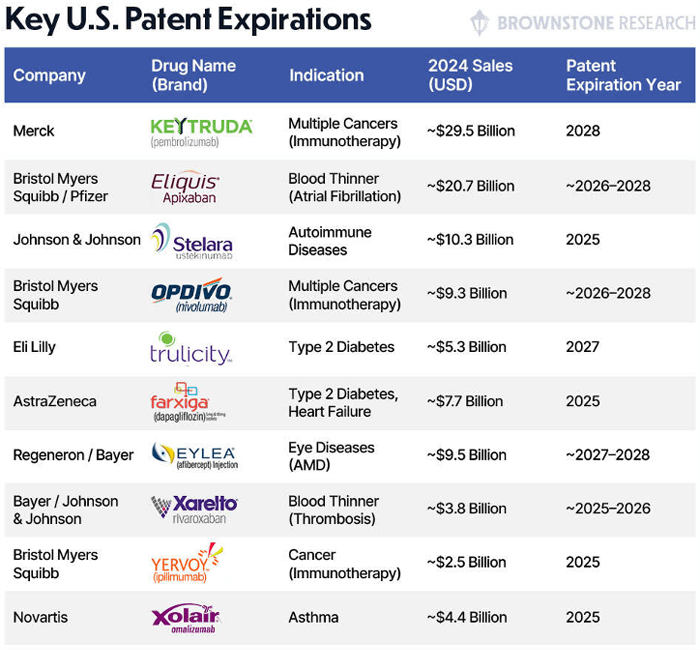
There are some absolutely blockbuster drugs in here – like Merck’s Keytruda for cancer, Bristol Myers Squibb’s (BMS) Eliquis for atrial fibrillation, J&J’s Stelara for autoimmune diseases, BMS’s Opdivo for cancer, and Eli Lilly’s Trulicity for type 2 diabetes.
Every pharmaceutical company is faced with the same problem when it has patent expirations: How will they replace that revenue?
The answer is simple: They have to acquire biotech companies with revenue-producing drugs to offset their revenue declines.
And the last few months have been incredible.
Look at some of the acquisitions just since October 2025:
And these are just the highlights.
Twenty-one acquisitions have taken place since September, and we can expect a whole lot more this year.
But there is one major issue that only industry insiders know…
The number of biotech companies that have FDA-approved drugs and are generating a material amount of revenue – revenue that would help big pharma replace their lost revenues due to the patent cliff – is also falling off a cliff.
And what this means is that pharmaceutical companies will have to move down the ladder to earlier-stage biotech companies that have promising drugs in later-stage clinical trials – but are still pre-product revenue – for their acquisitions.
And this M&A activity is going to fuel this biotech bull market.
When biotech companies are acquired, investors take their profits, and they recycle that capital back into a hot market to generate even higher returns.
And those who built those acquired biotech companies step into their next opportunities, raise capital, and build something entirely new.
Only this time, they’ll be leveraging vast computational resources and artificial intelligence.
And starting this year, they’ll also be leveraging artificial general intelligence (AGI), which will be capable of self-directed drug research.
The investment implications are incredible, which is why I’m leaning hard into biotech this year.
There is a lot more to come…
Jeff

Read the latest insights from the world of high technology.
Warning for anyone who has anxiety over the impact of AI on work, this is bound to cause convulsions....

Last week, Block CEO Jack Dorsey announced that the company would be cutting its organization almost in half…

We can’t provide any personal investment advice, but we can use a question as an example of how to...
Thanks for signing up for The Bleeding Edge — we’re glad you’re here!
Want updates sent straight to your phone too? Sign up for SMS alerts to get the latest delivered via text.
Brownstone Research: By submitting your phone number, you agree to our SMS Terms & Conditions, Terms of Use, & Privacy Policy, and give express written consent to receive marketing text messages from BSR. Messages are recurring & frequency may vary. Reply STOP to 94703 to opt out. Reply HELP to 94703 for info. Consent is not a condition of purchase. Message and data rates may apply. For additional information, you may contact Customer Service at 888-512-0726 or smssupport@brownstoneresearch.com.