



Anduril’s Arsenal
This is a landmark deal and the most significant initiative in shipbuilding and defense technology since World War II.



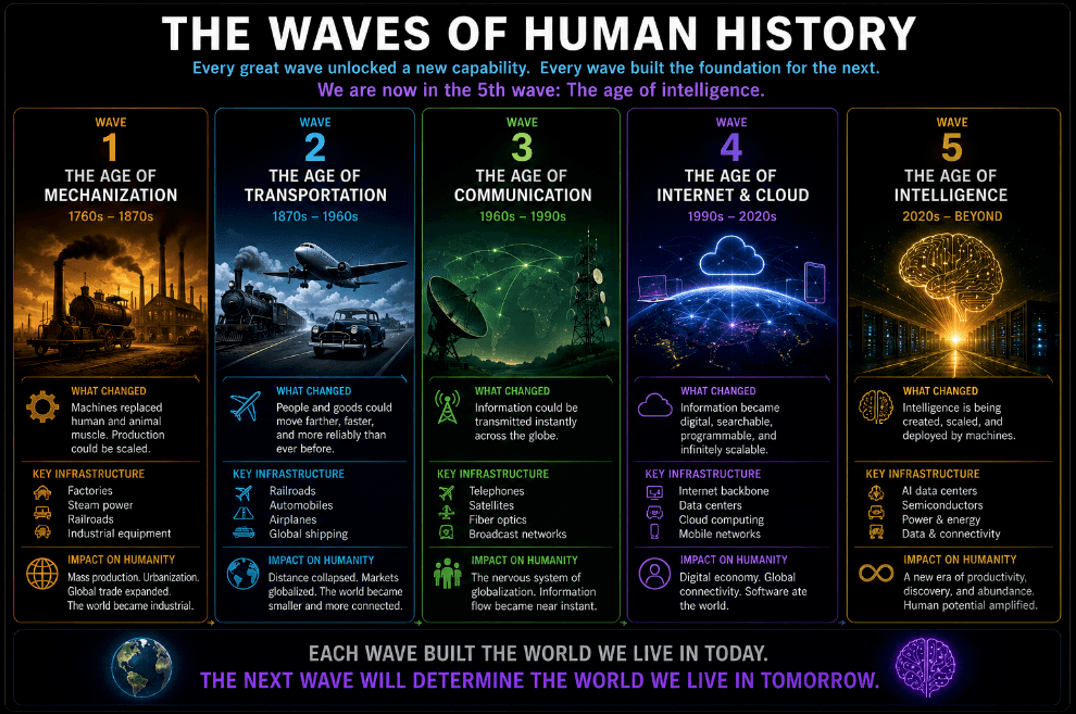
Human history tends to move in waves of innovation... and now, we're entering the next wave.
Managing Editor’s Note: Today, we’re handing over the reins over to longtime friend of Brownstone Research, Jason Bodner…
But first, Jason and Jeff have a warning… A proprietary indicator with a 100% accuracy rate going back years is signaling that a radical shift in the stock market is coming… a “regime change” that’s just weeks away from taking shape.
Jason’s seen this sort of shift happen three times in the past decade… and if history is any indicator, today’s top stocks could be overthrown by a group of unknown plays once the regime change begins.
If you want to learn more, you can join Jeff and Jason next Wednesday, May 20, at 8 p.m. ET. You’ll hear from them about this regime change… what’s prompting it… and a strategy you can use to potentially spot the new winners right before they break out.
Just go here to automatically add your name to the list… then read on for Jason’s Bleeding Edge feature.
In this issue, he’s diving into artificial intelligence as the fifth wave of human innovation… and the many layers of essential infrastructure that make up the foundation of this transformational technology.
Human history tends to move in waves of innovation.
The Industrial Revolution mechanized labor. Steam engines, factories, railroads, and steel transformed production and reshaped the global economy. Human muscle was amplified by machines.
Then came transportation. Automobiles, aviation, container shipping, and interstate highways collapsed distance and connected the physical world in ways previous generations could barely imagine.
Then communications. Telephones, satellites, fiber optics, and wireless networks enabled information to move across the planet, instantly, connecting the world in real time.
Finally, the internet digitized the economy. Software, cloud computing, smartphones, and search engines changed how people work, communicate, consume media, and build businesses.
There’s a pattern here as well. What we might consider sleepy, boring cash cows were once – at the start of the new wave – exciting upstart growth companies.
And now we are entering the next wave… with the next surge of huge growth stories.
Of course, I am talking about artificial intelligence (AI).
But unlike prior software revolutions, the AI boom is demanding a massive physical buildout beneath the surface of the economy.
The cloud used to feel weightless… just ones and zeros silently moving our data around in the air. Now, AI is making it heavy again.
Behind every AI model is a massive industrial system of electricity, water, fiber optics, semiconductors, cooling systems, concrete, steel, and land. Investors often focus only on GPUs, but the modern AI data center is really a giant machine built to manufacture intelligence at massive scale.
And that machine is growing rapidly.
The Stargate Initiative made headlines back in January 2025 when it was announced that the venture would commit $500 billion to build out essential AI infrastructure. And it was the gunshot that made the race official.
The world’s largest technology companies are spending hundreds of billions of dollars building AI infrastructure. AI spend from just the top four AI hyperscalers – Microsoft, Alphabet, Amazon, and Meta – is projected to exceed $700 billion in 2026. This is just the top four.
Hyperscalers are aggressively expanding compute capacity because demand for AI workloads continues to accelerate.
And the numbers are staggering.
A single advanced AI data center can require hundreds of megawatts of electricity. Large campuses are projected to consume as much power as small cities. In Northern Virginia – the largest data center market in the world – utilities are struggling to keep up with demand growth from AI infrastructure.
And demand is outstripping supply.
The physical construction itself is enormous. Large hyperscale facilities can require tens of thousands of tons of steel and massive amounts of concrete simply to support the buildings, cooling systems, and backup power infrastructure needed to operate dense AI clusters.
Then there’s the cooling problem.
Modern AI chips generate an extraordinary amount of heat. NVIDIA’s latest systems pack massive computational power into tightly concentrated racks, creating thermal loads far beyond traditional cloud computing.
Air cooling is increasingly insufficient. Many next-generation facilities are shifting toward liquid cooling systems that circulate chilled fluids directly through servers and networking equipment.
Water usage is becoming a serious discussion point as well. Some estimates suggest large AI data centers can consume millions of gallons of water per day for cooling, depending on climate and infrastructure design.
In certain regions, utilities and municipalities are already discussing the best ways to balance future AI development with long-term water availability. Orbital data centers, where the heat can radiate into the near-absolute-zero temperatures of space, are in the works. These will also need specialized infrastructure for space-based AI architecture.
The result is that AI infrastructure no longer resembles traditional software scaling. It resembles industrial scaling.
The kind of scaling can be generationally transformative.
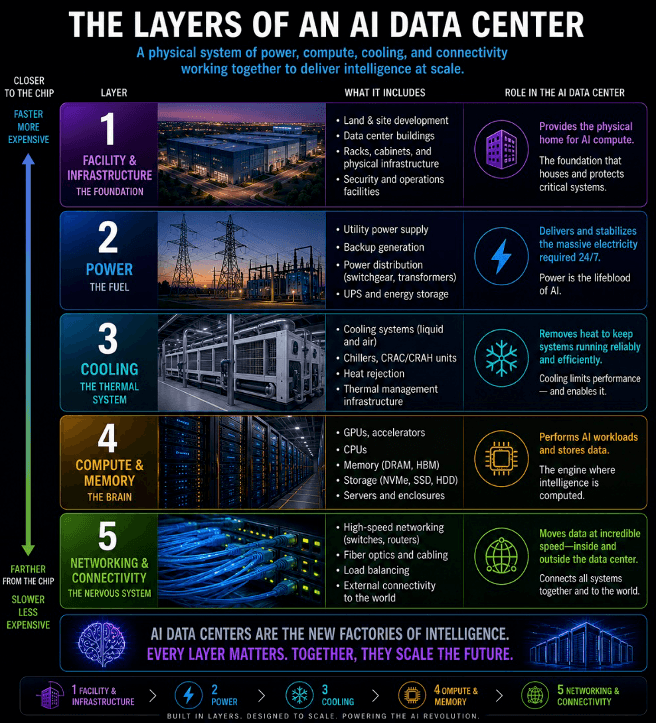
That infrastructure breaks down into five essential layers…
The first layer is land and buildings. AI clusters require enormous physical campuses with redundant systems, security, and room for future expansion. Location matters again because proximity to power, fiber, and cooling resources increasingly determines where data centers can be built, and why the builders are seeking solutions on multiple fronts.
The second layer is power… and the grid is under strain. Electricity may ultimately become one of the biggest bottlenecks in the entire AI buildout. Utilities, transformers, substations, backup generators, and grid modernization are all becoming critical pieces of the AI economy.
The third layer is cooling. Cooling systems used to be a background consideration. Now they are central infrastructure. Thermal management is becoming one of the defining engineering challenges of the AI era.
The fourth layer is compute and memory. This is where GPUs, CPUs, high-bandwidth memory, and advanced semiconductors sit. These components receive most of the attention because they directly perform the calculations powering AI systems.
The fifth layer is networking and optics. Massive AI clusters constantly move data between servers, racks, and facilities. Fiber optics, switches, interconnects, and optical networking systems act as the nervous system of the AI economy.
Importantly, growth is not isolated to one layer. That is why this opportunity appears so broad.
Memory companies are seeing demand surge because AI models require enormous datasets. Optical networking firms benefit because AI clusters move extraordinary amounts of information internally. Equipment manufacturers benefit because advanced chips require increasingly sophisticated fabrication processes. Utilities, power equipment providers, cooling specialists, and infrastructure firms are all beginning to participate in the same spending cycle.
This is why so many companies tied to data center activity are now projecting accelerating revenue growth over the coming years.
The market increasingly understands that AI is not just another software application.
It is infrastructure.
In many ways, this moment resembles earlier industrial expansions. Railroads needed steel. Electrification needed power grids. The internet needed fiber optics and wireless towers.
Artificial intelligence needs data centers.
And those data centers require an enormous physical ecosystem to support them.
The industrialization of intelligence may become one of the largest infrastructure buildouts of our lifetime.
This opportunity cannot be overstated.
Add Brownstone Research as your preferred source on Google to see our latest stories in your feed.
 Add as a preferred source
Read the latest insights from the world of high technology.
This is a landmark deal and the most significant initiative in shipbuilding and defense technology since World War II.
Google’s recent agreement reveals the scale of the AI power shortage and why supplying power is such an important...

There is something very special happening right now. A bloom of autonomous driving, and Austin is the epicenter.