


Leveraging AI for Personalized Cancer Therapies
Someone with no medical training whatsoever leveraged AI to devise a custom cancer vaccine entirely on their own, in...


There’s a financial tool of the ultra-wealthy that will soon be available to everyday investors, thanks to what’s going on in Washington, D.C.


In 2012, Oracle CEO Larry Ellison used an unusual financial tool to purchase a piece of paradise…
At 140 square miles, the small island of Lānaʻi is the sixth largest of the Hawaiian Islands. It’s mostly undeveloped, with not even a stoplight. And in 2012, Ellison purchased 98% of the island.
And bought it without spending a dime from his bank account.
Ellison didn’t draw from his savings or checking account when paying $300 million for his piece of paradise in the Pacific Ocean… nor did he liquidate any assets to raise capital for the island.
Instead, he used a tool reserved for the wealthiest of individuals and families in the world… a securities-backed line of credit (SBLOC).
This SBLOC allowed Ellison to pledge his Oracle shares as collateral for a loan.
SBLOCs don’t require borrowers to sell shares, which means Ellison could circumvent paying capital gains tax, the interest on the loan can be deducted from taxes, and the dividends from his Oracle shares can be used to pay off the loan.
It’s the ultimate tool for the wealthy to accumulate even more wealth.
Historically, SBLOCs haven’t been available to everyday individuals.
But thanks to the burgeoning digital financial ecosystem, these tools will soon be available to everyone, not just exclusively to the ultra-wealthy…
Projects such as Ether.fi are making it possible – and painless – to borrow against your assets.
We won’t have to be a private banking client with $10 million in a taxable brokerage account at banks such as Goldman Sachs or JPMorgan… or sign off on a stack of compliance paperwork to do it.
And the best part… crypto’s version of the Ellison loan will likely be available even sooner than we anticipated, based on recent news out of Washington, D.C.
Just a few days after President Donald Trump took the oath of office on January 20, he issued an executive order.
Titled Strengthening American Leadership in Digital Financial Technology, the order put a working group together of some high-level government officials, including the following:
It was an all-hands-on-deck approach to establishing the U.S. as a global leader in digital assets and blockchain technology.
Their task was to submit a report to the president in 180 days that would contain a suggested framework for governing the operation of digital assets in the United States. This included topics such as market structure, oversight, consumer protection, and risk management.
It was mandated to be detailed, transparent, and explicit. There would be no room for misinterpretation.
And in July, days after the report was submitted, the President, SEC, CFTC, and other relevant parties expressed alignment on one thing.
Bringing the financial system onchain. They called it Project Crypto.
Its implementation rests on the passage of a digital asset framework bill in Congress called the CLARITY Act.
This comes hot on the heels of the GENIUS Act – passed in July – which established a regulatory framework for stablecoins.
CLARITY was meant to go to vote in late October, but the government shutdown put everything on hold. As of now, it has already passed the House of Representatives. And from what we’ve recently heard, it seems next week it’ll be the hot topic in the Senate.
The bill is currently sitting in both the Senate Agricultural and Banking committees, where CFTC and SEC legislation originates.
Lawmakers have been consulting industry professionals over the last few weeks to get feedback on the bill’s language.
The goal is to see the bill move out of both committees before the New Year, which means we’ll want to be especially attuned to news coming out of Washington, D.C, next week.
The most interesting part, though…
Last week, the cryptocurrency exchange Kraken acquired Backed Finance – a company that creates something called xStocks. These are tokenized stocks and ETFs such as Apple, Nvidia, SPDR Gold Shares, Vanguard ETFs, Invesco’s QQQ, and the SPY.
We’ve discussed asset tokenization in previous issues of The Bleeding Edge… and this just goes to show that the industry isn’t waiting around.
Companies like Robinhood, Coinbase, Ondo Finance, and several others are racing ahead of Congress.
It’s why last week Larry Fink and Rob Goldstein from BlackRock were featured in The Economist, boasting the virtues of tokenization transforming finance.
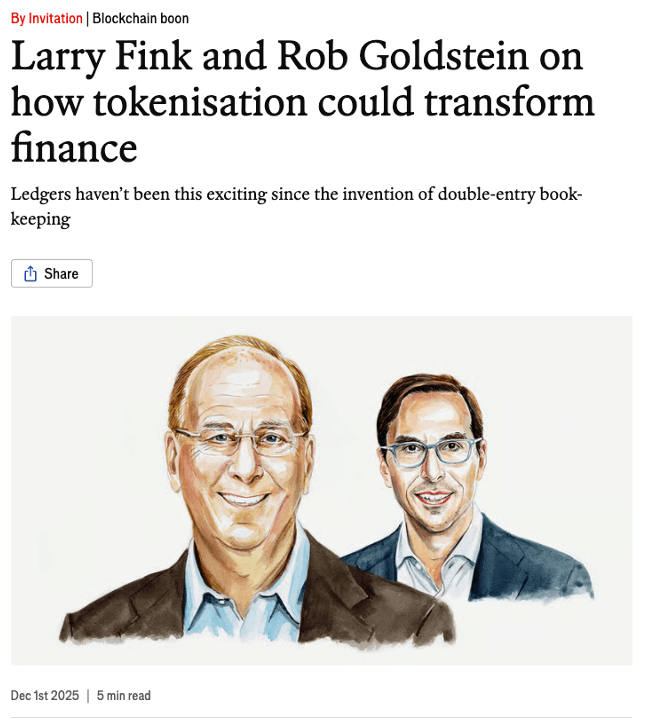
Source: The Economist
Even the Nasdaq exchange just submitted a filing to the SEC to allow tokenized securities on its stock market platform.
All the major players are jockeying for pole position.
And the public still hasn’t fully realized the impact of what is coming. The transformation of the financial system via Project Crypto is bigger than what most realize.
To demonstrate the impact, we need look no further than how Ether.fi’s credit card technology is hitting some major milestones of late…
Ether.fi is a non-custodial and decentralized staking protocol where stakeholders retain complete control of their assets.
Think of it as a blockchain-based neobank. Neobanks operate exclusively online, without traditional physical branches. Think Chime, SoFi, and PayPal.
And earlier this year, Ether.fi’s credit card finally made its way to the U.S.
The card is unique in that it’s not your typical crypto card.
We discussed this earlier in the year with The Largest Bank Margins Are Under Attack, where we explained that most cards over the years have been more like debit cards. Users were required to “top off” account funds to use the cards. There hasn’t been a credit option… until recently.
These cards have undergone an upgrade. There’s now an SBLOC-esque lending capability that leverages digital assets as collateral to borrow.
Ether.fi is an example of this technology. With the click of a button, users can generate a loan at 4% against their crypto assets, such as stablecoins, ETH, and BTC, among others.
Then spend that cash wherever most credit cards are accepted.
It’s a tool that’s democratizing the Larry Ellison trade.
And it’s happening autonomously. These credit lines happen with no middlemen, no paperwork, and no $10 million minimum.
Right now, mostly cryptocurrencies are used as collateral. But with the positive progress on legislation and tokenized stocks and ETFs, it’s only a matter of weeks before we see the first SBLOC against an asset like the SPY, GLD, or NVIDIA.
Once a stock, or any other asset, can be represented as a digital asset, it opens up a world of possibilities, as those assets can be used in smart contracts, like one tied to an SBLOC.
The more this financial system upgrade progresses – the more our current financial system finds its way onchain – the more assets that will be tokenized and that can be offered as collateral.
But to be clear, the trend of bringing finance onchain via Project Crypto extends well beyond just bringing stock and ETFs onchain.
It’s the entire banking infrastructure that’s getting an upgrade.
There is no bigger moment than right now when it comes to the future of finance.
Your Pulse on Crypto,
Ben Lilly
Senior Crypto Analyst, Brownstone Research

Read the latest insights from the world of high technology.
Someone with no medical training whatsoever leveraged AI to devise a custom cancer vaccine entirely on their own, in...

If NVIDIA hits the scale Jensen Huang is signaling, we’re no longer talking about incremental growth in data center...

When Elon Musk stated he wanted to build his own semiconductor manufacturing plant, many assumed he was just bluffing…
Thanks for signing up for The Bleeding Edge — we’re glad you’re here!
Want updates sent straight to your phone too? Sign up for SMS alerts to get the latest delivered via text.
Brownstone Research: By submitting your phone number, you agree to our SMS Terms & Conditions, Terms of Use, & Privacy Policy, and give express written consent to receive marketing text messages from BSR. Messages are recurring & frequency may vary. Reply STOP to 94703 to opt out. Reply HELP to 94703 for info. Consent is not a condition of purchase. Message and data rates may apply. For additional information, you may contact Customer Service at 888-512-0726 or smssupport@brownstoneresearch.com.