



This Could Make or Break CLARITY in 2026
If CLARITY stalls, for whatever reason, the industry will look to its fallback plan...



There’s a lot on the Senate’s plate right now. Thune will decide if the CLARITY Act gets priority…
What if the CLARITY Act doesn’t get to the floor for a vote?
This is the question that’s been rattling around in my brain over the weekend. And honestly, it’s a hard one to confront.
We’ve been discussing the digital asset framework bill as a much-needed piece of legislation for the digital asset market. It’s been more than a year in the making. And it seems the only individuals who don’t want to see it pass are political opponents like Senator Warren or those protecting Wall Street from disruption.
But the bill might not get to the Senate floor for a vote – because it may come down to whether there’s enough room in the schedule.
Senator John Thune is the majority leader in the U.S. Senate. One of his tasks is to set the Senate’s agenda. This includes things like nominee confirmations, funding discussions, and bringing certain bills to a vote.
The Senate is fast approaching a recess on August 7. It’s the longest break Congress has in the year, lasting between four and five weeks each summer.
Unfinished items pause for more than a month. Momentum would be difficult to build once again. Once Congress returns, many will be thinking more about their re-election campaign than passing a piece of legislation.
That’s why the main battle is getting the CLARITY Act to the floor for a vote.
Before the Senate goes on recess, it must deal with items like government funding and a budget framework, two nominees waiting to be confirmed (Todd Blanche for Attorney General and Keith Sonderling for Labor Secretary), the college NIL (name, image, likeness) framework bill, a surveillance authority in FISA section 702 and the National Defense Authorization Act… and the CLARITY Act.
There’s a lot on the Senate’s plate right now. Thune will decide what gets priority, likely today.
And if the CLARITY Act doesn’t get time on the Senate floor, then a vote won’t occur.
That’s the reality. And that brings us back to the starting question: What happens if CLARITY is postponed until after the recess?
You might expect me to say we should worry. But there are two considerations that explain why it won’t be the end of the world even if timelines get pushed back…
Even without the CLARITY Act, the Securities and Exchange Commission (SEC), Commodity Futures Trading Commission (CFTC), Office of the Comptroller of the Currency (OCC), and other agencies have already been very busy filling the gap in guidance.
In a joint effort back in March of this year, the SEC and the CFTC released a formal Token Taxonomy under U.S. federal law. It explicitly classifies 16 major assets (e.g., Bitcoin, Ether) and sorts crypto assets into five categories. These categories are digital commodities, digital collectibles, digital tools, stablecoins, and digital securities.
This was a major accomplishment, as it finally answered something as simple as whether Ethereum’s native token was a commodity or a security. (It’s a commodity.)
The two agencies have also released statements on tokenized securities and regulatory harmonization.
The SEC has pushed items like generic listing standards for commodity and crypto exchange-traded products, as well as in-kind creation and redemption for spot crypto ETFs. It also launched a Crypto Task Force to make good on Project Crypto – the initiative to put finance onchain.
The CFTC is doing a lot of work in upgrading our markets. It has been pushing forward on using tokenized collateral for margin, stablecoins as margin, leveraged products, and spot crypto contracts on CFTC futures exchanges. It is expanding what can be offered to the public – much of which is already popular in the digital asset industry.
Meanwhile, the OCC has released several letters ensuring crypto companies are treated fairly. The OCC has also granted various crypto companies like Circle, BitGo, Coinbase, Bridge, Crypto.com, and several others banking charters.
We’re even seeing crypto companies gain access to the Federal Reserve’s payment rails, which was unheard of two years ago.
All this to say, many of the pieces of what the CLARITY Act sets out to accomplish are already published via proposals, rulemaking, and no-action letters to companies.
That doesn’t change even if the CLARITY Act takes a bit longer to get here than we’d hoped.
Of course, the main benefit of the CLARITY Act is that all of these rules, regulations, and guidance will be codified with a level of permanence that these agencies’ actions lack. Permanence is a feature we shouldn’t take lightly.
A bill signed into law shows the industry that the U.S. won’t suddenly change its approach the day a new political administration rises to power. That helps retain developers, teams, and companies here in the U.S. It also attracts capital.
That’s why the best-case scenario is the passage of CLARITY. But in the event of a delay, the industry won’t be completely without the guidance it’s looking for.
And that brings us to the second consideration…
Many people are worried that the crypto market is on the cusp of more downside. And if the CLARITY Act doesn’t have a vote, that could be the tipping point for a selloff.
But I don’t think that’s the case.
In The Market Is Primed For CLARITY, we looked at a metric called skew, which measures how expensive put options are relative to calls. It was showing signs of a market structure change for the first time in over a year.
We also hit on other metrics such as Bitcoin Power Law, a model showing that current levels are very attractive. It suggested we are at or near a multiyear bottom in price.
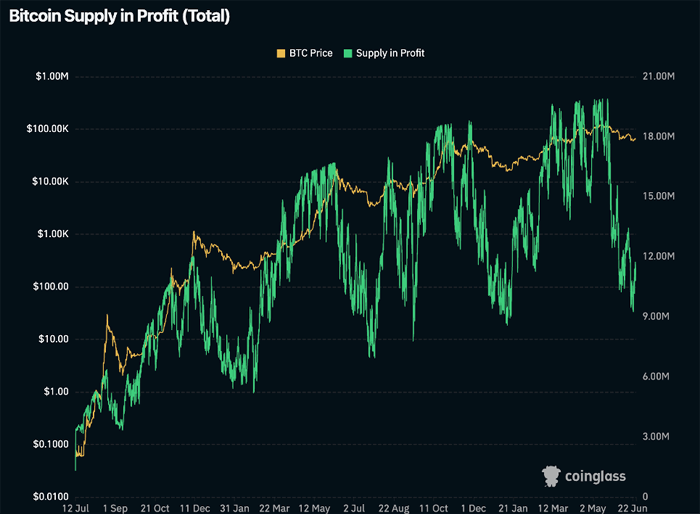
What we didn’t hit on was an onchain metric where we can measure what supply of Bitcoin (or other coins) is in profit. In simple terms, if a coin moved wallets yesterday, and price is up today, then those coins would be considered “in profit.” We often see this number quickly hit multiyear lows and then rise as price climbs higher.
The chart below shows that we recently hit a low of 9.48 million BTC in profit.
Source: Coinglass
At first glance, most analysts would think the green line still needs to dip lower before we’ll see a recovery. But here’s a hidden reality: A certain percentage of these coins don’t move anymore.
Coins that haven’t moved in seven years are often considered lost or held by individuals who never plan to sell. We can measure this in what’s called “HODL Waves.” Right now, more than 5 million BTC haven’t moved in more than seven years.

Source: Coinglass
When we remove the coins that haven’t moved in seven years or more from the earlier chart, the number of coins in profit drops to around five million. When we do that for prior bottoming out periods, we arrive at similar numbers.
That suggests that we’re at similar lows as prior bottoms.
So if the CLARITY Act doesn’t get to the floor for a vote, it doesn’t mean that lower lows are necessarily coming. If anything, it’s telling us we might be on the verge of a fake-out.
With these two considerations in mind, we can rest a bit easier. Don’t get me wrong – the CLARITY Act will be a huge and immediate tailwind for the industry. But even if it doesn’t make it to a floor vote before the August recess, the crypto market is holding strong, suggesting a turn higher is not that far around the corner.
Rather than falling prey to fear, we need to be building our portfolios today. Our focus needs to be on finding some of the best projects that are primed to succeed in the coming months and year.
Some might hesitate, worried they are not buying the absolute bottom. But that’s picking up pennies in front of a steamroller. These tokens can move fast.
In fact, just over the weekend, a project in our model portfolio within Permissionless Investor proved this point. We were up a few percent on Friday. By Sunday, the token was up more than 170%. And while the move is large, we expect a lot more upside as the bull market begins.
With or without the CLARITY Act, we’re building for what is about to be the biggest run you’ll ever see.
It starts soon.
Your Pulse on Crypto,
Ben Lilly
Editor, Chain of Thought
Read the latest insights from the world of high technology.
If CLARITY stalls, for whatever reason, the industry will look to its fallback plan...

It’s prying open the door. And once it opens, it won’t close.

We’re moving from the “walled garden environments” to public blockchains. It’s a major shift, and it’s picking up momentum...