


Nationwide Autonomy Within a Year
It’s now very clear that Tesla and the NHTSA have been working closely together…



Leo Aschenbrenner is proof the market doesn’t care how smart you are…

Leo Aschenbrenner was smart enough to get into Columbia at 15 years old.
He graduated as valedictorian at 19 – with a BA in economics, mathematics, and statistics.
While at Columbia, he co-founded the school’s effective altruism (EA) chapter, a virtue signaling movement that purports the virtue of earning a whole lot of money so that it can be donated in effective ways.
His interest in EA is what led to him joining a division of FTX, specifically the FTX Future Fund, which was the grant-giving arm of the cryptocurrency firm.
The CEO of FTX was, of course, Sam Bankman-Fried (SBF)… a vociferous proponent of effective altruism, which we learned was just a veil for one of the largest financial frauds in history.
SBF is now serving a 25-year sentence in prison for multiple counts of fraud and conspiracy, as he used FTX and EA as a mechanism to defraud all of his investors and enrich himself.
Aschenbrenner left FTX at the time the company was filing for bankruptcy in late 2022, for very obvious reasons.
Somewhat surprisingly, the departure led to him joining OpenAI’s superalignment team.
There, he worked with Ilya Sutskever – one of the most well-known figures in artificial intelligence.
Aschenbrenner was then fired in April of 2024, after that short stint at OpenAI.
OpenAI claimed that Aschenbrenner was linked to a leak of confidential information, a claim that Aschenbrenner has disputed.
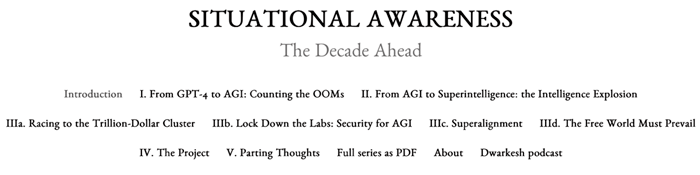
His short time at OpenAI and experience working on the bleeding edge of artificial intelligence inspired him to write a lengthy paper – Situational Awareness – that was a thesis about what the next decade would look like in a world being transformed by artificial intelligence (AI).
For anyone who would like to review the 165-page PDF, you can find it right here.
Source: Leo Aschenbrenner
Longtime readers of The Bleeding Edge, The Near Future Report, and Exponential Tech Investor will be familiar with much of the content contained within, as I’ve been writing about many of these themes for years. Being ahead of these trends is the key reason that my subscribers have profited as much as they have over the years.
Aschenbrenner did a nice job putting together a comprehensive picture of what he viewed the future – empowered by AI – would look like.
It was widely read by Wall Street and was seen as a viable roadmap to both artificial general intelligence (AGI) and ultimately artificial superintelligence (ASI).
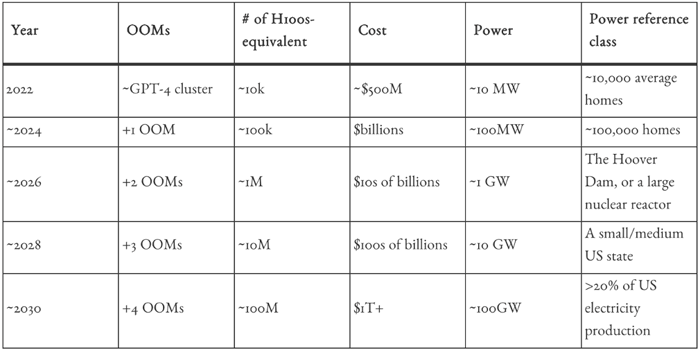
One chart in particular was simple to understand, which helped it capture a lot of analyst attention.
Shown below, it highlighted the amount of money needed to be invested to achieve AGI and eventually ASI – and the timeframe within which it would happen.
Source: Leo Aschenbrenner
Shown above, Aschenbrenner assumed that every two years, the amount of investment, GPUs, and power requirements would increase by an order of magnitude (OOM).
His forecast predicted that by 2030, AI infrastructure would scale to $1 trillion of investment, 100 million NVIDIA H100 equivalents, and 100 gigawatts of power required to run it all, amounting to more than 20% of the total U.S. electricity production.
That got a lot of investors excited about what was to come, and despite Aschenbrenner’s troubles at FTX and OpenAI, his thesis, Situational Awareness, was enough to raise $100 million in late 2024 from a number of big names in high tech.
And that’s how Aschenbrenner kicked off his hedge fund, aptly named Situational Awareness LP.
It had a mandate to invest in companies that would benefit from Aschenbrenner’s predicted trends.
By March of this year, Aschenbrenner had raised about $1.96 billion for his fund, and by early summer the value of the fund had risen to around $45 billion.
It saw an absolutely spectacular rise, especially since it was led by someone who had zero investment or trading experience when starting the hedge fund.
And last week, it all blew up. Completely.
In what will become one of the biggest self-inflicted detonations in the history of hedge funds, Aschenbrenner was forced to liquidate all his publicly traded equities held in Situational Awareness LP.
How it happened is pretty easy to understand.
Why/when it happened is far more interesting.
Aschenbrenner had used about 400% leverage in his hedge fund.
He borrowed capital to increase his bets and his returns for his hedge fund. He also used options for further amplification of his trades.
And then the market for AI-related investments got bumpy in July, amplified by cries that investment levels in building AI infrastructure were unsustainable.
Adding fuel to the fire, Meta’s (META) free cash flow fell to just above breakeven.
And Google reported negative free cash flow in its latest quarter for the first time in a very long time.
Despite neither company having any financial distress whatsoever, Wall Street isn’t used to seeing anything other than these two companies throwing off billions of dollars in free cash flow every quarter.
And then the topping on the cake: Last Tuesday, hedge fund giant Citadel began putting out a very public call to the market, signaling that the FOMC would raise interest rates 25 basis points on July 29.
Ironically, Citadel’s call was wrong…
But it created a lot of volatility in the market, added fuel to the fire in the declines of AI-related tech stocks, and led to the implosion of Situational Awareness LP.
How interesting…
This decline led to a completely unexpected outcome. Unexpected to most, at least.
Leo Aschenbrenner, in order to deal with his margin calls, had to start selling off his holdings in the fund.
And because he had leveraged his positions to such an extent, and those positions involved tens of billions of dollars’ worth of equities, his selling begat even more selling.
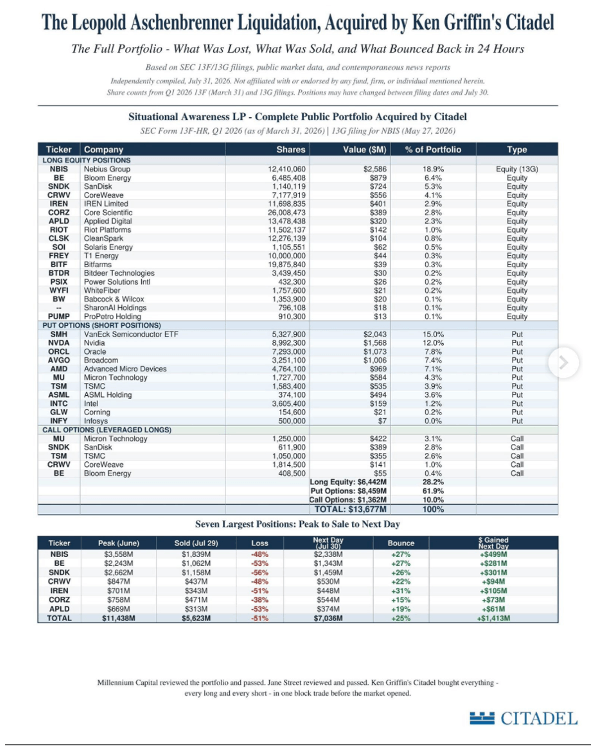
It got so bad, Aschenbrenner had to sell off his entire book of holdings in equities to a single hedge fund.
Said another way, he cut a deal to liquidate the entire portfolio (that could be liquidated) – in order to stay alive.
And guess who stepped in to buy the assets?
Citadel.
Citadel stepped up, and for about a 10% discount to the market value of the Situational Awareness LP shares, it spent about $13.7 billion buying up the entire book of Aschenbrenner’s hedge fund.
Source: Citadel
It was a scene right out of the drama Billions.
Bobby Axelrod knew the young 20-something – with no trading experience whatsoever – was heavily leveraged. And he set him up to knock him down.
Easy day.
Except rather than being fictional, it was Ken Griffin of Citadel using his decade of Wall Street smarts to school Leo Aschenbrenner.
Citadel is already up billions on the trade.
Cutthroat and brilliant.
Aschenbrenner made two critical mistakes:
Making highly leveraged directional trades may work out for a while, but they almost always end badly.
Aschenbrenner used no risk management at all for his hedge fund, and he paid the price dearly.
Citadel knew it, and it went for the throat.
All that is left of Aschenbrenner’s hedge fund now is the equity held in a number of private tech companies, most notably that of Anthropic.
It appears that he came close to selling $3.5 billion of his Anthropic position last Wednesday to raise cash…
But by Thursday morning, he decided against doing so. He clearly decided to negotiate with Citadel to take over his entire publicly traded book at a discount.
The Situational Awareness LP implosion was the event that pushed the market over the edge and resulted in a large selloff, particularly in the names that the hedge fund held leveraged positions in.
And Citadel’s acquisition of its positions appears to have put a bottom to the rout.
None of this circus had anything to do with the fundamentals of these companies… or with this continuing trend of record levels on increasing investment in AI infrastructure.
It was entirely due to overleverage and poor risk management.
The most ironic part of all this is that Aschenbrenner’s hedge fund was up 270% with all that leverage through the end of May.
After liquidation, the fund is still up about 80%.
If Aschenbrenner does nothing for the rest of the year, the returns will still be great.
But regardless, it was gross mismanagement of his limited partners’ funds.
Despite that, he is out trying to raise more capital to get the hedge fund going again.
Would you allocate capital to him after what we just witnessed?
Ironically, he’ll probably be able to do so, just not to the extent that he did before. It reminds me of Long-Term Capital Management (LTCM).
John Meriwether of LTCM blew up his first fund in 1998. It was one of the most spectacular fund implosions in history due to excessive use of leverage.
Despite that, people still gave him billions more to invest, and guess what happened…
Meriwether blew up his second fund, JWM Partners, much in the same way in 2009 under broadly similar circumstances.
Will the same thing happen with Aschenbrenner? Will next time be different?
Time will tell, and we’ll be keeping a close eye on what his fund does.
However, one thing is certain: This multi-year trend in investment in AI infrastructure isn’t slowing down anytime soon.
Next year’s investment levels will exceed $1 trillion globally, and the race towards ASI continues to speed up.
Hold on to your horses. The pace will accelerate.
And thanks to Aschenbrenner, there is a great window to build positions in some fantastic tech companies riding this trend.
Jeff
Add Brownstone Research as your preferred source on Google to see our latest stories in your feed.
 Add as a preferred source
Read the latest insights from the world of high technology.
It’s now very clear that Tesla and the NHTSA have been working closely together…

These two IPOs will be nothing more than liquidity events for the effective altruists, venture capital firms, and private...

Over the last week, we have discovered that this is a massive, well-coordinated psyop carried out by some powerful...