

The New Orbital Economy
Space may reward the picks and shovels of the orbital economy: power, materials, communications, autonomy, robotics.

The Biotech Buying Spree
By Jeff Brown, Founder & CEO, Brownstone Research
May has been a busy month for mergers and acquisitions (M&A) in the biotech and healthcare space, with several large deals showing renewed confidence across the industry.
Major companies like Roche (RHHBY), Bayer (Germany: BAYN), and Angelini (private) all made big moves by buying smaller, innovative firms.
These deals were not random.
They were carefully chosen to strengthen key parts of their businesses, whether in technology, new drugs, or expanding into new markets.
Together, they point to a clear trend: large biopharmaceutical companies are actively acquiring again after a slower period.
One of the most interesting deals was Roche’s acquisition of PathAI, a company that uses artificial intelligence (AI) to help doctors diagnose diseases like cancer.
Roche’s decision to buy PathAI for up to $1 billion shows how important artificial intelligence is becoming in healthcare, especially in cancer diagnosis. From my perspective, companies that aren’t actively using AI right now in the drug development process are typically at a severe competitive disadvantage.
PathAI develops software that helps doctors analyze tissue samples faster and more accurately using AI.
Roche, already one of the world’s biggest diagnostics companies, believes combining PathAI’s technology with its own cancer testing business could improve how diseases are detected and how treatments are matched to patients.
The deal includes $750 million upfront plus up to $300 million tied to performance milestones.
This shows how important AI is becoming in medicine. Instead of relying only on traditional methods, companies now want smarter, faster tools that can improve accuracy and patient outcomes.
Roche’s decision to buy rather than build this technology suggests that speed matters, and companies are willing to pay up to stay ahead.
Bayer’s purchase of Perfuse Therapeutics highlights a different but equally important need for replacing older drugs with new ones. This has been a common theme that we’ve been seeing since the fall of last year.
Bayer’s decision to buy Perfuse Therapeutics for up to $2.45 billion shows how valuable eye disease treatments have become in the biotech industry.
The deal includes $300 million upfront, with the rest tied to future milestones if the drug succeeds in testing and sales.
Perfuse’s main drug, PER-001, is being developed to treat glaucoma and diabetic retinopathy – two major causes of blindness around the world.
Unlike many current treatments that mainly slow damage, this drug may help improve blood flow in the eye and protect vision, which is why Bayer sees it as a potentially groundbreaking product.
Many big pharmaceutical companies are losing revenue as their older medicines face competition from cheaper alternatives. To keep growing, they need fresh treatments.
Going forward, we can expect more of these kinds of deals.
Big healthcare companies will likely continue buying smaller firms with strong technology or near-ready products, especially in high-demand areas like AI, rare diseases, and specialized treatments.
And only the most promising companies will attract big offers.
The Narrative Tug-of-War
By Larry Benedict, Founder, The Opportunistic Trader
After a surge to 16-month highs, U.S. Treasury yields pulled back this past week. U.S. 10-year yields fell back around 4.47%, a 0.22% drop from their May 19 high.
One of the major catalysts behind that sharp move lower was growing optimism around a peace deal with Iran. Tied to that was the potential reopening of the Strait of Hormuz.
Brent crude dipped from around $108 a barrel to under $96, and WTI fell from around $104 to briefly under $90. That took some pressure off inflation and eased expectations around future rate hikes.
In turn, that caused some softness in the U.S. dollar (USD), as you can see in the chart of the U.S. Dollar Index (DXY) below. DXY slipped back toward the middle of its recent trading range and right around its 50-day moving average.
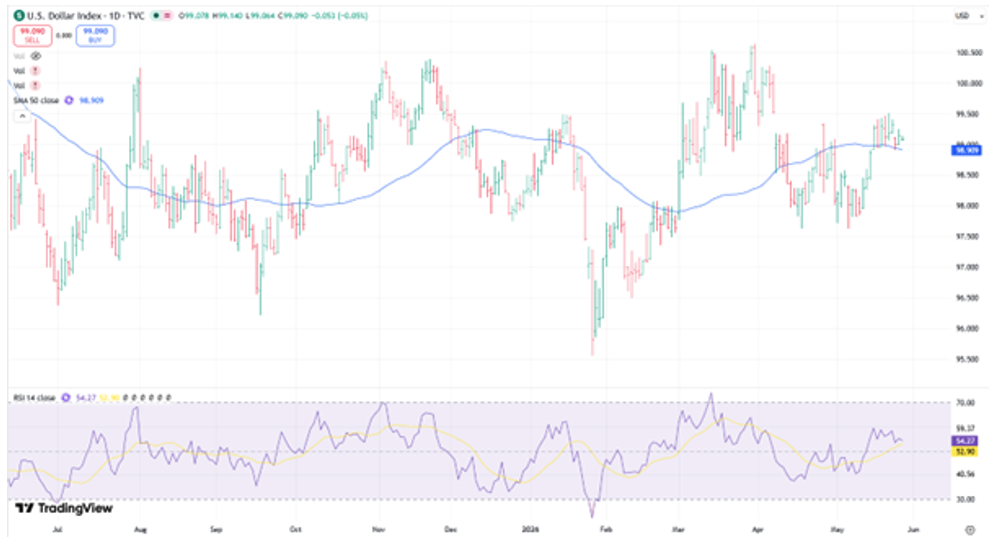
As we can see, changing expectations have kept us bouncing between different narratives, which influence the currency market and beyond.
One of the biggest narrative shifts this year has been from a likely rate cut to a potential rate hike. Lower oil prices (and lower yields) have seen the prospects of a rate rise slide by year’s end. They’re currently tracking around 36.2% for a 0.25% rise and 8.9% for a 0.5% rise.
That said, there were hawkish tones in the minutes of the Federal Reserve’s April meeting. Clearly, a growing number of officials are concerned about the long-term inflation trend, which was rising even before the hostilities in the Middle East.
But the crunch – and one of the reasons the USD has stalled for now – comes back to the new chair of the Federal Reserve, Kevin Warsh.
Although inflation risks remain elevated, it’s difficult to see Warsh rushing into aggressive rate hikes so early in his tenure, especially with the White House so opposed to tightening monetary policy. Irrespective of President Trump claiming that he wants Warsh to be “totally independent,” Trump clearly wants interest rates to head south.
That’s why the USD is stuck right around the middle of its range. The tug-of-war in the USD reveals the tension between inflation and the Fed’s next interest rate move. For now, that’s leaving the USD without a clear directional catalyst.
But with so many moving parts, I’m not expecting things to remain quiet for long. Markets are now trying to digest the impact of inflation and war in the Middle East against the prospect of a potential rate hike from the Fed.
Eventually, one side will give way.
A Civilization-Building Company
By Jason Bodner, Founder, Outlier Intel
“We do not want humans to have the same fate as dinosaurs.”
That sentence is not from a science fiction novel. It is from the S-1 filing SpaceX submitted to the SEC last week.
The proposed valuation runs to $1.75 trillion. The new billion-share grant to Elon Musk only vests on two conditions: a $7.5 trillion market cap, and a permanent human colony on Mars with at least one million inhabitants.
Read that twice.
This is not an aerospace company filing on the NYSE. This is a civilization-building company that happens to be filing on the NYSE. And the flow data has been telling you it was coming for weeks.
Inside the inflow data, six space-economy names caught persistent institutional bids last week. MDA Space led with inflows three days running. Voyager Technologies, the space station and defense systems company (not the crypto firm), posted two days. Redwire, which manufactures structural components for orbital infrastructure, also posted two days. Three more across Earth observation, satellite communications and aerospace electronics filled out the cluster.
Six names is not retail enthusiasm chasing a headline. Six names is multi-day institutional accumulation across sub-themes that build a coherent ecosystem. The SpaceX S-1 did not start this. The S-1 simply gave the move a name.
Three months before the filing, Musk merged xAI and X into SpaceX. Starlink’s $11 billion in annual revenue now subsidizes the AI buildout. Anthropic is reportedly paying SpaceX $15 billion a year. Orbital AI compute satellites begin deploying in 2028.
This is not a rocket company going public. This is the consolidation of launch, satellite communications, AI compute and sovereign-internet infrastructure under a single corporate umbrella, with an explicit thesis that the next industrial layer of civilization gets built in low Earth orbit and beyond.
Every industrial revolution rewarded the layer beneath the headlines. The internet rewarded software. Cloud rewarded compute. AI rewarded accelerators. Space may reward the picks and shovels of the orbital economy: power, materials, communications, autonomy, robotics.
The flow data is already pointing there. The headlines have not caught up yet.
© 2026 Brownstone Research. All rights reserved.
This report is for informational purposes only and does not constitute investment advice. Always conduct your own research and consider consulting a financial advisor before making investment decisions.