



Anthropic’s Risky IPO
Anthropic’s gig could be up, and its value as a private company could collapse.



Imagine millions, and eventually perhaps billions, of AI agents working continuously. Every one of them needs computing power. They need access to information. They create new information. And somewhere, all that activity has to physically happen.
Managing Editor’s Note: Today, our colleague Jason Bodner guides us through a tour of sorts of some of the essential infrastructure underlying artificial intelligence.
But first, a reminder… In just a few hours, Jeff and Larry are sitting down for their Dollar Trap emergency briefing.
They’ll break down why the U.S. dollar is in an inescapable trap that not even the president can stop from snapping shut, as well as how you can prepare ahead of the “reckoning.”
The broadcast begins at 8 p.m. ET. It isn’t too late to join. Just go here to add your name to the guest list. We hope to see you there.
Pick up your phone and ask any AI a question.
Maybe you want to know how far Jupiter is from Earth. Maybe you want it to summarize a 40-page report or plan your next vacation. A few seconds later, the answer appears.
It feels almost weightless.
There is no engine turning. No factory humming. Nothing gets delivered to your door. As far as you can tell, some software inside your phone simply produced an answer.
But somewhere, potentially hundreds or thousands of miles away, a giant machine just went to work for you.
Welcome to the AI data center.
If you want to understand where some of the biggest investment opportunities in artificial intelligence may come from, you need to understand what is happening inside it.

Most traders need Bitcoin to rise. Larry Benedict’s readers had chances at $6,000… $9,000… and even $22,000, no matter which way BTC moved. No coins, no wallets, no crypto exchanges. Just a regular brokerage account. The full strategy is revealed in this free interview.

Ask most Americans where their money is safe, and they’ll name the same four things. According to Jeff Brown and Larry Benedict, all four are now in danger. Not from a stock market crash, but from what they expect to happen to the U.S. dollar at 1:00 p.m. ET on Wednesday, October 7, on a deadline set by the federal government. During their upcoming emergency briefing, they’ll say why – and where the money goes instead. Click here to reserve your free seat.
A modern hyperscale data center can consume 100 megawatts of electricity or more. That’s roughly enough electricity to power 80,000 American homes.
And that’s just one facility. Some estimates have upwards of 5,000 data centers operational in the next three years. That’s enough to power 450 million homes. The US Census Bureau lists an estimated 149.5 million homes.
Data centers will triple the power requirements of all Americans very soon.
Inside data centers are thousands of servers, storage devices, processors, networking equipment, cooling systems, transformers, cables, and other equipment, all working together.
AI may be digital, but creating it is an increasingly physical process.
And the demands are growing.
The first wave of generative AI was mostly about asking questions and getting answers. But AI is beginning to move beyond simply answering us. The industry is developing AI agents designed to perform tasks, operate software, and work for us over longer periods of time.
Imagine millions, and eventually perhaps billions, of AI agents working continuously.
Every one of them needs computing power. They need access to information. They create new information. And somewhere, all that activity has to physically happen.
So let’s walk into our AI factory.
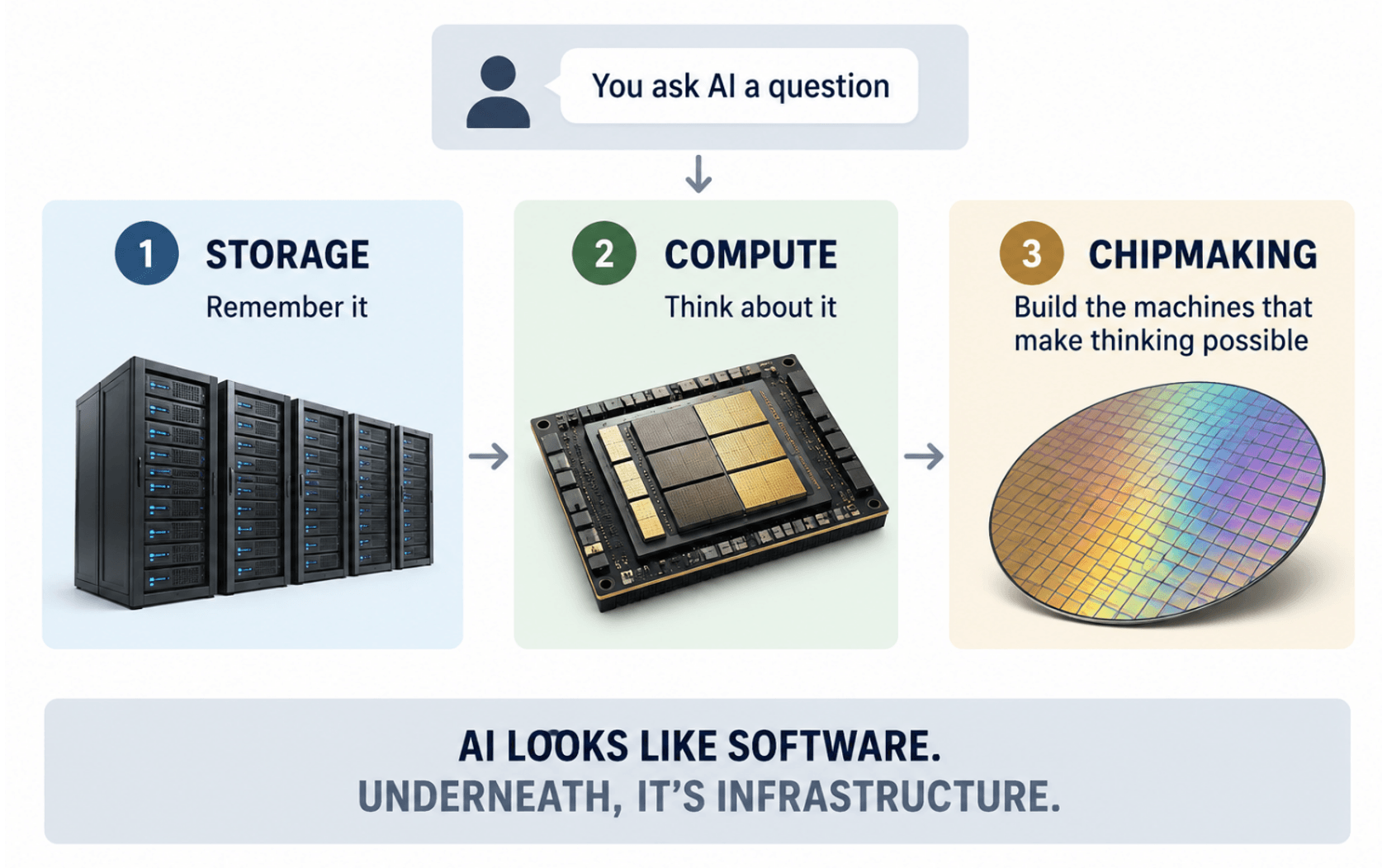
AI consumes staggering amounts of data.
Models train on data. They retrieve data. Businesses feed their own information into them. Users create more data every time they interact with them. AI agents could eventually create enormous amounts of additional information as they perform tasks throughout the day.
Data has an inconvenient property: it has to live somewhere.
That’s where storage comes in.
Think about the photos on your phone. You may call them “the cloud,” but they aren’t floating around in the sky. They physically exist on storage devices sitting inside data centers somewhere.
AI is no different.
Hard disk drives can store enormous quantities of information economically. Flash memory provides faster access when speed matters. Different jobs require different types of storage, but the basic principle is the same.
The more data AI consumes and creates, the more storage infrastructure the system needs.
But remembering isn’t enough.
AI also has to think.
This brings us to the processors.
You’ve probably heard of CPUs and GPUs. The difference is easier to understand than the names suggest.
A CPU, or central processing unit, is a general-purpose processor. It’s good at handling lots of different jobs and coordinating what a computer is doing.
A GPU, or graphics processing unit, was originally designed for computer graphics. Creating an image requires performing huge numbers of mathematical calculations simultaneously. Engineers eventually realized that the same ability was extremely useful for artificial intelligence.
That’s why GPUs became the workhorses of modern AI, hence Nvidia’s march to dominance.
A useful way to picture the relationship is a construction site. GPUs are the heavy machinery doing enormous amounts of computational lifting. CPUs help coordinate the broader operation, making sure different parts of the system work together.
Modern AI data centers can contain thousands of these processors connected together.
But now we’ve reached another question.
Who builds the machinery?
CPUs and GPUs don’t simply appear.
They begin as silicon wafers that travel through some of the most complicated manufacturing processes humans have ever invented.
A finished advanced semiconductor can require hundreds, and in some cases thousands, of individual processing steps.
Two of the most important are deposition and etching.
Deposition adds extremely thin layers of material onto a silicon wafer. Etching selectively removes material from those layers.
Deposit material. Etch away part of it. Add another layer. Etch again.
Repeat that process with extraordinary precision, and manufacturers gradually create the microscopic structures that become transistors and electrical connections.
There is another wrinkle making this even more interesting.
Chips are increasingly three-dimensional.
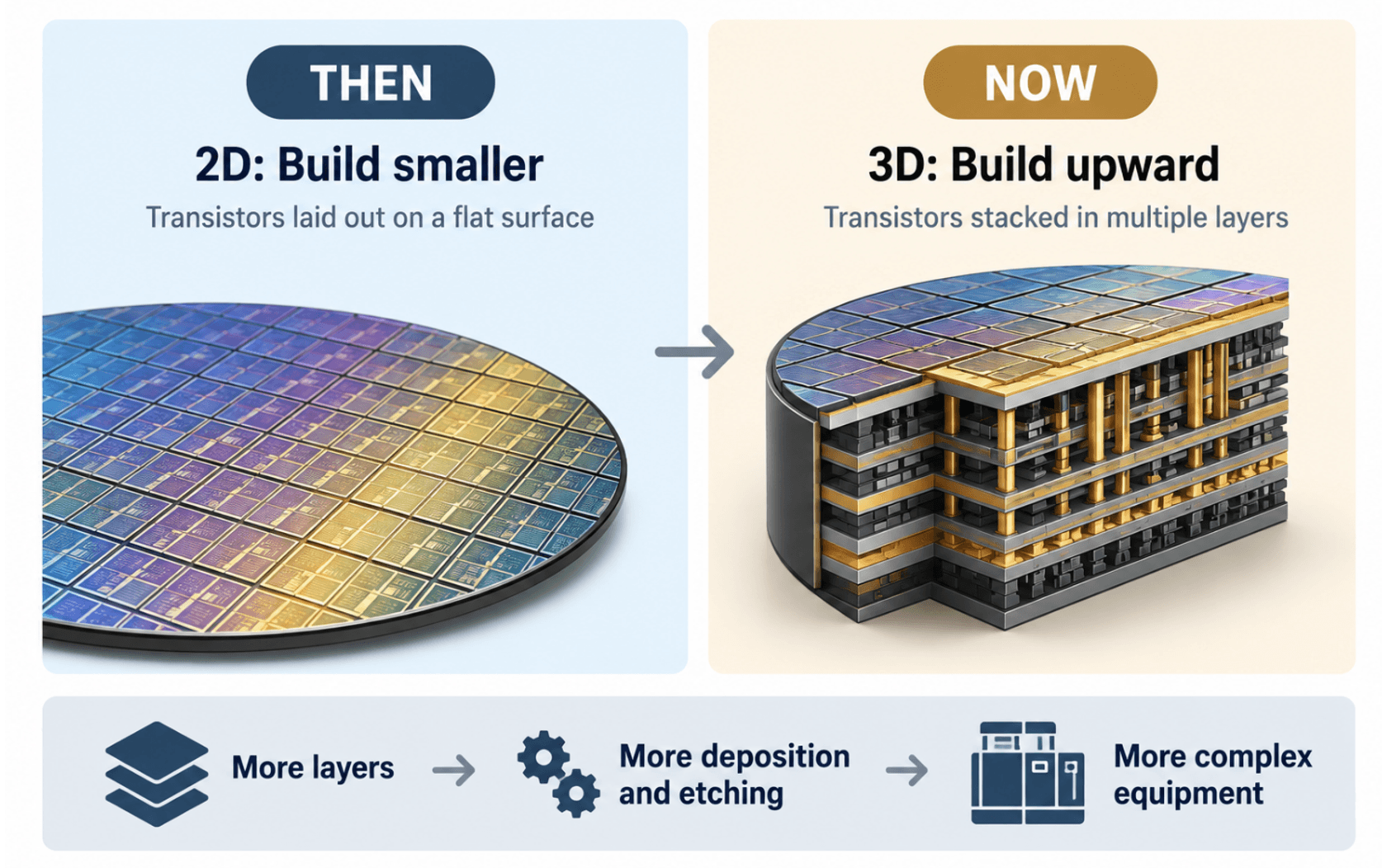
For decades, semiconductor progress largely meant shrinking features and packing more of them onto a flat piece of silicon. That’s becoming much harder, so chipmakers are increasingly building vertically as well.
Think of the difference between laying out a town and building Manhattan.
Once you start stacking intricate structures on top of one another, manufacturing becomes dramatically more difficult. More layers can mean more deposition, more etching, and greater demands on the equipment performing those jobs.
Our AI factory depends on another set of factories just to build the machinery inside it.
Now we can put everything together.
AI needs data. Data needs storage.
AI needs to process that data. Processing requires CPUs, GPUs, and other advanced chips.
Those chips need to be manufactured. As they become more complex and increasingly three-dimensional, the equipment required to build them becomes more sophisticated.
Then all of those processors and storage devices need electricity, networking, and cooling inside enormous data centers.
This is why I think it’s a mistake to view artificial intelligence purely as a software revolution.
Software is simply the part we see. Underneath it sits an enormous physical supply chain.
There are companies designing AI models. There are companies designing processors. Others make storage devices. Others manufacture the equipment used to fabricate semiconductors. Still others provide networking, electrical equipment, cooling and the buildings themselves.
And as AI becomes more capable, demands on that physical infrastructure can grow with it.
That’s the investment lesson…
Sometimes the biggest opportunity created by a new technology isn’t the product sitting in your hand. It’s everything required to make that product possible.
The next time you ask AI a question and an answer instantly appears on your phone, don’t picture an app.
Picture the factory behind it.
Regards,
Jason Bodner
Founder, Outlier Intel
Add Brownstone Research as your preferred source on Google to see our latest stories in your feed.
 Add as a preferred source
Read the latest insights from the world of high technology.
Anthropic’s gig could be up, and its value as a private company could collapse.

This morning, SpaceX launched the 14th flight of its Super Heavy booster and Starship from its Starbase, Texas facility,...

In today’s AMA, we explore the true utility of full self-driving vehicles… what to do when markets crash… and...