

Marketing Ploy or the Real Deal?
Whether it’s Anthropic or OpenAI, private AI companies need to continue to raise billions to fund their research and...


After decades of hesitation, the tide has finally turned. For the first time in a generation, global institutions, governments, and corporations are aligning around one conclusion: Nuclear energy is essential…
Managing Editor’s Note: We’re on the cusp of a new era of prosperity…
Innovation will accelerate to a pace that will feel impossible to track. Entire industries will be re-architected. Companies that adapt will thrive. Those that don’t… will vanish.
Fortunes will be made. And just as quickly, fortunes will be lost. The inflection point is approaching fast…
And Jeff’s got just the plan for how we can position ourselves before this new era of prosperity arrives.
You can go here to automatically sign up to join us next Thursday, December 18, at 8 p.m. ET. Jeff will get into all the details of a major breakthrough in artificial intelligence that’s just around the corner… and how it will trigger an economic “big bang” on a scale we’ve never seen before.
Then read on for today’s Bleeding Edge – a special edition with unlocked research on the global nuclear renaissance.
Many are clueing in to the fact that the only way to sustain artificial general intelligence on a global scale – and eventually artificial superintelligence – is through nuclear energy.
But today, we want to make clear exactly why this high-stakes energy renaissance is key to the most important race of our lifetimes…
The race to artificial superintelligence. Read on for more from Jeff…
The U.S. is in a modern, techno-centric Cold War with China. It isn’t fought with proxy armies or nuclear brinkmanship. It’s fought with electrons, algorithms, and silicon.
And the next global contest won’t be fought over land or ideology. It will be fought – and won – over energy and computation.
That’s why the following chart should make every American uneasy…
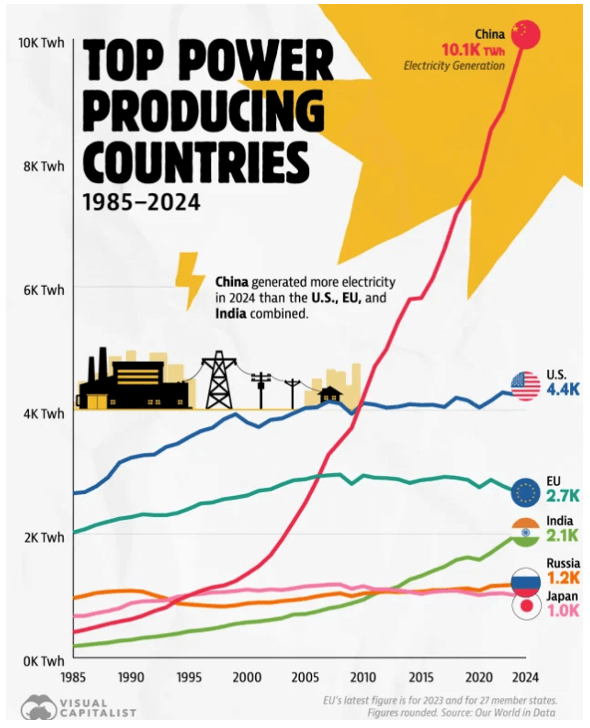
China now generates more than twice as much electricity as the United States. And it’s not just the level of output that’s alarming; it’s the trajectory. China’s power generation capacity is growing exponentially.
The single biggest bottleneck in the race to artificial general intelligence (AGI) and eventually artificial superintelligence (ASI) is power.
Forward progress now depends entirely on how much electricity a nation can generate and deliver to its data centers.
Never before in history has a single technology promised such a dramatic economic advantage to the country that masters it… or such a devastating disadvantage to those that fall behind.
If China becomes the world’s dominant energy producer and the first nation to reach AGI – let alone ASI – we’ll enter a geopolitical era unlike anything we’ve seen this past century.
And this time, the United States would not hold the strategic high ground. The threat would be a clear and present danger to the entire Western world.
If China controls AGI first, it will hold the most powerful force multiplier in human history. AGI will accelerate everything from autonomous weapons systems to logistics, finance, and cyber-warfare.
And Beijing understands this perfectly.
While the West debates and distracts itself with short-term profits and politics, China has spent two decades building the infrastructure of dominance. It will soon have the largest nuclear-power program on Earth, strategic uranium reserves, and a near-monopoly on the rare-earth minerals that make modern electronics possible.
Whoever controls the electrons and the algorithms will control the future.
I don’t say this to alarm anyone. But I want to make one point clear… This is the most important race of our lifetime.
That’s why I recently traveled to Idaho and Wyoming. These states are the quiet center of America’s next great power revolution.
Many have overlooked this region. They believe data centers should be built in Texas near the abundant natural gas from the shale oil fields. But the reality is that natural gas, coal, and solar are only a bridge to a future of abundant cheap, clean energy.
The next generation of data centers will demand electricity on a scale measured in gigawatts (GW) – enough to power entire cities – just to keep a single AI cluster running.
We need energy that’s abundant, reliable, and carbon-free. That leaves only one option.
If the U.S. wants to compete, it must build new nuclear power plants: first, fission, and then fusion.
Nothing else can scale fast enough or run clean enough to power the trillion-dollar AI infrastructure already under construction.
Out here in Idaho and Wyoming, I’m seeing the early signs of the energy renaissance.
This is ground zero for the fourth generation of nuclear power – what engineers call Small Modular Reactors, or SMRs. These next-gen reactors are smaller than the concrete domes making up the nuclear plants of the 20th century, yet they produce just as much electricity.
They operate at atmospheric pressure, so there’s no risk of a meltdown, and the waste they produce is minimal and far less radioactive.
This is nuclear technology reimagined for the 21st century. And it’s getting built now.
Following President Trump’s executive order (#14301) on nuclear energy earlier this year, the Department of Energy launched its Reactor Pilot Program, which has already resulted in the start of construction of three SMRs inside the Department of Energy’s secure perimeter at the Idaho National Laboratory. This is the same site where America tested its first reactors more than 70 years ago.
But this isn’t just a government initiative. Private enterprise is stepping up as well.
OpenAI cofounder Sam Altman has backed a company called Oklo (OKLO), one of the pioneers in modular reactor design. And NuScale Power (SMR) is already building its first full-scale prototype.
And just behind me in the picture below, taken in Kemmerer, Wyoming, construction crews are hard at work on TerraPower’s Natrium project – an advanced SMR paired with a massive energy storage system.
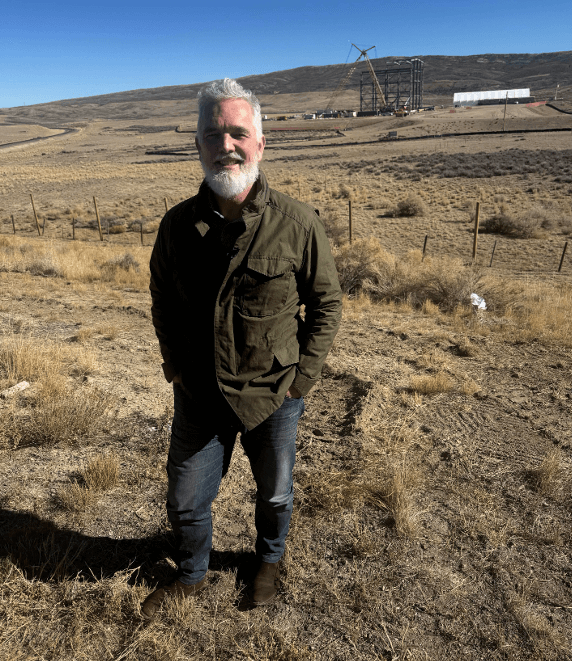
The above nuclear power plant is historic as it will become the world’s first coal-to-nuclear conversion. Just three miles away on the other side of the highway is an old coal plant that will be retired, and the Natrium power plant will replace the electricity production, and more, becoming a next-generation nuclear power plant and, of course, a zero-emission power station.
By 2030, it will be operational, and the transformation will be complete. Its opening will be symbolic of what will happen all over the country, designed to both transition to emission-free sources of electricity and fuel the AI-driven economy.
This is all incredible progress… but it’s arriving late. Nuclear energy programs were stifled in the U.S. for decades due to hypocritical politics.
While the U.S. debated the merits of nuclear energy, China built it. It now leads the world in nuclear construction, uranium supply chains, and reactor exports by a mile.
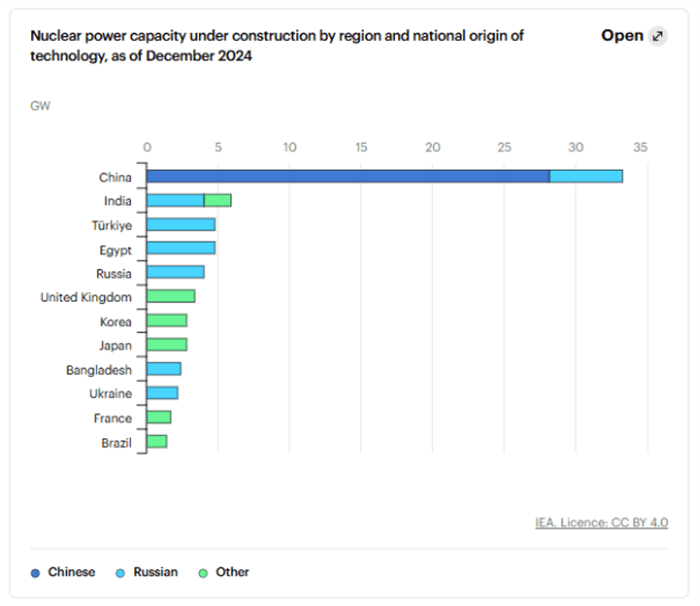
Source: IEA
The West must accelerate. Fast.
Because the stakes are high… much higher than most even realize yet.
If we don’t build out sufficient nuclear energy infrastructure, we risk falling behind in the most important race of our lifetimes – the race to artificial superintelligence.
Beyond narrow artificial intelligence… beyond the chatbots and voice assistants like Apple’s Siri… beyond even the self-driven, self-directed, thinking, iterating, and reasoning artificial general intelligence (AGI)… there is artificial superintelligence (ASI).
ASI is intelligence beyond human intelligence and reasoning, and it will likely be capable of exponential growth in intelligence. It will be sentient, sapient, and conscious in a way that’s difficult to conceptualize, especially given we’re still, for a short time, in a pre-AGI world.
It will be an incredibly powerful tool. And if we think the power demands on the data centers driving current iterations of artificial intelligence are high… ASI will require more electricity than any industry in history.
Current projections suggest that it will take over 100 GW of new, dedicated power to sustain an AI cluster capable of producing ASI.
But companies won’t want just the bare minimum computational power.
Sam Altman recently shared in an internal OpenAI Slack channel that he expects OpenAI will require nearly 250 GW of new electricity demand by 2033.
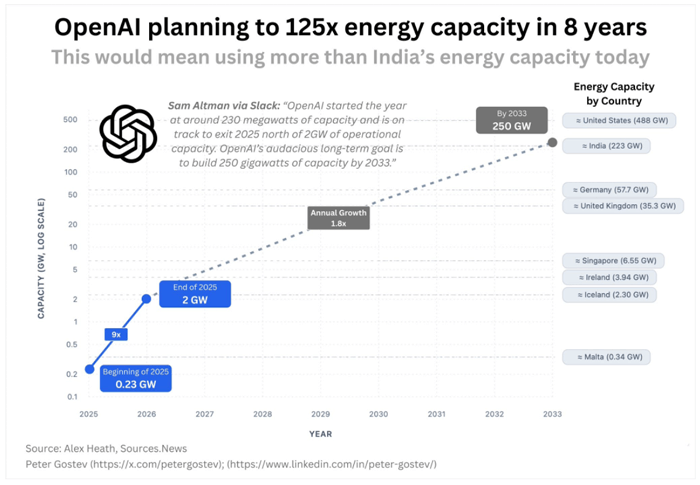
That’s just one company. If OpenAI does it, xAI will have to add 250 GW. Google will have to add 250 GW. Microsoft will have to add 250 GW. Meta will have to add 250 GW.
Those five companies alone could more than triple the Street’s 25‑year growth forecast… in just eight years. And that doesn’t count Amazon, Alibaba, Oracle, CoreWeave, Nebius, or the massive sovereign AI programs ramping up in the Middle East and Asia.
After decades of hesitation, the tide has finally turned.
For the first time in a generation, global institutions, governments, and corporations are aligning around one conclusion. Nuclear energy is essential.
Last year, the European Investment Bank (EIB) – one of the world’s largest public lenders – quietly signaled its willingness to fund new nuclear projects.
After 40 years on the sidelines, its €500 billion balance sheet could unlock dozens of new projects across the continent.
Then, in June of this year, the World Bank went further. It officially ended its decade-long ban on nuclear investment.
World Bank President Ajay Banga openly stated that electricity demand in developing nations will more than double by 2035, requiring annual investments in generation, grids, and storage to more than double from today’s $280 billion pace.
And barely a week later, the Asian Development Bank announced it was considering lifting its own nuclear restrictions. This is a clear sign that the world’s fastest-growing economies aren’t waiting for permission to power up.
According to Bank of America, the nuclear energy sector could become a $10 trillion global market opportunity, which it has called “the answer to the world’s power shortages.”
The bank’s long-term outlook projects between $181 and $215 trillion in total global energy investment over the next 26 years. And as the chart below shows, annual investment in clean energy tech will soar from the 2023 level.
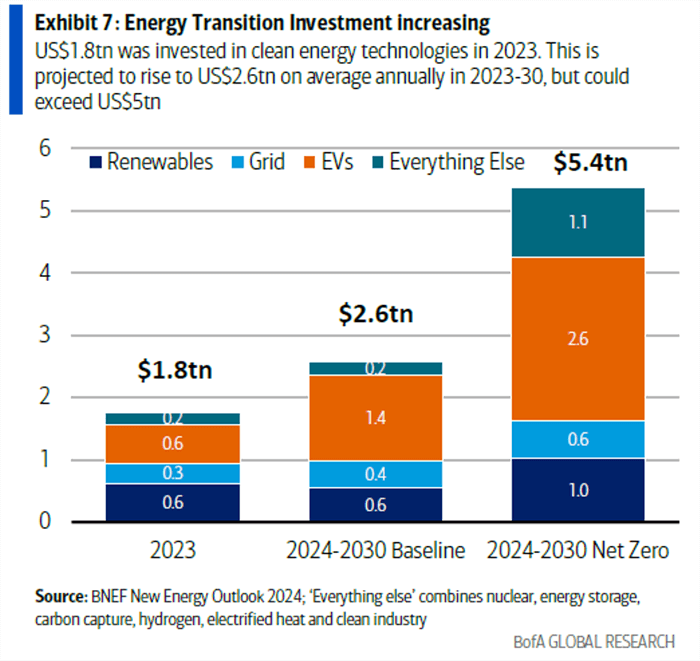
A growing share of that capital will flow directly into nuclear generation and uranium supply chains.
We now have the need, the political will, and the capital to get these projects off the ground. And perhaps most important, we have an entirely new source of funding.
Companies like Microsoft, Amazon, and OpenAI are already willing to spend billions to secure their own private power grids.
We’re entering an era when the world’s largest corporations will not just rent electricity. They’ll own or finance the plants that generate it.
Below is an infographic comparing the size of America’s largest nuclear fission power plants with the planned generation capacity for AI data centers.
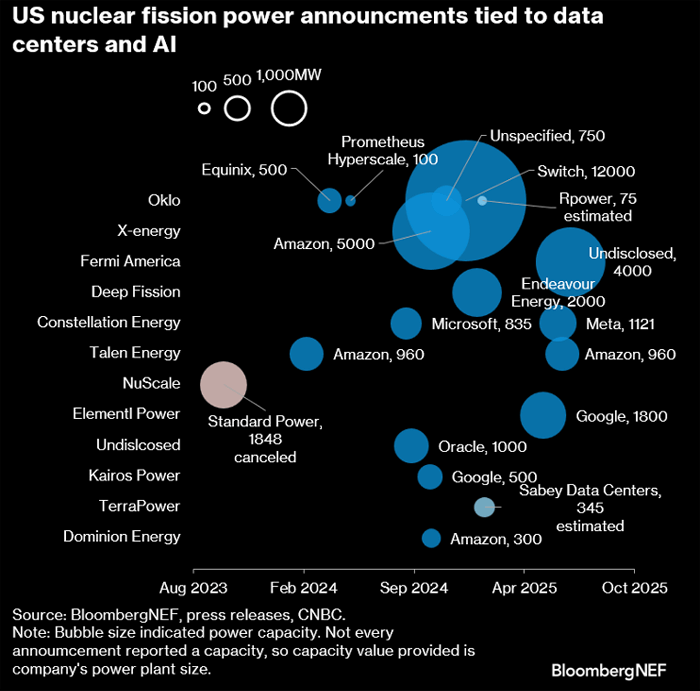
This all points to one clear outcome… a nuclear renaissance.
And the United States isn’t standing still.
As I covered in The Bleeding Edge back in May, the Trump administration issued four executive orders designed to accelerate nuclear plant construction and rebuild America’s domestic nuclear supply chain and workforce.
Once we achieve AGI – and I anticipate xAI will get there no later than spring 2026 – the race to ASI will gain speed. Demand for power is about to go absolutely sky high.
Nuclear energy development needs to become a matter of national priority, as much as it is a matter of national security.
The race is on…
Jeff
P.S. For too long, we have relied on certain countries for mining and enriching the element at the heart of this nuclear renaissance – uranium.
It’s a strategic vulnerability we can no longer afford.
To maintain energy independence and fuel the U.S. AI-era infrastructure buildout, the U.S. must shift enrichment and refining to friendly nations.
And there’s one company that is particularly well-situated to profit from not just mining… not only enrichment… but the entire nuclear value chain.
You can go here to learn more.

Read the latest insights from the world of high technology.
Whether it’s Anthropic or OpenAI, private AI companies need to continue to raise billions to fund their research and...
There was some renewed excitement in the last few days about fourth-generation nuclear fission technology and the Department of...
Early this month, Amazon (AMZN), through its Amazon Leo subsidiary, filed a petition with the Federal Communications Commission (FCC)....
Thanks for signing up for The Bleeding Edge — we’re glad you’re here!
Want updates sent straight to your phone too? Sign up for SMS alerts to get the latest delivered via text.
Brownstone Research: By submitting your phone number, you agree to our SMS Terms & Conditions, Terms of Use, & Privacy Policy, and give express written consent to receive marketing text messages from BSR. Messages are recurring & frequency may vary. Reply STOP to 94703 to opt out. Reply HELP to 94703 for info. Consent is not a condition of purchase. Message and data rates may apply. For additional information, you may contact Customer Service at 888-512-0726 or smssupport@brownstoneresearch.com.