



Nationwide Autonomy Within a Year
It’s now very clear that Tesla and the NHTSA have been working closely together…



The latest earnings reports suggest we are now entering the payoff stage…

Managing Editor’s Note: Today, we turn to our senior analyst over at The Near Future Report, Nick Rokke…
How quickly the market forgets, he points out… the spending comes before the payoff. When it comes to critical tech infrastructure, the return always comes after the investment.
And while Big Tech’s big bet on AI and its infrastructure is picking up… the payoff phase is just beginning.
Read on for more from Nick…
Amazon (AMZN) has already taught investors this lesson… But the market quickly forgets.
During the pandemic, the company built so much infrastructure, so quickly, that its free cash flow went backward.
Online orders were surging. Delivery networks were overwhelmed. And Amazon decided it could no longer trust outside carriers to control the most important part of its customer experience – the delivery.
So it launched one of the largest private infrastructure expansions in American history.
In two years, Amazon doubled the fulfillment footprint it had spent the previous 25 years building. Warehouses, sortation centers, delivery stations, aircraft, trucks, and hundreds of thousands of workers. By the end of it, Amazon’s last-mile delivery network was roughly the size of UPS.
That spending showed up immediately. The payoff did not.
Amazon’s free cash flow fell to negative $15 billion in 2021 and negative $17 billion the following year. To many investors, it looked like the company had massively overbuilt.
But the following year, the investment paid off. And they produced $32 billion in free cash flow – a $49 billion improvement in just 12 months.
The return came after the investment. It always does.
Today, we’re watching the same movie play out again. This time across the artificial intelligence industry.
Microsoft (MSFT), Amazon, and Google (GOOGL) are pouring hundreds of billions of dollars into AI data centers, advanced semiconductors, networking equipment, cooling systems, and electricity.
Once again, investors are focused on the cash leaving the door. And once again, they are asking, “Where is the return?”
The latest earnings reports gave us the clearest answer yet.
Microsoft Azure grew revenue 43% from the same quarter last year. Amazon Web Services accelerated 37%, its fastest growth rate in 18 quarters. And Google Cloud surged 82%.
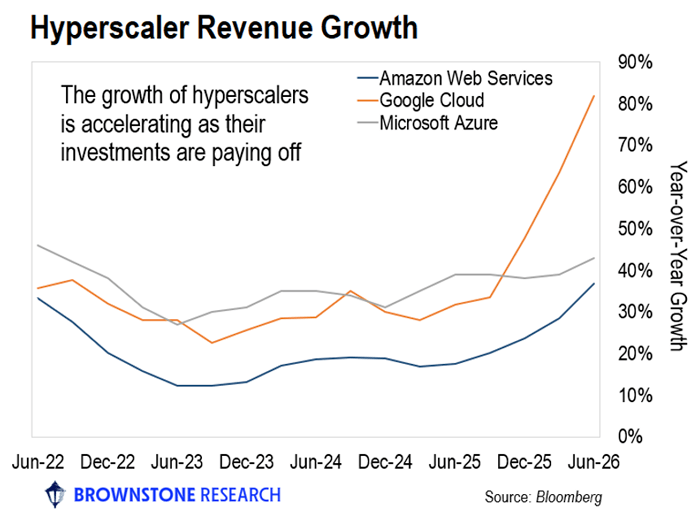
This is a massive reacceleration in growth. These aren’t startups doubling off a tiny base. They are $10-billion-plus businesses growing an average of 54% a year. And all three are accelerating as new AI infrastructure comes online.
Here at Brownstone Research, we’ve consistently ignored the fear spread by AI skeptics.
For years, they’ve pointed at the hundreds of billions of dollars Microsoft, Amazon, and Google have plowed into data centers and asked where the return was. Free cash flow is under pressure. Some of these companies may even go negative this year. And the spending plans keep getting larger.
It’s as if they expected the hyperscalers to plunk down the capital and have a data center appear overnight. But that’s not how this works.
Erecting an AI data center takes years. The land must be secured. The shell must be constructed. Transformers, cooling systems, servers, and networking equipment must be installed.
And only after the facility is connected to the grid can customers begin consuming the new computing capacity.
But now the latest earnings reports suggest we are now entering the payoff stage. Infrastructure built and financed over the past couple of years is coming online. And customers are consuming it almost immediately.
Let’s start with Microsoft. This past quarter, the company spent $36 billion on capital expenditures… most of it going toward data centers.
Microsoft only breaks out the growth rate of Azure. But we can get profitability metrics from its Intelligent Cloud (IC) division, which houses Azure, GitHub, and Windows Server products. Azure is estimated to generate about 85% of the division’s revenue.
Intelligent Cloud grew to $39.3 billion in revenue this past quarter. Operating income came in at $16.0 billion. That’s a 40.6% operating margin.
And here’s the part the skeptics miss. That $16 billion in quarterly operating profit now matches Microsoft’s entire quarterly capex bill from the end of 2024. The profits are chasing the spending higher… and catching up. We can see the pattern hold over time.
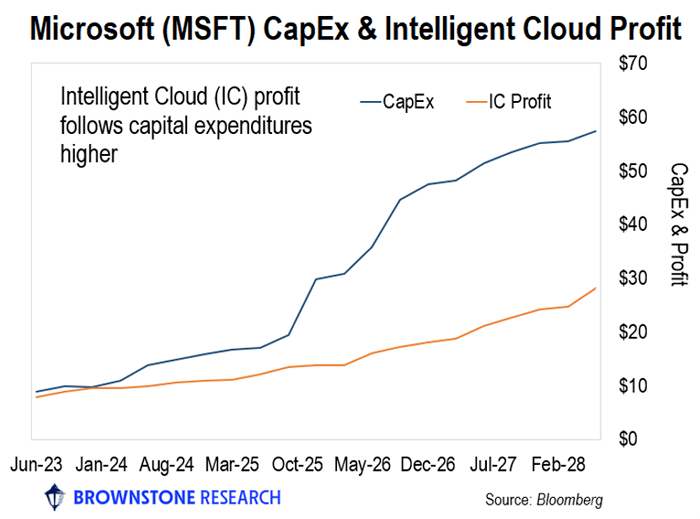
And this is likely to continue. Microsoft guided for Azure growth to accelerate further – to 45% year-over-year next quarter. That makes sense given the capacity coming online.
In each of the past three quarters, Microsoft has added roughly 1 gigawatt (GW) of new capacity. And each GW of capacity translates into about $10 billion of revenue. That’s the engine behind the reacceleration.
These are the most sophisticated data center operators in the world. They know where demand is… and where it’s going. They aren’t building on speculation. Microsoft is currently sitting on a $684 billion backlog. That’s contracted revenue the company collects as long as it can bring the data centers online in time.
The same story applies to Google and Amazon.
Google is a special case. Its Cloud revenue grew 82% year-over-year partly because it started from a smaller base than the other two. But there’s another reason… Google has started selling its custom Tensor Processing Unit (TPU) systems directly to customers.
For years, outside customers could only rent access to Google’s custom AI chips through Google Cloud. Now Google can use those chips internally, rent them through its cloud, or sell complete systems into facilities financed and operated by others. That’s a whole new revenue stream.
And Google’s backlog expanded to $514 billion – an increase of $50 billion in just three months.
The bears see huge capital expenditures and fail to see the future returns behind them.
They see Amazon and Google posting negative free cash flow this past quarter. They note Microsoft may not be far behind if capex rises a few billion more.
And they’ll point to Meta (META) and say its growth isn’t accelerating. But they fail to factor in that Meta is consuming most of its new capacity internally – using it to make its advertising machine more efficient. And Meta isn’t renting out compute to outsiders… yet…
They also say these are long-lived projects. The full returns will take years to measure.
But to us, the direction is clear.
Cloud growth is accelerating. Backlogs are expanding. New capacity is consumed nearly the moment it’s turned on. And cloud operating profits are soaring.
This is not what we would expect to see if the AI infrastructure boom were built on empty demand.
The issue is not finding customers for the infrastructure… It’s bringing enough infrastructure online to meet demand.
This creates a powerful, self-reinforcing cycle.
Hyperscalers invest in AI infrastructure. That capacity enables faster growth, more AI applications, and faster training reinforcement cycles for AI models.
This makes the AI models smarter, more efficient, and cheaper. That makes it easier for more people and businesses to see a return on AI spend. So they demand more.
That means hyperscalers get more revenue and profits, which gives them the financial firepower and the incentive to build even more capacity.
And that capital flows into the semiconductor and infrastructure supply chain.
The hyperscalers will need more GPUs from NVIDIA (NVDA) and AMD (AMD)… more custom accelerators designed with companies like Broadcom (AVGO)… more advanced manufacturing from Taiwan Semiconductor (TSM)… more high-bandwidth memory from Micron (MU)… more networking equipment… and more cooling and electrical infrastructure.
The question is now settled. The spending is paying off.
And as Jeff explained yesterday, much of July’s dip in tech stocks came from funds squeezing the large Situational Awareness fund into a margin call. That forced selling has now passed.
With the fundamentals this strong, we expect the market to continue on to new highs.
Stay invested. The payoff phase is just beginning.
Regards,
Nick Rokke
Senior Analyst, The Bleeding Edge
Add Brownstone Research as your preferred source on Google to see our latest stories in your feed.
 Add as a preferred source
Read the latest insights from the world of high technology.
It’s now very clear that Tesla and the NHTSA have been working closely together…

These two IPOs will be nothing more than liquidity events for the effective altruists, venture capital firms, and private...

Over the last week, we have discovered that this is a massive, well-coordinated psyop carried out by some powerful...