


An Exciting Moment for the Nuclear Fusion Industry
While I maintain that the “AI Fear Trade” is largely overblown, that doesn’t mean there won’t be market shocks...


It was a page directly out of SpaceX’s playbook…

Managing Editor’s Note: Tomorrow evening at 8 p.m. ET, Jeff is revealing the details behind a strange phenomenon that’s causing explosive surges in a very small group of stocks.
These massive surges affect less than 1% of stocks and often occur within a 24-hour period – so fast that by the time most folks are ready to get it, it’s too late.
The best way to take advantage is to already be in position before these surges occur… and that’s why Jeff and his team have designed an artificial intelligence to help spot these windows, weeks before they come.
Jeff’s getting into all the details tomorrow night. You can go here to automatically sign up to attend.
Imitation is a form of flattery.
Perhaps that’s the case with Jeff Bezos… and his efforts at his private space exploration company, Blue Origin.
Blue Origin’s New Glenn rocket was designed to mimic SpaceX’s ability to reuse the first stage of the rocket, returning the Falcon 9 or Falcon Heavy booster back to Earth.
SpaceX first demonstrated reusability in December 2015.
Since then, it has successfully returned about 550 boosters to launch pads or floating landing vessels in the ocean.
It may have taken a decade, but Blue Origin achieved its first reusable booster landing on its floating landing vessel, Jacklyn, in the Atlantic Ocean last November.
It was remarkable that after a decade of booster landings by SpaceX – showing the entire aerospace industry how it’s done – not a single incumbent aerospace company was able to do the same.
Only Blue Origin, a private company founded and funded by Jeff Bezos’ Amazon wealth, was bold enough to take a run at it.
It was a page directly out of SpaceX’s playbook.
It looked nearly identical to what SpaceX does, down to the floating landing vessel…
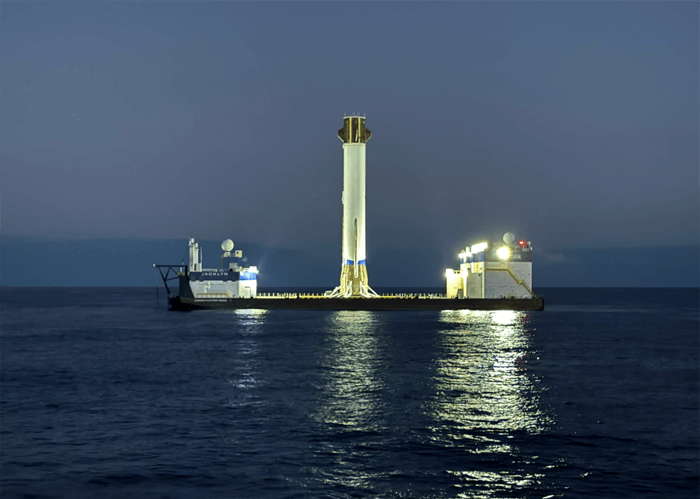
New Glenn Booster on Jacklyn Returning to Shore | Source: Blue Origin
Elon Musk congratulated the Blue Origin team at the time.
It’s a remarkable achievement, and despite SpaceX’s dominance in the launch industry, Musk recognizes that the industry still needs more disruption to grow the size of the space economy.
Blue Origin has been competing against SpaceX for business related to NASA’s Artemis moon missions – both in launch services, as well as for building a lunar lander.
Blue Origin is developing its Blue Moon lunar lander, which is reminiscent of the Apollo missions in the 1970s.
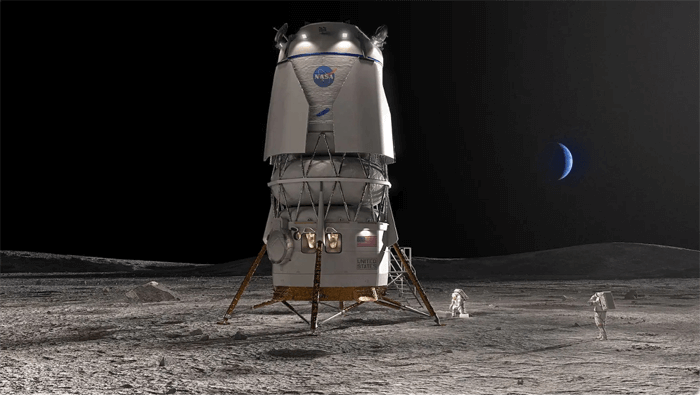
Blue Moon Mark 2 | Source: Blue Origin
And Blue Origin’s latest form of imitation was just announced days ago – in the form of TeraWave, a “6 Tbps Space-based network for global connectivity.”
It was announced and positioned in such a way to make it bigger and better than what SpaceX has already done with its network.
Shown below is its own table, positioning TeraWave against “Current LEO Constellations,” which means, of course, SpaceX.
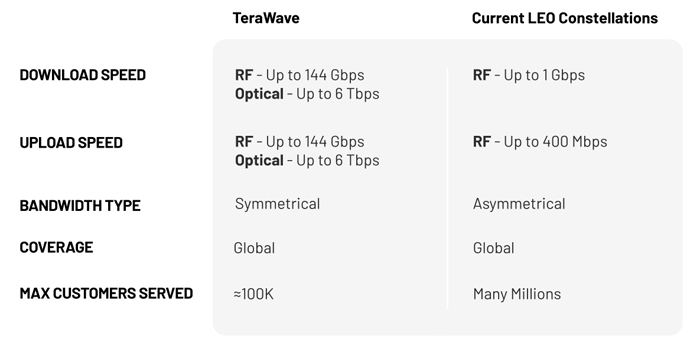
Source: Blue Origin
SpaceX’s space-based network is Starlink, of course, which has already launched about 11,000 Starlink satellites into low Earth orbit (LEO).
Currently, about 9,400 of those satellites are in operation, powering what I have always referred to as a literal World Wide Web – a space-based internet backbone.
But while the media and financial journalists focus on Starlink’s subscription-based business of providing space-based internet to consumer terminals on Earth, the significance of Starlink is much greater.
Starlink satellites have optical interconnections with each other, creating a mesh network in LEO that encompasses Earth.
It can route information and intelligence to any place in orbit and to any place on Earth.
No other company or government can do that.
It’s an enviable position to be in, which is why Blue Origin recognized the opportunity to build something similar – as an alternative to Starlink.
TeraWave is positioned as an “enterprise-grade” service, which will target corporations and governments.
Technically, the main points of differentiation are supposed to be symmetrical upload and download speeds of up to 144 Gbps over radio frequencies (RF) or 6 Tbps over optical links.
The technology has yet to be demonstrated, as the TeraWave constellation is targeted to begin in the fourth quarter of 2027, a couple of years from now.
Blue Origin is planning on 5,280 LEO satellites using RF links, and 128 mid-Earth orbit satellites providing the 6 Tbps optical links. This hybrid model is different than Starlink’s constellation, which is entirely LEO.
It makes sense for Blue Origin to focus on this space-based internet backbone for enterprise applications, as its consumer-facing space-based internet service is currently being led by none other than Amazon.
Project Kuiper – something we’ve followed closely in The Bleeding Edge – has been officially rebranded to Amazon Leo, which is targeting more than 3,000 satellites.
Amazon has launched 180 production satellites into orbit so far on rockets from SpaceX, United Launch Alliance, and soon Arianespace.
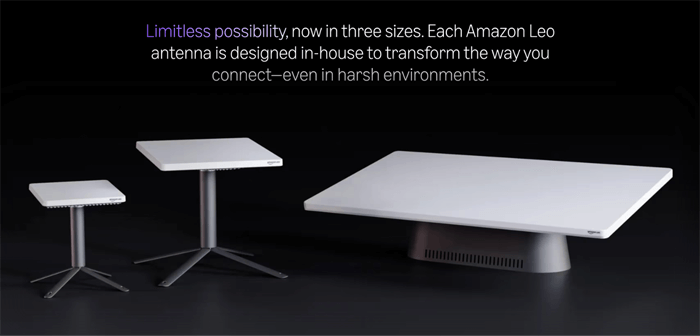
Amazon Leo Consumer Terminals | Source: Amazon
It’s not clear whether the TeraWave satellites will be able to leverage Amazon Leo satellites, but these two constellations are being built out for distinctly separate services.
Given the importance of what Jeff Bezos and his team at Amazon built with Amazon Web Services on Earth, the largest cloud services provider, it’s no surprise that Bezos wants to build an internet backbone in orbit.
He certainly could have done so at Amazon, but embedding TeraWave into Blue Origin while it is still a private company keeps the operational expenses of the satellites and launch services off Amazon’s books.
SpaceX has been remarkably successful with its business model, as well.
Starlink delivers most of SpaceX’s free cash flows, which fund the development of grand engineering challenges like sending the Starship to Mars.
Blue Origin is clearly trying to mimic SpaceX’s business model approach, hoping to create a cash flow-generating business with TeraWave, which will fund Blue Origin’s space exploration technology.
If executed well, Bezos will no longer have to pump $1 billion-plus into Blue Origin every year to keep it operational.
Blue Origin may be a decade behind, but it is making fantastic progress towards becoming an alternative to SpaceX.
Ad astra,
Jeff

Read the latest insights from the world of high technology.
While I maintain that the “AI Fear Trade” is largely overblown, that doesn’t mean there won’t be market shocks...

The more transactions that take place over Meta’s networks, the more money it makes. So why limit that to...

Cortical Labs has been developing a biological computing system based on human brain cells…
Thanks for signing up for The Bleeding Edge — we’re glad you’re here!
Want updates sent straight to your phone too? Sign up for SMS alerts to get the latest delivered via text.
Brownstone Research: By submitting your phone number, you agree to our SMS Terms & Conditions, Terms of Use, & Privacy Policy, and give express written consent to receive marketing text messages from BSR. Messages are recurring & frequency may vary. Reply STOP to 94703 to opt out. Reply HELP to 94703 for info. Consent is not a condition of purchase. Message and data rates may apply. For additional information, you may contact Customer Service at 888-512-0726 or smssupport@brownstoneresearch.com.