

The Largest Merger in History
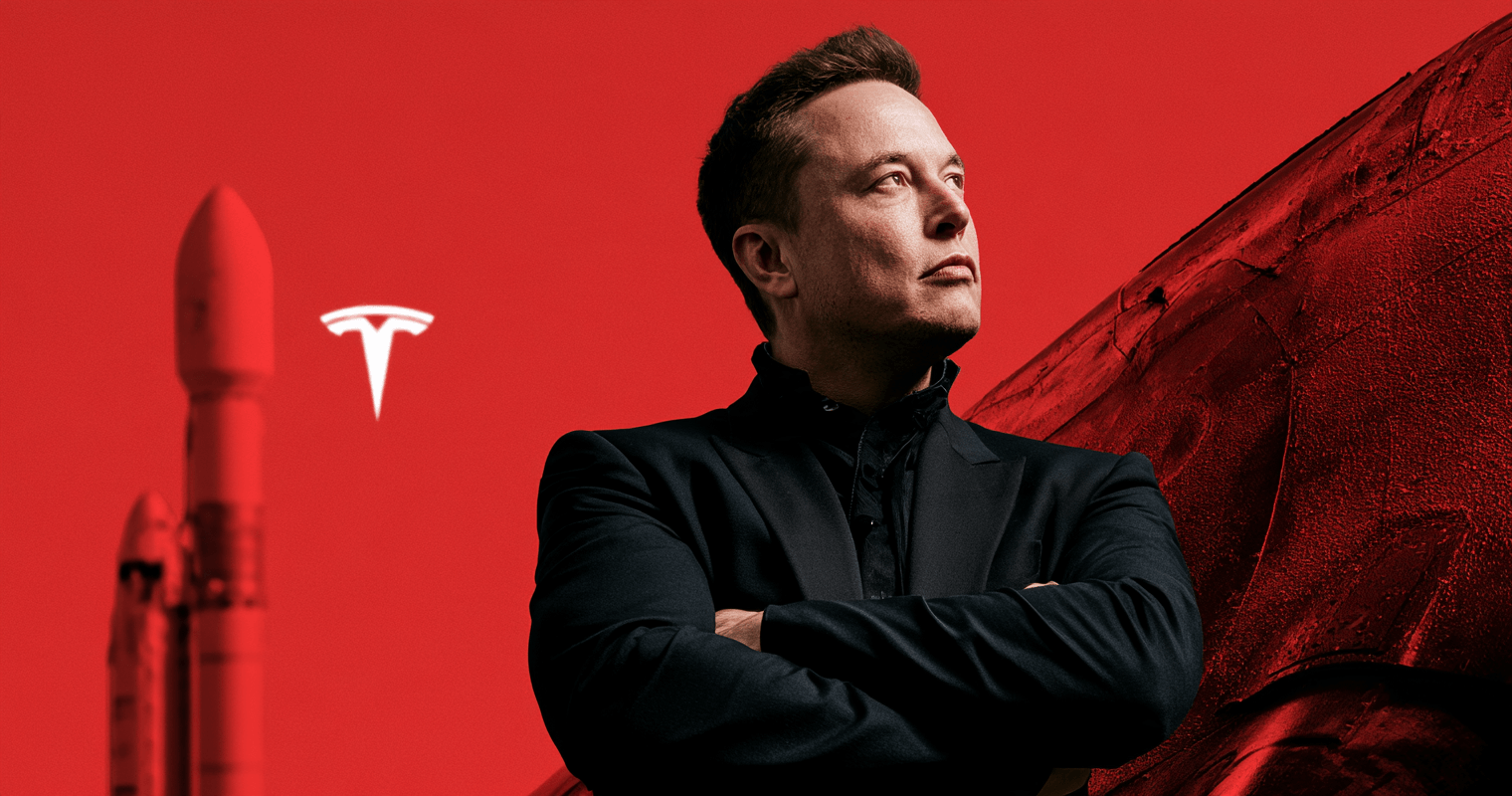
Tesla and SpaceX have now formed special committees to evaluate a potential merger between these two Elon Musk-led powerhouses.



The Cybercab is a remarkable feat of engineering that will soon dominate not only the autonomous ride-hailing industry, but the entire ride-hailing industry.
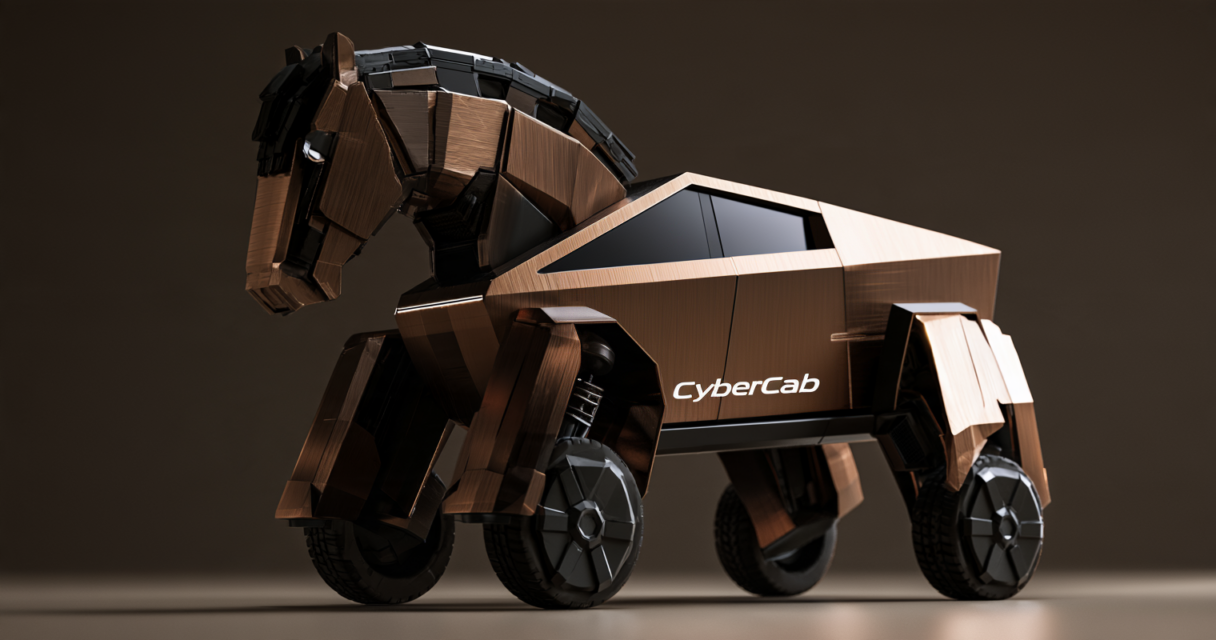
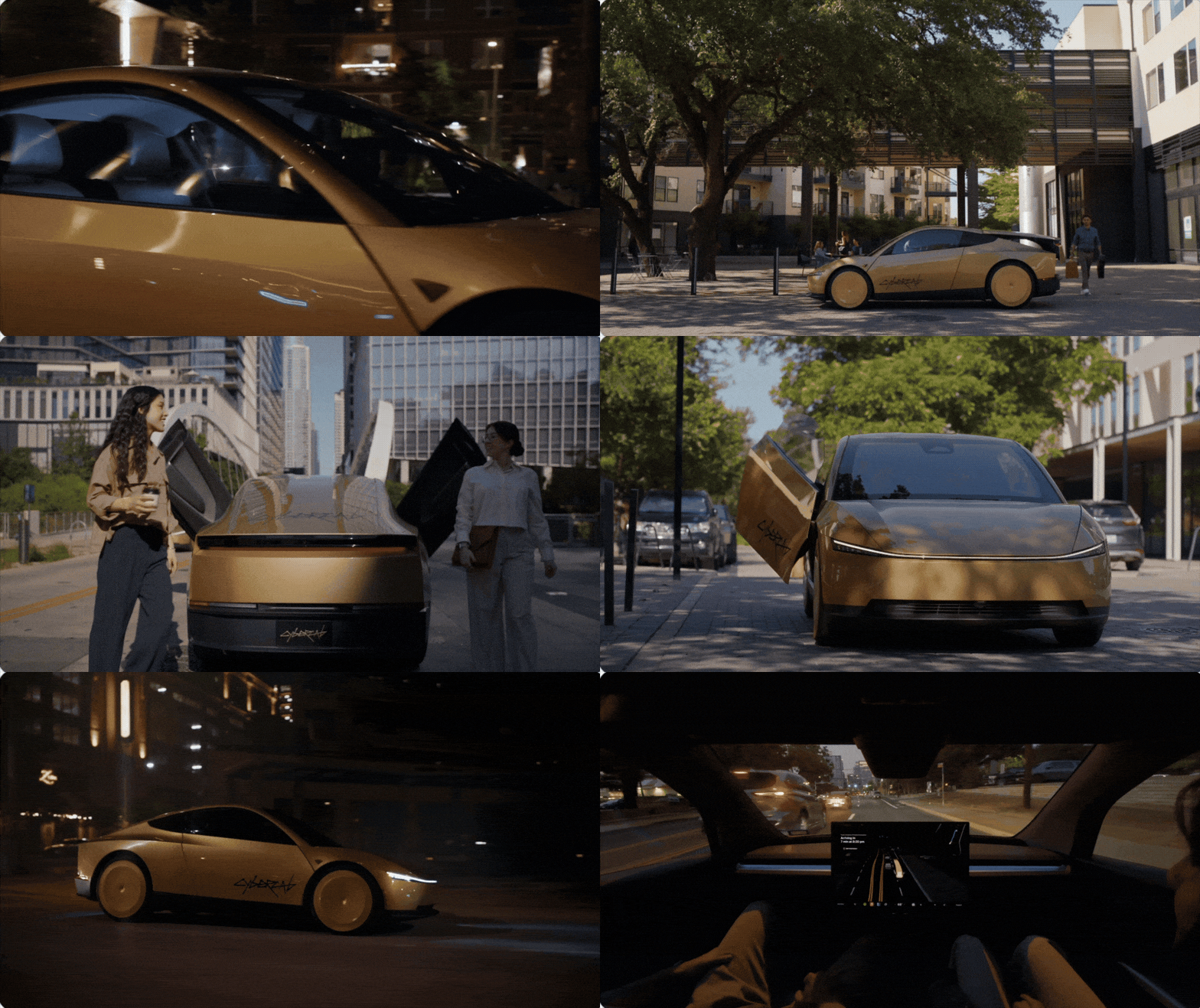
Last Thursday will go down in history as the most important date in autonomous driving technology – the official launch of Tesla’s Cybercab.
Source: X @Tesla
We certainly wouldn’t know it if we read and trusted the media.
The coverage was not very positive, and oftentimes negative.
But we won’t let that fool us.
The Cybercab is a remarkable feat of engineering that will soon dominate not only the autonomous ride-hailing industry, but the entire ride-hailing industry.
Tesla’s Cybercabs have something that no other company in the industry has: an entirely vision-based neural network – the autonomous driving “brain,” which enables Teslas to drive safer than humans from point A to point B without any passenger intervention.
The vision-based system means that geofencing is not required. Tesla’s autonomous brain enables it to drive anywhere in any condition.
Tesla’s most recent version of full self-driving (FSD) software, available on all Teslas, is nothing short of a stunning manifestation of intelligence.
One well-known media outlet humorously referred to it last week as “just a Level 2 driver-assist system that requires constant human supervision.” Nothing could be further from the truth.
I can’t remember the last time I had to touch the wheel or make any effort at all while being driven by my Tesla Model Y.
Just like a Model Y or Model 3, the Cybercab is equipped with nine cameras, eight of which are external, and one interior, which is what provides the neural network with its vision of the real world for navigation.
In addition to the cameras, the Cybercab has the added advantage of a more powerful self-driving computer, which is based on Tesla’s AI Hardware version 4 system.
The computer has more memory to enable even higher performance than normal production Teslas.
But what makes the Cybercab stand out compared to other production Teslas is the obvious… There is no steering wheel, brake pedal, or gas pedal.
By design, it is driverless and unsupervised.
Source: X @Tesla
I have long maintained that the killer app for the automotive industry isn’t a new design, a new color, or even longer range for electric vehicles.
It is autonomy.
The pundits still don’t understand this. The “killer app” for the automotive industry isn’t a new design, a modern color palette, or a clever folding tailgate on a pickup truck.
The killer app is autonomy – the freedom to not have to drive, the freedom to not have to worry about traffic, and the freedom to reclaim our time.
– Jeff Brown, “The “Killer App” for the Automotive Industry” | March 2025
Anyone who has made the leap to a Tesla and its FSD software understands this deeply.
On FSD, any stress related to driving is relieved.
Time is recaptured.
We can focus more on speaking with others in the car, or on the phone, than on driving.
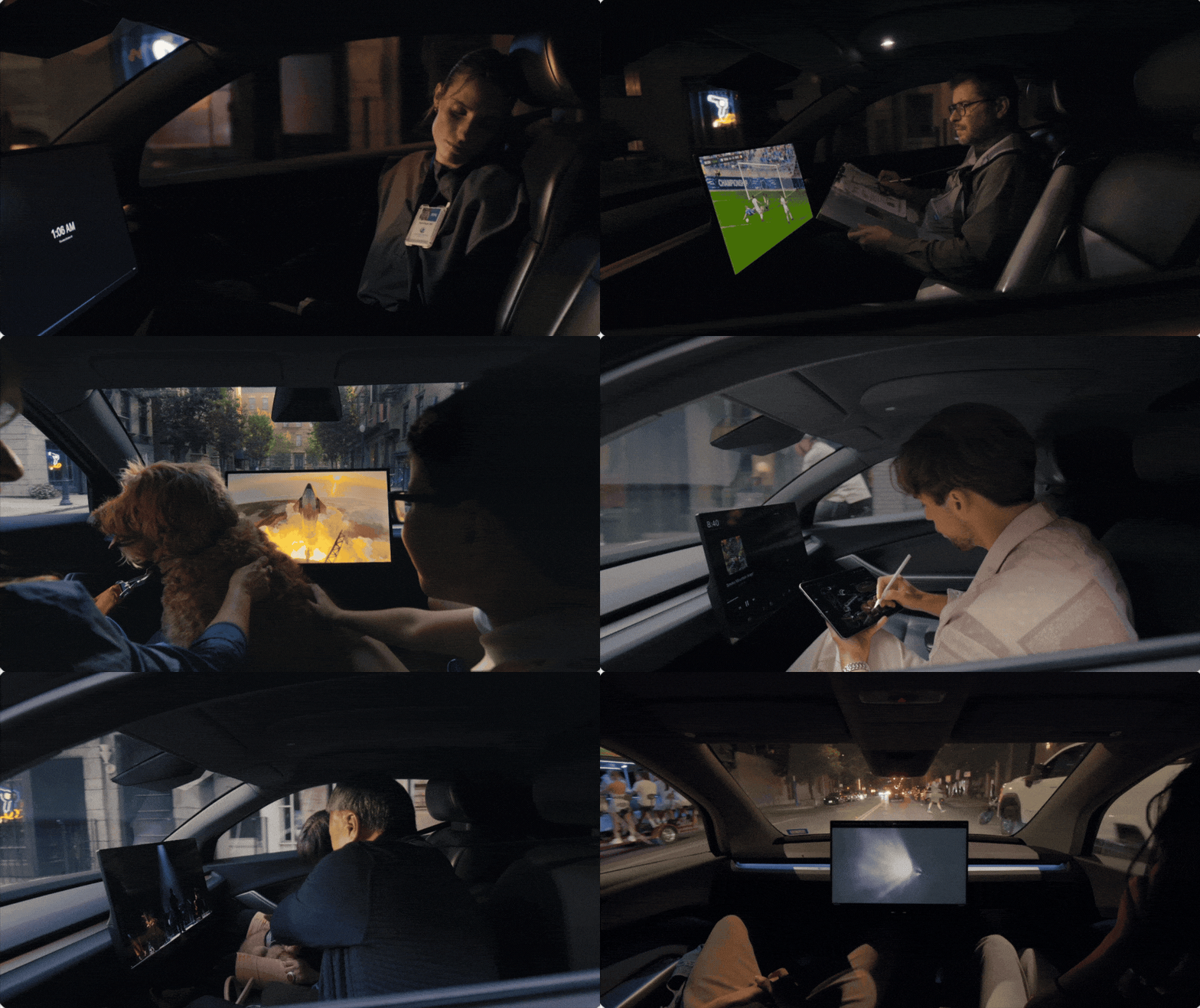
And the Cybercab is unsupervised autonomy. Passengers can do whatever they like.
They can sleep, they can hook up a gaming controller to play games, they can watch TV, take Zoom calls, do homework, enjoy a football game, or even sing karaoke.
Better yet, Cybercabs are being equipped with a Starlink receiver, which will make high-speed internet available to all passengers.
While many might say that this autonomy – enabling us to recapture time throughout the day – is the killer app worth paying more for, the economics are exactly the opposite.
Cybercabs – and any kind of Tesla Robotaxi – will be significantly cheaper than what’s available today.
Trump is finishing a 25-year battle against a foreign “cartel.” And a single ticker is handing investors the chance at payouts like $8,704 in six days from the fallout. Click here to watch the full story now.
Americans are discovering a rare "29% account" that pays 72x more than what your bank offers. It's NEVER been advertised to the general public… the big banks and financial giants have kept it to themselves for decades. Now it's available to everyday Americans - and banks are NOT happy about it. Discover the "29% account" here before they try to ban it.
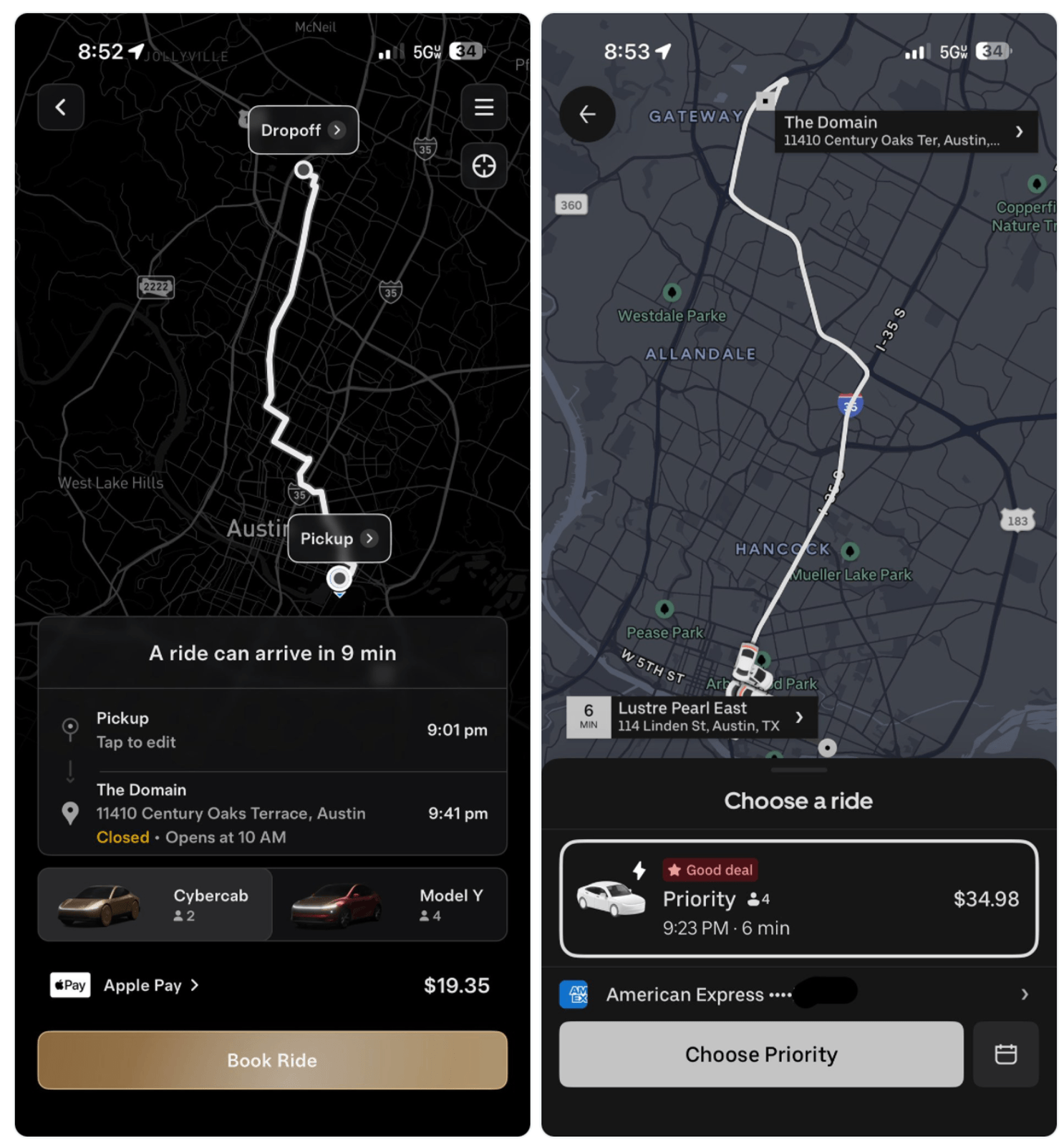
For comparison, here is an example from last Thursday for the exact same trip in Austin, Texas – Cybercab’s pricing is on the left, and Uber’s is on the right.
Source: @teslaflexx
The Cybercab is only 55% of the cost of an Uber ride.
And the pricing will decline as the Cybercab network scales up.
At scale, taking a Cybercab will be cheaper than most, if not all, public transportation networks.
Tesla isn’t in this to maximize profits.
Its strategy is to transform public transportation and deliver a point-to-point transportation service that is significantly safer and cheaper than human drivers.
Tesla’s FSD software has already been proven to be 7 times safer than human drivers, and this is possible because Tesla has already collected the data from 14.275 billion autonomous miles, the largest and most valuable training dataset by far in autonomy.
And it’s not just the economics of ride-hailing that will make the Cybercab so successful.
It’s the economics of owning and managing fleets of Cybercabs.
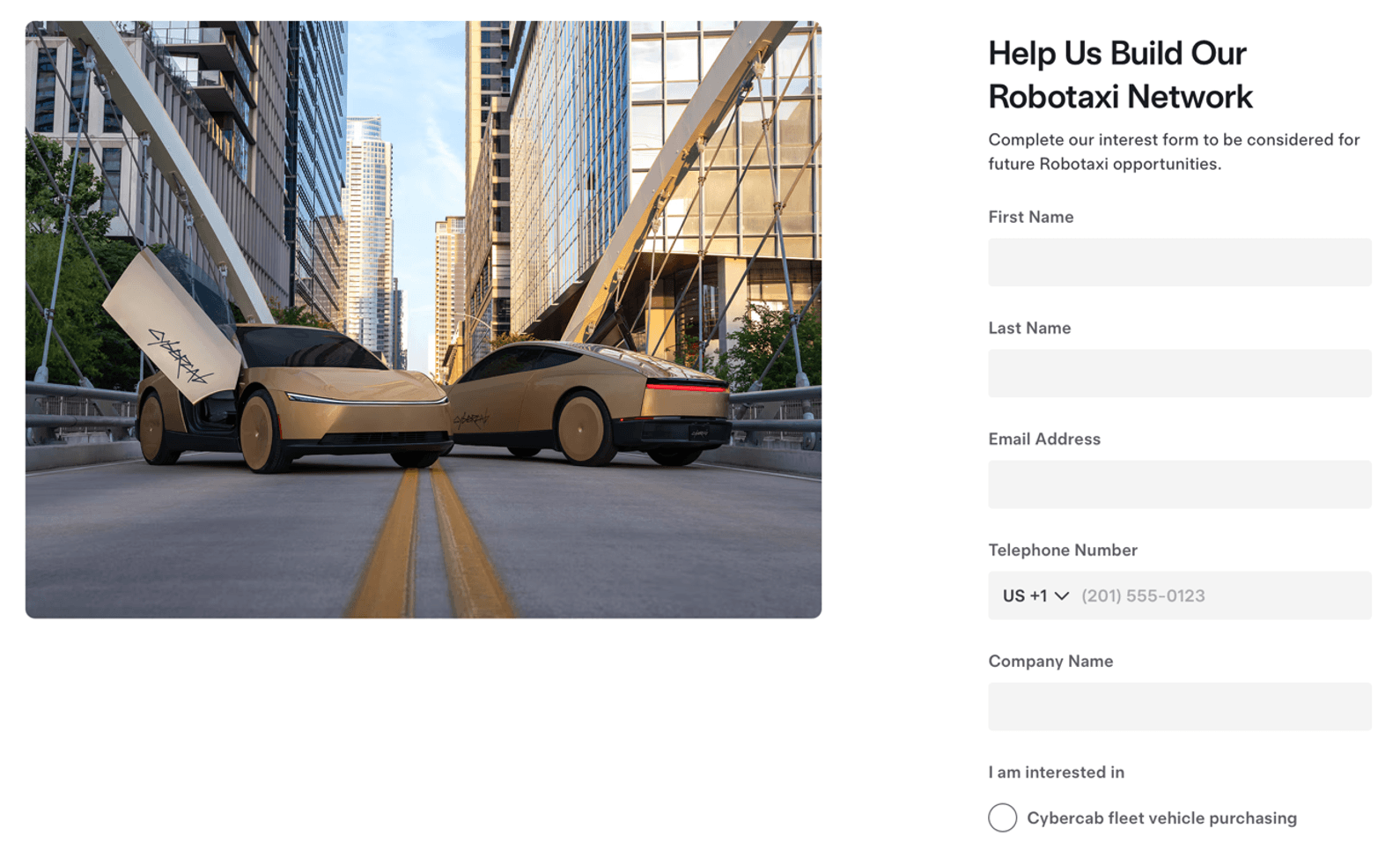
Made available since last week’s Cybercab event is an interest form for those interested in purchasing a fleet of Cybercabs.
For anyone interested, you can find the form right here.
Source: Tesla
In less than 48 hours, more than 73,000 interested parties clicked on the interest form to gain access to early Cybercab purchasing opportunities.
And the reason is simple – it’s an incredible money-making opportunity for those interested and willing to manage a fleet of Cybercabs.
I reviewed a straightforward analysis on how much revenue a single Cybercab would throw off a year for a fleet manager.
At 30% utilization, pricing at $1 a mile, assuming 35% of revenue goes to Tesla for creating the marketplace, gross profit would be around $14,000 a year.
That’s $14,000 a year with conservative assumptions, while accounting for all expenses associated with managing a Cybercab – the most significant of which are the costs to charge the Cybercab and for tires.
Given that the Cybercab is expected to cost around $30,000, these autonomous vehicles will print money with very limited effort by the fleet manager.
And with any form of financing or leasing made available, they’ll be profitable from day one.
That’s why the interest levels are so high.
The masterstroke by Tesla, however, is that it will allow Tesla owners – not just Cybercab owners – to opt in their Teslas into the Robotaxi network in the future.
So long as the Tesla has the Full Self-Driving (FSD) system, Tesla owners or lessees will be able to put their Teslas to work for them by sending them out to earn money through ride-hailing.
The brilliance of this is that the revenue from offering ride-hailing services will exceed the monthly cost of a Tesla lease or financing payment.
This effectively makes owning/leasing a Tesla not only free, but cash-generative.
This also means that lending standards can be reduced as ride-hailing revenue can be garnished to pay for the monthly lease payment.
Pretty much anyone will be able to get their own Tesla.
Very few have factored in what this means for Tesla and the ride-hailing industry as a whole.
In the very near future, Cybercabs will soon be everywhere and will dominate the entire autonomous ride-hailing industry.
When it happens, it will feel as if it happened overnight.
It will be a sudden realization.
Source: @RobotaxiRadar
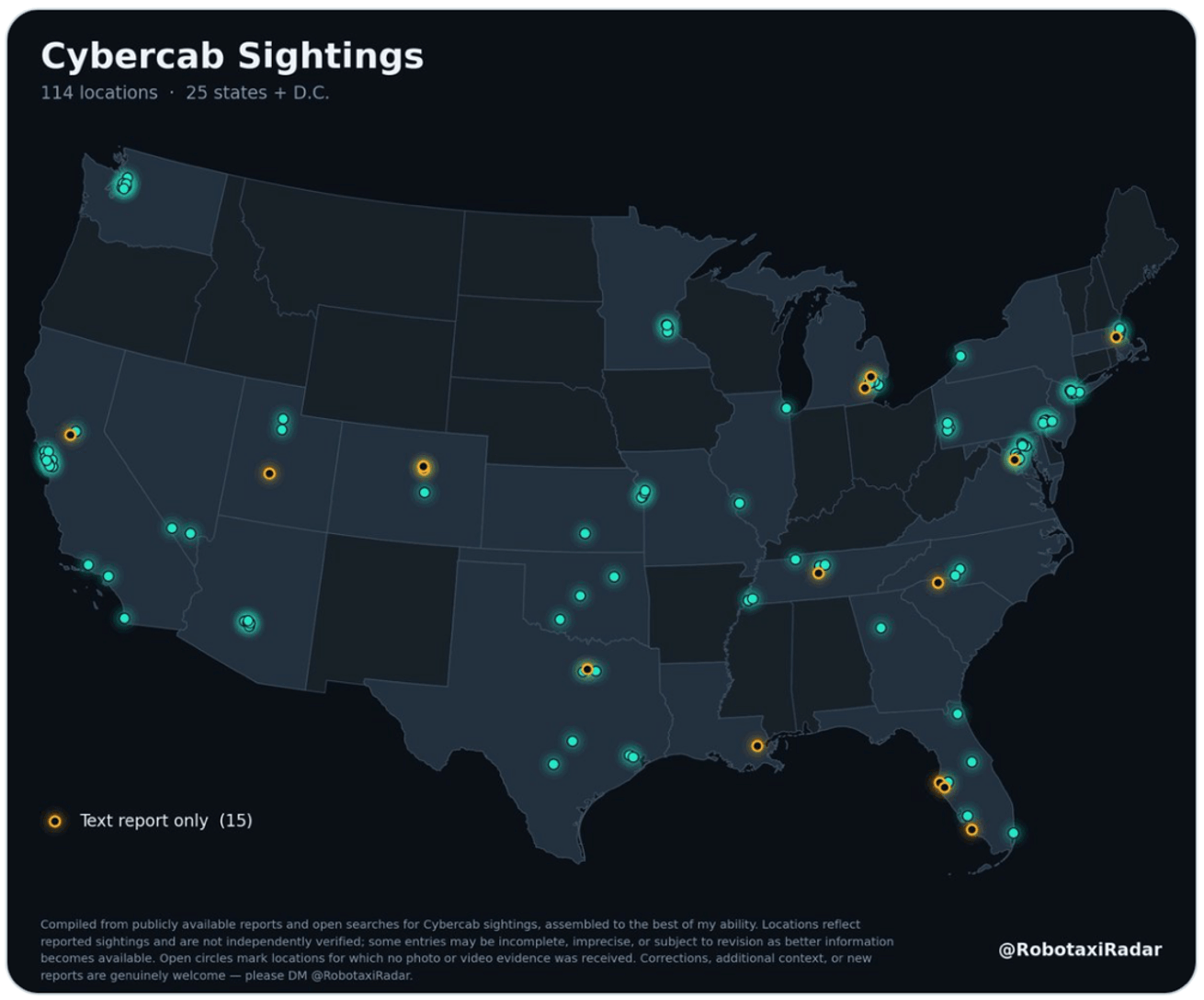
The reality is that Cybercabs are already proliferating.
There have already been 114 locations where Cybercabs have been seen in 25 different states.
It won’t be long before they are everywhere.
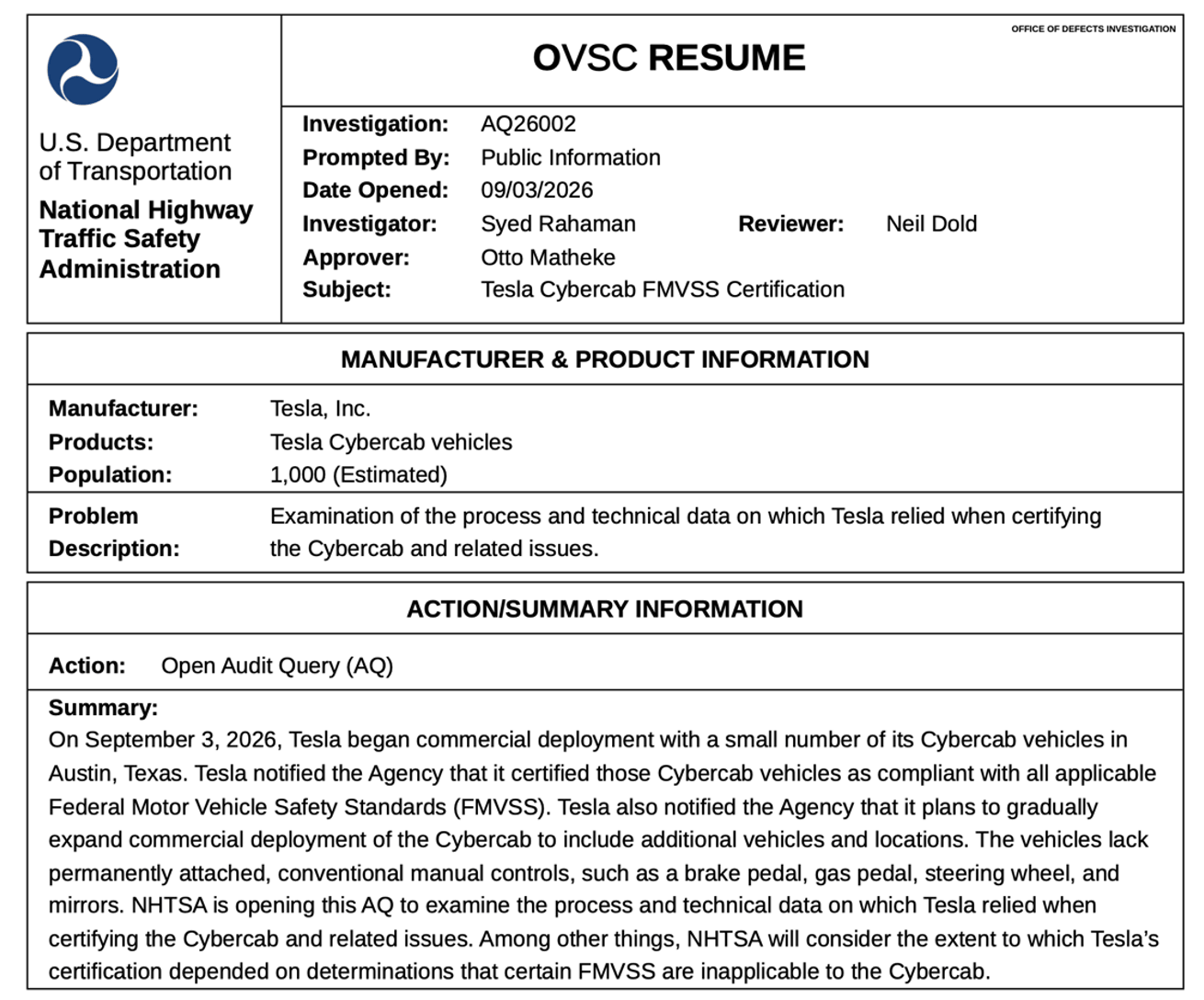
Ironically, what got more attention from the media than the technological breakthrough that the Cybercab represents is that the National Highway Traffic Safety Administration (NHTSA) launched an investigation into Tesla’s certification of the Cybercab on the very same day of the launch.
Source: NHTSA
This was obviously planned well in advance, and with the collaboration and discussion between Tesla and the NHTSA.
And while this is a routine process, it actually speaks to a much larger strategy that Tesla is implementing with regard to autonomy.
Tesla certified the Cybercabs “as compliant with all applicable Federal Motor Vehicle Safety Standards (FMVSS).”
This is telling.
Tesla isn’t applying for exemptions for the Cybercab from the NHTSA, which is what the other players in autonomous driving have been doing.
Tesla is certifying that the Cybercab is compliant with all applicable standards.
The nuance here is that the standards weren’t designed for vehicles that have no steering wheel, no gas pedal, or brake pedal.
In other words, it can’t be held as non-compliant for standards related to those automotive parts.
Tesla’s strategy is to force the issue of the need for the NHTSA to update its safety standards to account for fully autonomous vehicles.
And by doing so, this would make autonomous regulations and standards a national issue, rather than one that is regulated state-by-state.
One approval, at once, rather than a slow rollout.
Tesla is swinging for the grand slam, not just a home run.
With an update of safety standards to account for autonomy, Tesla will effectively set the standard.
And once the NHTSA gives Tesla the green light for Cybercabs, it also means that the millions of Tesla Model Ys, Ss, Xs, 3s, and Cybertrucks already on the road driving autonomously in “supervised” mode…
Will all be enabled for unsupervised driving… with a simple software download.
And that means… game, set, and match for Tesla.
Add Brownstone Research as your preferred source on Google to see our latest stories in your feed.
 Add as a preferred source
Read the latest insights from the world of high technology.
Tesla and SpaceX have now formed special committees to evaluate a potential merger between these two Elon Musk-led powerhouses.
This isn't about simply recreating the old system on new infrastructure…
As companies give digital workers more responsibility, protecting their systems becomes part of the cost of putting AI to...