




What Wall Street Is Still Missing About Tokenization
This isn't about simply recreating the old system on new infrastructure…


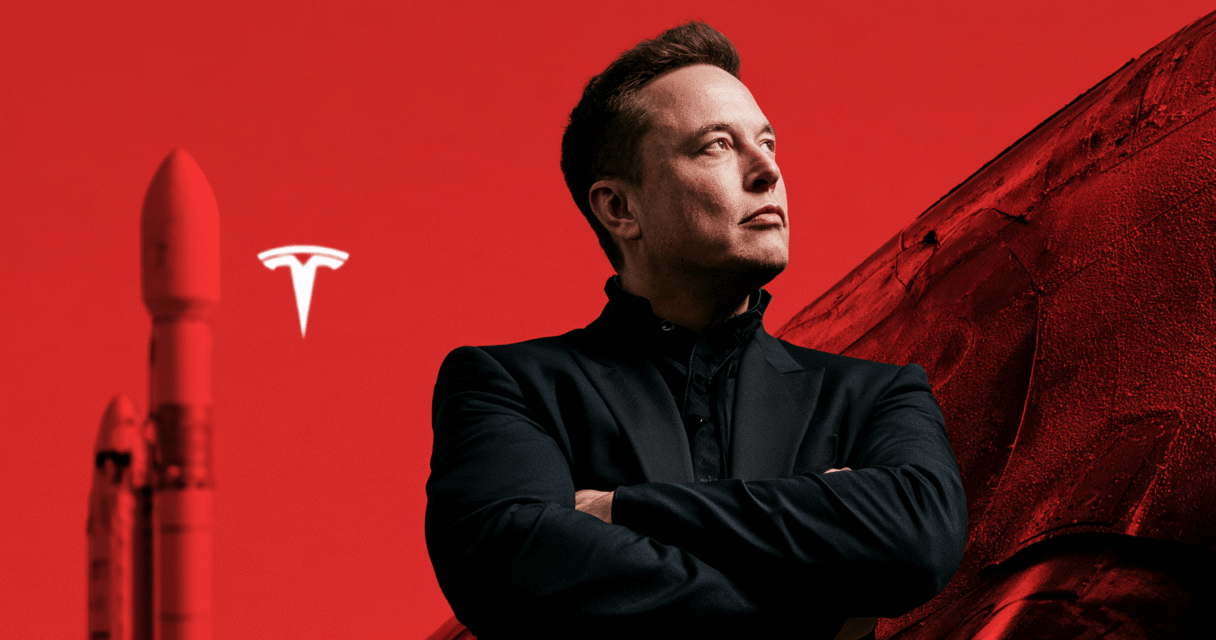
Tesla and SpaceX have now formed special committees to evaluate a potential merger between these two Elon Musk-led powerhouses.
Managing Editor’s Note: Don’t forget to sign up for Jeff’s AI Super Chip event next week…
He’s getting into the details of the California-based company that’s developed a chip that’s 50x more powerful than NVIDIA’s…
And could shake up the AI industry and spawn a new class of AI companies that could soar this year.
Just go here to sign up. Then read on for today’s AMA…
It’s no longer a rumor.
Tesla (TSLA) and SpaceX (SPCX) have now formed special committees to evaluate a potential merger between these two Elon Musk-led powerhouses. If the combination of these two companies moved forward, it would be the largest corporate merger in history.
One thing that I am certain of is that this discussion wouldn’t be happening without the blessing of Elon Musk.
From my perspective, the purpose of forming these special committees isn’t to determine whether a merger should move forward or not. It’s to determine how to make it move forward and under what conditions.
And the most important question to answer is how many shares of SpaceX will holders of Tesla receive in the combination of these two tech giants.
At this stage, with the recently announced plans of the Terafab – which will supply semiconductors to both companies – and the importance of Tesla’s Optimus robots to SpaceX for building lunar and Martian colonies… There is a lot of logic in combining the two companies and their respective technologies.
The end result will be the most valuable and most significant technology conglomerate in history, one that will literally change the course of humanity.
With that… have a wonderful weekend.
Hello Jeff and team,
Are you concerned at all with the recent plunging of the CBRS stock? Seems it could be just the unlock period, but the insiders have also been selling a lot. Also, MSFT announcing their own in-house inference chip doesn’t help matters either. Would like to hear your thoughts.
Thank you.
– Nathaniel W.
Hi Nathaniel,
In short, no, not at all.
Cerebras (CBRS) did not have a traditional lock-up expiration like most IPOs.
Typically, there is a 180-day lockup window restricting all executives, employees, and private investors (VCs & PE) from selling shares until the expiration 180 days after the IPO.
In these situations, it is not unusual to see a high-quality growth stock trade significantly above its IPO price for several months until the weeks leading up to the lockup expiration, when short-term capital tends to sell into the lockup expiration.
This happens because the fast money expects that the insiders will be selling a portion of their shares for the purpose of liquidity. Venture capital firms and employees will have held onto their shares for years, sometimes decades, without any liquidity.
So selling is often not a reflection at all on the value of the company, only that investors and employees want to sell a portion of their shares for liquidity or diversification or for practical matters like buying a new house or paying off a mortgage.
In the case of Cerebras, it has 11 lock-up expiration windows that began on May 14. The first two lockup expirations only freed up 2 million shares each, but the next seven lockup expirations ranged from 14 million to 36 million shares each lockup expiration.
There are only two expiration windows left: 19 million shares on October 28 and 14 million shares on November 10. After that, all shares will be free to trade.
It is nearly impossible to predict how much selling there will be across so many expiration windows. Cerebras’ first institutional round happened in 2016, so there are investors that have been illiquid for a decade. Institutional interest started to pick up in 2018 for Cerebras, which is when we saw a larger number of investors invest in Cerebras.
It’s clear from the trading action that several of these investors have opted for liquidity within the first five months of trading. I suspect that most of the selling pressure has passed.
There is nothing at all wrong with Cerebras. It is growing like wildfire. Current forecasts are for about $7.7 billion in revenue in 2028, which will result in about $3.7 billion in EBITDA and $3 billion of free cash flow. And Cerebras has enough money from its IPO that it will not need to raise additional cash at all.
The reality is that Cerebras will be able to sell as much of its wafer-scale semiconductor systems as it can have TSMC (TSM) manufacture. And from a competitive standpoint, it doesn’t matter so much that Microsoft (MSFT) or Meta (META) or Google (GOOGL) have their own semiconductor designs for training and/or inference. They are all constrained by TSMC’s manufacturing capacity, and the reality is that the AI industry requires all the inference that it can build.
And Cerebras’ system has unique competitive advantages that no other AI semiconductor company has.
We can expect continued volatility in such a high-growth stock, but this is a very special tech company with enduring technological advantages that is a critical supplier to this AI infrastructure boom that continues at an unabated pace.

The man who urged the public to buy Nvidia at a split-adjusted 63 cents has a startling new prediction: "October 28 could spark a financial crisis." But he's not predicting a typical crash. Instead, he has a peculiar warning and a radical new recommendation to review immediately.

A brand-new machine could make 70% of America’s oil imports unnecessary. Forget about the Strait of Hormuz. Or the Middle East, altogether. We’ll never have to rely on oil again. Google, Nvidia, and Goldman Sachs are pouring money into this breakthrough. And Jeff Brown names the stock behind it – free – in this video.
Hi Jeff,
While reading your October 16 Bleeding Edge edition, I was excited to see that you had replied to a reader’s question about balancing a portfolio.
I have had this same question for years. I have asked about it before, and I have been waiting a long time for an answer. Unfortunately, your reply seems to have completely side-stepped the question.
Suppose that my licensed financial planner and I have decided that X% of my portfolio should be invested in the Near Future Report recommendations, and suppose for the sake of a simple example that it works out to an investment of $100,000. Now, in order to follow your advice, I should put an equal part of that $100,000 into each Near Future Report recommendation.
So, to make the question as clear as possible, how much of that $100,000 should I put into each Near Future Report position right now, and how much should I leave in cash for future recommendations?
If I invest the full amount evenly in the current recommendations, then I will not have any cash to invest in future recommendations unless you give sell recommendations. But if I leave too much in cash, then it might never get invested, and it will become a drag on the portfolio performance.
In order to follow your equal-weight recommendation, we need to know how many positions you ultimately plan to hold in the Near Future Report portfolio, and you will need to issue “swap” recommendations rather than “buy” recommendations once the portfolio has reached its full capacity.
Without these two things, it is impossible for us to follow your equal-weight recommendation without holding a huge cash position, or without running an open-ended portfolio where we have a magical ability to conjure up new cash each time a new buy recommendation is published. Thank you. Best regards.
– Shawn D.
Hi Shawn,
I appreciate you writing in with this question. It’s completely reasonable, and it’s the right way to think about building a balanced portfolio.
For the Near Future Report, in normal market conditions, we can expect to see 12–20 individual positions in the model portfolio. During very healthy market conditions, we might see a few more, and during bear market conditions, I might recommend paring back the portfolio to only a handful of positions.
I wish I could provide a clear and singular answer like “10,” but that would result in very artificial model portfolio management. Every month, I provide research and analysis on one large-cap growth stock in The Near Future Report.
If I had a fixed number like 10, it would require me to recommend selling one stock every month, because each month I recommend a new stock that I’m excited about. This would result in a lower-performing portfolio. For example, it might “force” me to sell a great company for a small profit before it has a strong run-up in share price, resulting in missing out on a large profit.
Another example would be that it might force a sale of a position that we’ve held for less than 12 months, resulting in short-term capital gains. I’d much rather my subscribers lock in long-term capital gains (held for 12 months or more), as it results in a tax-advantaged sale at much lower tax rates.
As a publisher of investment research, my commitment to my subscribers is to publish new research every month with the goal of empowering my subscribers to make their own decisions about their investments and portfolio construction.
Every individual subscriber will have different reasons for selling or holding positions, like taxes, need for liquidity, desire to take a big profit off the table, or perhaps they’re just a little worried about market conditions.
I’m not able to give individualized investment advice, only general guidance. So, my team and I do our best to provide our subscribers the kind of information that is useful in making decisions about their own portfolios.
I know that’s not the exact answer that you’d like, but I hope the context is useful.
Thanks again.
[Regarding Nick’s Bleeding Edge – Google’s Nuclear Deal Reveals the Scale of AI’s Power Problem] The fastest way to add more capacity would seem to be to add PV solar and battery in the high desert due to the reliable sunlight. To avoid energy transmission problems, it seems to me that the large computing facilities (so-called data centers, but the power requirement is from computing, not data retrieval) are needed, but how fast could Helion Energy develop and replicate the 500-megawatt reactor?
– Wayne R.
Hi Wayne,
The reality is that companies are trying to acquire energy production regardless of where it comes from.
So yes, there are certain sunny climates that are ideal for adding large-scale solar power energy production quickly. There is less of a manufacturing bottleneck in solar panel production compared to something like natural gas turbine production.
But even when solar panels are coupled with industrial-scale battery backups, it is not robust enough for the 24/7/365 requirements of an AI data center.
It’s not that it wouldn’t work. It’s just that the energy requirements of any given data center (training or just for data retrieval as you suggested) would have to be specified to the absolute worst-case scenario (i.e., lowest energy production from a solar farm).
This is not an efficient or optimized design.
Plus, transmission losses are significant and become larger the greater the transmission distances are. Again, not an efficient design.
Supplementing electricity production from turbines with solar, or nuclear power with solar, is far more typical. It provides the guarantee of 24/7/365 power with the added benefit of lower-cost electricity from solar delivered through battery systems.
Nuclear fusion, however, has the benefit of the reliability of 24/7/365 power generation. And it, too, is the power of the sun… only a lot more powerful than solar panels.
Helion Energy has already partnered to build and deliver a 500-megawatt fusion plant with Nucor (NUE). Part of that deal was Nucor investing $35 million into Helion, and both companies have a target of bringing the 500 MW plant online by 2030.
Whether or not that time frame is realistic will depend heavily upon whether or not Helion meets its target for its Orion fusion plant, which is a 50-megawatt plant to be built in Malaga, Washington. This fusion power plant already has a power purchase agreement in place with Microsoft, and construction is already underway.
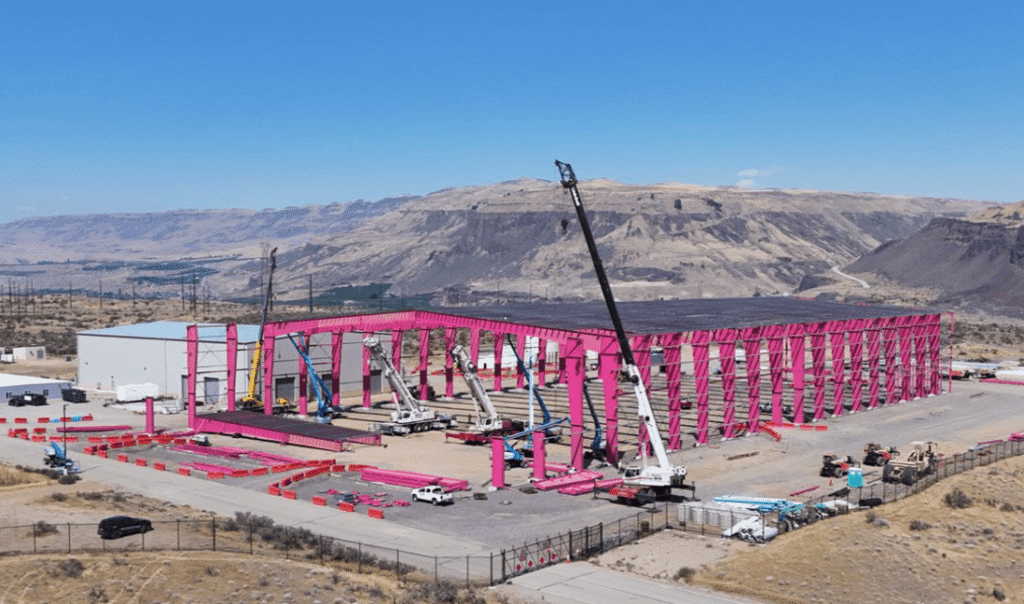
Helion’s Orion Plant Under Construction | October 1, 2026 | Source: Helion Energy
Nuclear fusion technology is making rapid advancements right now towards grid-scale energy production. But it will trail behind by a year or two advanced nuclear fission designs along the lines of what was demonstrated this summer with the Department of Energy’s Reactor Pilot Program, which I followed closely in The Bleeding Edge.
The “right” answer isn’t one source of electricity over the other.
The industry answer will be to source electricity from whatever sources it can develop in the short term, until the lowest-cost and cleanest source results in the majority of future adoption for power generation.
Jeff
Add Brownstone Research as your preferred source on Google to see our latest stories in your feed.
 Add as a preferred source
Read the latest insights from the world of high technology.
This isn't about simply recreating the old system on new infrastructure…

As companies give digital workers more responsibility, protecting their systems becomes part of the cost of putting AI to...

The technology connecting the world's fastest computers may be one of AI's most underestimated opportunities…