




Stablecoins Are Writing the Banks’ Obituary
What’s coming will look like what AI did to software companies – rapid disruption in a sector that investors...


The technology connecting the world's fastest computers may be one of AI's most underestimated opportunities…

Managing Editor’s Note: Today’s Bleeding Edge comes from our colleague, Jason Bodner.
Jason discusses how the technology connecting the world’s fastest computers may be one of AI’s most underestimated opportunities…
And if you enjoy today’s issue and want more of Jason, we feature his work often over at our First Signal free e-letter. Every Monday, Wednesday, and Friday morning, we publish a curated selection of top stories and research from the various experts across all our advisories.
You can go here to find out more.
You press a key on your keyboard. A letter appears on your screen.
Simple, right?
Actually, something remarkable just happened.
Beneath that key is a tiny electrical switch. Pressing it changes a circuit, creating a signal that a controller inside your keyboard recognizes. The controller converts that event into binary code, which your computer interprets and displays on your screen.
All of this happens almost instantly.
Now imagine you’ve typed a question into a chatbot like ChatGPT or Grok and pressed Enter.
The same process happens, but now your computer sends the request across a network, traveling through copper cables, wireless signals, and fiber-optic connections before reaching a data center.
Now, your question is in a different world.
Powerful processors perform a ton of calculations. Memory chips supply information. Networking equipment moves data between machines, while specialized optical components help them communicate at extraordinary speeds.
An answer appears on your screen sometimes fractions of a second later.
Behind that seemingly effortless exchange is a massive industrial challenge, and what I believe could be one of technology’s most important investment opportunities.
When your question reaches an AI system, software breaks your words into smaller units called tokens. A token might be a whole word, part of a word, or punctuation. The model converts these into numbers it can process.
Then billions or trillions of mathematical operations help the model generate its response, one token at a time.
These calculations require constant access to memory. In large systems, multiple GPUs share the workload, exchanging information continuously to keep everything running.
Imagine a factory that doubles the speed of every machine but leaves its conveyor belts unchanged. Eventually, production becomes limited by how quickly materials move between machines.
AI faces a similar challenge. As processors become faster and computing clusters grow larger, moving information efficiently becomes increasingly important.
This is why photonics matters.
We’ve discussed in other Bleeding Edge issues how photonics uses light to transmit information.
One wavelength can be seriously limiting. But decades ago, engineers realized a single optical fiber could carry multiple independent streams of information simultaneously using different wavelengths of light.
The technique is called wavelength-division multiplexing, or WDM.
Imagine turning a single highway into a multilane expressway without building another road by stacking up. Each wavelength carries its own stream of information through the same strand of glass.
In 1996, Ciena introduced a commercial system carrying 16 optical channels through a fiber pair, delivering up to 40 gigabits per second over distances as long as 600 kilometers.
Thirty years later, engineers are pushing far beyond those capabilities.
The industry is transitioning from 800-gigabit optical connections toward 1.6-terabit technology. A 1.6-terabit connection can theoretically transmit 200 gigabytes every second, roughly the equivalent of 50 full-length movies, assuming four gigabytes per movie.
And that’s a single connection. Large AI systems require huge amounts of them working simultaneously.
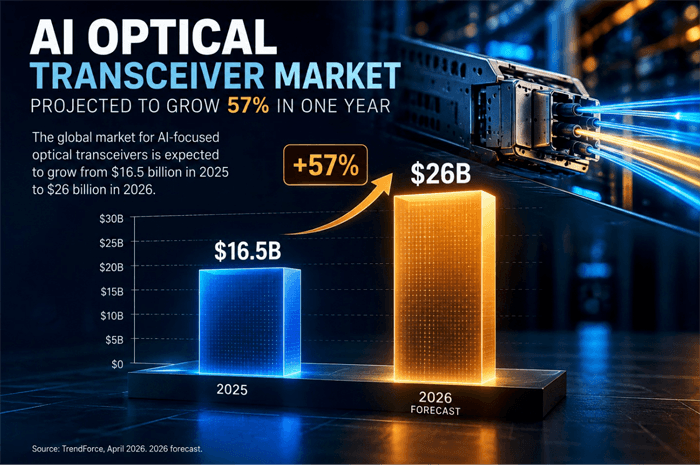
In April, research firm TrendForce projected that the global market for AI-focused optical transceivers, devices that convert electrical signals into light and back again, would grow from $16.5 billion in 2025 to $26 billion in 2026.
That’s more than 57% growth in a single year.
TrendForce also reported that data traffic at major North American cloud data centers has been growing more than 30% annually.
And optical transceivers are only one piece of the industry. Behind them are lasers, specialized semiconductors, photodetectors, precision packaging, and advanced manufacturing equipment.
Demand is growing so quickly that suppliers are struggling to keep pace.

On October 9, Lumentum CEO Michael Hurlston revealed that the company’s optical component production capacity was effectively sold out through early 2029.
For some products, Lumentum expects to be unable to satisfy approximately 70% of demand through 2027. For others, the shortfall could reach 30% through 2028. Customers are already reserving capacity for 2030.
These components aren’t easy to manufacture. Many rely on specialized semiconductor materials such as indium phosphide, requiring sophisticated equipment and manufacturing expertise that can take years to develop.
Earlier this year, NVIDIA committed $2 billion to Lumentum and another $2 billion to Coherent, alongside arrangements to secure future optical manufacturing capacity.
The world’s leading AI chipmaker is spending billions to ensure that the technology connecting its processors can keep pace.
We’ve seen similar urgency with memory. NVIDIA CEO Jensen Huang famously signed a wafer at SK Hynix with a simple request: “Please make more.”
Now that pressure is spreading through the optical supply chain.

Elon Musk is on record predicting this new opportunity is set to be 180 times bigger than the SpaceX IPO. That IPO minted 4,400 millionaires overnight. If this is 180 times bigger… Just imagine how many more Americans will become millionaires. Will you be one of them? Click here now.

A drilling crew near the Grand Canyon just confirmed what the International Energy Agency calls enough energy to meet global electricity demand 140 times over. Google signed a 15-year deal, and Bill Gates wrote a $100 million check. On October 20th, Washington hands this resource an edge no other energy source has. One company sits at the center. Get the name before October 20th >>
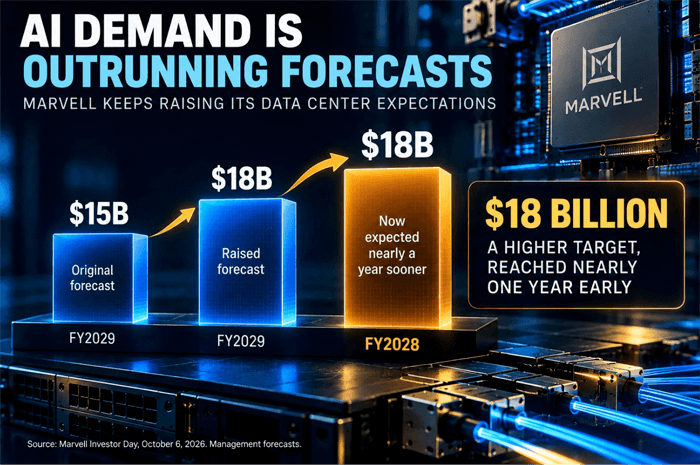
At its October 6 investor day, Marvell revealed how dramatically its data-center expectations had changed.
The company initially projected $15 billion in data-center revenue for fiscal 2029, then raised the target to $18 billion. Now management expects to reach approximately $18 billion in fiscal 2028, nearly a year ahead of schedule.
That’s roughly 70% compound annual growth from fiscal 2024, according to Marvell’s projections.
Marvell supplies custom AI processors and specialized connectivity technology. Although its growth extends beyond photonics, the acceleration across its data-center business is revealing.
One major supplier has customers reserving capacity years ahead. Another keeps raising its expectations because business is developing faster than anticipated.
These are companies manufacturing and selling the infrastructure AI requires. And the next wave of demand is already forming.
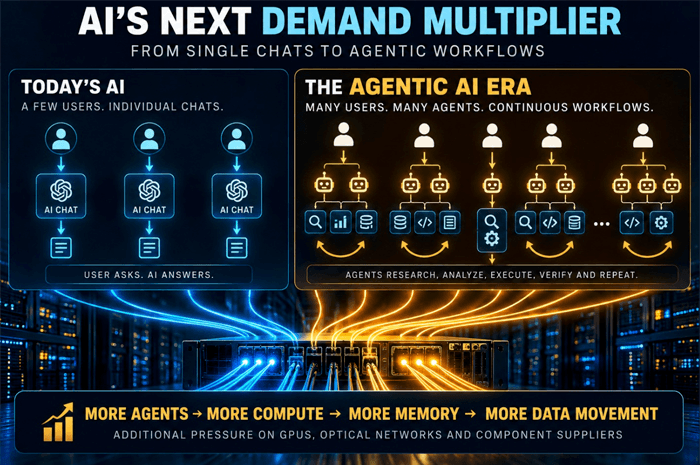
Until recently, most people used AI by asking questions and receiving answers. Increasingly, AI is completing tasks on our behalf.
An AI agent can research a company, analyze financial statements, execute code, consult other models, and revise its work before delivering a report.
One instruction can trigger dozens of separate computing operations, each requiring processing, memory access, and communication across networks.
Multiply that activity across millions of users and businesses.
McKinsey projects that AI inference, running trained models to produce answers and complete tasks, will account for approximately 60% of AI computing demand by 2030. It also estimates that inference-related data-center capacity requirements could grow roughly 35% annually through the decade.
Meanwhile, the International Energy Agency expects global data-center electricity consumption to more than double, from approximately 415 terawatt-hours in 2024 to 945 terawatt-hours by 2030.
As AI systems take on increasingly complicated work, the infrastructure supporting them must expand accordingly.
Optical connections are already widely used between networking equipment, server racks, and data centers. But much of the communication inside computing systems still relies on electricity.
Engineers are now bringing optical technology closer to processors through co-packaged optics, which integrates optical communication components alongside networking chips.
Shorter electrical connections can reduce power consumption while increasing bandwidth.
NVIDIA says its Spectrum-X Ethernet Photonics architecture can reduce power consumption per 1.6-terabit-per-second port by a factor of five compared with conventional pluggable optics.
Its SN6800 switch is designed to handle an extraordinary 409.6 terabits per second of aggregate bandwidth.
Yet this transition is only beginning.
Industry researcher LightCounting expects co-packaged optics to overtake conventional pluggable optical modules in shipments at advanced data rates around 2031. It also forecasts a market approaching $10 billion for co-packaged optical engines by 2030.
Reliability, heat, manufacturing yields, and cost remain challenges. But the economic incentive is substantial. Improving communication between expensive processors can make entire AI systems more productive.
Some photonics stocks have already delivered spectacular returns. Investors clearly recognize that this technology matters.
But a rising stock price doesn’t necessarily mean the market has correctly estimated future earnings.
Consider the evidence. Optical transceiver demand is projected to grow more than 57% this year. A major laser supplier has production capacity committed through early 2029. A leading semiconductor company expects to reach its ambitious data-center revenue target nearly a year early.
Meanwhile, AI agents are creating new workloads, GPU clusters are expanding, and the next generation of optical architecture is only beginning to enter the market.
Of course, shortages don’t last forever. New manufacturing capacity will arrive, competition will increase, and some technologies may prove less economical than expected.
But I believe investors may be underestimating how long this infrastructure expansion could last and how much money will ultimately be spent solving the communications problem.
I’ve spent decades studying how institutional money moves through financial markets. Some of the most interesting opportunities emerge when demand grows faster than companies can expand to meet it.
That’s what we’re witnessing in parts of the photonics industry.
The next time you type a question into an AI assistant, consider what happens after you press Enter.
Powerful processors are performing extraordinary calculations. Memory systems are delivering enormous amounts of information. Networks are moving data between machines at astonishing speeds.
And as AI becomes more capable, the demands on that invisible infrastructure will only intensify.
The race to build faster processors is far from over. But increasingly, the race to move information between them may be just as important.
And I believe investors are only beginning to appreciate what that means.
Regards,
Jason Bodner
Founder, Outlier Intel
Add Brownstone Research as your preferred source on Google to see our latest stories in your feed.
 Add as a preferred source
Read the latest insights from the world of high technology.
What’s coming will look like what AI did to software companies – rapid disruption in a sector that investors...


This is a landmark deal and the most significant initiative in shipbuilding and defense technology since World War II.