




A Bitcoin Forecast Based on Three Market Factors
Most Bitcoin predictions are not about being right... They're about grabbing a headline.



The DOE’s Reactor Pilot Program has already proven absolutely incredible for innovation in the private industry for the fourth generation of nuclear fission technology…
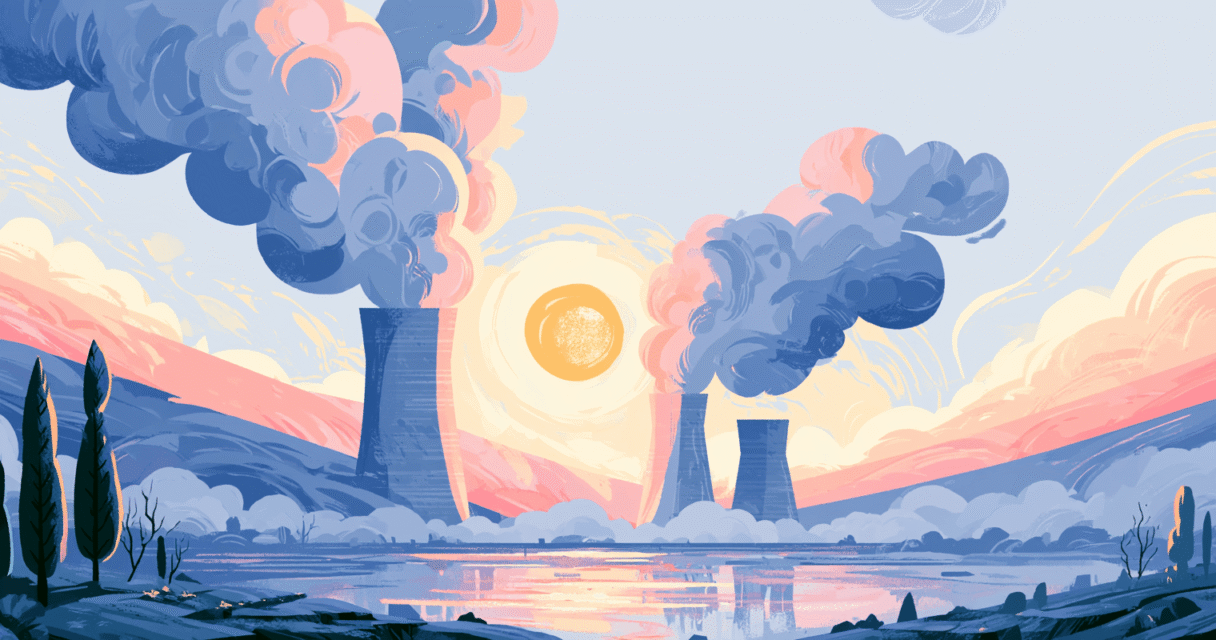
This week is a historic week for nuclear energy.
July 4, the 250th anniversary of the signing of the U.S. Declaration of Independence, is the deadline that President Trump set for at least three advanced nuclear reactors to achieve criticality, a goal that was set in Executive Order 14301 – Reforming Nuclear Reactor Testing at the Department of Energy – which was signed in May of last year.
It was an audacious goal, one that many thought to be impossible to achieve.
To build a fourth-generation nuclear fission reactor, gain all necessary approvals from the Department of Energy (DOE), and achieve criticality (i.e., a self-sustaining nuclear reaction), all in the span of a year, seemed impossible given the slow pace in the nuclear power industry over the last few decades.
But that was precisely the point of the executive order.
Executive Order 14301 directed the DOE to streamline procedures for advanced nuclear reactors to be qualified and become operational on DOE facilities. It also mandated that the DOE establish a reactor pilot program to achieve the ambitious goal of at least three reactors achieving criticality by July 4.
The DOE quickly established its Reactor Pilot Program and took applications between June 18, 2025, and July 21, 2025, announcing 10 companies – most of them private – and 11 projects last August:
As we explored in The Bleeding Edge – Weeks Away from Criticality, more than $1.9 billion had been raised on the back of the DOE “endorsement” by the companies selected to be part of the Reactor Pilot Program. Even more capital has been raised since then.
In that issue of The Bleeding Edge, I predicted that there would be four companies that would achieve criticality by July 4, and I named Valar Atomics, Aalo Atomics, Antares, and Atomic Alchemy – which is fully owned by Oklo (OKLO) – as the four projects/companies that would accomplish this.
It’s exciting to say that two of the four have already achieved criticality, putting us halfway to my prediction of four by July 4, and leaving us with only one more to go for the nuclear energy issue to achieve its goal of having at least three by that deadline.
I am 100% confident it will happen, given the progress being made.
On June 18, Valar Atomics announced that its Ward 250 microreactor achieved criticality for the first time.
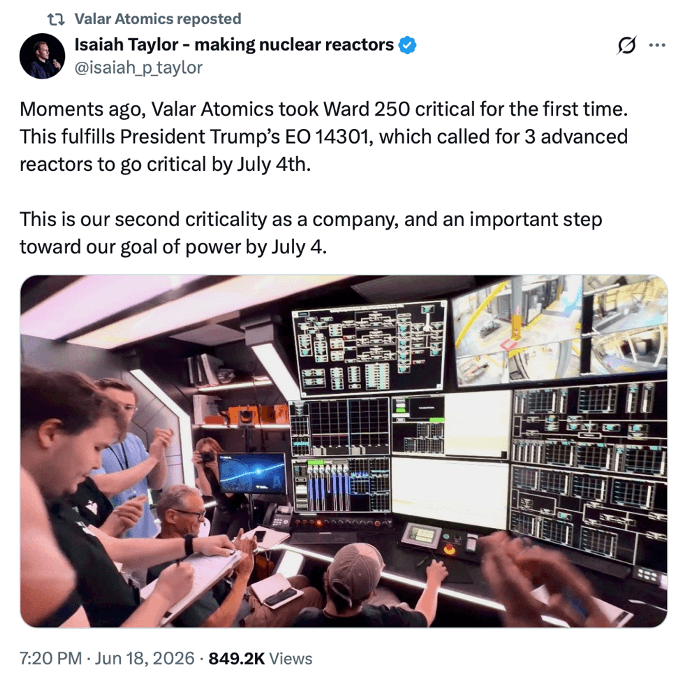
Even better yet, days after achieving criticality, the Ward 250 was able to produce 10 kilowatts of thermal energy, making it the first startup to produce nuclear power. Valar was able to demonstrate more than 24 hours of continuous operation producing power.
For context, all of these advanced nuclear reactors are small modular reactors (SMRs) or microreactors. These are reactors that can be centrally manufactured and transported wherever they need to be used to generate clean energy.
The Ward 250 is small enough to be transported on a semi or airlifted on a cargo plane, as shown below. Valar arranged to have the Ward 250 transported on a U.S. Air Force C-17 to its testing destination in Utah at the San Rafael Energy Lab.

Valar Atomics Ward 250 Reactor Being Loaded onto a C-17 | Source: US Air Force
A few days before Valar’s success achieving its criticality, Antares Nuclear was actually the first to achieve this historic goal on June 4 with its Mark-0 microreactor.
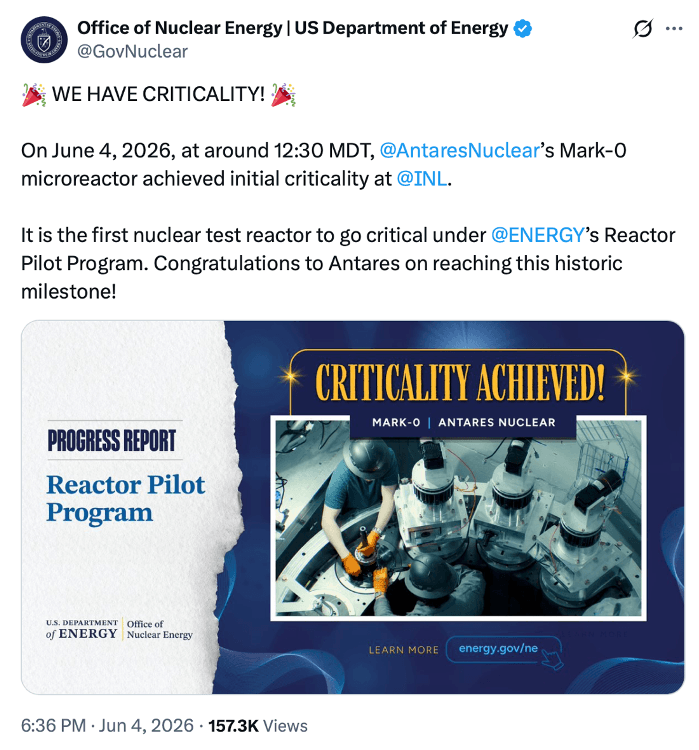
Antares’ success is strongly positive for the company, keeping to its development timeline of finalizing its reactor design this year, producing electricity in 2027, and then moving on to commercial deployments in 2028.
I also remain bullish that the remaining two of my top four picks will announce criticality by July 4.
Aalo Atomics, which shipped its reactor to Idaho on the Idaho National Laboratory grounds, is on track and planning to achieve criticality by July 4. While I can’t say for certain, it seems like they are targeting the demonstration for the 4th. Quite a way to celebrate.
And Atomic Alchemy, which is owned by publicly traded Oklo, also appears to be on track to demonstrate criticality at its Groves facility in Lockhart, Texas.
In addition to these four companies, two more have shown great progress towards achieving criticality by July 4.
One of the two is a complete wildcard, Deployable Energy, which wasn’t part of the DOE’s Reactor Pilot Program.
In March of this year, the DOE and the National Reactor Innovation Center (NRIC) teamed up to launch the Nuclear Energy Launch Pad, which is a follow-on initiative to Executive Order 14301 designed to promote rapid development of advanced nuclear technology by private industry.
Deployable Energy was selected as one of three nuclear energy companies initially selected to work with the NRIC and Idaho National Laboratory (INL) to build an advanced nuclear reactor on INL lands and work through the Nuclear Regulatory Commission licensing process.
What’s surprising is that Depoyable Energy was only founded in 2025 and has only raised $1.7 million to date, and yet it just received its Documented Safety Analysis from the DOE on June 17. This is the final step before attempting criticality. It’s not clear if they’ll be ready by July 4, but it seems like they are on a path towards achieving it sometime this summer.
Deployable Energy is developing its Unity microreactor capable of producing 1 megawatt of electricity, which will be commercialized as its Unity Nuclear Battery.
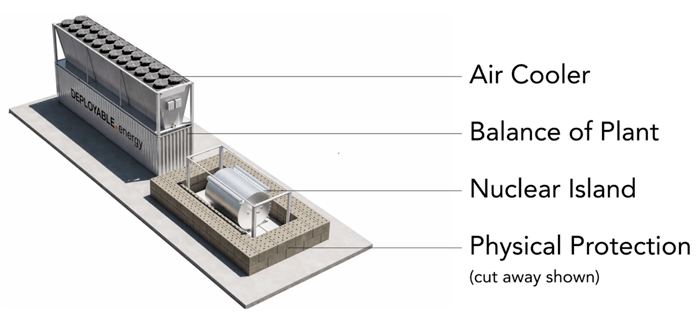
Deployable Energy Unity Nuclear Battery | Source: Deployable Energy
The final company with the potential to reach criticality is Radiant Industries, which has been building its prototype reactor at the Idaho National Laboratory’s DOME facility.
Radiant is hoping to get its Final Documented Safety Analysis from the DOE this week with a target to demonstrate criticality by July 4.
Out of all six of these companies, Valar and Aalo Atomics have the most momentum in terms of raising capital. Valar raised $450 million this March at a $2 billion post-money valuation. And Aalo Atomics is in the process of raising around $200 million at a $3 billion pre-money valuation.
The DOE’s Reactor Pilot Program has already proven absolutely incredible for innovation in the private industry for the fourth generation of nuclear fission technology…
It will have resulted in well over $2 billion of new investment in the sector and accelerated timelines for prototyping advanced nuclear energy production at a pace never seen before. Venture capital and private equity investors are leaning into the sector as a result of the radical shift in nuclear energy regulations. This has resulted in investment and innovation at a pace more akin to what happens in Silicon Valley, which bodes well for our future.
The result will be commercialization as early as the 2027/2028 timeframe by at least a handful of companies, which is desperately needed to help address the energy production needs to support the massive AI data center infrastructure buildout that will continue for years to come.
What has happened in the last 12 months is more than I’ve witnessed in the last two decades in this sector. That’s how special and incredible this moment in time is for the clean energy sector.
In addition to continued private financing rounds, we can also expect several of these companies to go public over the next 24 months as they transition from prototype reactors to commercial reactor production and installations.
Here’s to a future of abundant clean energy,
Add Brownstone Research as your preferred source on Google to see our latest stories in your feed.
 Add as a preferred source
Read the latest insights from the world of high technology.
Most Bitcoin predictions are not about being right... They're about grabbing a headline.

The fundamental relationship between man and machine has remained largely unchanged… Humans gave machines instructions, and the machines followed...

Tomorrow’s loans won’t be written by the banks of today. The deposits will flow to where the yield is....