



Anthropic’s Risky IPO
Anthropic’s gig could be up, and its value as a private company could collapse.



There is another type of cage match playing out in Washington right now… The bare-knuckle fight between CFTC Chairman Mike Selig and Chicago Mercantile Exchange’s CEO Terry Duffy.

On June 14, the South Lawn of the White House was transformed into an arena…
That evening, the section of the White House typically used for official state arrival ceremonies held a caged octagon where fighters duked it out in UFC Freedom 250.
Even if you didn’t watch the event, you probably heard about it.
What’s less known is another type of cage match playing out in Washington… The bare-knuckle fight between CFTC Chairman Mike Selig and Chicago Mercantile Exchange’s (CME) CEO Terry Duffy.
Some background…
The CME is suing the CFTC.
This is a big deal. The CME has been the favorite of the CFTC for years. They often get a say on virtually everything taking place in the markets they touch. It would be like Citadel, an entity known for front-running retail, getting upset at Robinhood, the entity that helps facilitate the front-running.
It’s a “cutting off the nose to spite the face” type of feeling.
And you can almost hear it with Terry’s comments…
“If you know me, I’m always up for a good battle. I’ve never shied away from one, and I won’t shy away from this.”
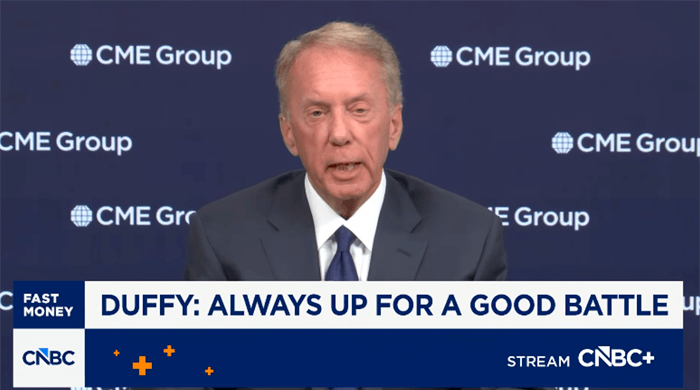
Source: CNBC
He’s clearly not backing down.
But not backing down from what?
Well, from this…
The CME is enraged over the CFTC’s recent ruling on Kalshi and Coinbase’s new offering.
It started with a May 29 decision by the CFTC to allow the prediction platform Kalshi and crypto exchange Coinbase to offer perpetual futures to retail investors.
Perpetual futures or “perps” are derivatives without an expiration date. They maintain their price relative to spot through a mechanism called “funding rate.” It’s a rate that traders who are long the asset pay to those who are short to keep their positions open. During bearish conditions, the opposite may occur.
This also enables traders to use greater leverage in the market, with some venues offering more than 100x leverage.
Perps have been incredibly popular in the cryptocurrency market. There’s about $90 trillion in annual volume, far eclipsing what happens on spot markets.
It also represents 90% of all derivative volume. And, at least until recently, it was unavailable to U.S. traders.
That was until Kalshi and Coinbase were given the green light by the CFTC.
Kalshi wasted no time in making up for lost time. The platform realized more than $100 million in volume within the first 24 hours, and approximately $1 billion in volume in just over a week into June.
Kalshi is now doing about $250 million per day on just the Bitcoin market alone. That’s about $45 million per year in fee capture based on a competitive 0.05% average fee.
This is a major revenue stream that opened up at Kalshi.
And Terry Duffy is not happy about it.
At least publicly, CME’s CEO is concerned about the risk perps pose to market stability and the well-being of retail traders.
Here he is on CNBC two weeks ago:
We are creating a regulatory framework for leverage. This is 2007 for retail. So, think of 2007 for homes. This is 2007 for retail. They have so many products that they’re going to have leverage to – the auto liquidation process that works for perpetuals that could trip over and cause cascading effects going down exponentially.
[…]
This is not self-dealing. I don’t want to have casinos in exchanges. I want to have products that people need to trade.
Maybe he really believes that – that perps are risky for retail, that they could spill over and have “cascading effects.”
But my gut says something else: Terry is jealous.
He’s doing the math and realizes these new financial products are going to make serious revenue for the companies that can offer customers the best trading experience.
The CME Group generated $6.5 billion last year. And Kalshi just opened a new market and saw what amounts to $45 million of annualized revenue walk into the door…
And that’s just one market.
Crypto has thousands of assets and a global user base. CME Group is late to a market opportunity that is significantly bigger than its entire business.
For CME, it looks like an attempt to protect its regulatory moat. It’s the oldest game in town.
But here’s the thing…
Terry’s argument seems to fall short.
Terry and the CME argued that the approved perpetual futures should be classified as swaps under the Dodd-Frank Act. If that’s the case, then entities like Kalshi and Coinbase would need to become swap dealers to offer perps.
This would also mean greater regulatory scrutiny and likely costs.
Now, I’m not a lawyer. Weighing the merits of CME Group’s case against the CFTC is out of my wheelhouse.
But I do understand how perps work. And if we just look at the function of perps versus swaps, it’s hard to feel like this lawsuit was done in good faith.
The perps market uses an order book with central clearing. Even its funding rate is a formula, not negotiated. Which is to say, trades are standardized throughout.
Swaps, on the other hand, involve two parties negotiating on terms. They can be customized.
These are not one and the same.
And I wouldn’t be surprised if Terry and company know this. But this playbook is becoming common.
Wall Street banks are doing everything they can to delay legislation that will give digital asset markets greater clarity.
After all, greater clarity means new tooling and infrastructure are given the green light. That tooling promises to remove the middleman activity in finance. And there go the juicy fees Wall Street can’t imagine living without.
It’s a threat to their bottom line. Readers will remember this from essays like Ring the Bell and The Gloves Are Coming Off.
CME is one example, but it’s not alone.
There’s the New York Stock Exchange and the Nasdaq. Two of arguably the most important stock markets in the world pushed back against the SEC’s proposed innovation exemption. The exemption was set to allow digital platforms to trade tokenized securities. Regular Chain of Thought readers will remember this story from A Selfish Motto Returns.
It’s the same playbook…
Delay the disruptors and innovators from offering new products by causing regulatory uncertainty, and protect your moat through regulatory capture.
But the incumbents are losing their cool now.
JPMorgan Chase CEO Jamie Dimon was cursing live on-air over the yield issue that has been a central sticking point on the CLARITY Act… something I have covered at length here at Chain of Thought. Terry Duffy is talking like he’s listening to Eye of the Tiger before a cage match.
These situations tend to happen when your back is against the wall, and you don’t see a way out. Frustration is boiling over.
This tells us the pro-crypto stance of regulators is not weakening. They are steadfast in their view of making America the crypto capital of the world. This friendlier stance towards innovation will only continue.
The disruptors and innovators are winning.
Your Pulse on Crypto,
Ben Lilly
Senior Blockchain Analyst, Chain of Thought
Add Brownstone Research as your preferred source on Google to see our latest stories in your feed.
 Add as a preferred source
Read the latest insights from the world of high technology.
Anthropic’s gig could be up, and its value as a private company could collapse.

This morning, SpaceX launched the 14th flight of its Super Heavy booster and Starship from its Starbase, Texas facility,...

In today’s AMA, we explore the true utility of full self-driving vehicles… what to do when markets crash… and...