




Why Long-Shot Bias Creates Easy Wins in Prediction Markets
Some of the best opportunities come from taking the other side of the trade when the crowd becomes too...


In a compressed window of just a few weeks, three separate advanced reactor developers received meaningful regulatory clearances…

For most of the last half-century, the Nuclear Regulatory Commission (NRC) has been where advanced nuclear reactor projects go to wait…
Design reviews stretched into years. Construction permits for anything that wasn’t a conventional light-water reactor were essentially nonexistent.
Innovation in the nuclear energy industry moved like molasses, almost frozen in time.
For example, the last high-temperature gas-cooled reactor (HTGR) to clear the NRC’s construction-permit process was nearly 60 years ago. Six decades of HTGR projects essentially stuck in limbo.
But fortunately, over the last 18 months, there has been an epic shift in the industry.
In a compressed window of just a few weeks, three separate advanced reactor developers received meaningful regulatory clearances…
The X-Energy milestone is the most commercially significant of the three.
On November 9, the NRC issued a construction permit for four Xe-100 high-temperature gas-cooled reactors at Dow’s Seadrift site in Texas. Each unit is rated at 80 megawatts electric and 200 megawatts thermal.
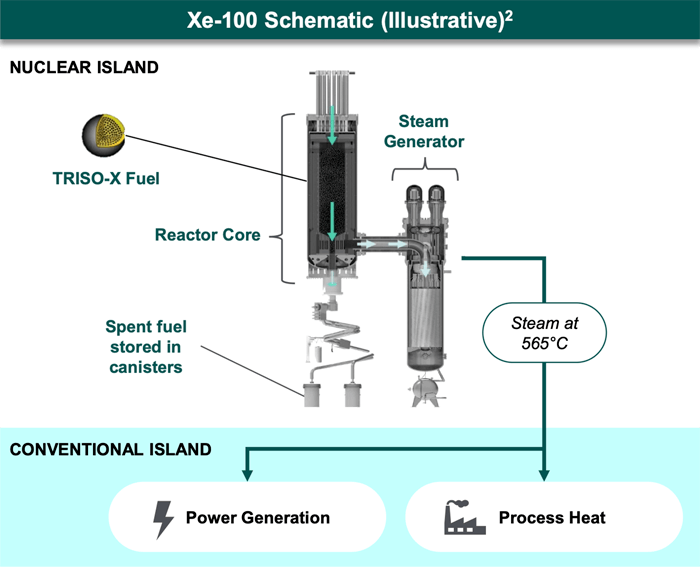
Xe-100 Design | Source: X-Energy
The four Xe-100 reactors are intended to supply both electricity and high-temperature process steam to Dow’s Texas chemical complex, replacing aging assets.
The review was completed in roughly 18 months – slightly ahead of the schedule the NRC itself had set. And the approval even came in months ahead of when X-Energy expected.
Not only is this the first construction permit for a high-temperature gas-cooled reactor in nearly six decades, but it’s also the first for a pebble-bed design, and the first for an advanced reactor co-located with active industrial operations.
HTGR differ from conventional reactors in that they, as the name suggests, use gas as a coolant rather than water, and have a specialized fuel design to allow for significantly higher temperatures versus water-cooled reactors.
The Xe-100 uses TRISO-X fuel – the coated particle design the Department of Energy has long described as among the most robust and “meltdown-proof” nuclear fuels available.
Combined with the reactor’s passive safety characteristics, the design supports an emergency planning zone measured in hundreds of meters rather than the traditional 10-mile radius of conventional light-water plants.
That smaller zone makes building a site next to an operating chemical plant, or any other industrial-scale facility, feasible.
To be clear, this construction permit received by X-Energy does not authorize operation. A separate operating license will still be required. And Dow has not yet made a final investment decision and is expected to consider a preliminary decision in 2027, with first delivery targeted for the early 2030s. But the regulatory path – and the commercial path – is now open.

Do you think the volatility is over? It’s just getting started… By January 3, most of today’s top stocks could lose their grip… and a new group of little-known stocks could seize power… soaring double, triple, and even quadruple-digits in a matter of weeks and months. The good news? Jeff’s colleague, Jason Bodner, created a way to potentially spot the new winners right as they break out 852%, 1,267%, 1,532%, and even 1,921% or more. Jeff and Jason are sharing all the details in a timely investment briefing, including the name of their #1 pick for 2027 – for FREE. Watch it here NOW.
It shows you the most profitable trades, 90 minutes before they occur, every morning. In 2026, TradeSmith officially booked gains of 7.6% in 24 hours on (TER)... 8.5% in 48 hours on (RDDT)... 14.4% in 48 hours on (MTSI)... and more. Try it on 2,467 stocks now (no purchase required).
The Antares and Radiant developments sit primarily under DOE authorization rather than full commercial NRC licensing, which is appropriate for test and demonstration units at national laboratory sites.
Antares’ Mark-0 achieved criticality at Idaho National Laboratory (INL) in June 2026 – the first privately developed non-light-water reactor to do so in the United States in more than four decades.
The October Nuclear Safety Design Agreement for Mark-1 establishes the safety framework for the company’s first electricity-producing unit. Antares plans to operate Mark-1 at full electrical power for several months in 2027 at Idaho National Laboratory before moving toward military deployments beginning in 2028 under programs such as the Army’s Janus initiative.
Radiant’s Documented Safety Analysis approval for Kaleidos similarly clears the path for extended full-power testing – targeted at 60 effective full-power days – at the National Reactor Innovation Center’s DOME facility at Idaho National Laboratory.
Taken together, these clearances illustrate a change in pace that would have been difficult to imagine even three years ago. The 2024 ADVANCE Act and subsequent reforms directed the NRC to modernize its approach to advanced reactors while preserving its safety mission.
The Department of Energy’s Advanced Reactor Demonstration Program and Reactor Pilot Program have provided cost-share support and demonstration pathways that let companies generate real operating data under DOE authority.
This had a direct and positive impact on private capital’s willingness to invest heavily in advanced nuclear reactor technology, driving billions of dollars into the sector.
In this most recent regulatory environment, X-Energy (XE) raised $722 million in July 2025, and an additional $700 million in November 2025, culminating in about a $1 billion raise this April at the time of its IPO. Also worth noting is that Amazon (AMZN) is its largest shareholder at 22% of outstanding shares, currently.
The co-location of X-Energy’s reactors with Dow’s chemical plant is a perfect example of Amazon’s interest in pairing clean energy production with its massive AI data centers.
The last major U.S. nuclear construction cycle produced plants that took more than a decade and far more capital than originally estimated. Vogtle’s AP1000 units in Burke County, Georgia, were the most visible recent example of that difficulty.
The entire project for those two new AP1000 reactors cost more than $36 billion, more than twice the original $14 billion estimate and finished seven years behind schedule.
The reality was that advanced reactor designs were left in a regulatory gray zone that discouraged investment. The result was stagnation while other countries continued building out their nuclear energy infrastructure.
The current environment – criticality demonstrations in mid-2026, safety agreements and analyses in the fall, and a full commercial construction permit for an industrial advanced reactor by early November – compresses what previously looked like multi-year or multi-decade timelines into months.
None of this guarantees that first-of-a-kind costs will come in on budget or that every project will reach commercial operation on the earliest schedules. Supply chains for long-lead-time components, fuel fabrication capacity, and final investment decisions remain ahead. But I’ve never seen a reason to be more bullish on nuclear energy in my entire life.
The X-Energy project still requires an operating license. Antares and Radiant must complete their DOE testing programs and translate that experience into commercial licenses. But the regulatory bottleneck that defined the industry for decades is no longer the dominant constraint it once was.
For anyone tracking the energy requirements of artificial intelligence infrastructure, industrial process heat, and reliable baseload power, the practical implications are easy to understand.
The United States has now demonstrated an accelerated pathway for advanced reactors to move from design through demonstration and toward construction on timelines that attract private capital rather than deter it.
The last several weeks simply made that shift easy to see in this series of approvals.
Add Brownstone Research as your preferred source on Google to see our latest stories in your feed.
 Add as a preferred source
Read the latest insights from the world of high technology.
Some of the best opportunities come from taking the other side of the trade when the crowd becomes too...

Of the 119 payloads aboard the SpaceX (SPCX) Transporter-16 launch on March 30, 2026, one in particular caught my...

The most significant announcements NASA Administrator Jared Isaacman made at the MAX POWER aerospace festival centered around a renewed...