




NASA Shooting for the Moon
The most significant announcements NASA Administrator Jared Isaacman made at the MAX POWER aerospace festival centered around a renewed...


Of the 119 payloads aboard the SpaceX (SPCX) Transporter-16 launch on March 30, 2026, one in particular caught my interest…
Managing Editor’s Note: Tomorrow evening at 8 p.m. ET, our colleague Larry Benedict is unveiling a brand-new kind of trade…
They’re called “Penny Tech Trades,” and they cost less than $1 per contract… And at tomorrow’s event, he and Jeff will demonstrate the trades on camera, using their own money.
In fact, every attendee at this Penny Tech Profits event gets four of these trades free, just for joining. It’s happening tomorrow, November 11, at 8 p.m. ET. Just go here to sign up with one click.
Of the 119 payloads aboard the SpaceX (SPCX) Transporter-16 launch on March 30, 2026, one in particular caught my interest…
Transporter missions are the aerospace equivalent of ride-share flights that typically enable more than 100 separate smaller payloads, typically small satellites, to reach low Earth orbit (LEO) cost-effectively.
One of the payloads on that Falcon 9 flight was a satellite bus managed by Momentus (MNTS).
Momentus aggregates a number of small payloads into a satellite bus and provides transportation services, delivering each payload to the desired orbit once the Falcon 9 inserts the satellite bus into orbit.
On board the Momentus satellite was a robotic machine called ASTRA – Autonomous In-Space Tensioned Reflector Assembly.
ASTRA was designed and built by a team of researchers at Caltech and funded by the Defense Advanced Research Projects Agency (DARPA).
The robot was a robotic truss builder designed to assemble a structure in space, something that had never been done before, hence my interest.
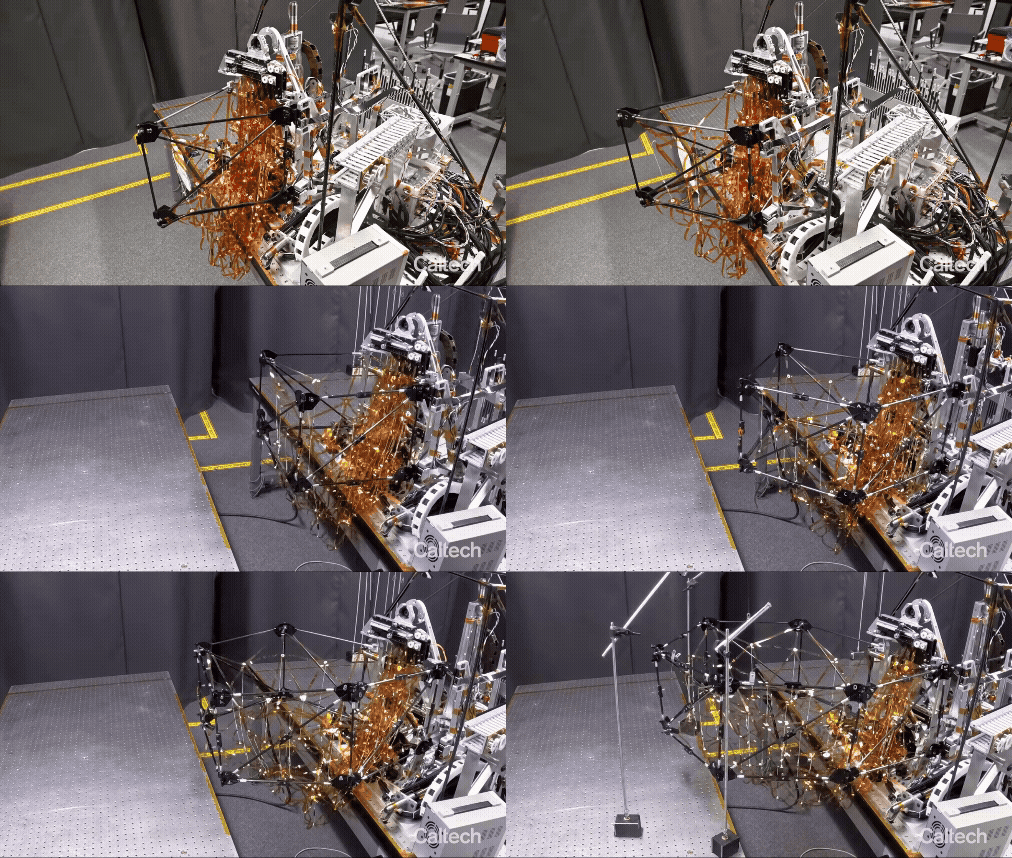
ASTRA Assembly Demonstration on Earth | Source: Caltech
ASTRA is part of DARPA’s Novel Orbital and Moon Manufacturing, Materials, and Mass-efficient Design (NOM4D) program. The purpose of ASTRA was to attempt an on-orbit assembly of a truss as a demonstration of what might be possible to construct very large structures in space autonomously. The short video above demonstrates the ASTRA robotic machine performing the task on Earth.
On-orbit autonomous robotic assembly is literally a bottleneck to what is possible for the space economy and in-space energy production.
The industry challenge has long been that the size of structures in space has been limited entirely by the size of the payload bay of a rocket like a SpaceX Falcon 9 or Ariane V rocket.
Space is limited inside a payload fairing, so every launch is optimized to utilize the space as much as possible with compact payloads.
Historically, there have been only two options to manage larger objects to be deployed into orbit or farther out in space. The first has been to stow or fold an object so that it fits into the payload fairing.
A simple example of that is the James Webb Space Telescope, which was launched in December 2021 on an Ariane V rocket to be deployed at Lagrange Point 2 in January 2022 – about 1.5 million kilometers from Earth.
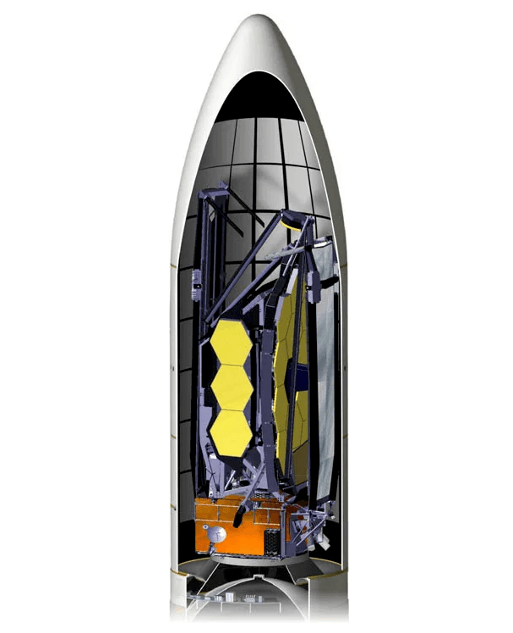
Rendering of James Webb Space Telescope Stowed in Ariane V Rocket | Source: NASA
Because the telescope wasn’t deployed in low Earth orbit, there was no other way to fully deploy the telescope without a mechanism to unfurl it into its final operating shape.
Which leads me to the second option in dealing with large structures in space…
Assuming the structure is being built within the reach of astronauts, a large structure could be pieced together by astronauts manually connecting smaller trusses/parts of a much larger structure.
The downside to that is, of course, that it is extremely expensive to do so, and it doesn’t scale well at all. The amount of labor depends entirely on how many astronauts can be in orbit in the right place at the right time.
Both approaches have severe limitations, which is why the Caltech experiment is so important.

For Jeff Brown and Larry Benedict's First-Ever On-Camera Trading Session. Tomorrow, November 11, at 8 p.m. ET, hedge fund legend Larry Benedict will trade his own money on camera. He has a 91% win rate with his new strategy, with an average hold of two days. Every attendee gets four never-before-shared “Penny Tech Trades” free. But according to our records, you have not yet claimed your spot. Click here to add your name to the guest list instantly.

Thanks to a major event in D.C., billions of dollars could surge into the market on days you can circle on your calendar today. Handing everyday Americans a chance to potentially pocket tens of thousands of dollars over the next 12 months. Hedge fund legend Larry Benedict says if you act now, you could potentially move your retirement forward by YEARS. And he’s giving away the ONE ticker he trades most to play it, completely free. Click here to get it before December 9.
After about six months of effort, the team at Caltech was able to build a third bay of a truss structure on-orbit. The ASTRA device launched with two pre-built bays, and a third was assembled by the robotic machine while on orbit.
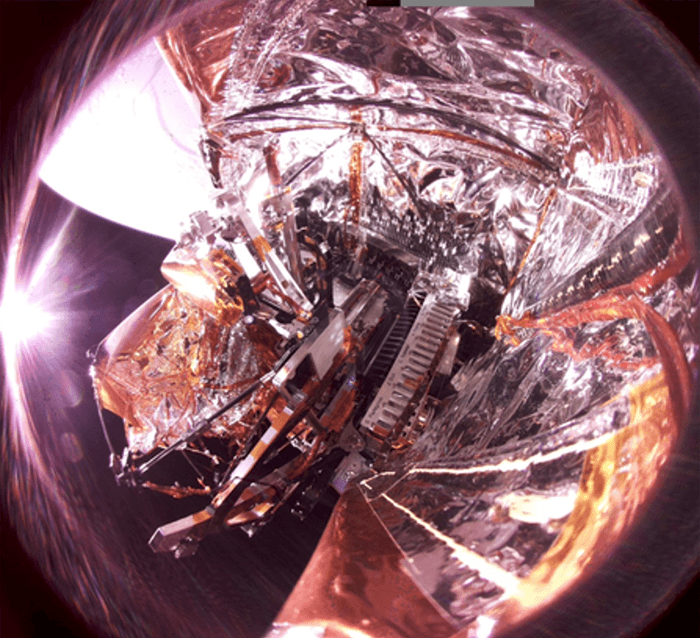
ASTRA Truss Builder from Low Earth Orbit | Source: Caltech/Momentus
This was an interesting proof of concept, and a small step towards the larger potential of this kind of robotic technology. For perspective, ASTRA was only able to build the initial section of what was to be a 1.4-meter reflective antenna from composite fiber tubes and aluminum joints.
It’s also worth noting that the assembly of the truss wasn’t fully autonomous. The Caltech team would send up instructions as they slowly assembled the truss. And they were only able to communicate with the ASTRA device in 15-minute blocks of time, only seven or eight times a day.
As ASTRA was in low Earth orbit, not geosynchronous orbit, the team had to wait until ASTRA was overhead to receive data and pictures and transmit new instructions step-by-step.
This is a problem that would be easy to solve for by utilizing the SpaceX Starlink on-orbit internet infrastructure that would have allowed for real-time communications regardless of where in orbit ASTRA was.
While the Caltech team was the first to test (semi) autonomous assembly in space, in the private sector Redwire (RDW) has been developing the technology to do something similar.
In partnership with NASA, Redwire conducted extensive on-Earth testing of a combined on-orbit manufacturing and assembly for NASA’s OSAM-2 project (On-Orbit Servicing, Manufacturing, and Assembly). For anyone interested in seeing an animation of what that might look like, you can see it here.
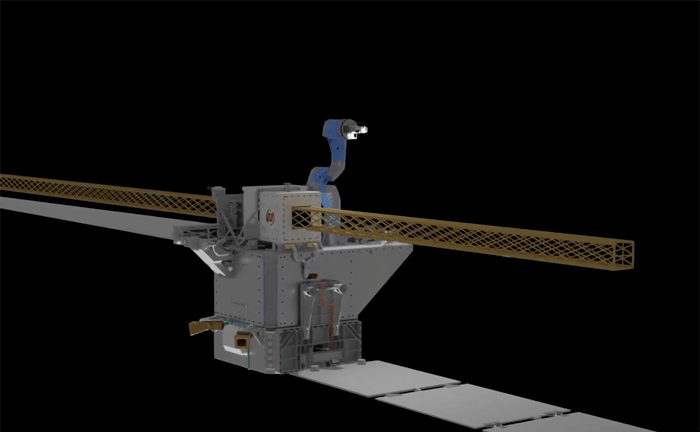
Rendering of OSAM-2 On Orbit | Source: NASA
Unfortunately, the OSAM-2 project was shuttered prior to an on-orbit test due to the reallocation of funding.
But this kind of on-orbit autonomous robotic assembly is inevitable in the near future.
There are clear economic drivers for doing so.
Two obvious commercial applications come to mind: Massive communication antennas most likely designed to enhance inter-planet communications, and for the purpose of large orbital solar power generation satellites.
The second will almost certainly be the driver, as SpaceX’s Starlink technology will be sufficient to establish a satellite constellation for the moon and eventually Mars, and the interconnects to link them with Earth.
Given the recent push to migrate AI computational resources to space to take advantage of free, limitless energy and free cooling, on-orbit assembly is technology that will improve the capabilities of these new AI satellites.
The only real limitation to the size of an AI satellite will be the size of the solar energy collecting structures. It wouldn’t surprise me a bit to see SpaceX announce robotic assembly for its forthcoming Starmind AI satellite constellation sometime in the near future. This would enable even larger AI satellites, because the majority of the mass is dedicated to power generation.
But that’s not the endgame for in-space energy production. The ultimate goal is to climb the Kardashev scale towards a Type II civilization that is capable of capturing and utilizing the energy output of its local star.
In our case, that is, of course, the Sun.
In the realm of science fiction, the way to do so has long been thought to be a Dyson Sphere, which is envisioned as a megastructure that encompasses all or part of a local star. It was first envisioned in 1937 in Olaf Stapledon’s 1937 novel Star Maker, but popularized by physicist Freeman Dyson in the 1960’s.
While theoretically possible, a complete Dyson Sphere is unlikely due to the scale and gravitational forces imposed on such a megastructure.
Far more likely is a Dyson Swarm, which would look more like a massive swarm of solar power-generating structures around the Sun, or around Mars in a sun-synchronous orbit capable of transmitting energy down to the Martian surface to power a thriving colony.
I know that might sound like something incredibly distant, a far-off hypothetical future rather than something that’s being actively built toward… but it’s not.
Elon Musk just announced a few days ago that SpaceX will launch its first AI data center satellite – the first of its future Starmind constellation – in Q3 of 2027 with significant volume in 2028, and very large volume in 2029. And each AI data center satellite (AI1) will be a small power generation satellite needed to power the computational resources.
The technology exists today. It’s all about the reusable Starship, consistent execution, and scaling up manufacturing to make it so.
All things that Elon Musk and his teams are the very best at doing.
Add Brownstone Research as your preferred source on Google to see our latest stories in your feed.
 Add as a preferred source
Read the latest insights from the world of high technology.
The most significant announcements NASA Administrator Jared Isaacman made at the MAX POWER aerospace festival centered around a renewed...

All of these technological advancements will require metals and materials on a scale we’ve never seen before…
I know that this will likely be an uncomfortable subject for many of us. It definitely falls under the...