




Prediction Markets are No Longer a Sideshow
Kalshi hit a record $98 billion in October volume. Here’s how prediction markets went from academic experiment to a...


I know that this will likely be an uncomfortable subject for many of us. It definitely falls under the realm of tinkering with nature.
Editor’s note: Jeff Brown and Larry Benedict call it the Penny Tech Trade: a new type of trade where every contract costs less than $1. One on Nvidia went from 2 cents to $1 in 2 days, while the stock was down. One on Microsoft went from 9.5 cents to $1 in 12 days, while the stock went nowhere. They say it is outperforming almost every other strategy they know of today. On Wednesday, November 11th at 8 p.m. Eastern, they’ll share all the details. Reserve your seat for the event with one click right here.
It reads like something out of a Michael Crichton novel…
A biotech billionaire teams up with a defense tech billionaire to create a new company that builds cybernetics technology and genetically engineered canines to protect and serve.
The name of the company?

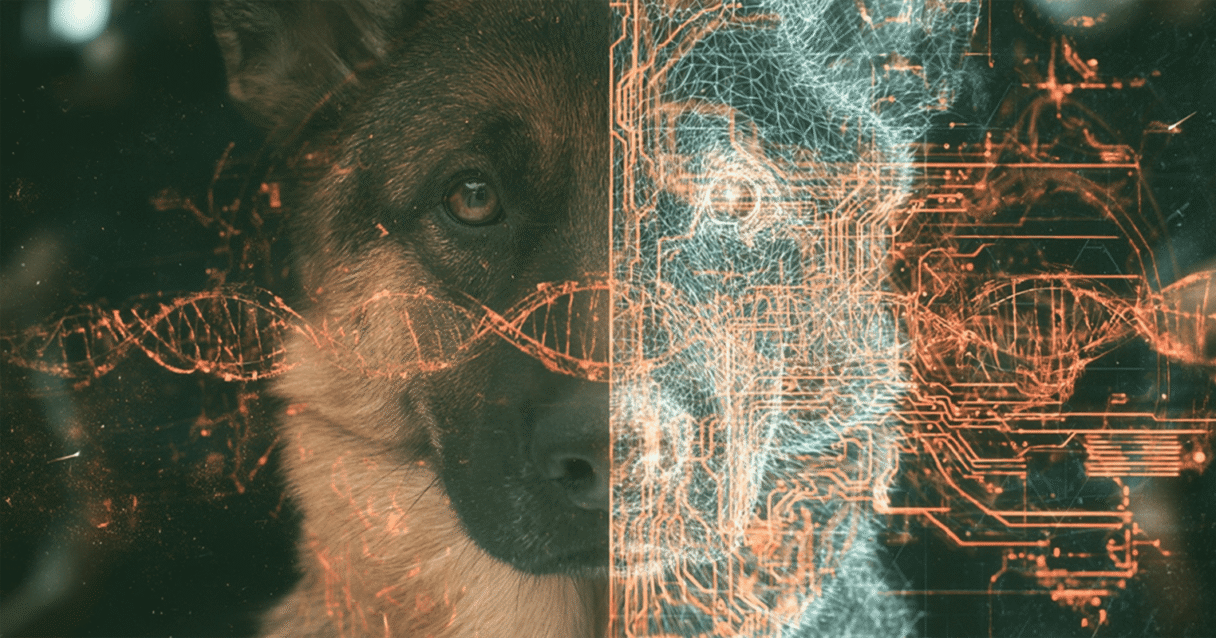
Source: Warhound
Only it’s not fiction. And the image above is from the company’s website.
Founded earlier this year, Warhound envisions genetically engineered canines designed for the U.S. military, first responders, and law enforcement.
Not only will these animals be optimized for certain tasks such as sniffing out bombs. They will also be bred to avoid genetic predispositions such as hip dysplasia, muscular atrophy, cancer, or problems with eyesight.
The reality is that many dogs bred for these challenging tasks do not make it through training due to genetic problems. Warhound believes it can solve that with genetic editing technology.
I know that this will likely be an uncomfortable subject for many of us. It definitely falls under the realm of tinkering with nature.
But this is a serious venture worth keeping an eye on because of the implications in medicine and biotechnology.

"I first recommended Nvidia at 66 cents. But right now, a brand-new kind of trade is generating far bigger returns from technology than any other type of trading or investing strategy I know of. Every trade costs less than $1 per contract. One on Nvidia increased 4,445% in two days, while the stock was down. One on Apple increased 733%... One on Microsoft increased 924%... This Veterans Day, at 8 p.m. ET, Larry Benedict and I are going to trade our own money on camera, so you can see exactly how it works." — Jeff Brown. Click here to join Jeff and Larry, free.

Nobody knows exactly when the AI boom ends. Fortunately, Garrett Goggin says you don't need to. Because gold miners are already producing record-high cash flow and profits – and yet mining still makes up only about 1% of global equities. Porter Stansberry recently called Garrett, “THE most knowledgeable gold analyst in the world.” Calling on 100-years of market returns, Garrett identified a pattern for knowing when money will stampede out of growth/AI stocks and into gold miners… and the four best miners to own before institutional money discovers the same trade. Go here for details on Garrett's four “Great Rotation” gold miners.
The two billionaires are none other than Ben Lamm, CEO of Colossal Biosciences, and Palmer Luckey, the founder of Anduril. We explored the latter on Tuesday in The Bleeding Edge – From Drones… to Laptops?
Both companies will be familiar to regular Bleeding Edge readers. Colossal Biosciences, on the surface, is positioned as the de-extinction company. Using DNA fragments from extinct species, Colossal is literally bringing species back to life such as the woolly mammoth, the dire wolf, the dodo, and others.
It’s not science fiction – it’s happening now, and Colossal has had some impressive successes already. Last month, Colossal’s dire wolves Romulus and Remus turned two and are reportedly perfectly healthy. They live on a 2,000-acre preserve. There are three now and Colossal intends to add many more.

Romulus and Remus | Source: Colossal Biosciences
The de-extinction angle always makes for spectacular headlines that are interesting and easy to understand.
But under the surface, Colossal is at the forefront of genetic engineering – developing artificial eggs, as well as artificial wombs that can be used for breeding animals, and ultimately human births.
Venture capital is taking the company seriously.
Colossal raised almost $1 billion by 2025 at a $10.65 billion valuation. Incredibly, it looks like Colossal is in talks to raise additional capital at a $25 billion valuation. It’s a spectacular rise for a company that was just spun out of Harvard in 2021.
Anduril’s rise is no less spectacular.
The company was founded in 2017 by Palmer Luckey, the developer of Oculus virtual reality technology, which was acquired by Facebook in 2014 for $2 billion.
Since then, Anduril has redefined what an AI-forward, modern defense technology firm looks like. It offers a wide range of autonomous vehicles operating under the water, on land, in the air, and even in space.
Anduril has already raised $11.87 billion to date and is now worth $61 billion. There are rumors of another funding round at even higher valuations in the coming months.
Luckey is to defense technology as Musk is to the aerospace industry – an outsider who innovated aggressively and achieved what the incumbents couldn’t or wouldn’t.
This is why Warhound has received so much attention. Ben Lamm and Palmer Luckey have incredible street cred in their respective fields.
And, like their current companies, the new venture is worth taking seriously.
The plan is for Colossal to provide the expertise in genetics and genetic engineering to Warhound. Meanwhile, Anduril will provide the software and hardware to support the genetically enhanced canines.
That means equipment like bulletproof vests for the dogs, goggles, and data sensors on the equipment that can send back environmental information to the handlers in real time.
Luckey appears to be a board member of Warhound but doesn’t currently have any equity in the business. Anduril will obviously benefit as a supplier to Warhound if it is successful. And Colossal has an equity stake in Warhound and will also receive revenue from licensing its technology.
Warhound just came out of stealth raising an impressive $200 million at a $1.2 billion post-money valuation. And it’s backed by Sequoia Capital, 8VC, Lux Capital, and, not surprisingly, In-Q-Tel, the venture capital arm of the CIA. These are all very heavy hitters.
That’s an impressive war chest for Warhound right out of the gate, and it is working on an accelerated time scale. The first group of genetically enhanced dogs is being incubated with births scheduled for early next year. The plan is to be able to put those dogs into service within two years.
And as Warhound optimizes the genetics of the dogs, it plans to clone the best of breed for the desired use.
You read that right: genetically engineered dog clones.
While this is clearly a new field, Warhound will definitely result in smarter, more capable, and healthier animals without the unwanted genetic predispositions.
And there are parallels to what’s happening with genetic editing as it applies to the human race.
Of course, today’s use of genetic editing is restricted to correcting unwanted genetic mutations that cause human disease. Germline editing, editing the DNA of reproductive cells or early-stage embryos, is not permitted.
It is, however, a vibrant topic of discussion.
If a parent has a harmful gene that is likely to be passed down to children, should they be allowed to correct that gene in the embryo so that the child doesn’t have the risk of a debilitating disease?
For most, that sounds perfectly reasonable. But keep pulling on that thread.
Should a parent be allowed to choose their children’s physical characteristics – height, strength, eye color, etc.?
That’s a thornier question… and I’d be curious to hear what readers think. You could send me your thoughts right here.
Regardless, the kind of work that Colossal and Warhound are doing is at the bleeding edge of genetic engineering and will move the field forward in ways that have long been portrayed in science fiction.
Jeff
Add Brownstone Research as your preferred source on Google to see our latest stories in your feed.
 Add as a preferred source
Read the latest insights from the world of high technology.
Kalshi hit a record $98 billion in October volume. Here’s how prediction markets went from academic experiment to a...

This product niche was right there for a company like Dell (DELL) or IBM (IBM) to run with. Yet...

Two nuclear fusion companies just landed CHIPS Act awards. Here’s why fusion needs its own semiconductor supply chain…