



Fusion Needs Semiconductors
Two nuclear fusion companies just landed CHIPS Act awards. Here’s why fusion needs its own semiconductor supply chain…


This product niche was right there for a company like Dell (DELL) or IBM (IBM) to run with. Yet they never did.

It sounds like a conspiracy, but it’s spelled out in black and white.
China’s National Intelligence Law, specifically Article 7, requires all of China’s citizens and organizations to “support, assist, and cooperate with national intelligence efforts in accordance with the law.”
At first glance, it sounds vague…perhaps intentionally so.
But what it means in practice is that China’s government can compel China-based or China-owned companies to install hardware and software into their electronics devices for the purpose of surveillance. Importantly, this applies to companies that sell products outside China.
The law also enables the government to gain technical access to any China-made electronics devices as well as any data that has been collected.
It’s hard to imagine a law like that in the Western world.
In the U.S., it would violate individual constitutional rights. Effectively, it would force U.S. citizens to engage in forms of espionage. And it would compel companies to place technologies in their products that they know could cause harm and be used in ways that violate the laws of other countries.
It’s unthinkable. And yet, this is the normal and legal construct in China. More importantly, it’s not optional. It’s a mandate.
In December 2020, the U.S. Department of Homeland Security (DHS) issued a warning to U.S. companies against using hardware, equipment, and digital services from firms linked to the People’s Republic of China.
The warning wasn’t issued thoughtlessly. It was well-founded in the realities of far too many documented cases of data surveillance on U.S. soil, of U.S. citizens, corporations, and government officials over the years.
The DHS stated clearly:
“The PRC’s data collection actions result in numerous risks to U.S. businesses and customers, including: the theft of trade secrets, of intellectual property, and of other confidential business information; violations of U.S. export control laws; violations of U.S. privacy laws; breaches of contractual provisions and terms of service; security and privacy risks to customers and employees; risk of PRC surveillance and tracking of regime critics; and reputational harm to U.S. businesses.”
For decades, U.S. consumers and businesses have enjoyed affordable electronics manufactured in China without understanding the real costs – loss of trade secrets, intellectual property, and individual privacy.
At a national level, the severity of this problem came to a head in March 2021. That’s when the U.S. government, through the Federal Communications Commission (FCC), banned the use of China-made telecommunications equipment, as well as prohibiting the authorization, importing, or selling of these products anywhere in the U.S. The two largest companies named were Huawei and ZTE.
To put the significance of this issue into context, Australia, New Zealand, the United Kingdom, and Canada implemented similar bans on Huawei and ZTE. Then Sweden, Romania, Estonia, Lithuania, France, Denmark, Poland, the Czech Republic, and even Japan imposed limits.
The focus was to get Huawei and ZTE telecommunications equipment out of wireless networks in order to protect against documented data surveillance and espionage.
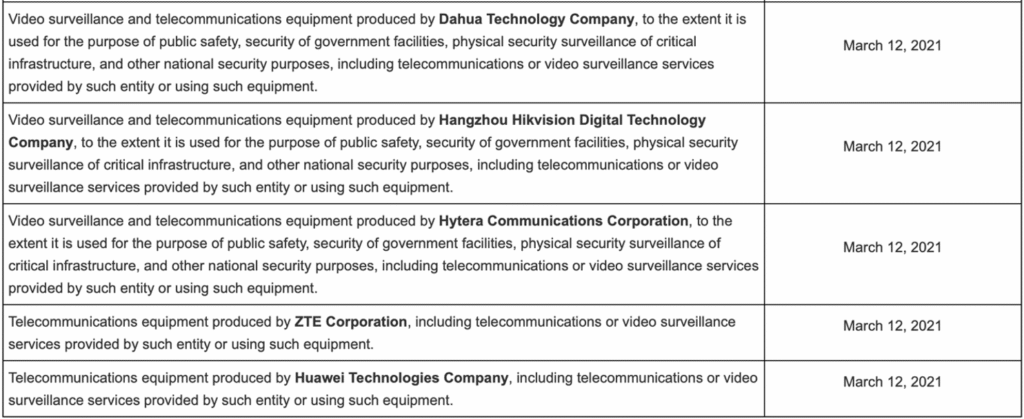
FCC Covered List, 2021 | Source: FCC
The 2021 ban also extended to popular video surveillance and telecommunications equipment manufactured by Hytera Communications, Hangzhou Hikvision Digital Technology, and Dahua Technology Company, all known to be compromised electronics systems made in China.
The list of banned electronics has since been expanded to include several other China-based companies, as well as Kaspersky-related cybersecurity software, which has ties to Russia.
Earlier this year, a long list of foreign-produced robotics systems, and a wide variety of drone-related products, including those consumer drones used by children, received a similar warning. Many of these devices collect data and send it back to China. For anyone interested in seeing the FCC’s Covered List, you can find it right here.
I’m very happy to see the government stepping up to acknowledge these vulnerabilities and active data surveillance of U.S. citizens and businesses. Whether it is a piece of consumer electronics or a smartphone application such as TikTok, it is a violation of U.S. law and also a violation of individual rights.
But warnings only go so far. The United States – and the West in general – is still largely dependent on China-made products simply because there are often no other choices. Which is why, in the most critical technology industries, steps are being taken to protect against this inherent security risk.

While everyone was distracted with the recent SpaceX IPO… Elon Musk quietly filed a patent with the U.S. Patent and Trademark Office to protect what Jeff Brown believes will be his next breakthrough… Something he called “the greatest tech invention in history.” Click here to see the details because Elon is predicting this new AI breakthrough will unleash a $1 quadrillion new wealth wave.

This company once ruled American tech. Its stock fell, and Wall Street wrote it off. But Larry Benedict believes Elon Musk is about to turn it into one of the greatest U.S. comeback stories. Get the overlooked ticker now.
In 2017, a concerted effort began to reshore the entire semiconductor supply chain. I covered this at length in yesterday’s edition of The Bleeding Edge.
It makes perfect sense.
Semiconductors are the foundation for any electronics product – smartphones, PCs, cars, appliances, or defense technology. Everything.
This initiative to onshore (or nearshore) critical industries is part of a larger trend that I’ve referred to as The Great Recalibration.
The $828 billion committed to securing the supply chain for electronic components related to semiconductors is an incredible development, but it doesn’t address the finished electronics products themselves.
The problem is that while semiconductors are being manufactured securely in the U.S., if the final product is assembled in China, then hardware and software can be inserted into the finished product under the auspices of China’s National Intelligence Law without our knowledge.
Anduril, a private company I wrote about last month in The Bleeding Edge – Anduril’s Arsenal, deeply understands this. And the company decided to do something about it.
In a bit of a surprise announcement, Anduril will be manufacturing laptops in the United States under its new product line – BlueChip.
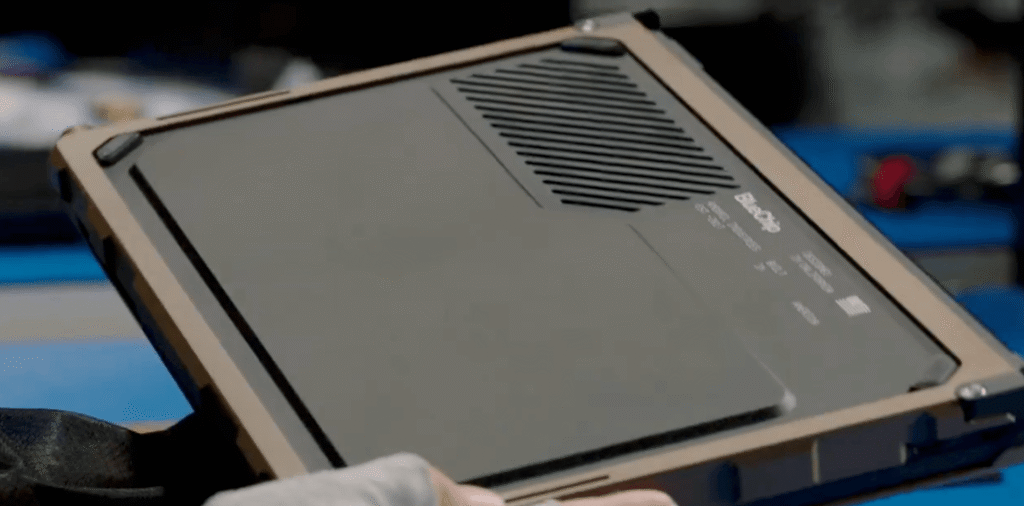
Anduril’s BlueChip Laptop | Source: Anduril
It has probably been almost 20 years since there has been any mass-market, large-scale assembly of laptops in the U.S. So this announcement is a big one. And it is coming from – of all places – a defense technology company, not a consumer electronics company.
Now, the question: Can Anduril pull it off?
I’m sure there will be plenty of naysayers. But it actually makes perfect sense.
Anduril has partnered with Qualcomm (QCOM), which is now manufacturing its Snapdragon X Series semiconductors at TSMC in Arizona. Anduril’s initial market focus is building U.S.-made laptops for government, defense, first responders, and public safety.
This is a logical place to start. These verticals are most sensitive to national security risks and data surveillance from foreign adversaries. Also, Anduril’s established relationship as a government contractor virtually guarantees the company would be considered for supply of these products.
On the topic of actually producing the laptops, Anduril founder Palmer Luckey made some very commonsense points:
“The stuff that Anduril makes every day is actually not that different from a computer. My drones are basically computers. They have memory, a GPU, a CPU, sensors, batteries, a rugged integration.”
“The only difference between an Anduril attack drone and a laptop is a keyboard and a screen. That is not that hard to figure out, especially for a guy like me who started Oculus and comes from the consumer electronics space.”
Luckey made the point to debunk the common refrain that it’s too expensive to manufacture in the U.S. The reality is that, with today’s automation and robotics technology, it is possible to manufacture electronics products in the U.S. at competitive prices.
Source: Anduril
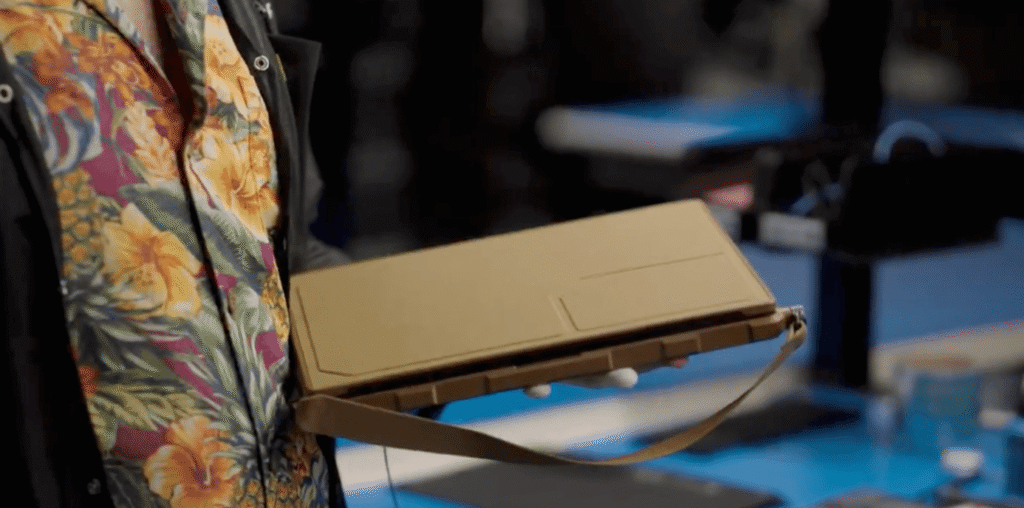
The BlueChip laptop is designed for rugged use. That’s perfect for users who have to operate in the field. Estimates are that it will run about 20% more than a high-end laptop.
That’s a very small premium for a product that can stand up to demanding environments.
And of course, with the key semiconductors being manufactured in the U.S. and the circuit board assembly happening in Anduril’s Arsenal-1 plant in Ohio, that’s a very small premium to ensure an uncorrupted supply chain and manufacturing process.
Anduril will start taking orders in 2027. If all goes well, it could lead to much larger production to an even wider portion of the laptop market.
This product niche was right there for a company like Dell (DELL) or IBM (IBM) to run with. Yet they never did. It’s ironic that a defense technology company is the one finally innovating on laptop manufacturing in the U.S.
Perhaps that’s why Luckey named the product BlueChip…? A bit of a poke at IBM, which used to lead in enterprise laptops, before eventually giving up and selling the division off to China-based Lenovo.
How the tables have turned.
Who wants a BlueChip laptop?
Jeff
Add Brownstone Research as your preferred source on Google to see our latest stories in your feed.
 Add as a preferred source
Read the latest insights from the world of high technology.
Two nuclear fusion companies just landed CHIPS Act awards. Here’s why fusion needs its own semiconductor supply chain…

AI can be used to bring about a world of incredible productivity and abundance, or it can be used...

These networks do more than elect politicians. They shape policy. And every so often one of them shows its...