




Dark Money Against Tokenization
These networks do more than elect politicians. They shape policy. And every so often one of them shows its...


AI can be used to bring about a world of incredible productivity and abundance, or it can be used for malicious intent and warfare.

Managing Editor’s Note: If you missed it, on Wednesday, Jeff Brown and CNBC’s “The Prophet” shared a warning for November 5. A new AI stock could make you 1,000% with a chip 50 times faster than Nvidia’s.
There’s only a short time to watch them unveil and demonstrate a historic AI breakthrough that could replace the Magnificent 7 and create a new order in the market. Watch the replay here (includes three free recommendations).
What a tumultuous week.
Institutional capital is going through one of its occasional fits with regard to AI infrastructure spending.
None of the financial media stated the most obvious fact… these companies can afford the investment in AI infrastructure. All of them have made the decision to forgo short-term quarterly results for long-term benefit.
Intel (INTC) was also rightfully gutted, currently down about 50% from September highs. Intel’s PC unit has been directly impacted by higher memory prices, as well as memory shortages for PCs. And the company will continue to need heavy research and development spending for years if there is any hope for it to recover some kind of leadership position in CPU technology and semiconductor fabrication services.
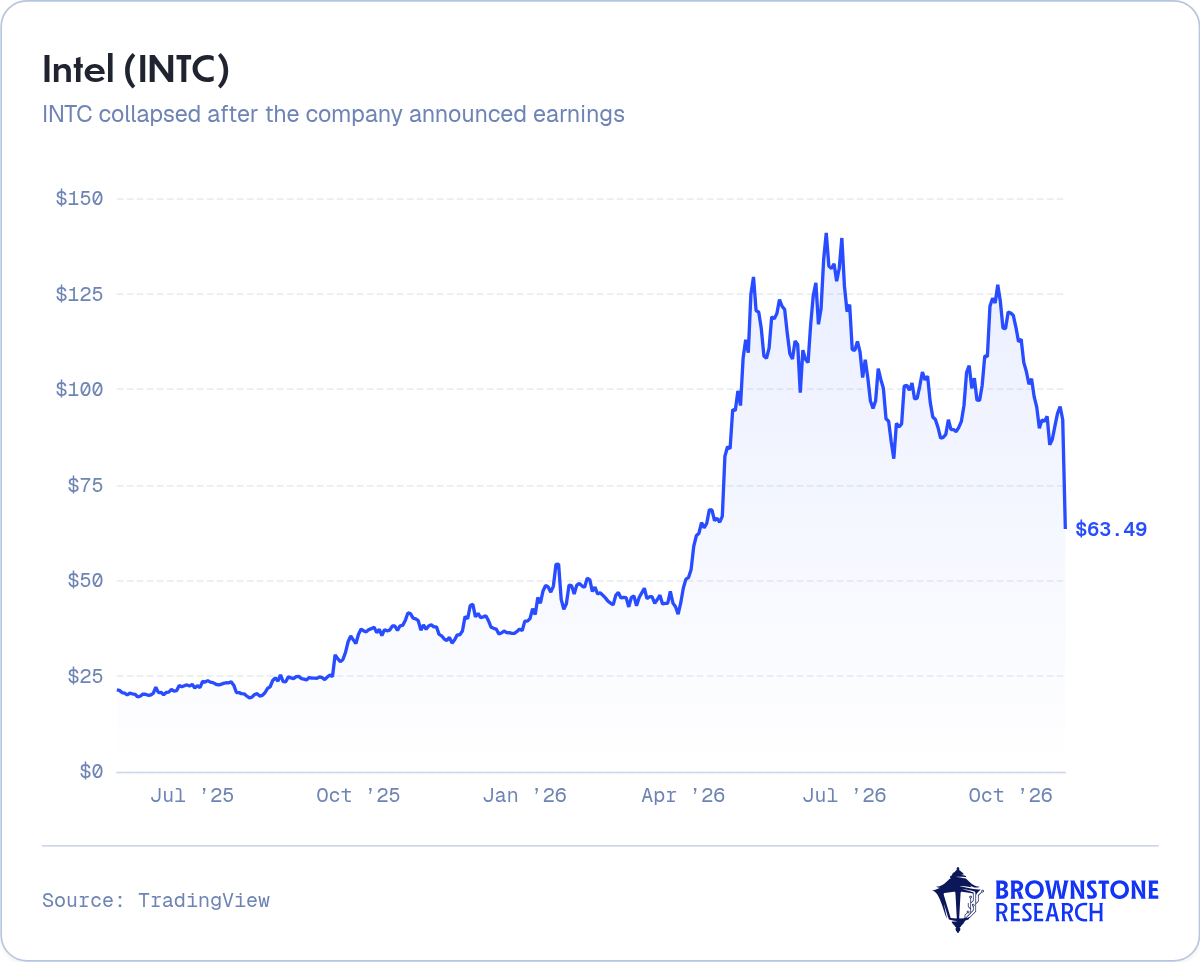
The reality is that all of these companies know that if they don’t invest heavily right now, they will be at a significant competitive disadvantage with respect to artificial intelligence. This latest bout of volatility is an excuse for institutional investors to lighten their positions, lock in 2026 bonuses, and then buy back in at lower levels looking forward into 2027.
We should expect that it will be a bumpy market for the next two or three weeks. And it’s worth keeping in mind that 2027 has all the makings of an incredible year for investing.
Have a wonderful weekend,
– Jeff
I just read Nick Rokke’s article about smarter AI creating a Cybersecurity Boom. AI seems to be a double-edged sword. In the realm of cybersecurity, it can expose vulnerabilities in software but also be used to attack those vulnerabilities. I have heard of increased hiring to rewrite and strengthen software, but I wasn’t aware of the number of people required.
Everyone knows that current cybersecurity systems don’t protect us. Wasn’t the FBI hacked about a month ago? The FBI? Shouldn’t they have the best security available?
– Jack F.
Hi Jack,
You’re absolutely right: AI is a double-edged sword. It can be used to bring about a world of incredible productivity and abundance, or it can be used for malicious intent and warfare.
It can be used for both offensive and defensive capabilities. This is precisely why the development of artificial intelligence and associated applications for defensive capabilities is so critically important.
Because so many of the AI models have been open-sourced, and other frontier AI models have been distilled by foreign adversaries, bad actors have access to bleeding-edge AI that can be used with malicious intent.
The cybersecurity industry, in general, has been very proactive over the years, employing early forms of machine learning, and now advanced artificial intelligence, to help reduce the attack surface for any network.
Cybersecurity systems absolutely protect us, more than you know. We never read about the millions of cyberattacks that have been thwarted by cybersecurity systems. The only stories that make the press are successful hacks that make for good headlines. This is unfortunate.
Corporations and governments have extremely complex cybersecurity challenges to overcome. There are hundreds, thousands, or tens of thousands of employees and contractors that have to have permissioned access to their networks and data, and access has to be granted to both company-issued computers, as well as personal smartphones and desktops for those working remotely. Cybersecurity policies are always a trade-off between security and providing enough network access flexibility to enable a productive workforce.
The reality is that IT networks that support an active workforce that enables remote access (i.e., people in the field, working from home, third-party contractors, etc.) are porous networks. Cybersecurity technology is used to manage the attack surfaces in real time. This is an impossible task for any human team today, which is why automated cybersecurity software is a critical necessity.
As for the FBI story, you might be surprised about what happened.
So yes, the FBI suffered a major cyberattack and related data breach in September that occurred through its recruitment portal – FBIJobs.gov. The attack was carried out by a group called ShinyHunters, which is very well known for cyberattacks for the purpose of extortion.
ShinyHunters used a known Oracle PeopleSoft vulnerability, software that was being used by the FBI for its recruitment site. By using this vulnerability, it was able to gain access to the FBI-managed Amazon Web Services GovCloud infrastructure to steal terabytes’ worth of FBI data.
But here’s the rub…
Oracle issued a software patch in June of this year to fix the vulnerability. The hack occurred in September.
The FBI had contracted Accenture (ACN) to maintain the FBI’s software for its cybersecurity systems. And the contractor from Accenture failed to apply the software patch, thus leaving the FBI’s network exposed to an attack.
The problem wasn’t cybersecurity software. The problem was 100% human error. The contractor failed to do their job. That contractor has since been removed – rightfully so.
Having worked in cybersecurity myself, I can say that it is as much about managing a process as it is about employing the technology to secure networks. It is endless and relentless, and every organization needs to remain paranoid and work relentlessly to maintain security.
There is no perfect cybersecurity system other than one that is air-gapped from the internet, which is not realistic for any organization that needs to function in the real world.
AI is enabling cybersecurity systems to become more intelligent and automated in ways that will reduce the potential for the kind of human error that we witnessed in the FBI ShinyHunters hack.
This is precisely why the cybersecurity industry is experiencing robust growth right now. The advancements in AI are the primary reason for increased cybersecurity spending, both from the perspective of defending against AI-powered attacks, and also employing AI to optimize cybersecurity processes and reduce the risk of human error.

A once forgotten American company is about to step into the heart of the race to build the next generation of AI. Larry Benedict believes November 30 could change how Wall Street sees it forever. See the ticker before it makes headlines.

A new AI Super Chip 50 times faster than Nvidia’s could reshape everyday life. Imagine AI that books all your appointments, “clones” you at work, and more. Beginning November 5, it could be driven by a new AI firm that could make you 1,000% if you buy now, BEFORE it goes mainstream. Get the full story here (including a free stock pick from an AI expert who recommended Nvidia before it rose 35,000%).
Jeff and Team,
At certain points, I would be dying for investment recommendations in stocks and crypto. Now I can’t keep up or keep enough dry powder to invest in every recommendation. Heck, I have had to start using Grok as my analyst to start parsing recommendations and get in on what we think are the best ones. To do this, with the help of Grok, I have developed a checklist and scorecard that tells me if it is a must-get-in, a watch for a lower price, get a small piece as a flier, or just hold off for now. It is working well.
– Daniel K.
Hi Daniel,
Thanks for sharing your dilemma, as I know a lot of subscribers have had a similar experience, especially for our Brownstone Unlimited subscribers who have access to all of the research that I publish.
I wish I had a simple solution to the dilemma that you raise. The “right” answer, however, is different for every individual self-directed investor depending on their own asset allocation model, which should be determined by their individual investment objectives, their current lifestyle, where they are in their career, how close they are to retirement, etc.
My goal is to empower my subscribers with a wide range of investment research that will address the needs and interests of all my subscribers regardless of their age, investment objectives, or retirement plans.
Whether it is large-cap growth (The Near Future Report), small-cap growth (Exponential Tech Investor), biotechnology (Early Stage Trader), short opportunities in volatile markets (Deep Access), digital assets/cryptocurrencies (Permissionless Investor/Neural Net Profits), natural resources (Critical Assets), institutional money flows driven research (Jason Bodner and Inflection Point/Outlier Alpha), and short-term trading opportunities (Larry Benedict and his Opportunistic Trader franchise), we have it and continue to invest in and improve our research in all of these areas.
The last remaining major category of research that I have long wanted to fill is income-related research. Many of my subscribers have been with me for more than a decade and have made fortunes, and eventually we all get to the stage when we want/need to slow down and shift a larger portion of our assets over to income-generating investments.
That is one of my big projects for next year, to launch income research for my subscribers that is interesting and leverages all of our expertise in growth assets. I’ve been developing some exciting approaches to income research and am very excited to begin sharing them with my subscribers.
I’m happy to see you leveraging Grok as a sounding board. One of its many strengths is objective analysis of past and present data.
One of its rare weaknesses, however, is predicting future outcomes due to imperfect or absent data. This is an area of expertise that I’ve developed over decades of hard work, real-world experience, investment, and analysis.
The latest frontier AI models are amazing collaborative tools that enable even higher levels of productivity, and the ability to scan and analyze an even broader field of assets to uncover asymmetrical trading and investment opportunities.
Ben Lilly is a good writer. I’ve been reading his work at Brownstone for a while now. I particularly like some of his stylistic elements, but when I read this paragraph: “I’m not sure who needs to hear this, but let’s say it one more time for those in the back: THE WORLD WILL NOT USE YOUR WALLED GARDEN JUST SO YOU CAN KEEP YOUR MARGINS.” with the bold print, I laughed out loud. Perfect.
Please pass along appreciation for the expertise Ben shares with us and my compliments on his writing style.
– Joseph B.
From Ben Lilly:
Joseph, thanks for the kind words. I’m happy to hear you’re enjoying the research. I hope some of the legacy institutions are reading as well. But based on what I’m seeing, many still don’t “get” what tokenization means.
The tokenization of real-world assets – stocks, Treasurys, money markets, etc. – is not some small upgrade to markets. It represents an existential rearrangement of what it means to invest and own assets. Tokenized assets will allow investors access to an entire ecosystem of decentralized solutions.
One example I covered in a recent issue of Chain of Thought was an application called Superform. It’s a “vault” strategy that anybody can deposit capital into, which is then deployed based on the strategy’s rules.
What this means in practice is that the vault could buy a tokenized stock such as Tesla, use it as collateral to borrow stablecoins, and then use those stablecoins to generate yield. Effectively, this means investors could generate a yield from their equity in Tesla (a stock that pays no dividend) while retaining the long-term growth potential of the tokenized equity.
The important point is that this is all autonomous and permissionless. There are no middlemen, no layers of friction that allow the banks to extract fees. It’s simply a better form of finance.
I do think the incumbents (the banks, mostly) understand that last part. They’re fighting tooth and nail to slow down the adoption of tokenized equities. For anybody who missed my coverage on that point, Wednesday’s issue of Chain of Thought is worth a read.
They can try to slow it, but they won’t stop it. With time, superior solutions eventually win out. Tokenized assets and decentralized finance are a superior solution to modern finance. End of story.
Thank you again for writing in, Joseph. And thank you for being a reader.
Add Brownstone Research as your preferred source on Google to see our latest stories in your feed.
 Add as a preferred source
Read the latest insights from the world of high technology.
These networks do more than elect politicians. They shape policy. And every so often one of them shows its...

The AI bears are interpreting weakness in stock prices as weakness in the AI revolution.

Anthropic’s IPO could be the biggest ever, at up to $2 trillion. Here’s why you may want to sit...