




Suddenly, the Pond is Covered
It’s a good way to visualize how big, consequential changes can sneak up on you.



It’s not about recreating the old system on new infrastructure…
Editor’s Note: Jeff Brown is airing his October Million-Dollar Cycle strategy session tonight at 8 p.m. ET.
He’s diving into this strange, cyclical market phenomenon that happens every four years. Despite its predictability, most folks don’t notice it until it’s already played out…
But it presents a huge opportunity for those who know what to watch for – and how to play the cycle.
Go here to automatically add your name to the guest list. We’ll see you this evening at 8 p.m. ET.
It was the 1960s. And a young engineer at the RAND Corp., a California think tank, made an incredible discovery.
The United States was deep in the Cold War, and an engineer named Paul Baran understood that America’s communication network would be severely crippled if a single bomb landed near an AT&T switching hub.
Switching hubs were where phone lines would be connected to form a single, continuous, unbroken line. Destroy the hub, and you destroy the ability for connections to be made.
Baran also realized something else. The one-to-one connection stayed fully occupied for the entire call. That meant the circuit kept relaying what it heard, even if it was just silence. In a sense, the phone line was always sending data.
Baran saw that the system was fragile… and inefficient.
His answer was a distributed network with no central hub. The data would travel from one location to another in small pieces, which were called packets.
Each packet would find its own way to the destination using whatever route was available at that moment. Once the packets arrived, they’d be reassembled so the receiver had no idea the message was ever chopped up.
It was revolutionary. But when Baran brought the idea to AT&T, the company didn’t understand it.
The company was too steeped in the old ways of doing things. AT&T engineers even assumed Baran didn’t understand the basics behind voice communication.
The company put Baran through condescending classroom sessions, diagramming how a basic telephone circuit worked. Its engineers were adamant that a phone call needed one continuous line.
Baran, out of frustration, published the idea in a series of papers titled “On Distributed Communications.”
AT&T might not have understood Baran’s proposal, but the Advanced Research Projects Agency at the Department of Defense did.
The agency borrowed Baran’s packet-switching idea and built upon it. In 1969, it launched Arpanet, a precursor to the modern internet.
It ain’t what you don’t know that gets you in trouble. It’s what you know for sure that just ain’t so. Or so said Mark Twain.
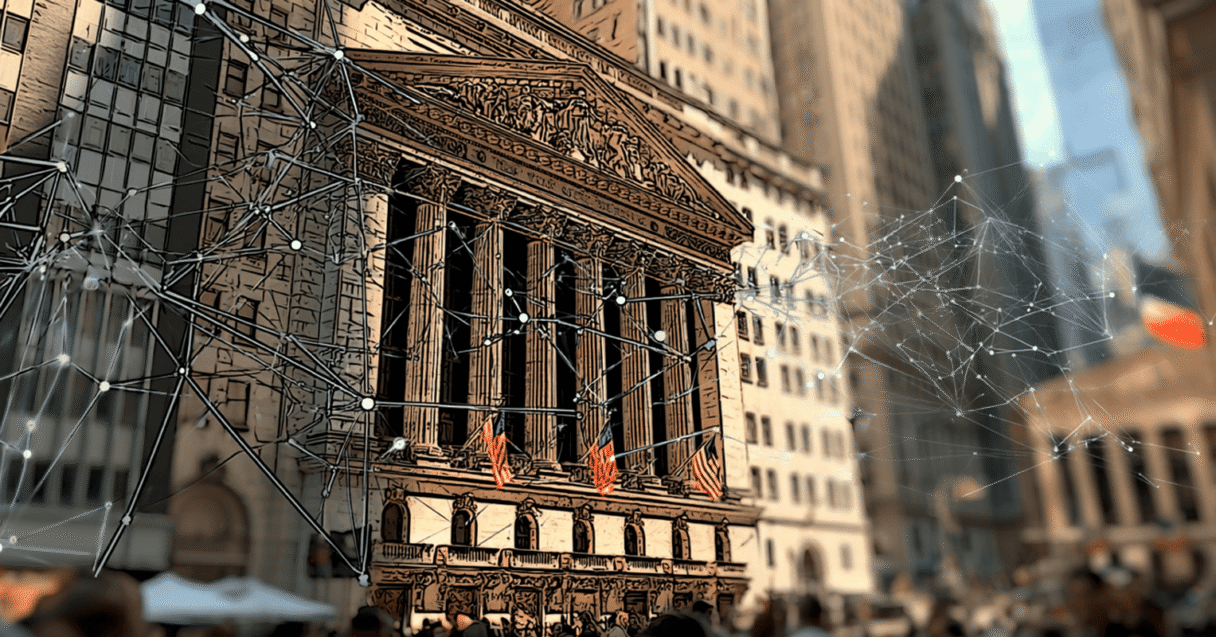
In the 1960s, AT&T knew for sure that communications needed one continuous connection. Today, many on Wall Street know for sure that tokenized assets are not a viable replacement for traditional stocks.
As I’ll show you today, it just ain’t so…
Conventional wisdom about tokenized stocks is that they allow individuals to own company shares in a blockchain wallet.
That’s shortsighted.
The introductory view is that these assets can be transferred from wallet to wallet in seconds. Trade them at any hour of the day. That’s true and extraordinary. But it still misses the point.
When stocks reside on public blockchains, the entire world of decentralized finance opens to them. As a result, applications and solutions that are either impossible or needlessly difficult today become commonplace.
It’s what Wall Street doesn’t understand. It’s why they keep pitching walled-garden solutions.
I’m not sure who needs to hear this, but let’s say it one more time for those in the back: The world will not use your walled garden just so you can keep your margins.
Builders are building to steal that margin. It’s capitalism.
Wall Street today is AT&T in the 1960s. They’re scribbling on a dry-erase board, explaining security entitlements, the DTCC, clearing, and settlement.
Meanwhile, the rest of the world has stopped listening.
They’re building…

Tomorrow, October 15, Marc Chaikin and Joe Austin will reveal a powerful breakthrough designed to pinpoint the top 5% of stocks in the market. They claim these are the only stocks you want to own as the AI bull market enters its most dangerous chapter yet. Get the details here.
What Jeff Brown has to say TONIGHT, Wednesday, October 14 at 8 p.m. ET… During his new strategy session he’s calling The October Million-Dollar Cycle. Click here to automatically save your seat… Because Jeff is going public with what could be the biggest AI secret of his career.
Let’s look at Coinbase’s tokenized stocks.
We last touched on these stock tokens when they were added to the lending and borrowing protocol, Aave, as part of its Equities Hub.
Users are now able to deposit Coinbase stock tokens as collateral and borrow stablecoins against them. The system is permissionless, meaning anybody can open a loan against Tesla stock with a few clicks. No application, no approval, no middleman.
That alone is a step beyond what the legacy system offers.
But here’s the real differentiator…
An application called Superform offers what DeFi calls “vaults.” A vault is a strategy anyone can deposit capital into, with the capital deployed automatically according to the strategy’s rules.
In this case, the vault buys Coinbase’s tokenized Tesla stock, deposits it into Aave as collateral, and puts the borrowed funds to work earning stablecoin yield. The vault manages the loan the whole way through, making sure it never drops below a safe threshold.
It’s an autonomous strategy that lets a Tesla holder keep their stock exposure while the asset works productively underneath.
How much does that work earn? Around 10% yield. That’s pretty good.
But there’s more.
Another protocol, Pendle Finance, built a solution where that yield-bearing Tesla position can be split into two. It allows a holder to sell the future yield and collect it up front as a fixed payment. And since the vault provider is handing out tokens as an incentive to users who try its products, those incentives get bundled into the upfront payment as well.
The result is a fixed yield of roughly 29% on Tesla stock tokens. That’s pretty insane.
Your stock, your dividends, plus a fixed return your broker has never imagined offering to you.
It’s a taste of what’s to come.
But these solutions are not coming to your brokerage account anytime soon. There are too many layers a typical broker would need to create to skim fees from before anything gets passed along to you.
Which brings us to one more example of how little Wall Street understands this technology…
The Canton Network is a permissioned blockchain built for financial institutions.
It issued various press releases on the news that it just completed its first OTC derivative swap.
The product is a total return swap, a contract between two parties. One side pays a fixed amount for the total return of a corporate bond index while the other side pays out whatever that return turns out to be, plus a spread.
It’s a popular product in traditional finance.
But here’s the tell that Wall Street still doesn’t get it.
That swap is a bespoke contract between exactly two parties. It is the direct and continuous line that AT&T insisted was the only solution that could exist.
Pendle takes the same economic idea of paying a fixed amount in exchange for an asset’s actual returns, and breaks it into pieces anyone can buy, sell, and trade in and out of freely, at any size, at any hour.
It brings liquidity to a market that was, and is, a one-to-one contract.
That’s what tokenized stocks are actually about.
It’s not recreating the old system on new infrastructure…
It’s imagining what becomes possible when new builders are free to create new solutions on open rails.
It’s about finding the next Amazons and YouTubes of the internet age.
Only this time, it’s happening with our financial system on permissionless, public blockchains.
Your Pulse on Crypto,
Ben Lilly
Editor, Chain of Thought
Add Brownstone Research as your preferred source on Google to see our latest stories in your feed.
 Add as a preferred source
Read the latest insights from the world of high technology.
It’s a good way to visualize how big, consequential changes can sneak up on you.
Most Bitcoin price projections are entertaining, but unhelpful. So, I made my own.