



Turning on the Spigot
Any sort of uptick in liquidity over the next year or two is the multiplier we didn’t see last...



Most Bitcoin price projections are entertaining, but unhelpful. So, I made my own.

Managing Editor’s Note: Every four years, something strange happens in the market. Jeff Brown calls it “the million-dollar cycle.”
You won’t hear about it on the evening news. Most financial advisors couldn’t explain it if you asked. And yet, like clockwork, it’s shown up again, and again, and again.
Most people don’t notice until it’s already played out. But a small group of investors knows exactly what to watch for. And each time this shift has taken hold, they have had the chance to turn a single $1,000 stake into six figures…
If you’d like to potentially be one of them, make sure to RSVP for Jeff’s upcoming event with one click here.
People are putting out new price projections for Bitcoin.
And most of them will be wrong…
That’s because most predictions are not about being right.
They are about grabbing a headline.
Publish a big enough number, and the media grabs hold and publishes it. It’s not because they think the analysis is genius… They just want clicks.
The more absurd, the better.
Take VanEck.
This is a global investment firm that’s been around since 1955, with more than $200 billion under management. It’s known for launching a gold equities fund in 1968, well before investing in a gold ETF was possible. And it made the leap into digital assets in 2017, when most firms were still learning what the asset class was.
Yet, despite that experience, its projections live where only Elon Musk can get us… Mars.
VanEck’s published bull scenario lays out a thesis where Bitcoin becomes the dominant global reserve asset. That means it’s settling 20% of international trade, 10% of domestic transactions, and sitting in central bank vaults alongside gold.
In such a world, the firm calculates, Bitcoin’s market cap would reach $1.12 quadrillion. That’s $53.4 million per coin.
It’s tantalizing. It’s also not going to happen.
The primary reserve asset of the digital age is shaping up to be U.S. Treasuries in the form of low-friction stablecoins.
And if the world ever loses interest in U.S. debt or the stablecoins that represent it, tokenization ensures people can easily swap those stablecoins for assets such as equities or commodities. Then transact with them like dollars.
This stablecoin and tokenized future is not the world VanEck paints. Which is partly why its price claim should be taken with some skepticism.
And while VanEck’s prediction may seem hyperbolic, it’s not the only one Bitcoin has seen.
Tom Lee called for $25,000 by the end of 2018; Bitcoin finished that year near $3,700.
John McAfee promised $1 million by the end of 2020. The asset only fell short by about $971,000.
Tim Draper said $250,000 by the end of 2022. Bitcoin closed the year around $16,500.
Here are some more:
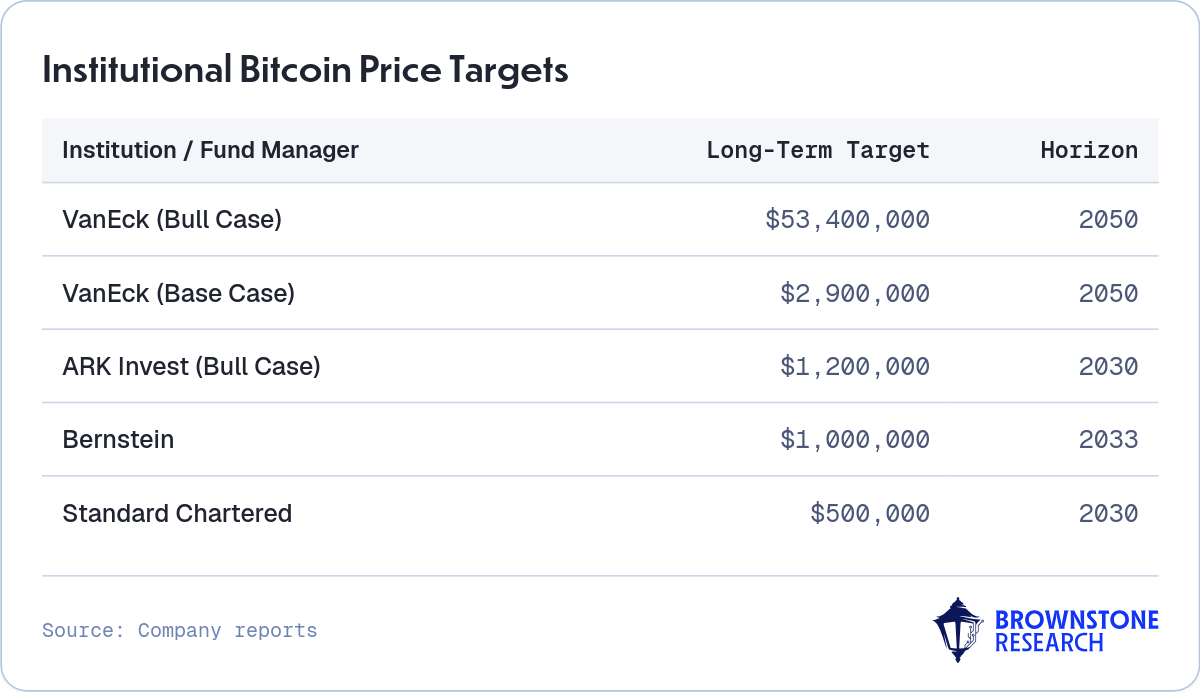
Investors look at these price targets and start to salivate. But it’s just not going to happen… sorry to say.
The point is that most Bitcoin price projections are entertaining… but unhelpful.
So, I made my own.
Over the past few weeks, we’ve talked about halving cycles, the Power Law, and how the Federal Reserve’s balance sheet amplifies or mutes each Bitcoin cycle. To drive the point home, I combined these three views of the market into a single model of our own so we can come up with our own prediction.
More on that in just a minute. First, a reminder of why any model is a starting point, not a destination.

This coming Wednesday, October 14 at 8 p.m. ET, Jeff Brown is going live with a HUGE AI update… To discuss a NEW AI trade that could mint millionaires… starting by the end of this month. Click here to save your seat for The October Million-Dollar Cycle…

One ticker could give you the chance to make all the money you need before the end of 2026. Larry Benedict has already identified it and believes the first move could begin on December 9. Get his ticker free before December 9.
A model is never a destination. Inputs move.
And two of the most important inputs of this model are about to move. One might move as soon as tomorrow, while the other one might shift at the end of this year.
Tomorrow is the 30-year U.S. Treasury auction. It’s one of the more interesting auctions on the calendar right now because Treasury Secretary Scott Bessent will be watching with intense focus.
His department is running a bond buyback program. It’s buying back longer-dated bonds such as the 30-year and reissuing that debt as short-term bills. The program carries a $6 billion cap per operation, tripled from the $2 billion cap his predecessor set.
Bessent is doing this to tamp down rates at the long end of the curve. Buying back long bonds reduces supply. Reduced supply meeting steady (or even rising) demand means the 30-year gets bid, means yields come down, and the federal government gets some breathing room.
So far, operations haven’t come close to that $6 billion ceiling. So many of the alarm bells being rung to date have been for nothing.
But with the 30-year yield at a 24-year high, and running higher with velocity, tomorrow’s auction could push Bessent to act quickly. If demand for long-dated debt comes in weaker than expected, Bessent might have to buy it himself.
In fact, the Treasury scheduled a buyback operation in the 20-to-30-year bucket for the very same day as the auction.
And each operation does one thing directly – devalues the dollar.
Here’s what I mean…
Bessent’s buyback window, scheduled to happen in two weeks, targets bonds issued during COVID. Rates were exceptionally low at the time.
Those bonds cost the government almost nothing in interest. Buying them back and reissuing the debt at today’s rates means the cost of maintaining the same level of debt rises.
Would you give up your 3% mortgage rate to lock in 7.5%? No… But the government isn’t spending money it earned. Its little maneuver will devalue the dollar.
Which is why the U.S. dollar index, as measured by the DXY, is one input into the model. It’s a way to measure whether demand for the dollar is rising or falling. Dollar falls, risk assets such as Bitcoin tend to rise.
The second input comes from the Federal Reserve.
When Fed Chair Kevin Warsh took the reins earlier this year, one of his first moves was creating a set of task forces to review how the Fed operates. One of them is focused squarely on the Fed’s $6.7 trillion balance sheet. It’s looking at its size, composition, and whether the current framework should change. The task force is set to release its findings by the end of the year.
The expectation is that it will propose new rules. We won’t speculate on the specifics. What matters is that once the findings land, we’ll know which direction the balance sheet is headed. And we’ll want a model that will help us gauge what that means for Bitcoin.
That’s why models are just starting points. They help us form a sound opinion based on how expectations change.
If we can project how the DXY will move and the direction of the Federal Reserve’s balance sheet, we will be able to figure out how amplified or muted future Bitcoin cycles will be.
That’s the point of what I’m calling the Power Law Multiplier.
We input those values and come up with an expectation for Bitcoin – timed to the halving cycle, and grounded by a baseline Power Law figure so the output can’t drift into quadrillion territory.
Here it is.
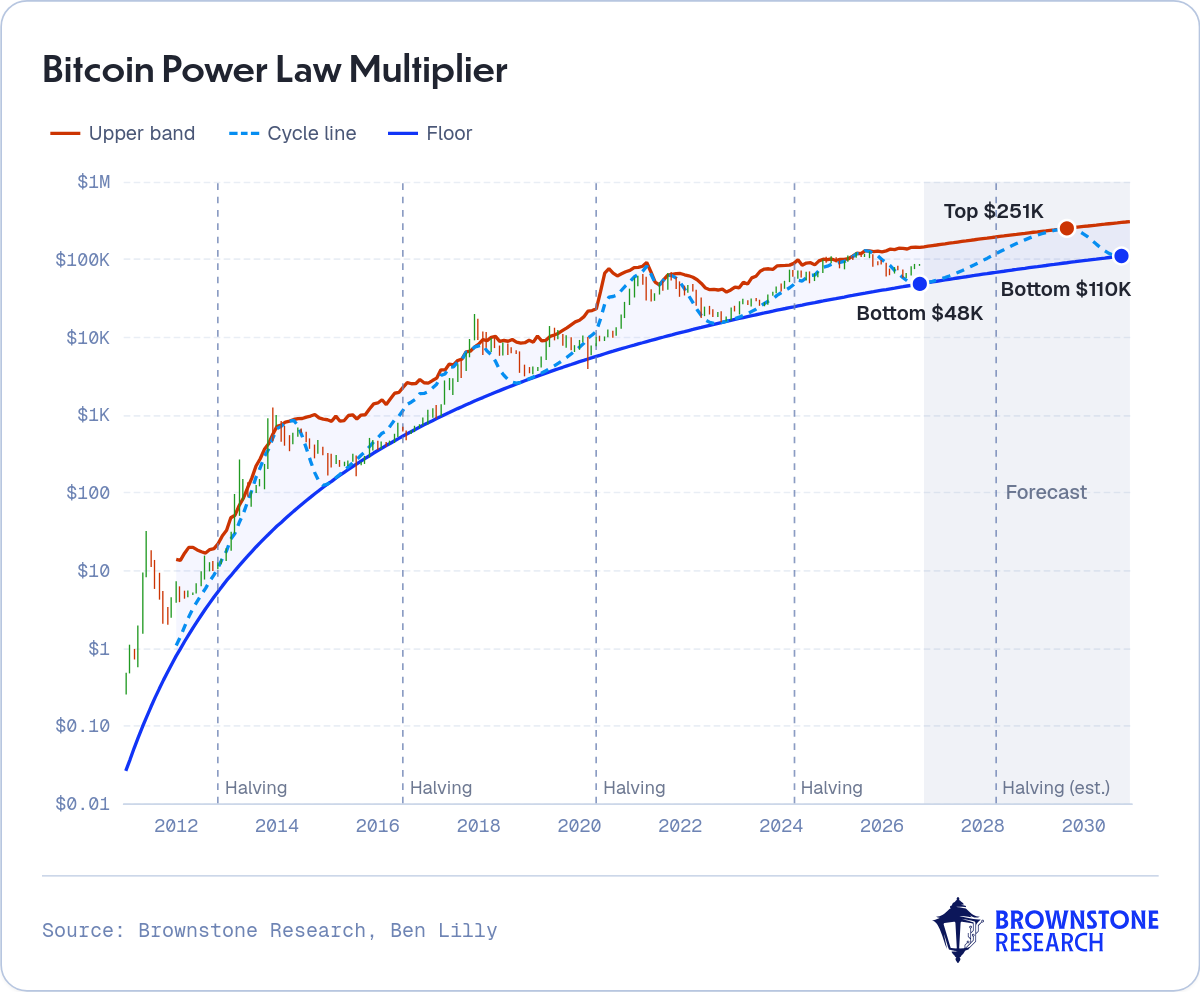
The model predicts Bitcoin will hit $251,000 in 2029. It then expects price to reach a floor of $110,000 in September 2030.
What makes the model useful is that it isn’t a single number. We can input different values for the DXY and the size of the Federal Reserve’s balance sheet to generate other estimates.
The $251,000 figure assumes both values stay right where they are today.
If we change those inputs, here are the results.
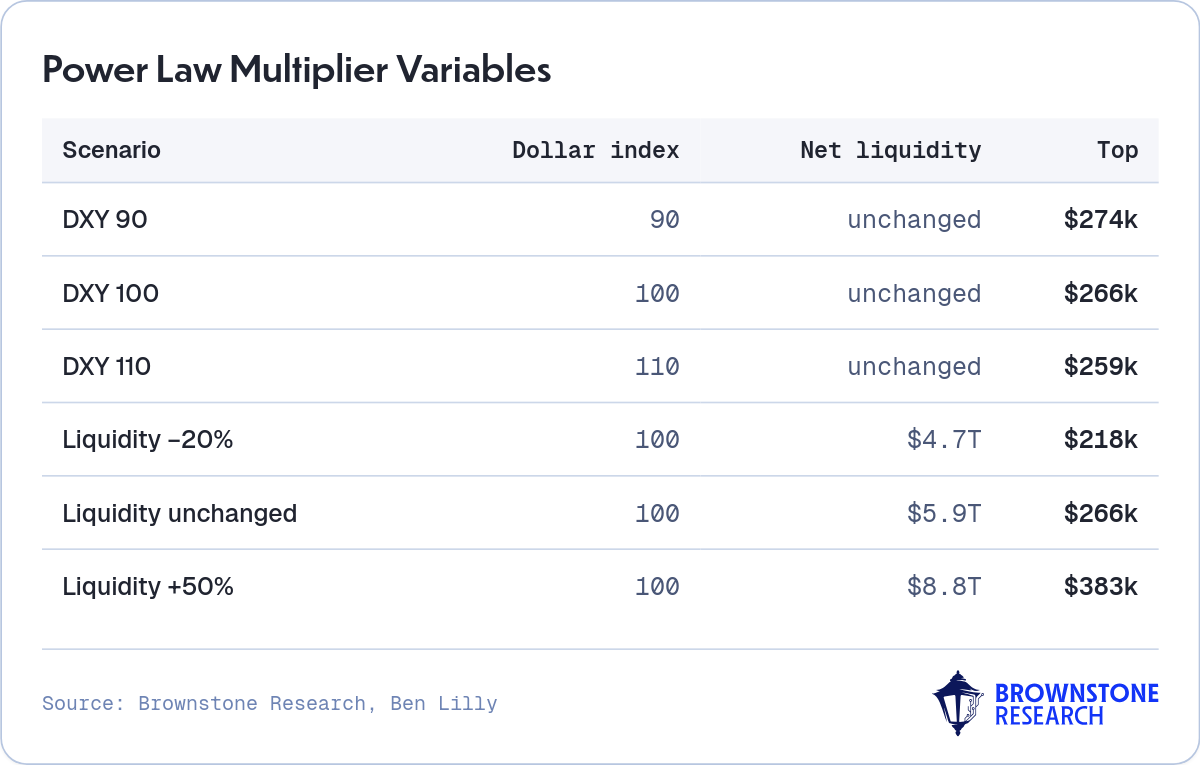
The moves are drastic.
A drop to 90 on the DXY is enough to push Bitcoin’s target to $274,000. And if the Federal Reserve grows its balance sheet by 50%, the effect pushes Bitcoin to $383,000.
That’s how much force these macro variables exert on Bitcoin when they move during the bullish part of its cycle. That’s the key. The model assumes the asset is in a bullish phase, which it is right now.
I use this model to help illustrate what we laid out in our last essay, Turning on the Spigot.
The Federal Reserve is a true amplifier of any Bitcoin cycle.
It’s why the last bull run was so muted. The bull cycle ran into a shrinking balance sheet and a firm dollar.
It’s also why we shouldn’t expect a similarly muted run this time around.
$251,000 represents a 3x gain from today’s price near $84,000. But more importantly, a market generating that kind of gain in its largest asset is a market poised to deliver bigger gains in the smaller tokens down the risk curve.
Which brings us back to the live variables.
Pay particular attention to what Bessent does in the weeks to come. If Treasury ramps up its buyback operations to the $6 billion level (or even exceeds it), then that bodes well for Bitcoin.
We’ll also watch for the Warsh task force findings at year-end. If the findings are supportive of future balance sheet expansion, that also bodes well for Bitcoin.
Those variables are shaping up to be a major catalyst for digital assets.
Most models and price projections focus on making headlines while painting pictures of a world that will never happen.
I’m just asking you to watch two numbers.
They will determine how high we go in the next couple of years.
Your Pulse on Crypto,
Ben Lilly
Editor, Chain of Thought
Add Brownstone Research as your preferred source on Google to see our latest stories in your feed.
 Add as a preferred source
Read the latest insights from the world of high technology.
Any sort of uptick in liquidity over the next year or two is the multiplier we didn’t see last...

The spread between what borrowers pay and what depositors earn no longer needs to fund a high-rise in Manhattan.

If Apollo is right, a bank run is coming. But it won’t be the panicked, lines-around-the-block variety...