




Your Next Loan Won’t Come From a Bank
The spread between what borrowers pay and what depositors earn no longer needs to fund a high-rise in Manhattan.



Any sort of uptick in liquidity over the next year or two is the multiplier we didn’t see last cycle.
Bitcoin hit its all-time high around $126,000 in October 2025.
At around $86,000 as I write, we’re a ways off from that. Right now, most investors are asking when (or if) we’ll ever see those old highs again.
Too few are asking a more interesting question: Why didn’t Bitcoin go much higher during its last peak?
After all, the timing of the peak was spot on.
Bitcoin tends to top out around 17.5 months after its halving.
The halving occurs roughly once every four years. It’s where the amount of new bitcoin being created gets cut in half. It’s a programmed supply change. And the market price of Bitcoin ebbs and flows around it.
The last halving landed in April 2024, and the market top arrived in early October 2025, right on schedule.
But the price was off.
When we look at the models the industry leans on to frame Bitcoin’s potential, something went wrong.
The Power Law model is one such method. It’s a law that suggests a change in one area creates a change in a secondary area. These two areas are time and price for Bitcoin. And it was suggesting a price upward of $460,000 in 2025.
A secondary model is Stock-to-Flow. It helps us predict the price of Bitcoin based on the amount of new supply entering the market. The model anticipated the price rising above $360,000.
Even my own prediction of $142,000 to $170,000 per bitcoin turned out too optimistic in hindsight.
The mispricing raises the question: Why was everyone so far off in 2025?
The reason is simpler than most want to admit.
And it tells us what to expect in the cycle ahead.
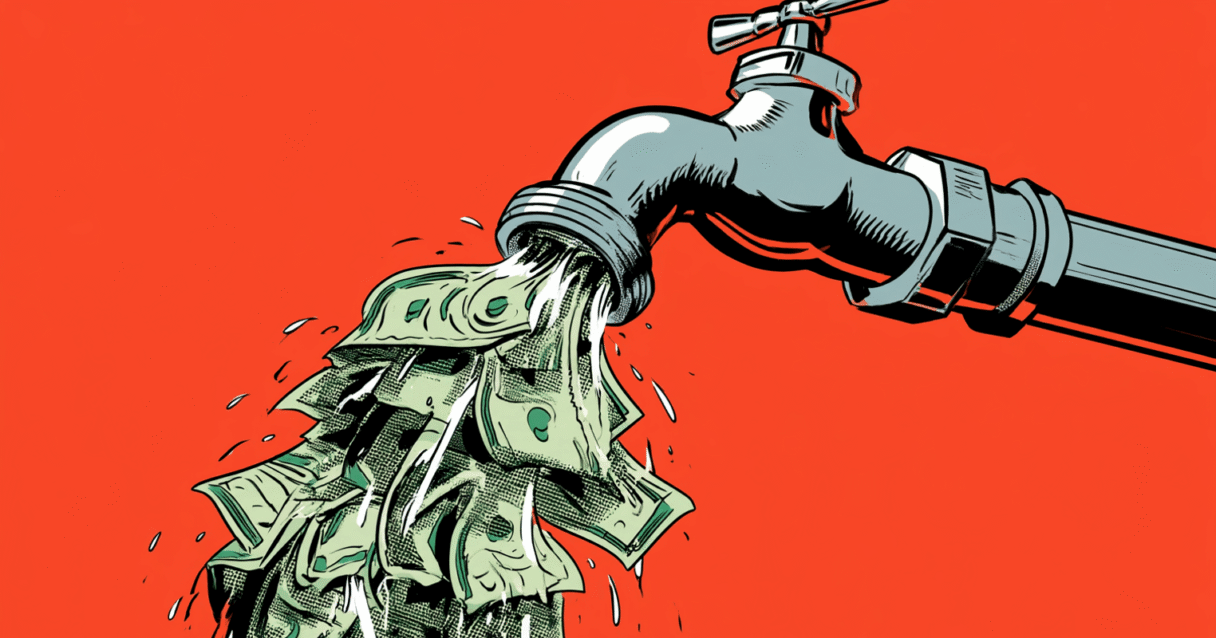
The Federal Reserve controls one of the most important liquidity spigots in finance. That would be its balance sheet.
It’s a bit of an oversimplification, but when the Fed’s balance sheet is expanding, the central bank is creating new capital and injecting it into the system. Whether its balance sheet is rising or falling determines how plentiful or scarce dollars are in the world.
More liquidity sloshing around the system means more capital chasing assets. All else equal, asset prices rise. Bitcoin is no exception. And once you understand the relationship between Bitcoin’s price and Fed liquidity, it’s hard to unsee.
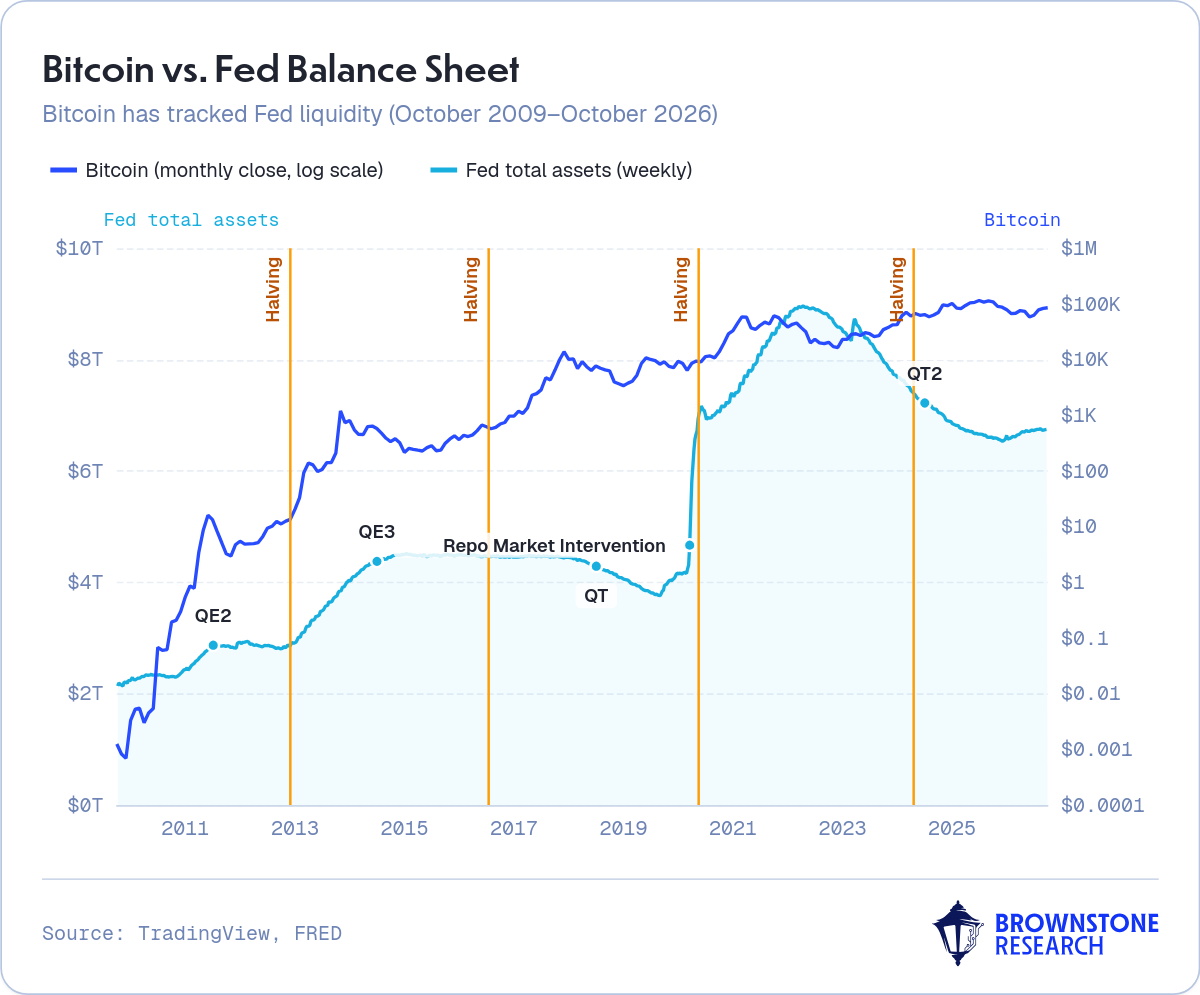
What should be abundantly clear is that, as the Fed’s balance sheet expands and liquidity enters the system, the price of Bitcoin climbs. The quantitative easing (QE) programs, such as those where the Fed purchased bonds on the open market in the 2010s (QE2 and QE3 on the chart above), are a perfect example.
It also works in reverse…
In late 2017, the Fed began what it politely called balance sheet normalization, better known today as quantitative tightening. This is where the Fed lets the bonds it holds mature without buying replacements.
The drawdown in the balance sheet ramped up through the start of 2018, just as the crypto market topped. It then rolled into a brutal bear market for the next year.
It was the same story in 2020. With the onset of COVID-19, the Fed pulled the same maneuvers and flooded the system with liquidity. Bitcoin and the entire crypto market went into a frenzy that ran until the spigot was shut off in late 2021.
The pattern is consistent.
But what matters for us today is what took place in 2025. Because that’ll tell us why Bitcoin’s price only hit $126,000 this time last year.

Jeff Brown calls it the “AI Master Key” – a tiny chip loaded on top of Nvidia’s processors. It’s sold out through 2027. The AI giants are expected to spend $2 trillion a year on the AI Master Key. And the three American-controlled companies are set to take off on Dec. 30. Jeff shows you how to get in with as little as $500 – and names one stock free.Click here to see how.

One tiny corner of tech (not AI) could be about to get a $5.9 trillion cash injection thanks to Trump. Silicon Valley insider Jeff Brown just held an urgent strategy session and gave a free pick for this new bull market. Click to get the FREE pick now.
The Federal Reserve turned the spigot off during Bitcoin’s latest bull cycle.
In fact, it was actively tightening the entire run.
On the surface, you might conclude the Federal Reserve’s actions don’t dictate whether we get a bull cycle at all.
And I agree.
As we laid out in The Data Says Bitcoin Bottoms on This Date, Bitcoin’s cycles revolve around its halvings.
The bottoms, the tops – the timing happens with remarkable consistency, regardless of what the Fed is doing.
But the Fed’s balance sheet acts as an accelerant. When liquidity is flowing in, the halving cycle gets amplified. This is the setup we saw in 2013, 2017, and 2021.
Each wildly overshot what came before.
When liquidity is draining, the cycle still happens, but the upside gets compressed.
That’s the answer to the question we opened with.
The 2024–2025 bull cycle ran on schedule. But it faced a headwind of shrinking liquidity.
It’s why $126,000 arrived instead of $360,000 or $460,000.
The models were unknowingly baking in an assumption that the liquidity spigot would be flowing.
It’s also why during this past cycle, smaller tokens – the altcoins that historically produce the wildest gains late in a cycle – never got their usual run. Altcoins are the highest-beta expression of liquidity. We didn’t have the excess dollars to produce the highly anticipated altcoin season.
Which tells us something about what to expect going forward…
For the first time since 2022, the multiplier is turning positive.
Quantitative tightening is over. The Fed announced the end at its October 2025 meeting and stopped the runoff in December.
The balance sheet has quietly begun growing again. It’s up roughly $140 billion over the past year.
Meanwhile, a second spigot is opening at the U.S. Treasury. The Treasury has been running buyback operations, stepping into the market to purchase its own longer-dated bonds. We covered this in Don’t Fight Bessent.
The Treasury’s repurchases aren’t much in the grand scheme. Treasury Secretary Scott Bessent announced in August that the repurchase program would increase to $4 billion. It sounds like a lot, until you consider that the Fed’s balance sheet expanded by about $8 trillion between 2008 and the peak in 2022.
But Wall Street expects the Treasury’s activity to rise in the coming months. You may have noticed that the 10-year yield has broken out above 5.3%, a level not seen since 2002. Bessent’s buyback program may be small… for now. But doubling the repurchase program was likely just the start. If he wants to get the long end of the curve under control, he’ll need to bring out the big guns.
This suggests a multiplier the market is not fully anticipating or pricing in.
And the timing is spot on.
The halving cycle points to a bottom happening before the end of the year, if it hasn’t already happened.
Any sort of uptick in liquidity over the next year or two is the multiplier we didn’t see last cycle.
This is why the market will be caught off guard. Investors who do expect a new bull expect it will be similar to the last one… subdued.
But that’s shortsighted.
The moment the U.S. Treasury or Federal Reserve turns on the spigot, be ready to act.
This halving cycle could be one for the record books…
Your Pulse on Crypto,
Ben Lilly
Editor, Chain of Thought
Add Brownstone Research as your preferred source on Google to see our latest stories in your feed.
 Add as a preferred source
Read the latest insights from the world of high technology.
The spread between what borrowers pay and what depositors earn no longer needs to fund a high-rise in Manhattan.

If Apollo is right, a bank run is coming. But it won’t be the panicked, lines-around-the-block variety...

The old guard is competing to build the new gatekeeper that the market uses … and the result will...