




The Agentic Bank Run
If Apollo is right, a bank run is coming. But it won’t be the panicked, lines-around-the-block variety...



The spread between what borrowers pay and what depositors earn no longer needs to fund a high-rise in Manhattan.

Eighty years ago, America’s housing boom started in a foxhole.
Soldiers coming home from World War II returned to a country short on homes.
Veterans were sleeping in tents, shacks, and ramshackle trailers that could barely keep the elements out. The greatest generation had won a war, only to come home to a housing shortage.
The government’s response was impressive.
Through the GI Bill, returning soldiers could get home loans with zero dollars down and terms stretching 20 to 30 years.
To appreciate how radical that was, consider the typical mortgage of the era… 50% to 60% down with a term of five to seven years.
The creation of credit set off one of the great economic booms in American history.
Housing starts went from 326,000 in 1945 to nearly 2 million by 1950. Developers raced to keep up with demand the credit had kick-started. William Levitt famously brought assembly-line methods to home building on Long Island. At peak production, Levitt was finishing a new home every 16 minutes.

Source: Getty Images, Realtor.com
And the boom didn’t stop at homes…
Streets, highways, schools, and stores sprang up around these developments. Entire suburban economies grew out of a single decision to extend credit to a new class of borrower.
But according to fearmongering from the banks, we could be on the verge of a major credit contraction. And on the surface, the argument makes sense. But dig even an inch deeper, and you’ll see that argument needs an upgrade.
On the contrary, we’re on the verge of the next great credit boom. Today, I’ll show you why.
But first, a little background.

In October 2019, Jeff Brown warned the Trump administration about China. Months later, his warning came true. Now he sees a new threat… And it’s creating a unique opportunity in the stock market. One stock in this space is already up 841%. And in this video, Jeff will name another key stock – for free. Click here for the details.

Last time Trump intervened in this overlooked sector of tech… you could have made 28x your money in just two days. Jeff Brown says history could repeat itself before November 3. He just gave a FREE ticker so you can get positioned. Click here to claim it.
Readers will recall our last essay on the agentic bank run.
Apollo Global Management explained that AI agents will soon sweep household cash automatically into accounts paying 3.3% to 5%. This cash will come from checking and savings accounts that pay national averages of 0.1% and 0.4%, respectively.
As deposits drain from traditional checking and savings accounts, the banks’ ability to underwrite new loans will be stymied. As credit contracts, the larger financial system, not to mention the economy, could be imperiled. That’s the argument, anyway.
It’s ironic that the banks correctly identified stablecoins as a potential catalyst for deposit flight. But agentic finance, a topic they’ve been largely supportive of, was the real catalyst all along.
Whether you read Ray Dalio’s How the Economic Machine Works, economists such as Schumpeter, Minsky and his Financial Instability Hypothesis, or more niche thinkers such as Richard Werner on how banks create money, they all sum to essentially the same thing.
Credit is the growth engine of economies. Take away the capital that lets banks lend, and you kill the engine.
On the surface, it makes sense.
But that’s exactly what the argument is. Surface level.
Consider this scenario…
Suppose you have instructed your agent to seek out returns in excess of what’s on offer with U.S. Treasurys. An obvious way to accomplish that would be to lend your cash to a well-qualified individual or entity.
This would not be a peer-to-peer loan where your capital is permanently tied up in one specific loan. It would be something closer to the lending pool you already experience at a bank.
It’s a setup where deposits are pooled, loans are drawn against them, and depositors receive a yield as compensation.
These pools already live on protocols such as Aave, Morpho, and Euler. Here is a quick comparison of what Aave is offering depositors.
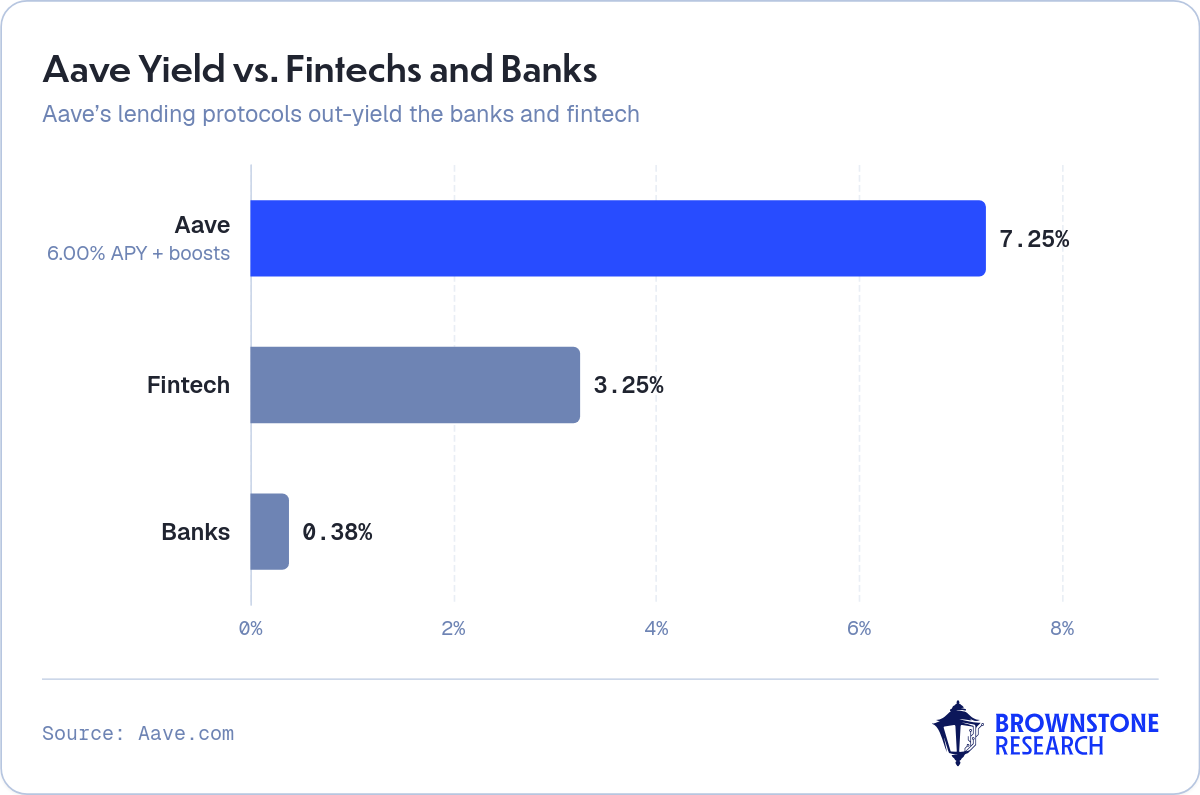
Lending protocols with no middlemen will replace your bank.
Banks pay generous salaries out of the yield they don’t pass on to you. JPMorgan Chase employs roughly 320,000 people. America’s credit unions employ hundreds of thousands more. A lending protocol pays no salaries and no bonuses. It’s autonomous software. There might be a few dozen developers maintaining code and running security checks, but that’s the payroll.
The spread between what borrowers pay and what depositors earn no longer needs to fund a high-rise in Manhattan.
What the banks are getting twisted up on is not whether lending continues. It’s who does the lending. Deposits leaving banks doesn’t destroy credit. It simply relocates it.
The credit engine keeps running. If anything, the amount of credit available will expand.
Franklin Templeton is an investment firm with $1.7 trillion under management and one of the earliest movers in digital assets.
Years ago, it rolled out a tokenized money market fund called the Franklin OnChain U.S. Government Money Fund (FOBXX). Today it holds roughly $740 million.
The asset does exactly what the name implies. It provides the yield of a money market fund… with all the convenience of a digital asset.
The news this week is that these tokenized money market fund shares can now be used as collateral on Bybit, one of the largest crypto exchanges.
The shares keep earning yield for the owner while the borrower receives a line of credit in USDT or USDC stablecoins.
Now, the idea of posting a token as collateral on an exchange is not headline news by itself. Crypto has done this for years. What’s interesting is whose assets are entering the ecosystem.
Franklin Templeton is not some startup experimenting with tokenized assets. It’s an institution with assets under management roughly on par with the GDP of Turkey. And it’s not the only one.
BlackRock’s tokenized money market fund, BUIDL, started down this path back in June last year with about half a dozen entities now accepting it. There’s even a UBS tokenized money market fund that is also being used in a similar fashion.
This is a progression. And Wall Street sees it coming.
Citi published a report showing 77% of financial institutions expect to use some form of tokenized collateral. Not by some far-off date, but this year.
And in the same report, it mentioned 5% of repurchase-agreement volume already trades in tokenized form each month. The repo market is the deepest credit market on the planet, and tokenization is already growing there.
Credit is changing.
In the postwar housing boom, it was the GI Bill and military service that led to a revolution in credit creation. Today, the new revolution is being led by tokenized assets.
And the important part is it’s not just money market funds…
Binance added tokenized stocks as collateral just a few days ago. Now, investors can hold shares of a company in tokenized form, borrow a stablecoin against them, and use that capital however they see fit.
That joins the news we shared last week of Coinbase’s tokenized stocks being accepted as collateral on an Aave loan.
The lending process is changing. The definition of collateral is expanding.
Soon, anything that’s tokenized with verifiable value will create credit.
Let’s take a moment and recall some of the figures we’ve been touching on.
Banks pay 0.1%. The high-yield accounts Apollo warned about pay 3.3% to 5%. And Aave is paying 7.25% to those depositing stablecoins on its platform.
What this means is that tomorrow’s loans won’t be written by the banks of today. The deposits will flow to where the yield is. The yield is where the borrowers are. And the borrowers can post a diverse set of collateral on public and permissionless rails.
We should not be worried about an economic crisis if deposits leave the banks.
The credit engine won’t die if a local credit union can no longer find deposits.
The loan process is being upgraded. Our financial system is being upgraded.
Eighty years ago, a credit unlock built the suburbs of America.
We’ll see what this credit unlock builds.
Your Pulse on Crypto,
Ben Lilly
Editor, Chain of Thought
Add Brownstone Research as your preferred source on Google to see our latest stories in your feed.
 Add as a preferred source
Read the latest insights from the world of high technology.
If Apollo is right, a bank run is coming. But it won’t be the panicked, lines-around-the-block variety...

The old guard is competing to build the new gatekeeper that the market uses … and the result will...

Blockchains are infrastructure built for machines. And now the machines are here.