


The Last Stand of the Old Guard
The old guard is competing to build the new gatekeeper that the market uses … and the result will...



If Apollo is right, a bank run is coming. But it won’t be the panicked, lines-around-the-block variety...
Managing Editor’s Note: The Dollar Trap airs tonight…
This evening, our colleague Larry Benedict is sitting down with Jeff Brown for an emergency briefing where they will reveal why the U.S. dollar is in an inescapable trap that not even the president himself can stop from snapping shut.
They will also show why the winners of the AI boom could effectively lose up to 40% of their gains in the aftermath… and how you can turn this chaos into profits if you know how to tackle it.
Just go here to automatically add your name to Larry’s guest list for tonight at 8 p.m. ET.
Wall Street is divided on digital assets…
And the split is becoming impossible to hide.
Two of the largest asset managers in the world published research endorsing public blockchains and agentic finance over the last two weeks.
We’re talking about a world where AI agents manage money and your investments autonomously. Just tell the agent how you want to deploy your capital… and off it goes.
Meanwhile, the banking lobby is still fighting yesterday’s war. It’s trying to convince regulators that stablecoins will drain bank deposits. This was its argument when stablecoin legislation called the GENIUS Act was signed into law. It’s the same argument used to keep the CLARITY Act from passing in the Senate earlier this month. And that’s despite stablecoins being the best tool for agentic finance.
What’s becoming clear is that the deposit-flight worry was surface level. The leaders of our banking institutions never thought AI, the technology they endorse, might be what ultimately threatens their business model.
But the two firms that are embracing the inevitable are calling their bluff.
And doing so in public.

Larry Benedict generated $274 million in trading profits and put together 20 profitable years in a row on Wall Street. While testing his new Bitcoin strategy, everyday readers following along saw an 85% win rate, with chances at $3,615… $4,036… and even $4,898 in profits. He walks through the whole thing, start to finish, in a free presentation. Click here to watch now.
The U.S. dollar is approaching the biggest disaster in over 50 years… on a deadline set by the federal government. Jeff Brown and Larry Benedict say the dollar won’t weaken. It will break.
For the prepared, it could be the opportunity of a lifetime – in a market that’s delivered gains like $11,475 in 28 days. They explain everything in a free emergency broadcast on TONIGHT, at 8:00 p.m. ET. Click here to reserve your seat.
(When you click the link, your email address will automatically added to guest list)
The first piece in support of the agentic economy came from Apollo Global Management, an asset manager with over $1 trillion in assets under management.
The comments came in its Daily Spark research note, under a title that doesn’t mince words: “Is an Agentic Bank Run Coming?”
It’s a piece that undoubtedly builds on what we discussed in What Most Investors Missed at Jackson Hole. In that piece, we discussed the idea of “AI moral hazard.” It’s the hypothesis that an agent might take action to maximize returns even if it’s damaging to the broader financial system.
For instance, could an agent, if armed with enough capital and leverage, engineer a crisis that forces a Fed bailout if it thought that would maximize returns? It’s not out of the question.
But Apollo’s note discussed something even more straightforward: What happens when AI does simple math?
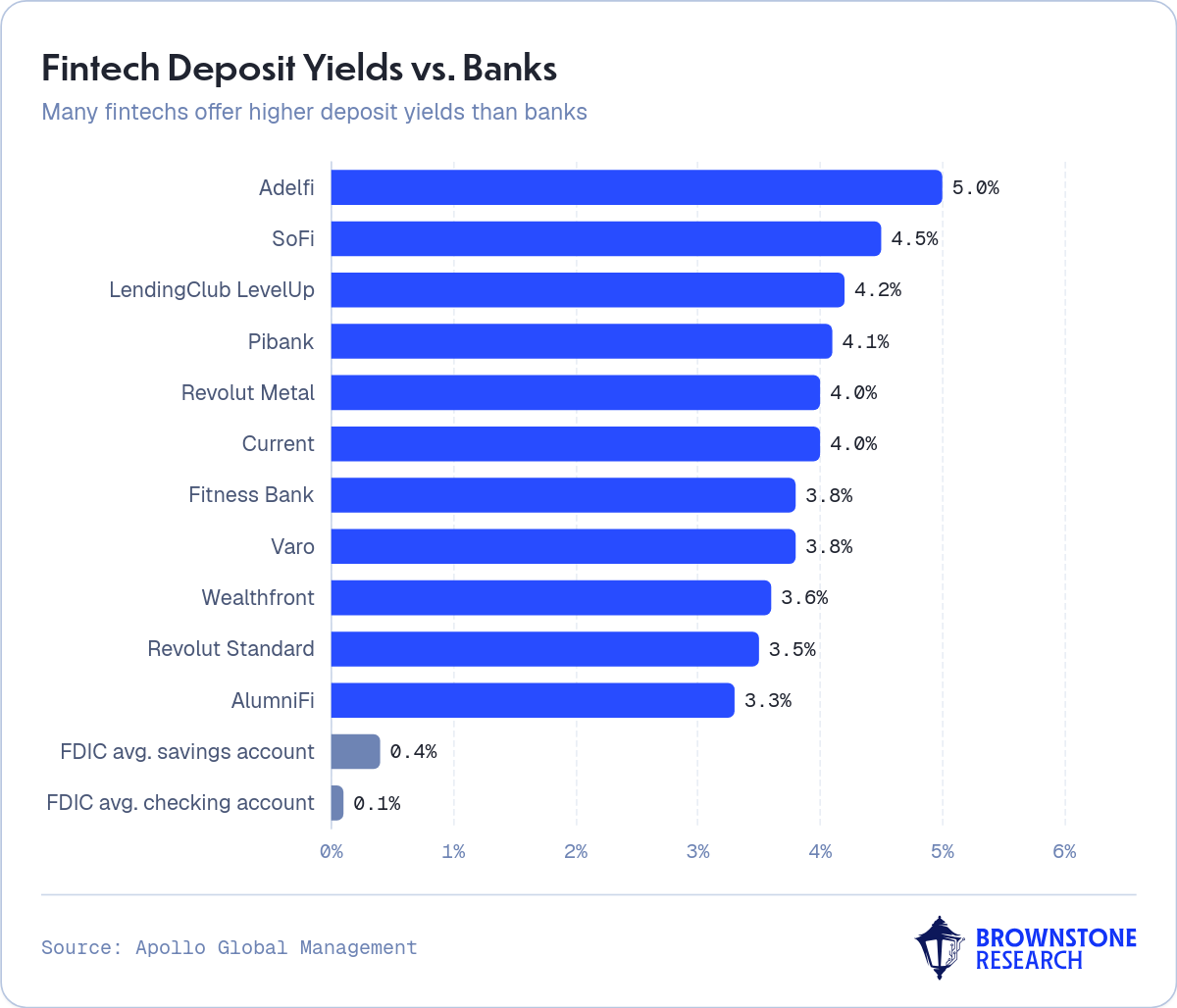
The average U.S. checking account pays 0.1% on deposits. Savings accounts pay around 0.4%. Meanwhile, money market funds and high-yield alternatives pay 3.3% to 5.0% on the same idle cash.
Banks have gotten away with this spread for decades because moving money is annoying. It requires a user to open multiple bank accounts, input various account numbers and routing numbers, wait several business days, and monitor the process along the way.
It takes time, which means households don’t sweep cash between accounts every week. There is simply too much friction.
Banks love this arrangement.
A $10,000 deposit in an average checking account earns the customer $10 per year. But the bank can lend that same deposit out at 7.5% on a 30-year mortgage. That turns the $10,000 deposit into $750 of revenue annually, with only $10 going to the customer whose deposit made the loan possible.
Apollo’s point is that AI agents remove this friction… and potentially unwind the bank’s business model.
In the author Torsten Slok’s own words:
Muse and similar agentic AI assistants could soon sweep household cash automatically into accounts paying 3.3% to 5.0%, instead of the 0.1% national average on checking accounts.
The point is simple: 4% is higher than 0.1%. An agent incentivized to maximize returns will take the higher yield every day. And the task of shuttling money to different accounts autonomously and continuously is child’s play. Now multiply that by millions of accounts.
Deposits flee. The bank’s ability to underwrite loans is crippled.
The banks understood this was also a risk with stablecoins, which is why they fought so hard to stop them.
Like money market funds, stablecoins have a current yield in the neighborhood of 4%. The mass adoption of those yield-bearing stablecoins, thanks to GENIUS, would trigger deposit flight and destabilize the system.
Now, Apollo is calling their bluff, forcing them to admit they just don’t want to innovate and would rather use regulatory capture to keep their margins.
That’s because the threat isn’t limited to just crypto. Even without a single stablecoin involved, agents were always going to hunt down yield wherever it lives. Whether it’s money market funds, Treasury products, or high-yield accounts, money will go where it earns.
The banks were crying foul over an inevitable future in which they can no longer quietly hoard the yield on our money.
If Apollo is right, a bank run is coming. But it won’t be the panicked, lines-around-the-block variety. It’ll be a continuous, autonomous, and perfectly rational drain.
And Apollo is not alone in seeing it.
The second piece that’s calling the banks’ bluff came from BlackRock, the largest asset manager on Earth.
Its Digital Assets Research team published a white paper titled “The Machine-Native Economy.”
We briefly touched on it last week, but for those who missed it, the paper reads like an endorsement of everything we’ve been writing about at Brownstone Research for two years (emphasis added):
Digital currencies, including stablecoins held in on-chain wallets… can support high-frequency, low-denomination transactions without human intervention. Where settlement occurs on permissionless networks, greater usage could increase demand for blockspace and validator services, creating a potential transmission channel to native cryptoassets. The extent of value capture will depend on each network’s fee, staking, and gas-sponsorship design.
What BlackRock is saying is that agents will transact constantly, in tiny amounts, with no human involved.
Banks and card networks are not built for that. But public blockchains are.
They run 24/7, settle in seconds, and let software hold and move money directly and autonomously. An agent with an onchain wallet can move assets, purchase data, even acquire more compute for itself, all on the same rails.
It’s the lowest-friction point for finance.
BlackRock takes it a step further. Reread that bolded line. It means the value of this activity flows to the tokens that agents run on.
It happens through fees, staking, and the demand for blockspace.
The world’s largest asset manager is describing, in a client-facing document, how public blockchain tokens capture value from the agentic economy.
Put the two papers together and you get the full picture.
Apollo says agents will do exactly what they’re told: maximize yield. BlackRock says they’ll do it on public and permissionless rails.
Meanwhile, the banks are still arguing about stablecoin yield.
Apollo and BlackRock are looking ahead.
In fact, both firms are already building on the frontier they’re describing.
Consider BlackRock…
It has its BUIDL fund, a multibillion-dollar tokenized Treasury fund that sits onchain. As of earlier this year, it can be traded on Uniswap, the largest decentralized exchange.
As part of that move, BlackRock purchased an undisclosed amount of UNI, Uniswap’s native token. That means BlackRock put a DeFi token on its balance sheet.
And just last week, BlackRock partnered with Ondo Finance to move three of its model portfolio strategies onchain as tokens. It is building on the frontier.
Apollo’s footprint is just as deep.
It tokenized its private credit fund, ACRED, which has shares onchain across multiple networks. Those tokenized shares are now used as collateral in onchain credit markets, where holders borrow stablecoins against their fund positions on Morpho, a decentralized lending protocol.
That involvement also led to Apollo putting Morpho’s native token on its balance sheet.
These two are not just talking about what the future of agentic finance paired with public, permissionless systems looks like. They are building it.
They are pitching their own products and services, which puts them in stark contrast to the other group on Wall Street.
The banks that aren’t building are sending lobbyists to fight their battles instead. They pushed against the CLARITY Act. And they’ve worked to instill fear of bank runs in regulators.
But the banks will lose.
Innovation is coming for their margins.
Change is coming.
Adapt, or die.
Your Pulse on Crypto,
Ben Lilly
Editor, Chain of Thought
Add Brownstone Research as your preferred source on Google to see our latest stories in your feed.
 Add as a preferred source
Read the latest insights from the world of high technology.
The old guard is competing to build the new gatekeeper that the market uses … and the result will...
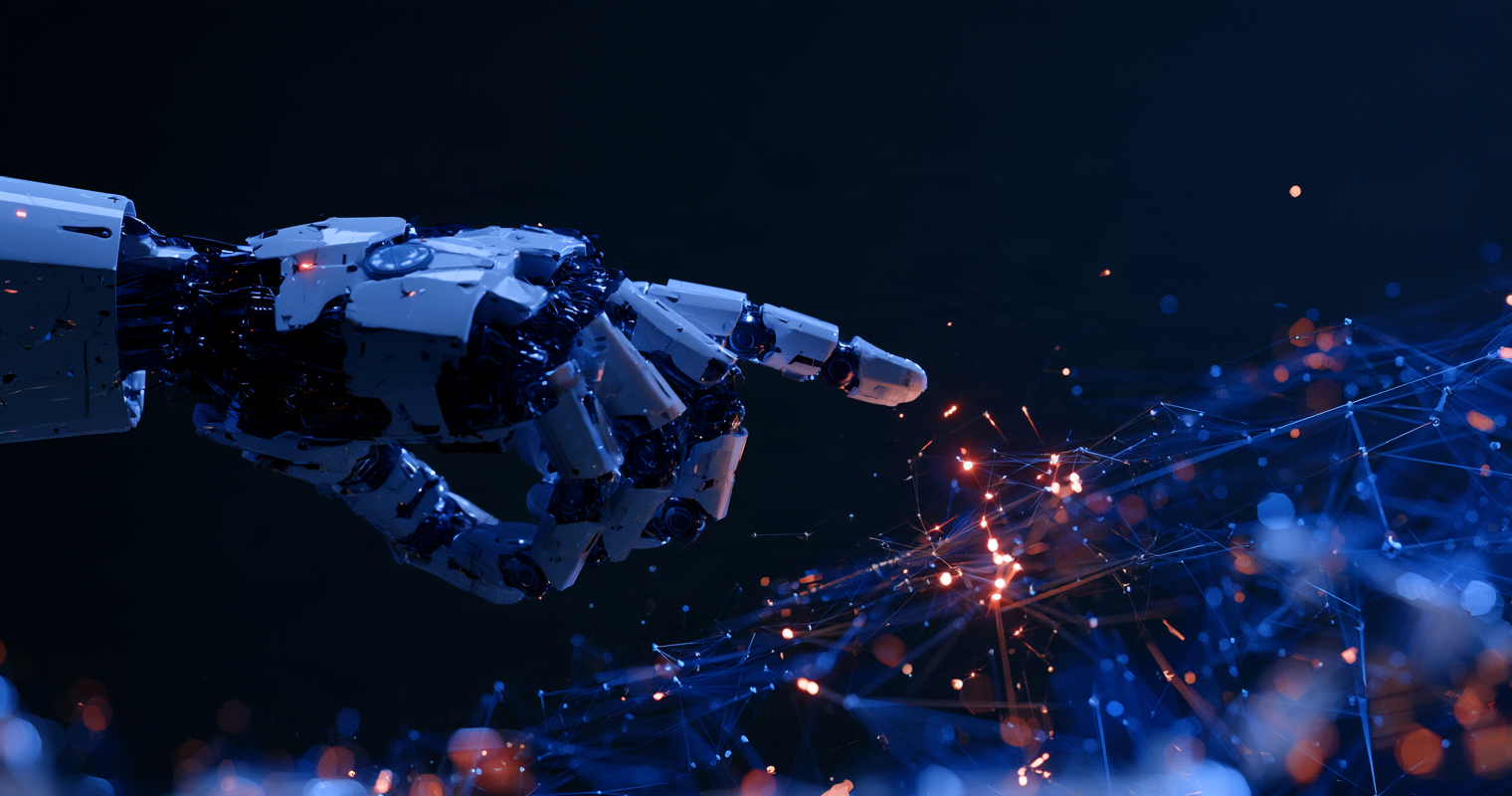
Blockchains are infrastructure built for machines. And now the machines are here.

If the cycle holds, we’ll look back at this moment in the fall of 2029 and realize that was...