




Wall Street’s “Blockbuster Moment”
JPMorgan can keep both pieces of infrastructure as long as it likes. But customers will decide where to do...



The future of finance is coming. And the central bankers, finally, are ready to accept that.

The S&P 500 index was ready to break below 1,000.
It was more than a year removed from the horrendous crash of 2008. The market was still on shaky ground.
It was August 2010. Federal Reserve Chairman Ben Bernanke addressed the media and those in attendance at the Jackson Hole Symposium.
One line summed up the general tenor of the speech:
Notwithstanding the fact that the policy rate is near its zero lower bound, the Federal Reserve retains a number of tools and strategies for providing additional stimulus.
Translation: The Fed would do whatever it took to jumpstart the markets.
Investors got the message…
The S&P 500 was up nearly 30% in less than six months.
His speech was one I’ll never forget. And the ability for the Fed chair to move markets makes Jackson Hole such an important event. Bernanke used the opportunity to light a fire under stocks. But it can also work in reverse.
In August 2022, Jerome Powell used the Jackson Hole event to deliver a direct 8-minute speech. At the time, consumer inflation was nearing double digits. Powell made it clear where his Fed’s priorities were.
He said the Fed would use its tools “forcefully” to bring down inflation. He referenced Paul Volcker, the Fed chair who hiked the Fed’s rate to nearly 20% to beat back the inflation of that era.
Once again, markets got the message. The S&P 500 was down about 15% by early October.
Because the Fed chair’s speech can move markets, it’s usually the only thing people pay attention to. Most don’t realize that the actual purpose of Jackson Hole is to discuss a slew of academic papers and presentations.
The material that is published around this event tells the world what is top of mind for global bankers. Each year I make it a point to go through it all in hopes of finding little nuggets of information that go unnoticed.
And this year, the topic hit close to home for digital asset investors.
The topic was “Financial Innovation: Implications for Payments and Policy.”
Here was the slide template used for various presentations. It’s a little ironic that the word “innovation” was presented in what looks to be a Reagan-era graphic design format. But I digress.
Source: Kansas City Fed
The agenda was focused on the literal themes we track here at Brownstone Research when it comes to digital assets.
The topics discussed were all centered on tokenized finance, stablecoins, and the future of banking. The financial upgrade we’ve been covering for years is hitting the world’s biggest stage.
The Bank for International Settlements, the U.S. Federal Reserve, Bank of England, European Central Bank, the International Monetary Fund, and other institutions were discussing a world where finance sits onchain.
These topics weren’t disguised. They weren’t buried in the footnotes. Have a look at one slide from the European Central Bank and you’ll see. They’re talking about onchain finance openly.

Source: Kansas City Fed
So, what were the takeaways from this event? And what does it mean for us as investors?
The first two are expected… The third one was a major surprise.
The U.S. dominance in finance will only grow.
Approximately 80% of all transactions globally involve the U.S. dollar on either side of the transaction. The growth of stablecoins will only solidify the role of the U.S. dollar in global finance.
The other concentration that was mentioned had to do with securities. This is a little less known, and a point I often make about why the U.S. needs to lead on the regulation front.
U.S. securities will become more attractive in the years to come. After all, the U.S. has the best-capitalized markets in the world and strong legal institutions protecting investors.
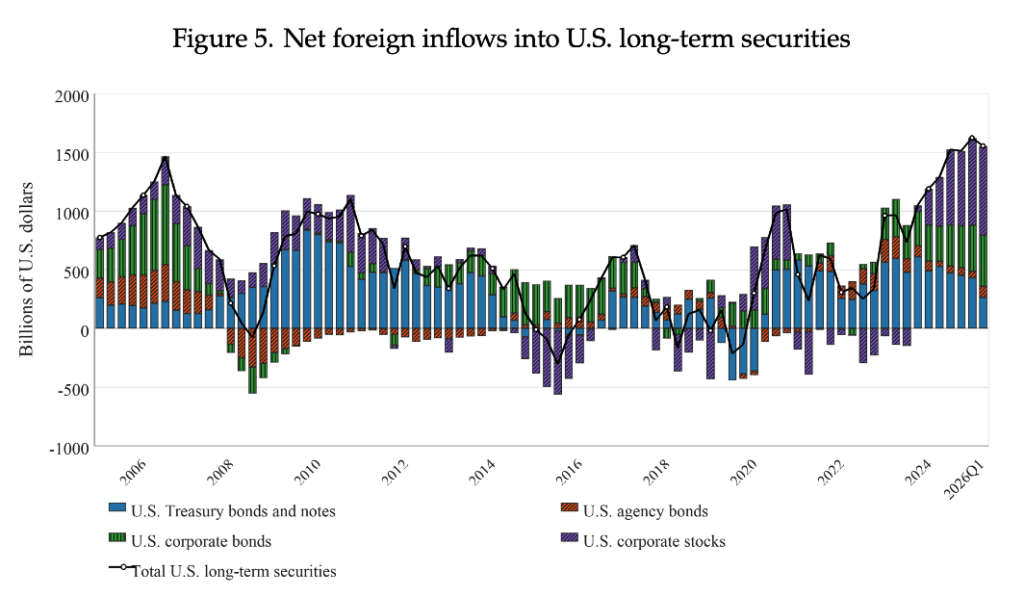
In fact, the trend has already been taking place over the last couple of years, as seen in the chart that accompanied one of the papers.
Source: Kansas City Fed
The point is that current innovation will reinforce the dollar and U.S. asset dominance globally.
What it didn’t shed light on was how the U.S. would take advantage of such a position… Something we mentioned last week in The Treasury Is Priming Onchain Stocks.
The second takeaway was related to the first.
It essentially reads something like this: Given the concentration of markets, risks will grow.
This was interesting. Typically, monetary policy responses involve injecting liquidity into the markets and buying assets that might be responsible for current financial stress.
The Bank for International Settlements was keen to consider possible safeguards and ways to essentially fence the system. That wasn’t the interesting part. More interesting was what wasn’t said.
It was this: At some point in the future, central banks will need to consider adding stablecoins or some other tokenized asset to their balance sheets.
This will happen, make no mistake.
Central banks are responding to onchain finance rather than dictating how it innovates. And because the central bankers are not innovators, their discussions on risk were lacking. If those risks ever become systemic, they will have to act.
The last finding was a topic that I hadn’t considered. It had to do with AI.
We’ve been discussing the importance of AI in a financial world that is increasingly digital and low friction.
Transaction volumes will surge, the ability to customize solutions will grow, and the role of agentic finance will become dominant.
In such a world, one author broke down some of the policy considerations that should be understood.
One such consideration was: AI moral hazard.
“Moral hazard” typically refers to investment banks acting recklessly because they know the Fed (and the government, if required) will bail them out.
But what happens when an AI begins to run simulations that expect the same thing? It becomes a game-theory decision. After all, if the government will always “save the day,” why wouldn’t an AI push the envelope risk-wise?
Bring it to the logical conclusion: Would an AI, armed with enough capital, attempt to create a crisis, thus prompting a Fed bailout, if it thought that would maximize returns?
It was a novel discussion. And it paints the picture of how central bankers will need to adapt in the years to come.
This Jackson Hole meeting is a true turning point for public and permissionless blockchain infrastructure.
It’s a recognition that finance is coming onchain. And it wasn’t subtle.
And central bankers need to come to terms with the fact that they will not be the architects of financial innovation. Innovation moved faster than they could even plan.
It’s now just about figuring out how to respond to the inevitable trends that are already underway.
The future of finance is coming. Project Crypto is going global.
And the central bankers, finally, are ready to accept that.
Your Pulse on Crypto,
Ben Lilly
Editor, Chain of Thought
Add Brownstone Research as your preferred source on Google to see our latest stories in your feed.
 Add as a preferred source
Read the latest insights from the world of high technology.
JPMorgan can keep both pieces of infrastructure as long as it likes. But customers will decide where to do...

The bank realizes it needs to compete in the future of finance, and it’s one where agents roam freely...