



The AI Doomer Counterattack
Companies such as Anthropic and OpenAI are screaming at the top of their lungs, “Regulate us!”



If the cycle holds, we’ll look back at this moment in the fall of 2029 and realize that was when it all kicked off.

Editor’s Note: Something is coming for the U.S. dollar … and hardly anybody is prepared.
That’s the message from our colleague and “Market Wizard” Larry Benedict. According to Larry, the dollar could break as early as Oct. 7. Not weaken, not slip – break.
It’s a bold claim, but Larry’s ready to share his findings – including what it means for investors – on Sept. 30 at 8 p.m. ET. Readers can sign up for the event with one click right here.
The Atlantic Ocean has not produced a single hurricane this season.
Not one.
There have been some named storms, such as Arthur, Bertha, and Cristobal, but none were of significance.
For context, the National Hurricane Center tells us there are an average of seven named hurricanes per year, according to data going back to 1991. Considering we’re more than halfway through hurricane season, we’d expect to have seen at least four by now.
But, no.
We are witnessing a 60-year record for the longest stretch without one. As a South Floridian, I’m very grateful for it.
Of course, the internet has more than a few hypotheses for the hurricane drought.
It’s the cloud-seeding programs, you see. No, wait, it’s the secret geoengineering initiatives. Maybe the government really does control the weather?
The boring truth is that this is a cycle doing what cycles do.
A strong El Niño is in place across the Pacific. Some forecasters are calling it a “super El Niño” for how strong it is. A super El Niño happens when the eastern Pacific warms 2 degrees Celsius or more.
As a result, wind patterns change over the entire tropical belt. The Atlantic Ocean gets hit with elevated vertical wind shear, which tends to break up storms before they develop into something serious.
It’s the rhythm of the planet … No secret government program.
Which brings me to Bitcoin.
It has its own version of weather cycles. And based on its own cycles, Bitcoin is standing at a fork in the road.
Either it continues trending higher ahead of its typical schedule or it takes one more dip in the weeks ahead before the real move begins.
Let’s have a look and see if we can predict which way it will go …

Brownstone Research founder Jeff Brown and hedge fund "Market Wizard" Larry Benedict are holding an emergency broadcast. They believe an event scheduled by Washington could gut the biggest winners of the AI boom. They’re talking about potential losses of up to 40%... Yet for the prepared, it could be the opportunity of a lifetime. Click here to learn more.

NASA is paying Elon Musk over $800 million to destroy the International Space Station. But according to Wall Street veteran Dylan Jovine, they’re paying a company one-one thousandth the size of SpaceX a billion dollars a year for the replacement. SpaceX gets a demolition job. The tiny company he's been researching gets a tenant. And NASA is far from the only one. Go here now for our newest space stock report >>> Because after Dylan recommended Rocket Lab to his readers at $3 and change, they saw the stock run up 3,874%. And he believes this one could do even better. Here’s the stock >>
Roughly every four years, Bitcoin undergoes an event called the halving.
After each halving, the number of new bitcoin issued at each block gets cut in half. It’s written into the protocol.
Specifically, supply growth drops by 50% every 210,000 blocks. And with each block arriving about 10 minutes apart, this places each halving nearly four years apart.
This supply schedule is the closest thing crypto has to a season.
Let’s start with when bottoms tend to form for Bitcoin relative to its next halving.
Bitcoin’s first cycle was when it was very new. There wasn’t much supply in circulation. Which means any uptick in demand created an immediate reaction in its price. For that reason, it’s worth setting the first halving aside.
Using the three other cycles, we see the bottom tends to materialize about 513 to 542 days before the halving. Let’s split the difference and call it 528 days.
When we look at the current cycle, we’ll see why that’s a bit odd.
The next halving is estimated for April 2028. If we assume for a moment that Bitcoin’s low took place below $60,000 on July 1, 2026, it would have arrived roughly four months early.
It would be the earliest bottom in Bitcoin’s history.
That’s because if the cycle were consistent with the prior three, the true bottom wouldn’t be due until the first or second week of November of this year (depending on where the halving date ultimately lands).
And there’s one more piece of information we should consider.
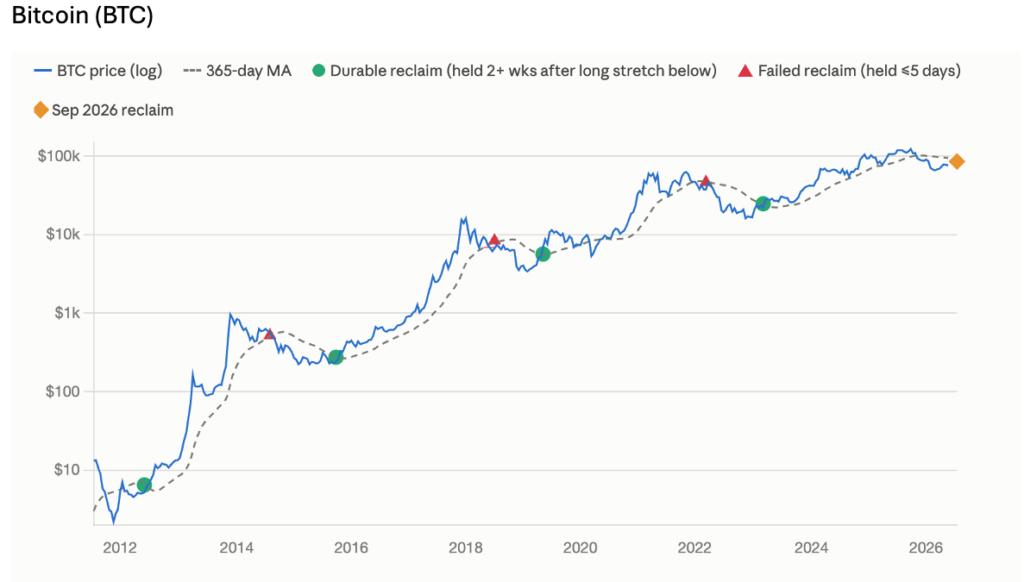
The one-year moving average for Bitcoin can help us spot when bull markets have arrived.
Here is a chart with 14 years of Bitcoin price and its one-year moving average. The green bubbles signify when Bitcoin moved above this moving average and stayed above for two weeks or more. The red triangles are moments when price couldn’t stay above the line for more than two weeks.
Source: Brownstone Research, Ben Lilly
The signal is clear. Every green bubble was a buy signal. Every red triangle was a sell signal. Every single time.
Those green buy signals tend to occur after Bitcoin has been below that moving average for months at a time, just like it was for much of this year.
Currently, Bitcoin has reclaimed the one-year moving average. The question that matters … can it hold this price level until the first week of October?
If it can, then we could confidently say we have another green bubble.
If it can’t, then Bitcoin will likely have a soft October before it begins to gear up for its true multiyear rally.
That’s the fork.
Does Bitcoin’s cycle begin four months early?
My vote is “yes.”
And even if price does break below the one-year moving average in October, I still think the bottom is in.
We’ll likely know one way or the other in the months ahead.
And assuming Bitcoin does kick off a new bull, what then?
The halving cycle isn’t just about finding the bottom. It’s about being prepared for the top.
Historically, Bitcoin peaks roughly 17.5 months after each halving.
This is consistent across the last three cycles. We’re talking a three-week difference. For a market this volatile, that consistency is remarkable.
If we apply the pattern to the upcoming halving, the expected top would be in October 2029.
Three years of possible gains ahead.
That’s the part worth sitting with. From where we stand today, this bull market has a lot of time to develop.
Fortunately, subscribers to Permissionless Investor have already benefited. We booked gains of nearly 700% and 100% earlier this week, with several more positions nearing triple-digit gains.
Bitcoin might muddle through October. Or its next multiyear run might have already begun.
It really doesn’t matter. If the cycle holds, then we’ll look back at this moment in the fall of 2029 and realize that was when it all kicked off.
The focus needs to be on finding the best projects positioned to dominate in this coming multiyear rally.
Because we’re still early.
And if you’re reading this, you’re among the few people who know that.
Your Pulse on Crypto,
Ben Lilly
Editor, Chain of Thought
Add Brownstone Research as your preferred source on Google to see our latest stories in your feed.
 Add as a preferred source
Read the latest insights from the world of high technology.
Companies such as Anthropic and OpenAI are screaming at the top of their lungs, “Regulate us!”

Get these assets so entrenched, so dug in, that no future administration can rip them out without creating systemic...

There’s plenty of blame to go around, and I’m more than happy to name names.