



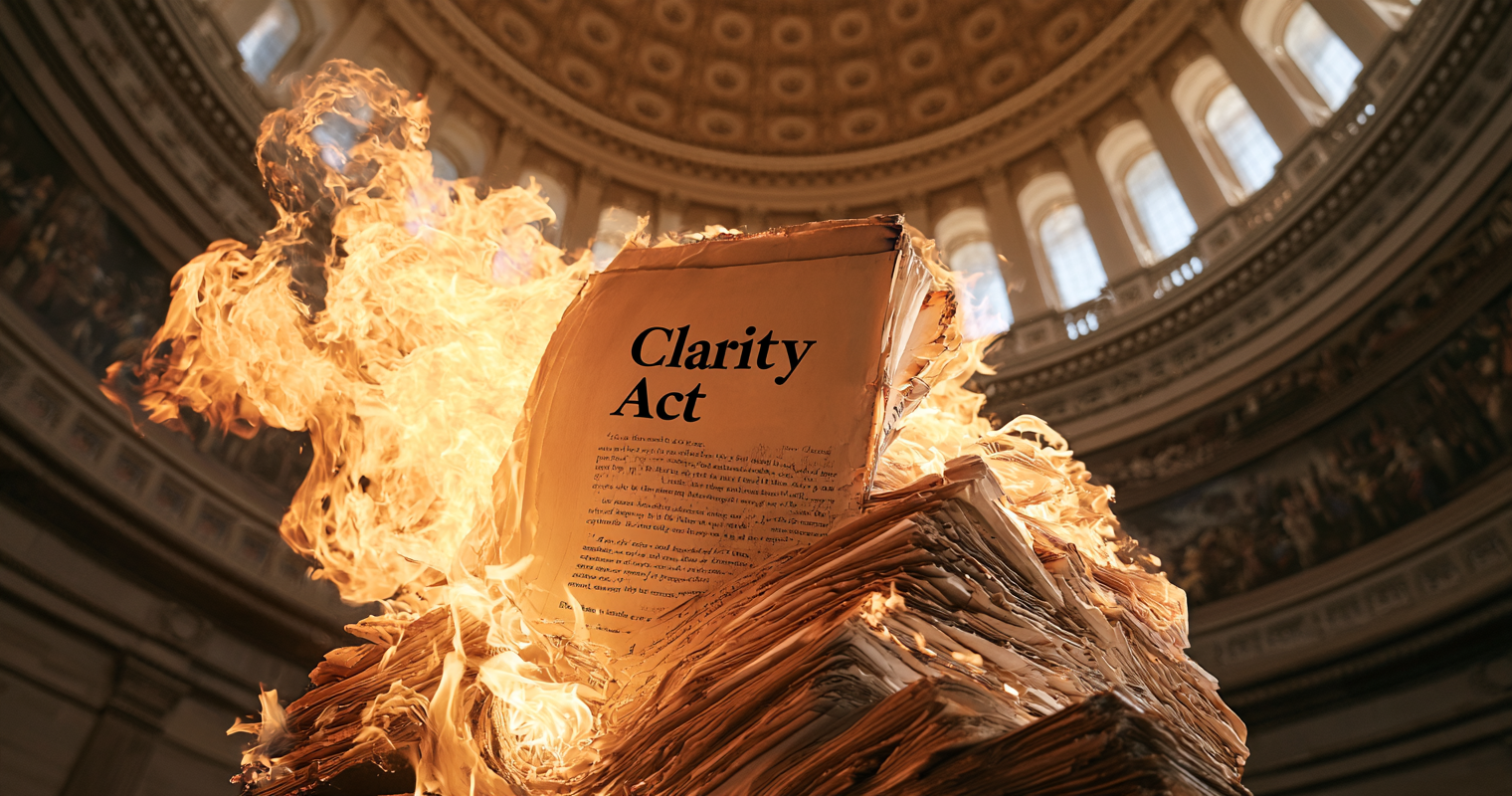
The (Temporary) Death of CLARITY
There’s plenty of blame to go around, and I’m more than happy to name names.



Get these assets so entrenched, so dug in, that no future administration can rip them out without creating systemic risk.

Digital assets have just over two years to solidify their position in the United States. If the industry fails, all bets are off.
In our last edition, I showed why there was plenty of blame to go around for the failure of the CLARITY Act, the comprehensive digital asset bill that would finally give the industry the guidelines it needs to operate and innovate in the United States.
I had some pointed critiques for the president, but I also said this:
Make no mistake, I’m an advocate of the innovation-first policies of this administration. No president has moved with such speed and earnestness to fulfill his campaign promises around crypto as this one has.
I don’t imagine I’d be able to say the same about a Democratic administration.
Based on the cynicism that was on display, it seems increasingly clear that side of the aisle has become more entrenched in its anti-crypto views. Chief among its members is Sen. Elizabeth “building an anti-crypto army” Warren, who would like nothing better than to melt the industry down and hang it on her wall as a trophy.
This is not a political letter. But who’s running the show in D.C. matters for this industry. So, we have to talk about it. And, based on the latest odds from Kalshi, it seems increasingly likely that the Dems will take the White House during the next cycle.
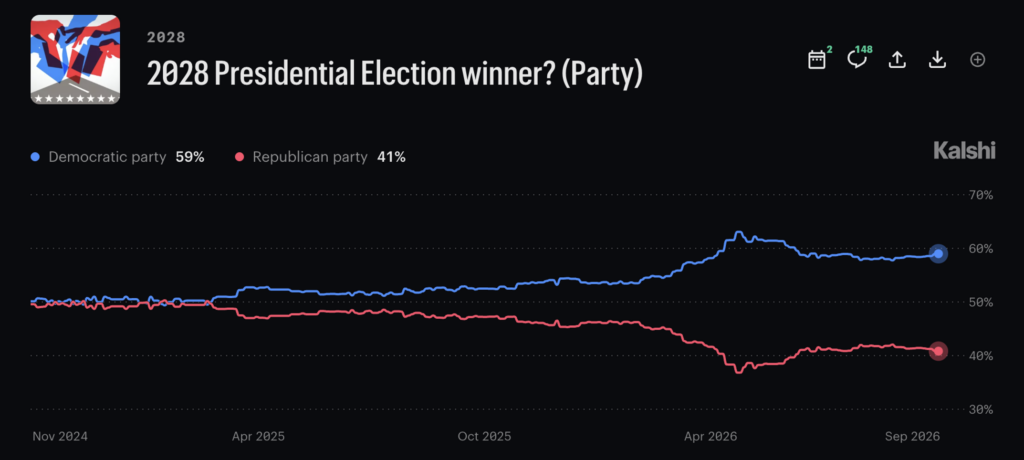
Source: Kalshi
Of course, anything can happen between now and then. But all the pieces are there for an unhappy electorate—rising gas prices, an unpopular war, and mortgage rates near 7%. Unhappy electorates don’t tend to reelect the party in power.
That means the administration has between now and then to help establish digital assets within the American financial system … before a hostile future administration is able to dismantle it.
And with CLARITY stalled, that task falls to the regulators.
Fortunately, they’ve been ready.

It will open a rare new investment vehicle that could have the biggest impact on your wealth since the dot-com era. In 2025 alone, it booked a 592% total gain in backtests. Soon, everyone will be using this type of financial AI to find stocks. So we urge you to try it now, BEFORE it spreads. Until Tuesday, September 22, claim free access here.

In 2022, when the Federal Reserve made its most dramatic pivot in history and the S&P lost nearly 20%, Larry Benedict didn't lose a single trade. He knew where the money was going and positioned his readers to profit. Trump is now installing his own Fed Chair, something Wall Street is already calling a generational shift. Larry says his readers will be ready for it. Click here to find out the one ticker he's positioning in, completely free.
For months, their teams have been preparing for what is about to come. It’s Plan B.
From our contacts in Washington, D.C., the various regulators have binders full of rulemakings and guidance. This is not a knee-jerk reaction, but a thorough and calculated plan of attack.
What we’re about to see is an intentional barrage of activity that will do what CLARITY failed to do. The goal now is straightforward …
Get capital and assets distributed throughout public blockchains fast enough that a new administration can’t undo it. Regulators are preparing to stomp on the gas until the industry reaches this point of no return.
And they’ve taken the first step …
An “innovation exemption” is relief the SEC creates from existing securities rules. It’s a regulatory sandbox that lets a new technology operate legally now while formal rulemaking catches up.
It’s a green light for an industry to act on.
Chair Atkins has been telegraphing one for tokenized stocks since he floated the concept to a room of digital asset insiders, including Jeff Brown and me, earlier this year.
Then, the incumbents got wind of it.
The SEC canceled a planned open meeting in May after closed-door pushback from Nasdaq, NYSE, and Cboe. They argued the exemption would create a parallel trading venue bypassing the rules they live under.
Then, the lobby group that the exchanges often work closely with, SIFMA (Securities Industry and Financial Markets Association), followed with a formal letter in June demanding full notice-and-comment rulemaking.
Then, in August, the SEC pulled the exemption release again. This was days before a scheduled meeting.
The official explanation was that the Commission didn’t want to step on Congress’ toes while CLARITY was being negotiated.
The unofficial explanation: Incumbents were stalling a rulemaking that threatens their business.
Either way, with CLARITY temporarily dead, the gloves have now come off.
Yesterday, the SEC issued the Innovation Exemption.
They created a new category called Tokenized Securities Venues, or TSVs. The order grants five-year conditional relief from the Exchange Act’s “exchange” definition as it relates to platforms trading tokenized NMS stocks.
We can think of NMS as the regulated market system, meaning virtually all publicly traded stocks in the U.S. This relief is also for permissioned liquidity pools.
Said another way, the SEC just blessed automated market makers (AMMs) as a legal venue for U.S. stock trading. AMMs are core decentralized finance trading primitives. They’re how nearly all decentralized exchanges operate.
It’s why Uniswap (UNI) is up around 100% since the end of August, with the biggest moves over the last two days. Tokenized stocks can now be traded with certain permissions on permissionless technology.
With that said, the order leaves some items unanswered by design.
Synthetic tokens are excluded. These include derivative tokens, token-linked instruments, and offshore wrappers without real share ownership.
That seems reasonable.
Regulators want a security moving onchain to be the security, not a shadow of it, which is exactly why the SEC dropped the transfer-agent rule two weeks earlier.
The transfer-agent proposal lets a blockchain serve as the legal record of ownership. The innovation exemption lets those same onchain shares trade.
The SEC is coming out of the gate swinging two days after the debacle in Congress. Atkins called the order “a bridge toward durable rulemaking.”
We’re going to hear a lot more from the SEC very soon.
And they aren’t the only ones pushing …
The CFTC joined the same day with its own news.
It released a no-action letter that grants relief to all providers of “passive” crypto trading software.
In plain English, the letter is referring to noncustodial wallets, onchain exchange front ends, and aggregator interfaces that display market data and route users to registered venues.
These are your MetaMask wallets, Uniswap interfaces, and other interfaces that route users to various onchain exchanges.
These will not be treated as regulated intermediaries, assuming they never custody funds, never execute orders with discretion, and meet disclosure conditions.
This is what the CLARITY Act was intended to do for DeFi front ends.
This has been a sticking point for DeFi for years.
Developers have been building in fear that writing an interface to a smart contract makes them brokers. That’s because these interfaces are the access point to permissionless rails.
Without this no-action relief, everything the SEC is enabling would be ineffective.
What’s clear from the timing is that the CFTC and SEC are acting in unison with a plan.
And the industry seems to grasp it …
S&P Global announced on Sept. 17 that it is acquiring OpenZeppelin.
OpenZeppelin is the closest thing crypto has to a building code. Its open-source smart-contract libraries underpin most major stablecoins and tokenized funds.
Its infrastructure has seen $37 trillion in value transferred.
This now belongs to the company that rates the world’s credit.
The stated strategy here is “bringing trusted data, benchmarks and transparent risk assessment to markets as they move onchain.”
Think about what that implies.
Ratings agencies exist to certify what institutions can touch. S&P just bought the ability to certify smart contracts. It is now the audit stamp, the benchmark plumbing, and what onchain index products are built on.
This came exactly one week after Nasdaq put $100 million into Kraken’s parent to trade tokenized equities.
The exchanges are buying in, the ratings agencies are buying in, and the custodian of the entire U.S. market flips on its tokenization engine next month.
The biggest players are spending serious cash just to catch up.
We are sure to see more deals like this in the coming weeks.
Let’s step back for a moment.
On Tuesday, Congress fumbled CLARITY and jeopardized the future of the industry.
Two days later, the SEC legalizes AMM trading of U.S. stocks … The CFTC green-lights the access point to onchain finance … And S&P buys its way into understanding onchain risk.
Regulators are starting to move at breakneck speed.
And their goal should be no secret …
Get financial assets and capital fully distributed across networks and platforms. Get these assets so entrenched, so dug in, that no future administration can rip them out without creating systemic risk.
We are about to see a major acceleration toward onchain finance.
Brace yourself.
Your Pulse on Crypto,
Ben Lilly
Editor, Chain of Thought
Add Brownstone Research as your preferred source on Google to see our latest stories in your feed.
 Add as a preferred source
Read the latest insights from the world of high technology.
There’s plenty of blame to go around, and I’m more than happy to name names.


If CLARITY stalls, for whatever reason, the industry will look to its fallback plan...