



This Could Make or Break CLARITY in 2026
If CLARITY stalls, for whatever reason, the industry will look to its fallback plan...



It’s for your protection, you see. Because it always is.

Managing Editor’s Note: Whispers about the upcoming Anthropic IPO have been gaining volume… It could prove to be an incredible opportunity, if you know how to play it.
But pre-IPO access is often walled off from those outside of the upper echelons of Wall Street, while most investors miss out on the lion’s share of the opportunity.
That’s why Jeff is teaming up with a former Wall Street insider to unveil a strategy for everyday investors to cash in on what is shaping up to be a historic IPO season… before Anthropic and OpenAI have their own trillion-dollar-plus IPOs.
He’s airing all the details – including the names of three pre-IPO recommendations for a few of the season’s biggest IPOs – on Wednesday, September 16, at 8 p.m. ET.
You can go here to automatically add your name to the guest list…
On Sept. 8, a pretraining researcher named Jacob Coxon resigned from Anthropic. He announced his departure with a social media post warning that the people building AI “earnestly believe that it could kill us all by the end of the decade.” He went on to say the labs at the forefront of this work are “gambling with our lives.”
As Jeff wrote in AI Doomer Propaganda Machine last week, this smelled fishy from the start …
Jacob Coxon’s post amassed over 150 million views in 16 hours on an X account created in January that had only a single prior post. This came after a Wall Street Journal exclusive interview was published 18 minutes before the post went live.
Coxon had been at Anthropic roughly four months, in an entry-level role, and walked away before his equity vested.
Three AI policy organizations amplified the story within hours. Each organization is lobbying the government for restrictions on AI development. The usual suspects chimed in.
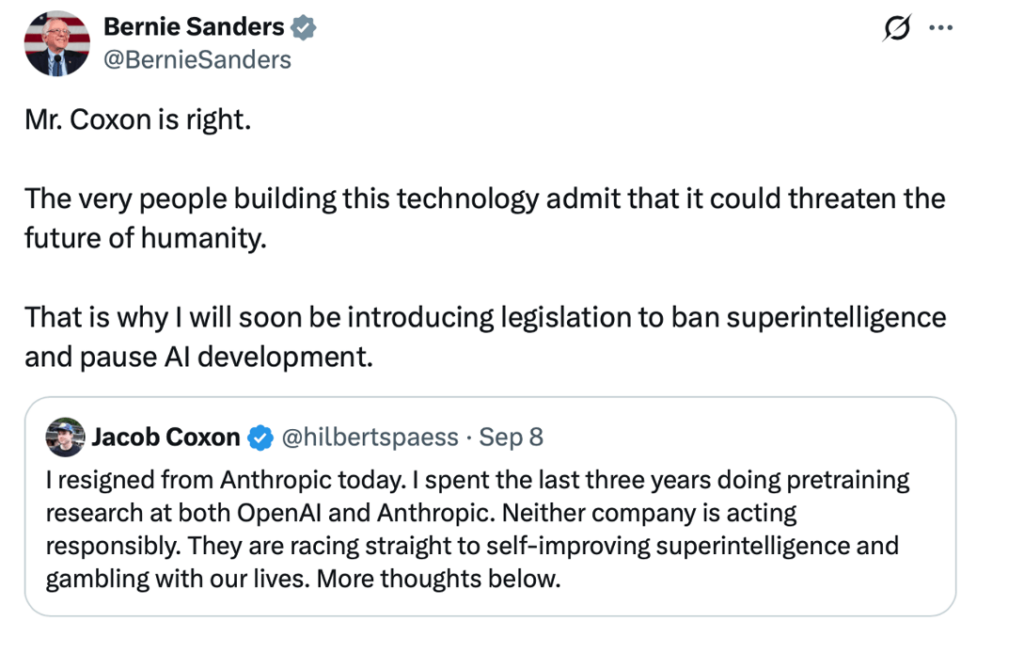
Source:X @BernieSanders
Then on Sept. 12, a few days after the social media post, Anthropic CEO Dario Amodei wrote “We Must Pace the Frontier.”
You can read the full post for yourself right here, but here’s the money quote:
But over the last few months, I have become convinced that fully addressing the risks requires even more prudence — not just investing in risk prevention, but pacing the rate of capabilities advancement so that risk prevention has time to keep up. We must slow the pace at which we improve the capabilities of AI models.
This is a marketing campaign, make no mistake. One that looks to give a regulatory moat to the AI labs already in the lead.
We are talking independent monitoring of frontier models, industry-wide rules, and ultimately global regulation.
The FRONTIER Act was introduced back in July. It would mandate audits and incident reporting above a compute threshold. Importantly, it treats releasing open model weights as a regulated “deployment.”
For longtime digital asset investors, this should all feel very familiar.

By November 11, Jeff Brown believes Elon Musk is going to help trigger a historic rally in what could be… “The Only AI Stock You Need to Retire.” Wall Street is already projecting sales will triple in 2027 alone. Click here to see the details before it’s too late.

Phase 1 made Jeff Brown famous: He predicted the SpaceX IPO – the biggest IPO in history – back when Wall Street said it was impossible. But SpaceX was just the starting gun. Anthropic – an estimated $2–$4 trillion listing – is coming. OpenAI is right behind it. And more than 100 tech IPOs worth an estimated $8.5 trillion are lining up after them. Now, on Wednesday, September 16, at 8 p.m. ET, Jeff goes live with Phase 2 of his IPO plan: a first-of-its-kind AI-powered pre-IPO strategy – and to prove it works, he'll name three free recommendations on camera. Register for the Super IPO Summit...
It really wasn’t that long ago that digital assets were considered dangerous. Digital currencies such as Bitcoin were little more than a money-laundering scheme for terrorists and drug traffickers.
Elizabeth Warren—who never saw a financial innovation she didn’t want to strangle in the crib—was emblematic of this mindset. Here she is as recently as 2023:
The Treasury Department is making clear that we need new laws to crack down on crypto’s use in enabling terrorist groups, rogue nations, drug lords, ransomware gangs, and fraudsters to launder billions in stolen funds, evade sanctions, fund illegal weapons programs, and profit from devastating cyberattacks.
Never mind that decentralized blockchains are transparent and immutable, thus making them poorly suited to hiding illicit activity. And never mind that the vast majority of criminal financing is still conducted with fiat currencies.
All that mattered was that crypto was dangerous. It needed to be destroyed. It’s for your protection, you see. Because it always is.
It’s an appeal to your emotions in order to get you to ignore the logic.
The result was a “regulation through enforcement” approach that might as well have been a reign of terror. The lead inquisitor was one Gary Gensler, former head of the SEC. He refused to write rules telling builders what’s legal. And instead opted to sue them for guessing wrong. His SEC brought 125 crypto enforcement actions over four years, nearly twice the number of his predecessor.
A typical conversation during this era went something like this:
The Industry: Hey, we have this cool new product we’d like to launch to our customers. We’d like to get the SEC’s feedback to make sure everything is compliant.
The SEC: We’re suing you.
I’m only half-joking.
The fact that this approach helped protect the legacy incumbents from disruption was surely just a coincidence.
Thankfully, the current administration saw through the charade and threw its weight behind digital assets.
The result is that the very institutions that initially supported the regulatory throttling are building on the very rails they tried to strangle years ago.
JPMorgan recently issued its deposit token on Base, a public blockchain built on Ethereum. Goldman and BNY are issuing money market funds onchain. BlackRock operates a money market fund on Ethereum that flows through decentralized exchange infrastructure. Apollo Global Management is offering private credit onchain and letting holders use their shares as collateral. And Nasdaq just put $100 million behind Kraken to trade tokenized stocks.
The permissionless rails that were once the bogeyman of Washington, D.C., are now winning. The incumbents couldn’t beat them, so they’re joining.
But here we are again with a new, highly disruptive technology. And once again, you need protecting.
This is exactly what we warned about in AI’s Bitcoin Moment and The Government Subpoenaed Your Mind: we are entering a world of permissioned AI use, where “safety” is the brand and the barrier to entry is the product.
Operation Choke Point 2.0 was the banking arm of the “regulation by enforcement” playbook. Federal regulators quietly pressured banks to cut off crypto companies.
There was no legislation, no public rule, just letters with thinly veiled threats. And for banks that would do almost anything to not run afoul of regulators, that was enough.
It was dismissed as a conspiracy theory until Coinbase’s Freedom of Information Act (FOIA) litigation revealed 23 FDIC “pause letters” instructing banks to halt crypto-related activity.
These actions led to crypto-friendly banks Silvergate and Signature being targeted and unwound.
Electric Capital’s developer data tells the story in three numbers: the U.S. share of crypto developers fell from roughly 40% in 2018 to 26% by 2023, and by 2024 fully 81% of crypto developers were building outside the United States.
Offshore exchanges and foreign jurisdictions gained footholds they still hold today.
And the CLARITY Act, the digital asset bill that promises to improve the situation, is facing an uphill cloture battle in the Senate this very week.
This is the impact of regulatory capture. The innovators didn’t stop—they just left.
The same playbook that dealt digital assets a body blow and sent innovation offshore is now trained on artificial intelligence, specifically on permissionless alternatives.
And if something isn’t done, the results will be the same.
The good news is that the doomers might be too late.
Permissionless alternatives for AI development aren’t a decade behind.
They’re live and growing.
Start with Venice.ai—a project Permissionless Investor subscribers have watched rise more than 500% since we opened our position. Venice serves uncensored open-source models with no server-side data retention.
This is private, permissionless inference, paid through its token on Base. It now counts roughly 3.5 million users, processes over a trillion tokens a month, and crossed $100 million in annualized revenue.
It’s no coincidence its native token, VVV, hit all-time highs on Sept. 9 … the day after the Anthropic resignation went viral.
The market drew the connection in real time.
The same bid showed up across our model portfolio in themes such as decentralized training, inference, and even vision models.
This niche of the AI industry has often been overlooked. But progress is reaching a tipping point at the exact moment it needs to.
Decentralized pretraining has scaled from a few million parameters to 100 billion in about two years. Prime Intellect’s INTELLECT-1 proved 10B parameters across three continents in late 2024. Nous Research pretrained its 40B Consilience over the open internet through 20 trillion tokens. Templar’s Covenant-72B was trained this March across 70+ permissionless nodes on commodity internet at 94.5% compute utilization. And Macrocosmos’ Orion-100B was the largest LLM pretraining run ever attempted over the open internet.
This is frontier-scale capability. No data center, no permission.
Decentralized vision models are beating the giants. A distilled vision model from a certain network outperformed GPT-4o, Gemini, and Claude on object detection this June. And the model is only 19 megabytes.
Open source is, at most, four months behind the frontier labs, per Epoch AI. Kimi K2.6 currently leads closed rivals on SWE-Bench Pro. Open models run up to 40x cheaper than closed models.
And now the weights of open-source AI models are being put on public blockchains to be called upon by anybody at any time.
This is the race the frontier labs don’t want you to know about.
You can’t subpoena a model whose weights are on a hundred thousand machines. You can’t send a pause letter to a decentralized network.
Permissioned AI feels the open-source competition closing in. As we wrote in Like Buying Bitcoin When It Was Still “Dangerous”, the federal government will try to ban open-source models.
They will fail. Because we know how this movie ends.
The same banks that once blacklisted crypto are settling billions a day on public chains. The exchanges that were sued are being built on top of or bought by leaders such as Nasdaq.
And the largest asset managers are moving assets on permissionless and decentralized exchanges, networks, and lending markets.
The AI doomer machine is something we’ve already witnessed once this decade.
Don’t get shaken by the song and dance. Invest in the accelerators.
Go permissionless.
Your Pulse on Crypto,
Ben Lilly
Editor, Chain of Thought
Read the latest insights from the world of high technology.
If CLARITY stalls, for whatever reason, the industry will look to its fallback plan...

It’s prying open the door. And once it opens, it won’t close.

We’re moving from the “walled garden environments” to public blockchains. It’s a major shift, and it’s picking up momentum...