



The Last Stand of the Old Guard
The old guard is competing to build the new gatekeeper that the market uses … and the result will...



Digital asset investors know this fight. They’ve been fighting it for years now.

A few years back, Anthropic admitted something out in the open.
You might have missed it, but it shouldn’t surprise you.
Here’s CEO Dario Amodei testifying in front of Congress back in July 2023:
I think in most scientific fields, open source is a good thing… and I think even within AI there’s room for models on the smaller and medium side… And I think to be fair, even up to the level of open-source models that have been released so far, the risks are relatively limited… But I’m very concerned about where things are going… I think the path that things are going, in terms of the scaling of open-source models — I think it’s going down a very dangerous path.
That last line is interesting…
Open-source models, said Amodei, aren’t just “bad” or “less useful.” They’re dangerous!
The insinuation, of course, is that the ‘closed models,’ like the ones Amodei’s company builds and sells access to, are good and safe!
And if we accept this, then the policy is straightforward: Ban the open-source models. Build up the closed ones.
Digital asset investors know this fight. They’ve been fighting it for years now.
A Bitcoin ATM appeared in the halls of Capitol Hill in 2014.
Colorado Democratic Rep. Jared Polis placed a $10 bill into a machine that provided him with a piece of paper. On that paper was a unique code for 0.02 Bitcoin.
It was the first Bitcoin purchased on Capitol Hill.
The entire transaction was an attempt to dispel the fears of Bitcoin.
And, yes, politicians were afraid of Bitcoin.
Some were calling for the outright prohibition of the currency such as Sen. Joe Manchin, D-W.Va. He wanted to see a ban on this “dangerous currency from harming hard-working Americans.”
The skepticism didn’t stop in those early days…
In 2023, the crypto industry accused the Biden administration and SEC Chair Gary Gensler of attempting to de-bank crypto-related companies in an effort known as Operation Choke Point 2.0.
As the name suggests, the idea was to choke off crypto and entities operating in the space from the banking system.
This, in combination with the SEC’s “regulation via enforcement” approach was attempting to strangle the most consequential financial technology of our lifetimes.
The ecosystem has come a long way since. And (finally!), many in the federal government are working towards commonsense regulation via the now-passed Genius Act and the almost-passed CLARITY Act.
But it took time. And for those in support of open-source, decentralized financial solutions, there were plenty of fights along the way.
Decentralized AI—what I’ll call “DeAI”—is having that fight now.
When Amodei was testifying in Congress about open-source models, he was referring to models where the developers and scientists make the underlying code, algorithms, and training weights publicly accessible.
It allows other builders to inspect, modify, and even fine-tune their own models without needing to pay the creator. It’s a similar mentality that gave rise to many of the protocols that exist within the digital asset arena, with most running on open-source codebases.
The idea around open-source models is that it incentivizes greater collaboration and innovation. It speeds up iteration and even creates greater resiliency in what is being built.
These are all noteworthy.
But fear remains…
Specifically, there is fear that these AI models could hack into various systems that we all rely upon every day.
In fact, National Security Agency chief Joshua Rudd said Anthropic’s Mythos “broke into almost all of our classified system, not in weeks, but in hours,” according to Sen. Mark Warner of Virginia.
This fear has grown considerably over the last few weeks on the heels of the U.S. issuing an export ban on the most recent release by Anthropic. We even mentioned that, because of this ban, Anthropic will need to pivot to permissioned AI…
They will verify your identity and, based upon their policy, will grant you access to certain models, or prohibit you.
It’s for your protection, you see.
It always is.
Along similar lines, OpenAI paused its rollout of its latest model, GPT-5.6. It’s currently restricted to trusted partners.
We expect OpenAI will similarly require users to hand over personal information as well in the coming weeks, only expanding the trend of permissioned AI.
But here’s the thing…
Open-source models are not far behind these frontier models. The most recent GLM-5.2 scored similarly to Anthropic’s Sonnet 4.6, which was released in February of this year. By Fall, we should see an open source model rival Mythos and GPT 5.6.
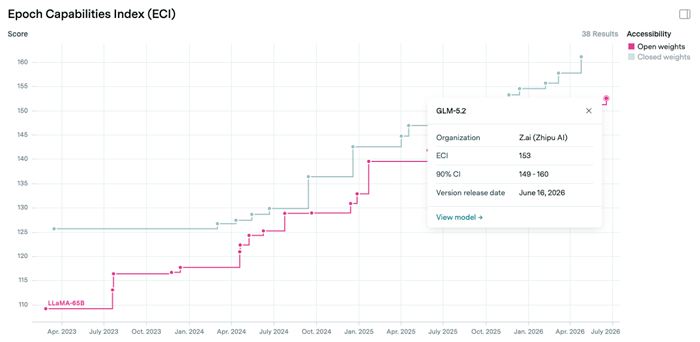
Source: Epoch AI
Right now, open-source models look to be about 3-4 months behind frontier labs.
But decentralized AI will change the game…
Decentralized AI is the ability for models to either run or train on peer-to-peer networks.
We’re talking about networks like what was experienced with public blockchains such as Bitcoin and Ethereum. These are networks where individuals were able to run software that verified the blockchain.
The only difference now is, instead of using computing power to secure a network, we’re talking about computing power to run or train AI models.
We covered this before in Chain of Thought. You might recall this chart…
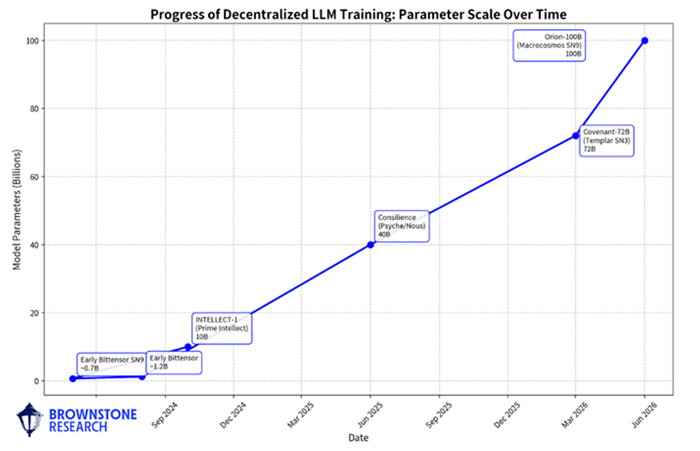
What it shows is that, in a span of two years, decentralized training has gone from sub 1-billion parameter size to 100 billion.
This is significant because it shows that bigger models can be trained on distributed, retail hardware across the globe in a permissionless manner.
It’s a massive infrastructure unlock.
And the industry is making it easier for retail to “rent” their compute towards projects building open-source models.
We’re going to see projects launch tokens, give out tokens in exchange for compute, and likely other incentives to help bootstrap their models into the market.
Quite a few projects are already making headway in the space. One project is Dark Bloom, which makes low-cost, private inference on idle Macs possible. Another is c0mpute, which has a decentralized, private, and uncensored AI inference network. One more is Pluralis, which is creating AI with distributed consumer GPUs.
There are others. And as the frontier models become more permissioned, the call for permissionless solutions will only grow louder.
Perhaps the federal government will try to ban open-source models.
They will fail.
And along the way, there will be plenty of investments in this space.
To me, it will be like buying Bitcoin in 2014, back when it was still “dangerous.”
Your Pulse on Crypto
🏴☠️ Ben Lilly
Editor, Chain of Thought
Add Brownstone Research as your preferred source on Google to see our latest stories in your feed.
 Add as a preferred source
Read the latest insights from the world of high technology.
The old guard is competing to build the new gatekeeper that the market uses … and the result will...

Blockchains are infrastructure built for machines. And now the machines are here.

If the cycle holds, we’ll look back at this moment in the fall of 2029 and realize that was...